Environmental Events and News for Nassau and Suffolk Counties (Region 1)
The New York State Department of Environmental Conservation sent this bulletin on 06/25/2020 05:31 PM EDT |
| DEC Delivers - Information to keep you connected and informed from the NYS Department of Environmental Conservation |
| Share or view as a web page || Update preferences or unsubscribe |
Environmental Events and News for Nassau and Suffolk Counties (Region 1) |
|
The Nutrient Bioextraction Initiative is investigating how effective the use of seaweed and shellfish aquaculture is at removing excess nitrogen from water. Go online for more information on the initiative. Long Island Office Offer First Ever Drive-In Parking Lot Pesticide Certification ExaminationsDEC’s Region 1 Bureau of Pesticides created the first ever drive-in pesticide certification examination program in New York State. The first-ever exam was administrated at Jones Beach’s Field One on June 23 and had 24 test takers. DEC developed this program because of the COVID-19 pandemic, which, since March, forced DEC to cancel all pesticide applicator certification exams. This resulted in a backlog of individuals seeking certification. The New York State Office of Parks, Recreation and Historic Preservation has been a supporter of this effort by providing the facility where DEC staff can administer and proctor the exams. Next exam dates: June 30; July 7, 14 and 21 For exam information, please contact DEC Region One Bureau of Pesticides Office: (631) 444-0340.
Photo caption: DEC Drive-In Pesticide Exam Proctors. DEC Pesticides Staff with Drive-In Exam Takers at Jones Beach State Park. DEC Staff and Volunteers Remove Water Chestnut from Wantagh Mill Pond
Water chestnut is an aquatic invasive plant that is native to Eurasia and Africa. It was introduced in the United States in the mid-1800s as an ornamental plant. Water chestnuts form dense mats of rooted vegetation that can be very difficult to get through in a boat, kayak, canoe, or when swimming. Water chestnut fruits are often found along the shoreline and bottom of waterways. Their very sharp spines can cause painful wounds when stepped on. The dense mats of vegetation shade out native aquatic plants that provide food and shelter to native fish, waterfowl, and insects. Decomposition of these mats reduces dissolved oxygen levels and may impact fish. The 2020 effort resulted in 141 bags harvested for a total of 3,525 pounds of this invasive species being removed. In In 2019, over 100 bags of water chestnut (approx. 3,000 lbs.) were removed. Besides the effort at Wantagh Mill Pond, DEC’s Freshwater Fisheries staff, volunteers and Nassau County personnel have also focused efforts on Massapequa Reservoir. Through the combination of hand pulling and the use of a Nassau County harvester, water chestnut has been nearly completely removed from this water body. Photo caption: Marine Habitat Protection’s Stephanie Larkin picking water chestnut at Wantagh Mill Pond on June 18, 2020. Region One Beehive Installation
On June 22, the State commemorated these steps during National Pollinator Week, June 22-28 (PDF), with a proclamation issued by Governor Andrew M. Cuomo, affirming New York’s commitment to promoting the health and recovery of pollinators. On April 20 and 27, the DEC Region 1 Sustainability Committee received three packages of honey bees. Each package contained a complete colony of honey bees, including one queen bee, about three pounds or 10,000 worker bees, and a little bit of food for the journey. Honey bees face increasing challenges, including parasites, pathogens, pesticide exposure, nutrient deficiencies, habitat loss and fragmentation, and more. As stated in the NYS Pollinator Protection Plan (PDF), over the past several years, the loss of managed pollinator colonies in the state has exceeded 50 percent. The upward trend in colony loss observed over the last decade is unsustainable. Many DEC office buildings across the state are located on what was once wild, undeveloped land that pollinators might have called home. By establishing multiple hives in the region, we are ensuring that we can maintain continuous pollination and support the bees. DEC has already taken steps to acknowledge pollinators through the Pollinator Task Force and by promoting National Pollinator Week. At DEC, we are acting on this plan and leading the state by example by providing safe, healthy homes for honey bee colonies. While one of the colonies at the site died less than a week after being installed in April, the Stony Brook hive collection recently received a dramatic success when one colony split off or swarmed becoming a new colony after several weeks of successful honey and egg production. To ‘swarm’ means that the queen bee and about half of the worker bees permanently leave the hive (in a literal swarm of bees) to find a new home. Swarming is basically a healthy colony’s way of reproducing and increasing the wild bee population. Caption: Workers enter honey bees into the new hives. |
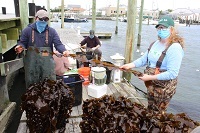 DEC and partnering staff collected Sugar Kelp at Point Lookout, Nassau County, Long Island recently during a nitrogen reducing pilot project. The project aims at using seaweed and shellfish to remove excess nitrogen and phosphorus from surrounding waters in an effort to improve the waterbody’s health, otherwise known as Nutrient Bioextraction. This effort is part of DEC’s Long Island Nitrogen Action Plan.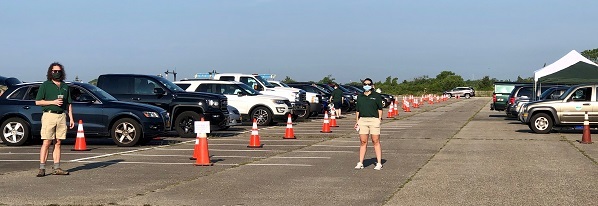
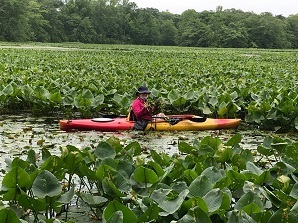 On June 18, DEC staff along with volunteers from Long Island Paddlers and Nassau County Soil and Water Conservation District, once again pulled water chestnut from Nassau County’s Wantagh Mill Pond - one of the more popular freshwater fishing locations in Nassau County. This is annual effort that has been going on several years at this location and at other locations in Nassau County.
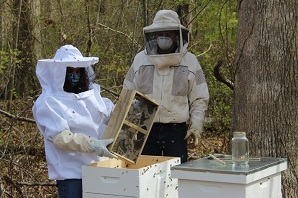 The New York State Departments of Agriculture and Markets (AGM) and Environmental Conservation (DEC) recently announced new actions to benefit and protect New York’s pollinators, including bees, butterflies, and hummingbirds. AGM issued new guidelines to help businesses create pollinator-friendly habitats on commercial properties or utility project sites. In addition, DEC’s Long Island Office in April brought in two bee colonies that have now grown into a third colony in late June showing the success of the regional office’s pollinator development program.
|
The New York State Department of Environmental Conservation respects your right to privacy and welcomes your feedback | Update preferences or unsubscribe | Learn more about DEC Delivers. |
|
Connect with DEC:     2020 Census: New York counts on you |
|
| Basil Seggos, Commissioner | |