Each May and June, Motorists Should be on the Alert for Turtles Crossing the Road
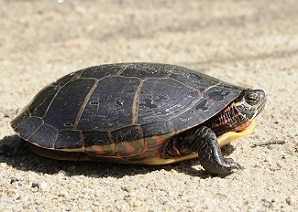 Our native turtles are on the move in May and June seeking sandy areas or loose soil to lay their eggs. In New York, thousands of turtles are killed each year when they are struck by vehicles as they migrate to their nesting areas. Our native turtles are on the move in May and June seeking sandy areas or loose soil to lay their eggs. In New York, thousands of turtles are killed each year when they are struck by vehicles as they migrate to their nesting areas.
What you can do to help:
- If you see a turtle on the road, please give turtles “a brake”. Slow down to avoid hitting it with your car.
- If you can safely stop your vehicle, please consider moving it to the shoulder on the side of the road in the direction it was facing.
- Picking the turtle up by its tail may frighten or injure it. You can pick up most turtles by the sides of the shell.
- Use caution when moving snapping turtles; either pick her up at the rear of the shell near the tail using two hands, or slide a car mat under the turtle to drag her across the road.
- Please do not take turtles home. All native turtles are protected by law and cannot be kept without a permit. All 11 species of land turtles that are native to New York are declining.
The Arrival of Spring and Summer Mean the Arrival of Young Wildlife – “If You Care, Leave them There”
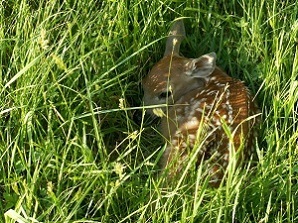 In the spring and summer, you may come across young wildlife that appear to be abandoned. In an effort to reduce the spread of COVID-19, New Yorkers are spending more time at home than normal and seeing more young birds and other wildlife as a result. While some are learning survival from one or both parents, others normally receive little or no parental care. Often, wild animal parents stay away from their young when people are near. The young are left hidden in a safe place and the parent may be nearby. Because of their behavior, the most common species to be mistakenly "rescued" by humans are young fawns, cottontail rabbits, and fledgling birds. When people attempt to handle or raise wildlife, these well-meaning acts of kindness tend to have the opposite result. Many of the animals soon die despite their best efforts. In the spring and summer, you may come across young wildlife that appear to be abandoned. In an effort to reduce the spread of COVID-19, New Yorkers are spending more time at home than normal and seeing more young birds and other wildlife as a result. While some are learning survival from one or both parents, others normally receive little or no parental care. Often, wild animal parents stay away from their young when people are near. The young are left hidden in a safe place and the parent may be nearby. Because of their behavior, the most common species to be mistakenly "rescued" by humans are young fawns, cottontail rabbits, and fledgling birds. When people attempt to handle or raise wildlife, these well-meaning acts of kindness tend to have the opposite result. Many of the animals soon die despite their best efforts.
DEC also reminds people that young wildlife are not pets. Keeping wildlife in captivity is both illegal and harmful to the animal. Wild animals are not well-suited for life in captivity and may carry diseases that can be transferred to humans. However, when you encounter a young wild animal that is obviously injured or orphaned, call a wildlife rehabilitator. All wildlife rehabilitators are trained volunteers licensed by DEC.
Photo by Art Jacobson.
Help Protect Nesting Birds
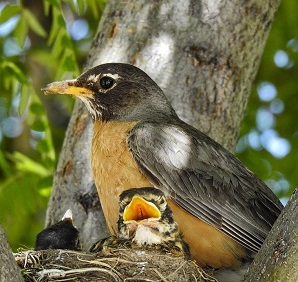 With more of us at home these days, you may have noticed birds taking up residence in your yard. This is a great opportunity to enjoy watching birds from home! In the spring and summer, many bird species will set up nests in shrubs (catbirds and common yellowthroats) and on tree limbs (robins, orioles, or vireos). Chickadees, nuthatches, or woodpeckers may be nesting in tree cavities. These nests may be hard to spot from the ground. To protect birds, wait until the fall to cut or prune trees and shrubs if possible. Birds such as house wrens, phoebes, and Carolina wrens often get creative and build nests on decks, porches, or sheds! With more of us at home these days, you may have noticed birds taking up residence in your yard. This is a great opportunity to enjoy watching birds from home! In the spring and summer, many bird species will set up nests in shrubs (catbirds and common yellowthroats) and on tree limbs (robins, orioles, or vireos). Chickadees, nuthatches, or woodpeckers may be nesting in tree cavities. These nests may be hard to spot from the ground. To protect birds, wait until the fall to cut or prune trees and shrubs if possible. Birds such as house wrens, phoebes, and Carolina wrens often get creative and build nests on decks, porches, or sheds!
Fields may be habitat to ground-nesting birds, such as bobolinks or Eastern meadowlarks. They use these areas to build their nests and raise their young. You can help by doing a walkthrough before mowing, but nests may be difficult to spot. It’s best to wait until later in the summer to do your first mowing to make sure that birds have matured and can escape from mowers and tractors.
Note: Native bird species—including their eggs or young—are protected under the Migratory Bird Treaty Act, which makes it illegal to intentionally remove or destroy a nest. However, you may remove a nest with no eggs, abandoned nests, or nests of non-native and non-migratory birds, such as starlings and house sparrows. Many songbirds are done nesting in a few weeks. If you wait until chicks fly away, nests can be removed if needed.
Visit the DEC website to find more information about what to do when encountering young wildlife.
May 23rd is World Turtle Day®
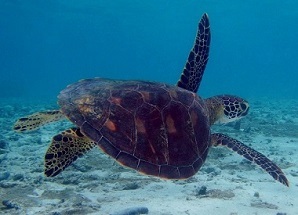 American Tortoise Rescue (ATR), a nonprofit organization for the protection of all species of tortoise and turtle, created World Turtle Day® to celebrate and protect turtles and tortoises and their disappearing habitats around the world. These gentle animals have been around for 200 million years, yet they are rapidly disappearing due to smuggling, the exotic food industry, habitat destruction, global warming, and the pet trade. The four species of sea turtles that can be found in New York waters are either threatened or endangered. American Tortoise Rescue (ATR), a nonprofit organization for the protection of all species of tortoise and turtle, created World Turtle Day® to celebrate and protect turtles and tortoises and their disappearing habitats around the world. These gentle animals have been around for 200 million years, yet they are rapidly disappearing due to smuggling, the exotic food industry, habitat destruction, global warming, and the pet trade. The four species of sea turtles that can be found in New York waters are either threatened or endangered.
Here are a few ways you can help sea turtles:
-
Reduce, Reuse, Recycle and Rethink: these are simple steps to help protect marine species.
-
Don't litter: unwanted trash makes its way just about everywhere, including our waterbodies.
-
Don't release balloons or lanterns: releasing balloons into the environment is potentially fatal for sea turtles, as balloons and plastic bags are commonly mistaken as prey (such as jellyfish).
- Volunteer for beach and park clean ups.
- Stay Informed and share your knowledge with others.
Photo by NOAA.
|