A Project of the Hudson River Estuary Program
Compiled by Tom Lake, Consulting Naturalist
COVID-19 Guidance for Enjoying the Outdoors
While enjoying outdoor spaces, please continue to follow the CDC/NYSDOH guidelines for preventing the spread of colds, flu, and COVID-19:
• Try to keep at least six (6) feet of distance between you and others.
• Avoid close contact, such as shaking hands, hugging, and kissing.
• Wash hands often or use a hand sanitizer when soap and water are not available.
• Avoid surfaces that are touched often, such as doorknobs, handrails, and playground equipment.
• DEC recommends avoiding busy trailheads. Find the trails less traveled and visit when trails may not be as busy during daylight hours.
Overview
On this week’s vernal equinox, the first day of spring, we began year 27 of our Hudson River Almanac.
Our new world of the COVID-19 (coronavirus) demands an effort to control the spread of the virus by observing social distancing. We hope the Hudson River Almanac, both by participating in its stories and reading those of others, will strengthen our connection to the outdoors.
The Almanac can be a vital cyber-outdoors adventure, a safe and vicarious venue for readers reminding us of the value of a walk on the beach among migrating sea-run fishes, a hike in the hills listening to spring songbirds, observing eagles on eggs at a distance, watching coyotes prowl the fields, and not seeing foxes cleverly avoiding us. All of this and more becomes an antidote to anxiety.
Highlight of the Week
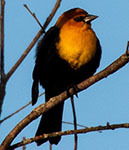 3/20 – Washington County, HRM 202: Earlier today, Thom McLenahan came upon a yellow-headed blackbird (Xanthocephalus xanthocephalus) near a marsh area at Fort Edward, about a mile east of County Road 42. (Photo of yellow-headed blackbird courtesy of Zach Schwartz-Weinstein) 3/20 – Washington County, HRM 202: Earlier today, Thom McLenahan came upon a yellow-headed blackbird (Xanthocephalus xanthocephalus) near a marsh area at Fort Edward, about a mile east of County Road 42. (Photo of yellow-headed blackbird courtesy of Zach Schwartz-Weinstein)
- Zach Schwartz-Weinstein (Hudson-Mohawk Bird Club)
[Later, Scott Varney (Hudson-Mohawk Bird Club) also found the yellow-headed blackbird on Mahaffey Road in Fort Edward and made sound recordings of its song. Scott commented that the bird’s song sounded a bit like a cross between a red-winged blackbird and R2D2 (Star Wars reference).
The yellow-headed blackbird’s native breeding range extends from the North American mid-west to the far west. They are reported occasionally in our area, but they are not common. Tom Lake]
Natural History Entries
3/14 – Saugerties, HRM 102: Our timing was good, but the seal seemed to be in hurry. We no sooner scanned the glassy surface of Esopus Creek in midday than we spotted the harbor seal cruising upstream, dark round head bobbing along. We could not even count to ten before he sounded. We waited and waited, but he never reappeared. A little farther upstream anglers were catching jumbo yellow perch. They would soon have competition. This was Day 223 for the seal at river mile 102.
- Tom Lake, Phyllis Lake
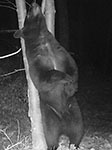 3/14 – Gardiner, HRM 73: Last night a black bear appeared on my trail camera. The camera caught a nice photo as the bear scratched its back on a tree. I thought that it was quite a coincidence that the bear did this right in front of my trail camera. (Photo of black bear courtesy of Karen Maloy Brady) 3/14 – Gardiner, HRM 73: Last night a black bear appeared on my trail camera. The camera caught a nice photo as the bear scratched its back on a tree. I thought that it was quite a coincidence that the bear did this right in front of my trail camera. (Photo of black bear courtesy of Karen Maloy Brady)
- Karen Maloy Brady
3/14 – Hook Mountain, HRM 31: It was a lean day at the Hook Mountain Hawkwatch. We spotted three raptors, all red shouldered hawks, two of which were migrating. All were seen far to the west-southwest. I was interested this year in trying to ascertain whether what I had been told for years that the best winds for hawk migration at this watch in spring were from the northwest, even though logically I would expect hawks to prefer a tailwind. We decided to come up in different types of winds, except for east winds. So far this year, south winds (tail winds) have been far better.
- Ajit I. Antony, Felicia Napier, Liza Antony
3/15 – Fort Miller, HRM 192: I spotted my first osprey of the season today, three of them in fact, from the Green Bridge on River Road. This seemed a bit early, but awesome nonetheless!
- Scott Varney (Hudson-Mohawk Bird Club)
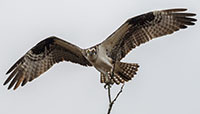 3/15 – Fort Miller, HRM 192: I counted forty snow geese on the river at Fort Miller in mid-afternoon. They shared the expanse with a single Canada goose and a hen common merganser. (Photo of osprey courtesy of Jim Yates) 3/15 – Fort Miller, HRM 192: I counted forty snow geese on the river at Fort Miller in mid-afternoon. They shared the expanse with a single Canada goose and a hen common merganser. (Photo of osprey courtesy of Jim Yates)
- Mona Bearor (Hudson-Mohawk Bird Club)
3/15 – Saratoga County, HRM 166: Thirteen snow geese, mixed in with Canada geese, were on the river at Middleline Road in the Town of Ballston this afternoon.
- Gregg Recer (Hudson-Mohawk Bird Club)
3/15 – Schenectady County, HRM 157: Fifty snow geese flew over in formation at Duanesburg, Route 20, headed toward Esperance.
- Sue Rokos (Hudson-Mohawk Bird Club)
[This is the time of the season when many thousands of snow geese pass through the Hudson Valley on their way north to their breeding grounds after wintering in Delaware, Maryland, and Virginia (DelMarVa). Tom Lake]
*** Fish of the Week ***
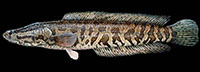 3/15 – Hudson River Watershed: Fish-of-the-Week for Week 63 is the northern snakehead (Channa argus) number 214 (of 230) on our watershed list of fishes. If you would like a copy of our list, e-mail - trlake7@aol.com. 3/15 – Hudson River Watershed: Fish-of-the-Week for Week 63 is the northern snakehead (Channa argus) number 214 (of 230) on our watershed list of fishes. If you would like a copy of our list, e-mail - trlake7@aol.com.
The northern snakehead is an aggressive, invasive, predatory fish native to areas of Asia. Adult northern snakehead can grow to 18.0 pounds and to more than three feet in length. They are voracious predators, eating almost anything they can fit in their mouths, including other fishes, crustaceans, frogs, and small reptiles.
In late May 2008, it was discovered that the northern snakehead had been introduced into Orange County – possible aquarium release – in the upper Catlin Creek watershed near Ridgebury Lake in the Town of Waywayanda (first record from the watershed). This created concerns about the effect that this large predator could have on native species. The northern snakehead is a very resilient fish; it has an accessory breathing apparatus that allows it to survive in poor water quality, even out of water for several days at moderate air temperatures and can move short distances over wet ground. They would also be able to survive the cold water of New York winters.
NYSDEC Region 3 Inland Fisheries took immediate action to eradicate this species to protect native fish populations and prevent any possible expansion of the northern snakehead beyond the headwaters of Catlin Creek. It was evident from the evidence gathered that the northern snakehead were, or soon would be spawning, lending urgency to immediate eradication measures.
Temporary fish barriers were erected in Catlin Creek delineating the area followed by capture and removal of those that were found. Monitoring included the use of a variety of fish capturing techniques, as well as many water samples taken and analyzed for snakehead environmental DNA. In 2008 and 2009, DEC collected a total of 341 northern snakeheads ranging in size to 32-inches long.
Since 2009, there has been no further evidence of northern snakeheads in the Catlin Creek watershed. (Our thanks to Fisheries Biologist Michael Flaherty for much of this information.) (Photo of northern snakehead courtesy of Susan Trammell)
- Tom Lake
3/16 – Minerva, HRM 284: I was out for a hike to the “back forty” and found no real signs of spring: no fat red maple flower buds, no red-winged blackbirds, and no snow fleas, although the back-capped chickadees were calling their spring calls. And, so far, no signs of the ice breaking up.
- Mike Corey
[“Back forty” is a colloquial expression meant to convey wild or rough terrain adjacent to a developed area. In the instance of a farm, for example, it might be a small percentage of the land left uncultivated or natural, frequently in the “back forty acres” of the property. Tom Lake]
3/16 – Athens, HRM 121: In early afternoon, we walked the path from Route 385 toward the Vosburgh Swamp and heard wood frogs "quacking" in a vernal pond.
- Jean Bush
3/16 – Hyde Park, HRM 82: For more than 30 years, I have tracked winter snowfall in Hyde Park. So far, my winter 2019-2020 log lists 26-inches of snow since December 1, well below our 43-inch average (our recent 10-year average has been near 49-inches). Eleven of this winter’s 26-inches fell during a double-storm on December 1-2. Yet, this has been nowhere near the almost snow-less winter – six inches – of 1988-1989.
- Dave Lindemann
3/16 – Bedford, HRM 35: Virtually all the nests were now occupied at the Bedford great blue heron rookery. I could also see mating behavior going on, lots of nuzzling and inter-twining of long necks. I am struck by how sparse the rookery is this year – only 10-12 nests that I can count; they have clearly lost a lot of nests. I’m not sure if trees have fallen down or nests have fallen out of trees.
- Rick Stafford
[Before the area became a rookery, it was a thick red maple swamp. One season the red maples suddenly died from water inundation, and I was alarmed. However, the next year the herons took advantage of all the new snags, and a rookery began. I investigated and discovered that the red maple swamp had been flooded by beavers building a dam below. Beaver do a great service by creating new habitat as “environmental engineers.” They first create snags that woodpeckers and other birds and wildlife use. Eventually, as the swamp fills in, “beaver meadows” will emerge, habitat for the now extirpated bog turtle among other species. Jim Nordgren]
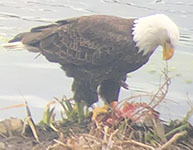 3/17 – Saratoga County, HRM 166: One of the adults from bald eagle nest NY329 took advantage of a large, dead fish (possibly a victim of ice fishing) and had an easy Saint Patrick’s Day feasting on the shore of Ballston Lake. (Photo of bald eagle courtesy of Christa Ippoliti) 3/17 – Saratoga County, HRM 166: One of the adults from bald eagle nest NY329 took advantage of a large, dead fish (possibly a victim of ice fishing) and had an easy Saint Patrick’s Day feasting on the shore of Ballston Lake. (Photo of bald eagle courtesy of Christa Ippoliti)
- Christa Ippoliti
3/17 – Yonkers, HRM 18: Our Center for the Urban River at Beczak staff continued to daily monitor our glass eel fyke net. Today, we collected 77 glass eels (1,385 on the season), 20 amphipods (Gammarus sp.), two shore shrimp, a mud crab, and four delightful mummichogs (killifish). The salinity was 5.29 parts-per-thousand (ppt), and the water temperature was 45.9 degrees Fahrenheit (F).
- Jason Muller
- A Little Killifish Haiku
Genus: Fundulus
Species name: heteroclitus
I call you "killi."
- Chris Bowser
[Our glass eel research net is called a fyke. The name is derived from the Colonial Dutch word for a fishnet –fuyck or fuik – that forms the shape of a truncated cone. The name was used to describe a neighborhood of the early settlement at Fort Orange (17th century Albany) because of two roads that emanated from the fort, one along the shoreline and the other leading inland. Viewed from the north wall of Fort Orange, these diverging roads would have resembled the basic shape of a fyke net. Tom Lake]
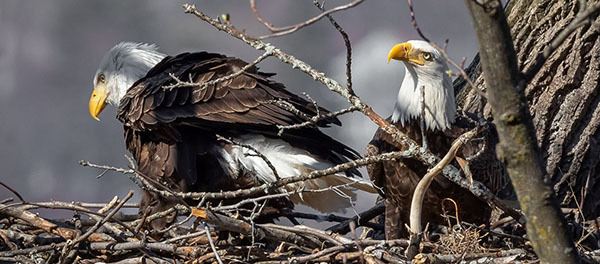
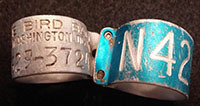 3/18 – Town of Poughkeepsie: It was early evening on incubation day Day 31 at bald eagle nest NY62. One adult (best guess the male) was hunkered down in the nest; the second adult, probably the female, was perched in a hardwood to the north of the nest, a tree we used call “Dad’s Tree,” but now referred to as the North Tree. She was waiting to take her turn on the overnight incubation shift. (Photo of NY62 band courtesy of Tom Lake) 3/18 – Town of Poughkeepsie: It was early evening on incubation day Day 31 at bald eagle nest NY62. One adult (best guess the male) was hunkered down in the nest; the second adult, probably the female, was perched in a hardwood to the north of the nest, a tree we used call “Dad’s Tree,” but now referred to as the North Tree. She was waiting to take her turn on the overnight incubation shift. (Photo of NY62 band courtesy of Tom Lake)
- Tom Lake, Phyllis Lake
[“Dad’s Tree” honored the original male of the pair that started bald eagle nest NY62 in the Town of Wappinger in 2001. That male (banded by DEC as N42), was struck and killed by a train near the mouth of Wappinger Creek in February 2017. The new male, with the original female (she will be 26 years-old this April), has fledged two nestlings in both 2018 and 2019. Tom Lake]
3/18 – Bedford, HRM 35: I checked out the Great Blue Heron rookery and found four herons standing guard on a nest and four settled down in the nest with just its bill showing. This is a good indication that egg laying has begun. Herons typically lay two to five eggs and begin incubating right after the first egg is laid. The single herons were very likely the males, each guarding the nest they had selected and were waiting for their mates to show up. In the coming weeks, there will be more activity as more herons arrive. This is the ninth year since the rookery began in 2012.
- Jim Steck
3/18 – Hook Mountain, HRM 31: The turkey vultures were already aloft when we got to the Hook Mountain Hawkwatch. We saw a marked difference between the migratory vultures and the locals. The former kept rising high on thermals, setting their wings, and drifting northeast. The non-migratory turkey vultures (10) and black vultures (24) were seen to the west-southwest.
We watched an immature peregrine falcon dive on an adult red-shouldered hawk, then chase a turkey vulture for a while, and later dive on an immature red-shouldered. Red-shouldered hawks (13) were high count among 26 migrating raptors. We also saw our first osprey of the season.
- Ajit I. Antony, Felicia Napier, Liza Antony
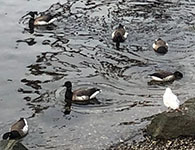 3/18 – Queens, New York City: Taking an afternoon walk along the East River toward Socrates Sculpture Park was a help in coping with the COVID-19 coronavirus. A whole group of shorebirds was hanging out at a small sandy beach on the river next to the park. Among them were six wintering brant and several Canada geese. (Photo of brant courtesy of Jen Adams) 3/18 – Queens, New York City: Taking an afternoon walk along the East River toward Socrates Sculpture Park was a help in coping with the COVID-19 coronavirus. A whole group of shorebirds was hanging out at a small sandy beach on the river next to the park. Among them were six wintering brant and several Canada geese. (Photo of brant courtesy of Jen Adams)
- Jen Adams
3/19 – Hudson River watershed: On today’s vernal equinox, which arrived at 11:48 PM, the first day of spring, we began our twenty-seventh year of the Hudson River Almanac.
The Almanac began on the vernal equinox of 1994 (each Almanac covers vernal equinox to vernal equinox, a natural year). It was a modest public forum for sharing stories (real stories and tall stories), ideas and adventures from the High Peaks of the Adirondacks, 320 miles away, to the sea. Our intention has been to document events that define the seasons. The Almanac has since grown to a distribution list approaching 20,000 readers featuring photographs and a range of contributions from elementary school poetry to the proclamations of scientists.
Perhaps the most memorable vernal equinox was 2001. It was the dawn of springtime, but winter still held the upper Hudson in its grip. At first light, we were able to walk across the river at the Ice Meadows (Warren County, river mile 245) over 15-20-foot-high walls of ice as though it were a mighty glacier from 20,000 years ago.
- Tom Lake
3/19 – Hudson River: The vernal equinox is a global, astronomical phenomenon when spring comes to the Northern Hemisphere and autumn arrives in the Southern Hemisphere. It is a magical concept when you think of it. The Sun was exactly above the Equator today, day and night were of equal length, and standing on the equator would produce no shadow.
Several times we have taken Dutchess Community College anthropology students to a precise location on the equator near Otavalo, Ecuador. Our GPS registered 00º 00' 0" (degrees, minutes, seconds) latitude and, with the sun directly overhead, we cast no shadow. Straddling the equator, students had the unique opportunity to stick one arm into spring and the other arm into autumn.
- Tom Lake
3/19 – Newcomb – HRM 302: On the vernal equinox, the Hudson River had opened up at the Route 28N bridge. Hooded and common mergansers have both been seen on the water. There was still patchy snow cover on south-facing slopes and open areas. American robins and red-winged blackbirds helped to make it sound like spring.
- Charlotte Demers
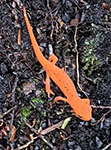 3/19 – Hurley, HRM 91: After working from home all day, we went for a late afternoon walk on the Hurley Rail Trail. Two signs of spring that highlighted the hike were finding round-lobed hepatica (Hepatica americana) in bloom and a red eft, the juvenile land-dwelling stage of the eastern newt (Notophthalmus viridescens). (Photo of red eft courtesy of Nancy Beard) 3/19 – Hurley, HRM 91: After working from home all day, we went for a late afternoon walk on the Hurley Rail Trail. Two signs of spring that highlighted the hike were finding round-lobed hepatica (Hepatica americana) in bloom and a red eft, the juvenile land-dwelling stage of the eastern newt (Notophthalmus viridescens). (Photo of red eft courtesy of Nancy Beard)
- Nancy Beard, Karl Beard, Betsy Blair
3/19 – Town of Wappinger, HRM 67.5: It was first light, but heavy overcast and a steady drizzle meant that there would be no visible sunrise on today’s vernal equinox. However, in the diffused and even light of dawn, the head of an adult bald eagle simply glowed. In each of the two local bald eagle nests, one adult was hunkered down incubating eggs. Whenever I see this, I always wonder where the other adult is hanging out. The eagle I was watching now, perched in a creek-side sycamore, was likely the missing adult from one of the nests. It was low tide – time for hunting the tidewater shallows of Wappinger Creek.
- Tom Lake
3/20 – Minerva, HRM 284: On the first full day of spring, we still had 8-12-inches of snow on the ground, and the lakes and ponds still had ice. Today was a day of maple sap-boiling – the last few days have been amazingly good for sap collection. I am hoping to end up with a quart-and-a-half of syrup. Today, I heard my first red-winged blackbirds passing through.
- Mike Corey
3/20 – Germantown, HRM 108: I went out to the yard this morning, walked to the fence behind my house, and listened. Yes! Spring peepers were singing from the adjacent pond and a woodcock, somewhere on the neighboring property, was calling. Small joys in these tough times.
- Mimi Brauch
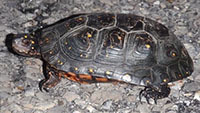 3/20 – New Paltz, HRM 78: On an early evening dog walk down Pine Road, I came upon a spotted turtle trying to cross over. I moved the turtle to the opposite shoulder and noted that it was a male (concave plastron). It had a carapace length roughly the distance between my thumb and forefinger (four-inches). I was pretty amazed that a pond turtle would be moving across the road on the second day of spring! (Photo of spotted turtle courtesy of Bob Ottens) 3/20 – New Paltz, HRM 78: On an early evening dog walk down Pine Road, I came upon a spotted turtle trying to cross over. I moved the turtle to the opposite shoulder and noted that it was a male (concave plastron). It had a carapace length roughly the distance between my thumb and forefinger (four-inches). I was pretty amazed that a pond turtle would be moving across the road on the second day of spring! (Photo of spotted turtle courtesy of Bob Ottens)
- Bob Ottens
3/20 – Town of Wappinger, HRM 68: A female summer tanager (Piranga rubra), first spotted at our seed feeders on January 15, was still there this morning 8:05 on Day 65. For Dutchess County, there are only three previous records of a summer tanager and none in winter.
- Melissa Fischer, Stephen Fischer (Ralph T. Waterman Bird Club)
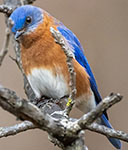 3/20 – Town of Poughkeepsie, HRM 68: At a time when we are seeking wild places to safely roam, one of the very best spots to find eastern bluebirds is by investigating the thickets at Bowdoin Park, a Dutchess County park in Wappinger Falls. (Photo of bluebird courtesy of John Badura) 3/20 – Town of Poughkeepsie, HRM 68: At a time when we are seeking wild places to safely roam, one of the very best spots to find eastern bluebirds is by investigating the thickets at Bowdoin Park, a Dutchess County park in Wappinger Falls. (Photo of bluebird courtesy of John Badura)
- Tom Lake
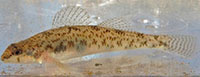 3/20 – Putnam County, HRM 55: In setting our seine, we were hustling in advance of promised thunderstorms with high winds. Along the eerily quiet, flat calm river, it seemed to be truly the quiet before the storm. The warm air temperature (73 degrees F) belied the season, but the chilly river (45 degrees) made it real. Despite the optimal low tide, our expectations were nil. We continually hauled an empty net up on the sand until our persistence paid off: tessellated darters (62 millimeters) never looked so good. (Photo of tessellated darter courtesy of Tom Lake) 3/20 – Putnam County, HRM 55: In setting our seine, we were hustling in advance of promised thunderstorms with high winds. Along the eerily quiet, flat calm river, it seemed to be truly the quiet before the storm. The warm air temperature (73 degrees F) belied the season, but the chilly river (45 degrees) made it real. Despite the optimal low tide, our expectations were nil. We continually hauled an empty net up on the sand until our persistence paid off: tessellated darters (62 millimeters) never looked so good. (Photo of tessellated darter courtesy of Tom Lake)
- Tom Lake, Phyllis Lake
(1 inch = 25.4 millimeters)
3/20 – Yonkers, HRM 18: Our Center for the Urban River at Beczak staff continued to daily monitor our glass eel fyke net. Over the last three days we have captured 69 glass eels (1,454 on the season), 20 amphipods (Gammarus sp.), one sand shrimp, and three delightful mummichogs!
Evidence of the perpetual ebb and flow of tidewater, salinity fluctuated from 3.2 to 4.9 parts-per-thousand (ppt) and the water temperature ranged 44.2 to 45.7 degrees F.
- Jason Muller
[A fyke net is a sampling device used most often for fish, but occasionally for turtles. They are a series of hoops, 10-12-feet-long, connected by mesh netting through which fish pass, leading to a “cod end” where captured fish accumulate. When used in a Hudson River tributary, fykes are set facing downstream to collect fish such as glass eels heading upstream. At the downstream opening, a section of netting is angled away on either side from the initial hoop to serve as a guide, encouraging fish to take the path of least resistance toward the mouth of the net. - Tom Lake]
Spring 2020 Natural History Programs
Cooperative Angler Program
Do you fish for striped bass in the Hudson River? You can be part of the Cooperative Angler Program, share your fishing trip information, and help biologists understand and manage our striped bass fishery. Fill out a logbook we provide or record your trips on your smart-phone using DEC's Hudson River online logbook (PDF) whenever you fish on the tidewater Hudson River. Record general location, time, gear used, what you caught (or if you didn't catch anything) and return the logbook when you are done fishing. You'll receive an annual newsletter summarizing the recreational fishery information, in addition to the latest news regarding Hudson River regulations and the river.
For more information on the angler program and instructions on installing the Survey123 App to access the online logbook, visit Hudson River Cooperative Angler or email hudsonangler@dec.ny.gov. If you primarily fish for striped bass in New York waters south of the George Washington Bridge, the DEC has a separate Striped Bass Cooperative Angler Program.
DEC Seeks Birdwatchers to contribute to 2020 Breeding Bird Atlas
State Department of Environmental Conservation (DEC) Commissioner Basil Seggos has announced a call for citizen-science volunteers to help in the development of a comprehensive, statewide survey that takes place every two decades to detail New York’s breeding bird distribution. Starting in 2020, five years of field surveys will be conducted by volunteers and project partners to provide the data that will be analyzed to create the third New York State Breeding Bird Atlas.
“Just as New Yorkers are embarking on the 2020 Census to track human populations and trends, DEC and our partners track our natural populations to evaluate the effectiveness of New York’s programs and initiatives to promote diverse and healthy wildlife,” Commissioner Seggos said. “The Breeding Bird Atlas is a valuable tool to help protect birds and habitat, and I encourage all New Yorkers to get outdoors safely and responsibly and participate in this year’s survey while practicing social distancing.”
DEC is partnering with the New York Natural Heritage Program, SUNY College of Environmental Science and Forestry (ESF), Audubon New York, Cornell Lab of Ornithology, New York State Ornithological Association, and New York Cooperative Fish and Wildlife Research Unit on this project. When complete, the atlas will provide species-specific details about distribution, maps, and illustrations.
The last atlas was published in 2008, with information on its results available on DEC’s website. Five years of fieldwork by more than 1,200 contributors provided the data for the second addition to New York’s understanding of the state’s avifauna (birds). This substantial book revealed striking changes in the distributions of many of our breeding birds since New York's first Breeding Bird Atlas was published in 1988. Data showed that half of New York’s 253 species showed a significant change in their distribution, with 70 species showing increases and 58 species showing declines. A comparison study between the first two atlases showed that the distribution of 129 species moved northward an average of 3.58 kilometers due to climate change. The 2020 atlas will provide further data on this shift and climate change’s potential impact on wildlife.
To participate, volunteers can make a free eBird account and submit data online through the atlas website (ebird.org/atlasny) or via the eBird mobile app. Simply record the species and any breeding behaviors observed. All sightings can count. As observations are reported, data can be viewed here: https://ebird.org/atlasny/state/US-NY.
Hudson River Miles
The Hudson is measured north from Hudson River Mile 0 at the Battery at the southern tip of Manhattan. The George Washington Bridge is at HRM 12, the Tappan Zee 28, Bear Mountain 47, Beacon-Newburgh 62, Mid-Hudson 75, Kingston-Rhinecliff 95, Rip Van Winkle 114, and the Federal Dam at Troy, the head of tidewater, at 153. The tidal section of the Hudson constitutes a bit less than half the total distance – 315 miles – from Lake Tear of the Clouds to the Battery. Entries from points east and west in the watershed reference the corresponding river mile on the mainstem.
To Contribute Your Observations or to Subscribe
The Hudson River Almanac is compiled and edited by Tom Lake and emailed weekly by DEC's Hudson River Estuary Program. Share your observations by e-mailing them to trlake7@aol.com.
To subscribe to the Almanac (or to unsubscribe), use the links on DEC's Hudson River Almanac or DEC Delivers web pages.
Discover New York State Conservationist - the award-winning, advertisement-free magazine focusing on New York State's great outdoors and natural resources. Conservationist features stunning photography, informative articles and around-the-state coverage. Visit the Conservationist webpage for more information.
Useful Links
National Oceanic and Atmospheric Administration online tide and tidal current predictions are invaluable when planning Hudson River field trips.
For real-time information on Hudson River tides, weather and water conditions from sixteen monitoring stations, visit the Hudson River Environmental Conditions Observing System website.
DEC's Smartphone app for iPhone and Android is now available at: New York Fishing, Hunting & Wildlife App.
Adventure NY
Under Governor Cuomo's Adventure NY initiative, DEC is making strategic investments to expand access to healthy, active outdoor recreation, connect more New Yorkers and visitors to nature and the outdoors, protect natural resources, and boost local economies. This initiative will support the completion of more than 75 projects over the next three years, ranging from improvements to youth camps and environmental education centers to new boat launches, duck blinds, and hiking trails. Read more about the Adventure NY initiative. For more information on planning an outdoor adventure in New York State, visit DEC's website at http://www.dec.ny.gov/outdoor.
Information about the Hudson River Estuary Program is available on DEC's website at http://www.dec.ny.gov/lands/4920.html.
|