Be on the Lookout for Amphibians Crossing the Road
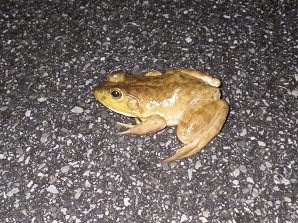 With the arrival of spring temperatures, amphibians have begun their annual migrations to woodland pools to breed. Often, they must cross roads to reach these pools. In New York, this migration usually occurs on rainy nights in late March and early April, when the night air temperature is above 40F. When these conditions exist there can be explosive, "big night" migrations, with hundreds of amphibians on the move. Volunteers can help document these locations and help amphibians like wood frogs, spotted salamanders, American toads, or spring peepers safely cross the road. Drivers on New York roads are encouraged to proceed with caution or avoid travel on the first warm, rainy evenings of the season. Amphibians come out after nightfall and are slow moving; mortality can be high even on low-traffic roads. With the arrival of spring temperatures, amphibians have begun their annual migrations to woodland pools to breed. Often, they must cross roads to reach these pools. In New York, this migration usually occurs on rainy nights in late March and early April, when the night air temperature is above 40F. When these conditions exist there can be explosive, "big night" migrations, with hundreds of amphibians on the move. Volunteers can help document these locations and help amphibians like wood frogs, spotted salamanders, American toads, or spring peepers safely cross the road. Drivers on New York roads are encouraged to proceed with caution or avoid travel on the first warm, rainy evenings of the season. Amphibians come out after nightfall and are slow moving; mortality can be high even on low-traffic roads.
Photo by Sandy Van Vranken.
Accessible Recreation at Wildlife Management Areas
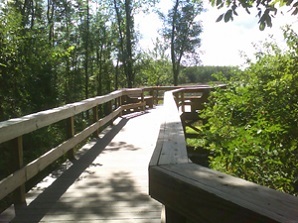 During the current COVID-19 public health crisis, getting outdoors and connecting with nature is a great way to help maintain our mental and physical health. Scientific studies show that time outside in nature significantly reduces stress and anxiety; lowers blood pressure; improves mood, energy, and sleep; and boosts the immune system. There are several Wildlife Management Areas (WMAs) where people with disabilities will find accessible features and can get out and enjoy nature. The WMAs listed below all have accessible parking and are all within 30 miles of some larger cities, listed in parenthesis: During the current COVID-19 public health crisis, getting outdoors and connecting with nature is a great way to help maintain our mental and physical health. Scientific studies show that time outside in nature significantly reduces stress and anxiety; lowers blood pressure; improves mood, energy, and sleep; and boosts the immune system. There are several Wildlife Management Areas (WMAs) where people with disabilities will find accessible features and can get out and enjoy nature. The WMAs listed below all have accessible parking and are all within 30 miles of some larger cities, listed in parenthesis:
-
Braddock Bay WMA has an accessible wildlife observation and fishing platform on Salmon Creek (Rochester).
-
Hamlin Marsh WMA offers an accessible hunting blind and a separate accessible observation deck with benches, overlooking Hamlin Marsh. The deck is built near a vast marshland that contains waterfowl in migratory seasons. The hunting blind is located on open water and features a 600-foot wooded access path (Syracuse).
-
Spicer Creek WMA has an accessible trail and two hunting blind/observation decks (Buffalo).
-
Three Rivers WMA has an accessible duck blind not far from the end of the administrative road which heads north off of Route 113/Kellogg Road (Syracuse).
-
Tillman Road WMA contains approximately 300 feet of accessible boardwalk with a viewing platform. It is located at the northern end of the WMA, adjacent to the parking lot off Shisler Road (Buffalo).
-
Vosburgh Swamp WMA has an accessible waterfowl hunting and wildlife viewing blind at the north end of the swamp. A trail and short boardwalk to this blind originates from the middle parking lot off of Four Mile Point Road (Albany).
While enjoying outdoor spaces, please continue to follow the CDC/NYSDOH’s guidelines for preventing the spread of colds, flu, and COVID-19:
- Try to keep at least six feet of distance between you and others.
- Avoid close contact, such as shaking hands, hugging, and kissing.
- Wash hands often or use a hand sanitizer when soap and water are not available.
- Avoid surfaces that are touched often, such as doorknobs and handrails.
Visit our Accessible Recreation Destinations webpage for more locations to visit.
Watch the Skies for Spring Bird Migrations
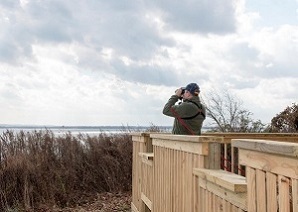 Spring is an ideal time to observe bird migrations. New York is conveniently located along the Atlantic Flyway, one of the main migration routes. This gives you a great opportunity to observe birds flying to their summer breeding grounds. Spring is an ideal time to observe bird migrations. New York is conveniently located along the Atlantic Flyway, one of the main migration routes. This gives you a great opportunity to observe birds flying to their summer breeding grounds.
Grab your binoculars and check out one of these hot spots:
-
Northern Montezuma Wildlife Management Area (WMA), Cayuga, Seneca, Wayne Counties—a stopover for many species of ducks who are headed farther north. You can see shorebirds, raptors, waterfowl, and songbirds at this WMA.
-
Montezuma Wildlife Refuge, Cayuga and Seneca Counties—an endless list of birds can be seen here.
-
Braddock Bay WMA, Monroe County—find waterfowl, raptors, and songbirds.
-
Iroquois National Wildlife Refuge, Genesee and Orleans Counties—see many species of waterfowl.
-
Derby Hill Bird Observatory, Oswego County—known for migrating hawks.
-
Bashakill WMA, Orange County—view hawks, marshbirds, and waterfowl.
-
Central Park, NYC—see warblers, in addition to many other species.
It’s impossible to list all the great bird-viewing locations, but look for an Important Bird Area or Bird Conservation Area near you.
DEC Postpones April 3 Exams for Falconry, Wildlife Rehabilitator, and Leashed Tracking Dog Licenses
Out of an abundance of caution and to limit the community spread of COVID-19, DEC has postponed the examinations scheduled for April 3, 2020, to practice the sport of falconry, become a wildlife rehabilitator, or use leashed tracking dogs to find wounded or injured big game animals. The exams were originally scheduled to be administered at DEC regional offices statewide.
DEC will offer these examinations on August 14, 2020, at most DEC Regional Offices. Individuals currently registered for the April 3 examinations can register for the August examinations by contacting the Special Licenses Unit at 518-402-8985 or SpecialLicenses@dec.ny.gov and request to have their names included for the August exams.
All others who wish to apply for the August exams can visit the DEC Special Licenses Unit website and complete an exam registration form. Applicants can mail, fax, or email the completed form to: NYSDEC Special Licenses Unit, 625 Broadway, Albany, NY 12233-4752; fax: 518-402-8925; email: SpecialLicenses@dec.ny.gov. For phone inquiries, contact 518-402-8985.
Trout and Salmon Fishing Season Opens April 1
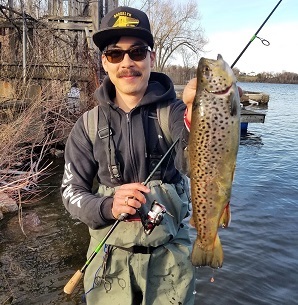 Trout and salmon fishing season opens on Wednesday, April 1. New York's coldwater lakes and streams offer springtime trout anglers the opportunity to pursue trout in a wide array of settings across the state. During the current COVID-19 public health crisis, getting outdoors and connecting with nature while angling in New York's waters is a great way to help maintain mental and physical health. Trout and salmon fishing season opens on Wednesday, April 1. New York's coldwater lakes and streams offer springtime trout anglers the opportunity to pursue trout in a wide array of settings across the state. During the current COVID-19 public health crisis, getting outdoors and connecting with nature while angling in New York's waters is a great way to help maintain mental and physical health.
While enjoying the outdoors, please continue to follow the CDC/New York State Department of Health guidelines for preventing the spread of colds, flu and COVID-19:
- Try to keep at least six feet of distance between you and others.
- Avoid close contact, such as shaking hands, hugging, and kissing.
- Wash hands often or use a hand sanitizer when soap and water are not available.
- Avoid surfaces that are touched often, such as doorknobs, handrails, and playground equipment.
When fishing, DEC recommends avoiding busy waters, following the guidelines on DEC's website about fishing responsibly in New York State, and purchasing sporting licenses online.
DEC has posted the 2020 Spring Trout Stocking summary online. Visit our website to find current freshwater fishing regulations, trout fishing techniques & methods, and catching and releasing trout guidance.
|