A Project of the Hudson River Estuary Program
Compiled by Tom Lake, Consulting Naturalist
Overview
Our week was dominated by the start of our annual Mid-Winter Bald Eagle Census, a time when we take stock of our bald eagles, both residents and wintering birds from the north and east. Our first snowy owl showed up, an event that could be repeated several more times as winter becomes serious.
Highlight of the Week
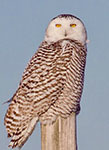 1/5 – Albany, HRM 145: I spotted a snowy owl perched on top of the radar antenna array on the USS Slater, a World War II destroyer escort museum vessel moored on the Hudson River at the Port of Albany. I was unable to stop at the time and, when I went back a couple of hours later, the owl was gone. Instead, there was an adult peregrine falcon perched on a lower yardarm. It was probably one of the peregrines that nest on the nearby Dunn Memorial Bridge. Peregrine falcons do not tolerate snowy owls in their territory. (Photo of snowy owl courtesy of Curt Morgan) 1/5 – Albany, HRM 145: I spotted a snowy owl perched on top of the radar antenna array on the USS Slater, a World War II destroyer escort museum vessel moored on the Hudson River at the Port of Albany. I was unable to stop at the time and, when I went back a couple of hours later, the owl was gone. Instead, there was an adult peregrine falcon perched on a lower yardarm. It was probably one of the peregrines that nest on the nearby Dunn Memorial Bridge. Peregrine falcons do not tolerate snowy owls in their territory. (Photo of snowy owl courtesy of Curt Morgan)
- Rich Guthrie
Natural History Entries
1/4 – Troy, HRM 153: The Troy Christmas Bird Count was conducted by 25 birders in seven field parties. They documented 60 bird species on a rather soggy day with light rain and fog. The rivers and streams were flowing while ponds and reservoirs were largely iced-over. Highlights included one each snow goose, northern pintail, bufflehead, Iceland gull, merlin, and sharp-shinned hawk. There were two each Cooper’s hawk and eastern screech-owl. Among the larger assemblages were red-winged blackbird (44) and brown-headed cowbird (36).
- Larry Alden, Penny Alden (Hudson-Mohawk Bird Club)
1/4 – Wappinger Creek, HRM 67.5: There was a scattering of diving ducks on the 1.6-mile tidal reach of Wappinger Creek this morning, including common and hooded merganser, bufflehead, and at least one ruddy duck. With no eagles in sight, the waterfowl seemed at ease.
- Tom Lake, B.J. Jackson, T.R. Jackson
[“Eagle food!” Diving ducks, such as mergansers, are more common targets of eagles than marsh ducks. While mallards, black ducks, teal, wigeon, pintails, and wood ducks spring straight up from the water, diving ducks, such as mergansers, require a “runway” to get airborne providing an easier target for eagles in a stoop. Tom Lake]
1/4 – Town of Wappinger, HRM 67.5: The adult pair in bald eagle nest NY459 were hard at work arranging twigs and branches in their nest. While the pair has been busy, often an immature bald eagle has been perching nearby. It is difficult to assess the intentions of immatures in this setting. During this time of the season, they could be winter migrants from points north or a summer fledgling from a local nest.
- Mauricette Potthast
1/5 – Newcomb, HRM302: It looked like a peaceable kingdom under the bird feeders this morning. There was a gray squirrel, a red squirrel, and an eastern chipmunk side-by-side all nibbling fallen seeds. Gray squirrels are not a common occurrence in this part of the Adirondacks, and their appearance is noteworthy. I doubt they travel far from the food security of the bird feeders in winter. The eastern chipmunk is one of two that regularly visit the feeders, and I suspect these chipmunks are a result of late litters. They are likely young chipmunks that did not have the time to cache enough food resources for the winter. We did not have adequate seed crop for them until the fall when we had one of the best beechnut crops ever recorded. It also helps that our snow cover only averaged four-inches in December.
- Charlotte Demers
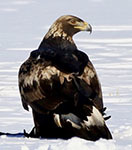 1/6 – Catskill Mountains: Today ended the 39th consecutive season of monitoring migrating raptors at the Delaware-Otsego Audubon Franklin Mountain Hawkwatch near Oneonta, Otsego County, in the northern Catskills. No birds were tallied today under overcast skies with gusty west-northwest winds. 1/6 – Catskill Mountains: Today ended the 39th consecutive season of monitoring migrating raptors at the Delaware-Otsego Audubon Franklin Mountain Hawkwatch near Oneonta, Otsego County, in the northern Catskills. No birds were tallied today under overcast skies with gusty west-northwest winds.
For the season, the golden eagle total stood at 166, somewhat below the 19-year average of 183, since full time counting began at the site. Red-tail hawks totaled 922, only half of the average of 1,727, continuing a downward trend. All Accipiters were notably down, as were osprey and American kestrels. Record season highs were set for turkey vulture and broad-winged hawk. Disappointingly, no black vultures were spotted, a set-back for a hoped-for regular appearance following a 2018 count of 15 and a 2017 count of six (only two black vultures had been recorded in the previous 28 years). Total raptors were 5,237, due largely to the excellent broad-winged hawk count in September. This makes two seasons in a row above average for total birds. (Photo of golden eagle courtesy of Justin Schmidt)
- Andrew Mason
*** Fish of the Week ***
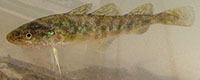 1/7 – Hudson River Watershed: Fish-of-the-Week for Week 52 is the Atlantic tomcod (Microgadus tomcod), number 105 (of 230) on our watershed list of fishes. If you would like a copy of our list, e-mail - trlake7@aol.com. 1/7 – Hudson River Watershed: Fish-of-the-Week for Week 52 is the Atlantic tomcod (Microgadus tomcod), number 105 (of 230) on our watershed list of fishes. If you would like a copy of our list, e-mail - trlake7@aol.com.
Atlantic tomcod are an Arctic fish. Bigelow and Schroder's Fishes of the Gulf of Maine (1953) cite their general range as “... northern Newfoundland to Virginia.” They are one of eight members of the cod family (Gadidae) found in the Hudson River watershed. The others are the Atlantic cod, pollock, silver hake (“whiting”), red hake (“ling”), spotted hake, white hake, and the ephemeral fourbeard rockling.
Tomcod are an anadromous species that live in salt water as an adult and return to freshwater to spawn. Unlike the herrings in the Hudson River that spawn in spring, tomcod spawn in late-fall and winter, from November to February. In cold winters, they spawn under the ice from the Hudson Highlands northward thus earning them the nickname “frost fish,” a Dutch Colonial colloquialism.
Tomcod mature at 6-7-inches in 11-12 months and can grow to 15-inches, although in the Hudson River, most are ten-inches or less. Their species name, Microgadus, alludes to their smaller size compared to the nearly identical Atlantic cod (Gadus morhua). Young-of-year tomcod are found in the lower estuary and East River in summer.
In winter, 50 years ago, tomcod was abundant enough so that some taverns in the lower river served fried tomcod as a snack with beer in lieu of peanuts. However, tomcod numbers in the river have been declining over the last few decades and, being a boreal species, climate change has been suggested as a possible cause. (Photo of Atlantic tomcod courtesy of Steve Stanne)
- Tom Lake
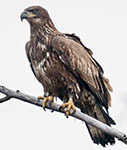 1/8 – Town of Wappinger, HRM 67.5: There have been a lot of young bald eagles flying around the NY459 nest area on Wappinger Creek. And on windy days, there seemed to be even more activity – I counted six immatures today near the train trestle. One flew close enough to get its picture taken. It was a wonderful moment. (Photo of bald eagle nest NY459 courtesy of Mauricette Potthast) 1/8 – Town of Wappinger, HRM 67.5: There have been a lot of young bald eagles flying around the NY459 nest area on Wappinger Creek. And on windy days, there seemed to be even more activity – I counted six immatures today near the train trestle. One flew close enough to get its picture taken. It was a wonderful moment. (Photo of bald eagle nest NY459 courtesy of Mauricette Potthast)
- Mauricette Potthast
[Given the season, these immatures are likely the vanguard of the wintering eagles from points north and east. Eagles living in the north wake up one day in winter and discover the lakes, ponds, and rivers are frozen, and their primary food sources have either left (waterfowl) or are inaccessible (fish). When we finally get a real Arctic blast, with ice on the river, there will be many more eagles in the lower estuary. Tom Lake]
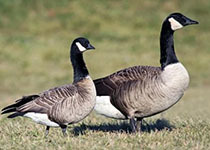 1/9 – Coxsackie, HRM 124: I saw a cackling goose in the river in midday. It was in with a number of Canada geese at the Coxsackie Boat Launch. (Photo of cackling goose courtesy of Jay McGowan) 1/9 – Coxsackie, HRM 124: I saw a cackling goose in the river in midday. It was in with a number of Canada geese at the Coxsackie Boat Launch. (Photo of cackling goose courtesy of Jay McGowan)
- Roddy Greaves (Hudson-Mohawk Bird Club)
[The cackling goose (Branta hutchinsii) is a smaller version of the Canada goose. It was formerly considered the smallest subspecies of one variable species, but recent work on genetic differences found the four smallest forms to be very different. These four races are now recognized as a full species: the cackling goose. It breeds farther northward and westward than does the Canada goose. Cornell Lab of Ornithology]
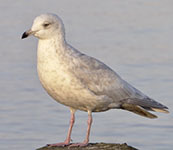 1/9 – Beacon, HRM 61: In late afternoon, among a large assemblage of gulls, I was able to spot a single white-winged gull, a first-year (bird-of-the-year, born this past summer) Iceland gull, at the Beacon train station waterfront. (Photo of Iceland gull courtesy of Curt McDermott) 1/9 – Beacon, HRM 61: In late afternoon, among a large assemblage of gulls, I was able to spot a single white-winged gull, a first-year (bird-of-the-year, born this past summer) Iceland gull, at the Beacon train station waterfront. (Photo of Iceland gull courtesy of Curt McDermott)
- Ken McDermott
[The Iceland gull (Larus glaucoides) is a medium-sized gull that breeds in the Arctic regions of Canada and Greenland. They are migratory, wintering in the northernmost states of the eastern U.S. When we talk of “white-winged gulls” in the eastern United States we are referring to Iceland and glaucous gulls. Adult ivory gulls are pure white and incredibly beautiful but are uncommon to rare in our watershed. Only glaucous gulls of the other two species are always white-winged in all cycles of molt. Their wings have white primaries in all stages of life. Iceland gulls have variability in all stages (like most gull species) and as adults, can have primaries that range from white to black. Curt McDermott]
1/9 – Manhattan, HRM 1: We braved the frigid waters of the river to check our research gear at The River Project’s sampling station on the lighthouse tender Lilac moored at Pier 25 in Hudson River Park. Even the mud crabs were in reduced numbers due to the season, and we found predominantly shore shrimp and isopods in the traps. Winter torpor is definitely in full swing.
- Siddhartha Hayes, Toland Kister, Melissa Rex
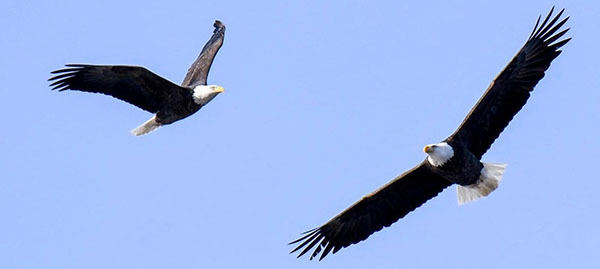
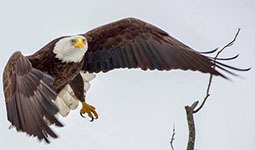 1/10 – Hudson River Watershed: This was Day One of the forty-second annual Mid-Winter Bald Eagle Census for the Hudson River watershed. (January 11, was a "bad weather" day.) 1/10 – Hudson River Watershed: This was Day One of the forty-second annual Mid-Winter Bald Eagle Census for the Hudson River watershed. (January 11, was a "bad weather" day.)
Acquiring meaningful data from the annual Mid-Winter Bald Eagle Census has always been at the whims of the weather, particularly ice-cover. The survey is conducted each year at roughly the same time (early January) for the sake of consistency (data comparison). However, the number of eagles, either an abundance or scarcity, often does not accurately reflect the number of wintering eagles that are here or will be here in the wake of the next serious blast of winter weather. Collected data are sent to Mike Vissichelli, Operations Program Manager, North Atlantic Division, U.S. Army Corps of Engineers 301 General Lee Avenue, Brooklyn, NY 11252
The Almanac joined this effort in 1999. At that time, eagles in the watershed were scarce, making it a very intense survey. Peter Nye (DEC, now retired) would meet with many of us in the Hudson Valley for strategy sessions a week or more in advance. Bald eagles were an endangered species (removed from the Endangered Species List in 2007) and it was serious business. On count day, Pete would fly down the river in a helicopter from Troy to the Tappan Zee to get an eagle count to compare with our terrestrial numbers.
Our individual reach of the river has been Clinton Point-Marlboro Creek south to Cornwall Bay-Storm King (river miles 69-57). In years with plenty of ice, our high count has been 52 (2001). In ice-free years, we have seen only one eagle (2011). The warmest census day was in 2006, at 46 degrees Fahrenheit (F). The coldest was two degrees F in 2004. Across 21 years, the ratio of adults to immatures has been 7.3 adults to 3.8 immatures. (Photo of bald eagle courtesy of Jackie Currie)
1/10 – Eastern Dutchess County, HRM 96: I went out to the area around Stissing Mountain this morning and spotted both an adult and an immature golden eagle, as well as one immature bald eagle.
- Bob Gramling
[Eastern Dutchess County has been a wintering ground for a small number of golden eagles in past years, usually in the Pawling-Amenia-Route 22 corridor to Stissing Mountain. Deborah Tracy-Kral]
1/10 – Norrie Point, HRM 85: We saw two adults and one immature bald eagle today as we looked out our window at the Norrie Environmental Education Center. They were soaring around high over the river. We frequently see these three around here.
- Maija Lisa Niemistö
[Dave Lindemann found the two adults later in the day, perched offshore on Esopus Island. Dave concluded that these were the mated pair from bald eagle nest NY142 across the way in Ulster County. Tom Lake]
1/10 – Dutchess County, HRM 76-67: I counted seven adult bald eagles this morning, six of them mated pairs from nests NY62, NY372, and NY459. The seventh was an immature hanging around the mouth of Wappinger Creek.
- Bob Rightmyer
1/10 – Town of Wappinger, HRM 67.5: We started out on our eagle survey in the monochrome moments of first light with the air temperature just below freezing. The 1.6-mile tidewater reach of Wappinger Creek was practically ice-free. From there south to Storm King Mountain, we tallied seven bald eagles, including a pair at the Brockway nest (NY377) just upriver from Beacon, an immature on Cedarcliff and two adults in Cornwall Bay (nest NY050), both latter sightings in Orange County.
- Tom Lake, B.J. Jackson
1/10 – Charles Point, HRM 43: Despite a mild winter that offered little encouragement or need to migrate downriver for open water, I spotted three adult bald eagles this morning along the river with their bright white heads.
- Jay Melnick
[In severe winters, there are few better places to view wintering bald eagles than out on the river ice of Peekskill Bay from China Pier at Charles Point. At its peak in February, a hundred eagles might be spread out along the two-mile reach from Dunderberg Mountain downriver to Indian Point. Tom Lake]
1/10 – Hudson River, HRM 118-34: I periodically take Amtrak from Manhattan to Albany, and I always make sure I get a window seat so I can enjoy the spectacular views. Without fail, I see eagles, and today was no exception. In the 84 miles between Croton-on-Hudson and the city of Hudson, I saw ten bald eagles. First, there was a pair together in a riverside tree, then three more (two adults and an immature) on inshore ice upriver, and then five more at various points. It seemed like each time my eyes left my laptop and I looked out the window we passed by another eagle. Next time I think I will just put the laptop away and purposely look for eagles. Whether I'll have as much luck, is another story.
- Constance Hasko
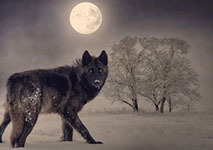 1/10 – Town of Wappinger, HRM 67: Tonight was the full moon of January. For the last couple of weeks, our sleep had been intermittently interrupted by coyotes baying in the dark-of-night forest. Tonight, they were wolves-by-proxy. Algonquian and Haudenosaunee people of our watershed referred to the howls of wolves on icy nights in mid-winter, hauntingly highlighted by the full moon, as the Wolf Moon. (Photo of wolf moon courtesy of Len Melisurgo) 1/10 – Town of Wappinger, HRM 67: Tonight was the full moon of January. For the last couple of weeks, our sleep had been intermittently interrupted by coyotes baying in the dark-of-night forest. Tonight, they were wolves-by-proxy. Algonquian and Haudenosaunee people of our watershed referred to the howls of wolves on icy nights in mid-winter, hauntingly highlighted by the full moon, as the Wolf Moon. (Photo of wolf moon courtesy of Len Melisurgo)
- Tom Lake
Hudson River Miles
The Hudson is measured north from Hudson River Mile 0 at the Battery at the southern tip of Manhattan. The George Washington Bridge is at HRM 12, the Tappan Zee 28, Bear Mountain 47, Beacon-Newburgh 62, Mid-Hudson 75, Kingston-Rhinecliff 95, Rip Van Winkle 114, and the Federal Dam at Troy, the head of tidewater, at 153. The tidal section of the Hudson constitutes a bit less than half the total distance – 315 miles – from Lake Tear of the Clouds to the Battery. Entries from points east and west in the watershed reference the corresponding river mile on the mainstem.
To Contribute Your Observations or to Subscribe
The Hudson River Almanac is compiled and edited by Tom Lake and emailed weekly by DEC's Hudson River Estuary Program. Share your observations by e-mailing them to trlake7@aol.com.
To subscribe to the Almanac (or to unsubscribe), use the links on DEC's Hudson River Almanac or DEC Delivers web pages.
Discover New York State Conservationist - the award-winning, advertisement-free magazine focusing on New York State's great outdoors and natural resources. Conservationist features stunning photography, informative articles and around-the-state coverage. Visit the Conservationist webpage for more information.
Useful Links
National Oceanic and Atmospheric Administration online tide and tidal current predictions are invaluable when planning Hudson River field trips.
For real-time information on Hudson River tides, weather and water conditions from sixteen monitoring stations, visit the Hudson River Environmental Conditions Observing System website.
DEC's Smartphone app for iPhone and Android is now available at: New York Fishing, Hunting & Wildlife App.
Adventure NY
Under Governor Cuomo's Adventure NY initiative, DEC is making strategic investments to expand access to healthy, active outdoor recreation, connect more New Yorkers and visitors to nature and the outdoors, protect natural resources, and boost local economies. This initiative will support the completion of more than 75 projects over the next three years, ranging from improvements to youth camps and environmental education centers to new boat launches, duck blinds, and hiking trails. Read more about the Adventure NY initiative. For more information on planning an outdoor adventure in New York State, visit DEC's website at http://www.dec.ny.gov/outdoor.
Information about the Hudson River Estuary Program is available on DEC's website at http://www.dec.ny.gov/lands/4920.html.
|