A Project of the Hudson River Estuary Program
Compiled by Tom Lake, Consulting Naturalist
Overview
The incredible Saugerties Lighthouse harbor seal was seen again this week, extending its amazing record for local longevity. The annual bald eagle nest refurbishing was underway in preparation for the 2020 breeding season, and our fishes were becoming scarce!
Highlight of the Week
12/5 – Saugerties, HRM 102: As if on cue, our seemingly “resident” harbor seal made an appearance this afternoon. This seal was first seen here on August 21, making today Day 106.
Guests at our lighthouse reported seeing the seal in the mouth of Esopus Creek eating a fish and took a photo from the lighthouse tower. Today’s visitors were treated to a trifecta: the harbor seal feeding, a bald eagle soaring, and the Hudson River Sloop Clearwater sailing past. A couple of hours later, we again spotted the seal swimming on the south side of the lighthouse.
- Patrick Landewe, Anna Landewe
Natural History Entries
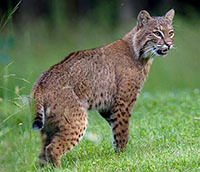 11/30 – Dutchess County: Bobcats (Lynx rufus) are found throughout North America from southern Canada to southern Mexico and are not at all uncommon in the Hudson Valley. They are crepuscular, meaning that they are most active at dawn and dusk. Though many felines have long, sinuous tails, an adult bobcat's averages just 6-7-inches in length; the common name bobcat is a reference to this stubby appendage. Solitary hunters by nature, bobcats lay claim to an area of land that can be anywhere from 1-18 square miles in size (ranges tend to be smaller in summer and larger in winter as they hunt for prey). (Photo of bobcat courtesy of Deborah Tracy-Kral) 11/30 – Dutchess County: Bobcats (Lynx rufus) are found throughout North America from southern Canada to southern Mexico and are not at all uncommon in the Hudson Valley. They are crepuscular, meaning that they are most active at dawn and dusk. Though many felines have long, sinuous tails, an adult bobcat's averages just 6-7-inches in length; the common name bobcat is a reference to this stubby appendage. Solitary hunters by nature, bobcats lay claim to an area of land that can be anywhere from 1-18 square miles in size (ranges tend to be smaller in summer and larger in winter as they hunt for prey). (Photo of bobcat courtesy of Deborah Tracy-Kral)
- Mark Mancini
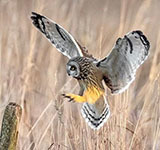 12/1 – Ulster County, HRM 74: In late afternoon, during a visit to the Shawangunk Grassland National Wildlife Refuge in Galeville, we witnessed a typical late-autumn, early-winter event. From the viewing platform, we watched short-eared owls performing their dips, darts, dives, and glides over the grasslands. We were surprised this early in the season, when one owl came right to the post in front of the viewing platform. Last year, they kept their distance for a while. We also spotted a few northern harriers hunting in the distance. (Photo of short-eared owl courtesy of John Badura) 12/1 – Ulster County, HRM 74: In late afternoon, during a visit to the Shawangunk Grassland National Wildlife Refuge in Galeville, we witnessed a typical late-autumn, early-winter event. From the viewing platform, we watched short-eared owls performing their dips, darts, dives, and glides over the grasslands. We were surprised this early in the season, when one owl came right to the post in front of the viewing platform. Last year, they kept their distance for a while. We also spotted a few northern harriers hunting in the distance. (Photo of short-eared owl courtesy of John Badura)
- John Badura, Debbie Quick, Dwight Reed, Debbi Lephew, Jack Currie
[The short-eared owl (Asio flammeus) occurs on all continents except Antarctica and Australia; thus, it has one of the most widespread distributions of any bird. Short-eared owls breed in Europe, Asia, North and South America, the Caribbean, Hawaii and the Galápagos Islands. It is partially migratory, moving south in winter from the northern parts of its range. The short-eared owl is known to relocate to areas of higher rodent populations. It will also wander nomadically in search of better food supplies during years when vole populations are low. Ehrlich, Dobkin, Wheye (1988)]
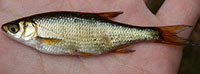 12/1 – Beacon, HRM 61: This was not how a morning on the beach ought to be – a test of endurance. There was no sunrise, the sky was a leaden gray, and the air was frigid 19 degrees Fahrenheit (F). But we were committed to discovering what was home in the river today, even if that turned out to be nothing. We seined with some urgency given the winter storm warning in effect – a serious storm was close. In a season of diminishing returns, it was not surprising that the 39-degree F water was clear and empty, except for water chestnut seeds. We agreed: just one fish and we were out of there. Our goal was reached on the next haul, a single golden shiner (Notemigonus crysoleucas), a small, 48-millimeter (mm) fish that never looked so good. As we reluctantly cleared the final haul of water chestnuts, we thought of the lyrics from a Gordon Bok ballad, Mrs. MacDonalds Lament: 12/1 – Beacon, HRM 61: This was not how a morning on the beach ought to be – a test of endurance. There was no sunrise, the sky was a leaden gray, and the air was frigid 19 degrees Fahrenheit (F). But we were committed to discovering what was home in the river today, even if that turned out to be nothing. We seined with some urgency given the winter storm warning in effect – a serious storm was close. In a season of diminishing returns, it was not surprising that the 39-degree F water was clear and empty, except for water chestnut seeds. We agreed: just one fish and we were out of there. Our goal was reached on the next haul, a single golden shiner (Notemigonus crysoleucas), a small, 48-millimeter (mm) fish that never looked so good. As we reluctantly cleared the final haul of water chestnuts, we thought of the lyrics from a Gordon Bok ballad, Mrs. MacDonalds Lament:
When the wind's away, and the wave's away,
That crazy old fool will go down on the bay,
Dodgin' the ledges and settin' his gear,
And come back when the wind drives him in.
Yet he knows full well the fishin' is done ...
His credit’s all gone and winter has come,
But as sure as the tide will rise and run,
He'll go back on the bay again.
(Photo of golden shiner courtesy of Tom Lake)
- Tom Lake, A. Danforth
[Note: one inch = 25.4 millimeters (mm)]
12/1 – Rockland County, HRM 42: We witnessed a stunning event today: An adult bald eagle pursuing a great blue heron! The heron circled Lake Tiorati in Harriman State Park with the eagle in hot pursuit. The heron’s energy seemed to be waning, and the bird started going down like a rock. With a big splash, the heron hit the water, seemingly doomed. Shortly, the eagle swooped down and likewise splashed in the water. However, when the water droplets settled, the eagle was flying off with empty talons. The heron flailed around a bit, and then with some effort, took off flying in desperation toward the other end of the lake where it landed safely among some trees. We were left wondering how the heron had survived the attack.
- Peter Cutul
12/1 – Rockland County, HRM 33: I checked on bald eagle nest NY336 today and found that last year’s nest had been severely damaged and was no longer inhabitable. However, the pair had built a new nest not far to the north. I had seen the pair perching in the new tree previously, so it may have been a favorite. One adult was in the nest today; by size I suspected it was the female. I also spotted what may have been the male of the pair just north of the causeway between New City and Congers.
- Chris Galligan
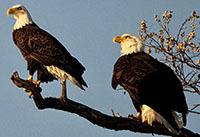 12/2 – Town of Poughkeepsie: The adult pair from bald eagle nest NY372 were on station today and looking ready to begin their new breeding season. This is one of several Hudson Valley bald eagle nests for which we try to maintain a low profile and whose exact location, if known, might leave them vulnerable to intrusion. (Photo of bald eagles courtesy of John Devitt) 12/2 – Town of Poughkeepsie: The adult pair from bald eagle nest NY372 were on station today and looking ready to begin their new breeding season. This is one of several Hudson Valley bald eagle nests for which we try to maintain a low profile and whose exact location, if known, might leave them vulnerable to intrusion. (Photo of bald eagles courtesy of John Devitt)
- John Devitt
[Two decades ago, you could cite the number of bald eagle nests in the Hudson Valley on one hand. Following the fledgling of their young, the adults would disappear for a few months from late summer through early winter. Now, however, with a much greater density of eagles and nests in the Hudson Valley, the adults stay close, seemingly loathe to leave the area fearing that when they come back another pair may have taken over their nest. Tom Lake]
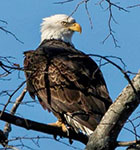 12/2 – Town of Wappinger, HRM 67.5: As with NY372, the adult pair from bald eagle nest NY459 were also on station today and looking ready to begin their new breeding season. Their nest required some refurbishing, and they had been hard at it bringing new sticks and structure to support the nest. (Photo of bald eagle courtesy of Debbie Lephew) 12/2 – Town of Wappinger, HRM 67.5: As with NY372, the adult pair from bald eagle nest NY459 were also on station today and looking ready to begin their new breeding season. Their nest required some refurbishing, and they had been hard at it bringing new sticks and structure to support the nest. (Photo of bald eagle courtesy of Debbie Lephew)
- Mauricette Char Potthast, Dana Layton
[Bald eagle nest NY372 was first constructed in 2016, first used seriously in 2017, then lost to straight-line winds in the midst of tornadoes in 2018 (with two surviving nestlings). The nest was rebuilt for 2019 and this past summer fledged three nestlings. Tom Lake]
12/3 – Selkirk, HRM 134: In yesterday morning’s snow at Henry Hudson Park in Selkirk, I came upon a mixed songbird flock that included a ruby-crowned kinglet and a yellow-rumped warbler. There were large flocks of blackbirds flying east across the river, and a great blue heron came flying down the Vlomankill.
- John Kent (Hudson-Mohawk Bird Cub)
12/3 – Manhattan, HRM 1: Despite the encroaching cold, our staff continued to check our research gear in Hudson River Park at The River Project’s sampling station on the lighthouse tender Lilac moored at Pier 25 through all seasons. Despite the fact that many species we normally work with have migrated to warmer waters or entered into states of torpor, we still found an adult white perch in one of our crab pots (200 mm) as well as two tiny juvenile blue crabs (10-20 mm) in our minnow pot.
-Toland Kister, Siddhartha Hayes, Mackenzie Pope
12/4 – Westchester County, HRM 34: I have been fortunate to live on sixty wooded acres in Pound Ridge for nearly 40 years. About five years ago, we purchased four trail cameras. Now we view more than 400 images of wildlife daily, something that has become a major part of our lives. We have at least four bobcats; I have seen three and friends have seen a fourth on my property. It is such a privilege to see a bobcat and capturing their behavior on a trail camera is the ultimate. On snowy mornings, their tracks are everywhere. A year ago, this week, I noted that our bobcats were really marking up our beech trees (soft bark) to remind us that they were around.
- Michael Byrne
12/4 – Town of Wappinger, HRM 67.5: We were looking for newly-arrived winter waterfowl on Wappinger Creek tidewater but found nothing new. However, as we were leaving, a huge cloud of blackbirds, extending from directly overhead nearly to the horizon, passed. It was a murmuration of starlings, “murmuration” being a collective noun for large flocks of blackbirds. With starlings, these migrating flocks can sometimes number half-a-million birds.
- Tom Lake, B.J. Jackson
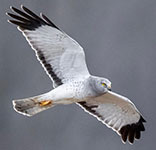 12/4 – Brooklyn, New York City: There had been several male northern harriers hanging around the grasslands of Floyd Bennett Field for the last three days. Yesterday, two harriers patrolled the edges of the Grasslands Restoration and Management Project areas quite amicably and completely independently, as if they'd worked out the division of space some time earlier that day. 12/4 – Brooklyn, New York City: There had been several male northern harriers hanging around the grasslands of Floyd Bennett Field for the last three days. Yesterday, two harriers patrolled the edges of the Grasslands Restoration and Management Project areas quite amicably and completely independently, as if they'd worked out the division of space some time earlier that day.
This morning, I watched another gorgeous male hunting the grasslands directly off the north entrance to the park – a wonderful welcome after a gruesome commute. This male was exceptionally pale, Wedgewood blue, which rendered him nearly invisible against a leaden, icy sky. His lovely dark "fingers" pumped slowly, as if catching the beat of Beck's super-psychedelic song "Elevator Music," which suddenly seemed to be playing just a little too loudly on the car's sound system. It was remarkable how that one tune was at once the perfect antidote for horrible traffic and a perfectly metered soundscape for hunting “gray ghosts.” (Photo of northern harrier courtesy of John Badura)
- Dave Taft
[The male northern harrier, or marsh hawk, pale with black wing tips, is a light-colored raptor that birders often refer to as the “gray ghost.” Tom Lake]
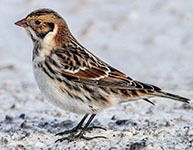 12/5 – Saratoga County, HRM 200: I drove past some of the dairy and horse farms in the Northumberland farmlands this morning in search of field birds. There was snow was on the ground, but there were few if any fresh manure spreads. Nevertheless, I eventually did find, altogether, 20 horned larks. After looking at my photos, I discovered one Lapland longspur mixed in with the larks, but no snow buntings. I also watched as seven black vultures breezed by. (Photo of lapland longspur courtesy of Andrew Simon) 12/5 – Saratoga County, HRM 200: I drove past some of the dairy and horse farms in the Northumberland farmlands this morning in search of field birds. There was snow was on the ground, but there were few if any fresh manure spreads. Nevertheless, I eventually did find, altogether, 20 horned larks. After looking at my photos, I discovered one Lapland longspur mixed in with the larks, but no snow buntings. I also watched as seven black vultures breezed by. (Photo of lapland longspur courtesy of Andrew Simon)
- John Hershey (Hudson-Mohawk Bird Club)
12/5 – Croton Bay, HRM 34: I was taking the 7:15 Metro North commuter train this morning from Croton Harmon to Grand Central when, just south of the Croton River train trestle, I spotted an adult bald eagle snatch a fish from the Hudson River within fifty feet of the train. After grabbing the fish, it headed north. Since the train was heading south, I only had a brief view of the eagle with its catch, thus the catch was unidentifiable before it faded in the distance. It was an excellent beginning to the day!
- Hugh L. McLean
*** Fish of the Week ***
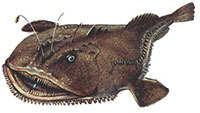 12/5 – Hudson River Watershed: Fish-of-the-Week for Week 50 is the goosefish (Lophius americanus), number 112 (of 230) on our watershed list of fishes. If you would like a copy of our list, e-mail - trlake7@aol.com. 12/5 – Hudson River Watershed: Fish-of-the-Week for Week 50 is the goosefish (Lophius americanus), number 112 (of 230) on our watershed list of fishes. If you would like a copy of our list, e-mail - trlake7@aol.com.
The goosefish, a temperate marine stray, is the only member of its family (Lophiidae) found in our watershed. They have a myriad of other common names that reflect their morphology, such as anglerfish, headfish, monkfish, allmouth, and fishing frog. They are found from the Gulf of Saint Lawrence south to the Carolinas, and from the tideline to nearly 2,200 feet deep. There are two records of note for the goosefish from the Upper Bay of New York Harbor, fishes taken by Ron Ingold in his commercial shad gillnet near the George Washington Bridge (1974 and 1975).
Bigelow and Schroeder (1953) describe the goosefish as “... having a very large and flattened head, wider than it is long, and longer than its body [maximum length four-feet], giving it a tadpole-like appearance. Their enormous mouth [up to 3.5-feet-wide] is directed upward with a projecting lower jaw filled with long, curved, very sharp teeth.” The foremost of three spines on its head has a flap of skin at its tip that dangles, sways, and jigs in the water, not unlike a baited fishing line, serving as a fish attractor (thus, anglerfish).
They are a quite indiscriminate predator, being fond of lobster, crabs, squid, and flounder among many other fishes. Their ability to consume prey is legendary: 21 market-size flounder plus a dogfish; 75 adult Atlantic herring; seven wild ducks. Aquatic birds are also favored including loons, mergansers, double-crested cormorants, and herring gulls. And, on at least one occasion, a sea turtle. (Photo of goosefish courtesy of Herb Sagers)
- Tom Lake
12/6 – Hudson River Watershed: As a service to birders and Christmas Bird Count coordinators, the New York State Ornithological Association maintains an easy-to-use, one-page online calendar of New York State Christmas Bird Counts: http://nybirds.org/ProjCBC.htm
- Carena Pooth (R.T. Waterman Bird Club)
12/6 – Manhattan, HRM 1: It was a relatively warm, overcast afternoon, as I checked our research gear in Hudson River Park at The River Project’s sampling station on the lighthouse tender Lilac moored at Pier 25. While fewer animals were present, they were no less interesting and important. A crab pot held an adult white perch 200 (mm) as well as a juvenile blue crab (17.5 mm). Many familiar invertebrate species were also present, including shore shrimp, mud crabs, isopods, amphipods, and mud dog whelk snails.
- Toland Kister
Winter 2019-2020 Natural History Programs
We All Live in a Watershed Poster Contest
NYSDEC and the New York Water Environment Association are holding a We All Live in a Watershed poster contest. The poster contest is designed to encourage middle-school students to learn about the watersheds where they live and how to conserve and protect these water resources.
Students may use any type of media, including watercolor, pen and ink, crayon, chalk, and markers to create original hand-drawn artwork. We will choose 14 winning posters and compile them for distribution as part of a 2021 calendar.
All middle school students (Grades 6-8) in New York State public and private schools are eligible to enter the poster contest. One student per poster may enter. We must receive all posters by Friday, January 10, 2020. For more details, please visit https://www.dec.ny.gov/education/32108.html.
Hudson River Miles
The Hudson is measured north from Hudson River Mile 0 at the Battery at the southern tip of Manhattan. The George Washington Bridge is at HRM 12, the Tappan Zee 28, Bear Mountain 47, Beacon-Newburgh 62, Mid-Hudson 75, Kingston-Rhinecliff 95, Rip Van Winkle 114, and the Federal Dam at Troy, the head of tidewater, at 153. The tidal section of the Hudson constitutes a bit less than half the total distance – 315 miles – from Lake Tear of the Clouds to the Battery. Entries from points east and west in the watershed reference the corresponding river mile on the mainstem.
To Contribute Your Observations or to Subscribe
The Hudson River Almanac is compiled and edited by Tom Lake and emailed weekly by DEC's Hudson River Estuary Program. Share your observations by e-mailing them to trlake7@aol.com.
To subscribe to the Almanac (or to unsubscribe), use the links on DEC's Hudson River Almanac or DEC Delivers web pages.
Discover New York State Conservationist - the award-winning, advertisement-free magazine focusing on New York State's great outdoors and natural resources. Conservationist features stunning photography, informative articles and around-the-state coverage. Visit the Conservationist webpage for more information.
Useful Links
National Oceanic and Atmospheric Administration online tide and tidal current predictions are invaluable when planning Hudson River field trips.
For real-time information on Hudson River tides, weather and water conditions from sixteen monitoring stations, visit the Hudson River Environmental Conditions Observing System website.
DEC's Smartphone app for iPhone and Android is now available at: New York Fishing, Hunting & Wildlife App.
Adventure NY
Under Governor Cuomo's Adventure NY initiative, DEC is making strategic investments to expand access to healthy, active outdoor recreation, connect more New Yorkers and visitors to nature and the outdoors, protect natural resources, and boost local economies. This initiative will support the completion of more than 75 projects over the next three years, ranging from improvements to youth camps and environmental education centers to new boat launches, duck blinds, and hiking trails. Read more about the Adventure NY initiative. For more information on planning an outdoor adventure in New York State, visit DEC's website at http://www.dec.ny.gov/outdoor.
Information about the Hudson River Estuary Program is available on DEC's website at http://www.dec.ny.gov/lands/4920.html.
|