A Project of the Hudson River Estuary Program
Compiled by Tom Lake, Consulting Naturalist
Overview
This is the season when we hear of bird migrations in the air and fish migrations in the water. This week, however, we learned of a different sort of a migration, an overland search by a young black bear seeking a territory of its own.
Highlight of the Week
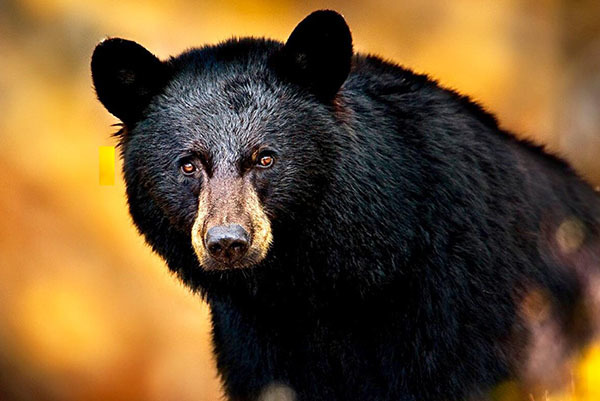
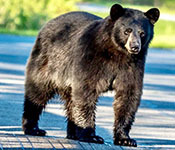 10/15 – Millbrook, HRM 82: Four days ago, Nelson Johnson captured an image of a black bear on his trail camera. The bear had an ear tag, number 311. As a DEC Bear Program Technician, I was able to research the bear’s history.
The black bear was first encountered by DEC on May 7, 2019, when he was stuck up a tree in the middle of Monsey, a community in Rockland County, nine miles west of Nyack. He was considered to be an urban-nuisance bear and needed to be relocated. The bear was captured, ear tagged (number 311), weighed (170 pounds) and then released the same day in Sterling State Forest. Judging by its teeth and their growth, we aged the bear as a yearling. It was quite big for a yearling, but this is not too surprising if they grow up in an urban environment with access to a lot of human food resources.
The bear’s post-tagging journey was quite formidable, traveling at least 60 miles northeast, upriver to Millbrook in Dutchess County in 157 days. However, that is not totally unusual for a young bear that is trying to find a place to establish a home range. But, the bear’s jump across the Hudson River was definitely unique. (Photo of black bear courtesy of Jodie Preuss)
- Emily Carroll
[The DEC released a Guidance to Homeowners on how to avoid problems with black bears.
http://www.dec.ny.gov/press/113258.html]
Natural History Entries
10/12 – Minerva, HRM 284: This weekend was peak fall color, no question, and was just beautiful. At a bit higher elevation in the Adirondacks. however, it was past peak. No hint of snow as yet in the High Peaks.
- Mike Corey
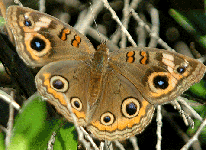 10/12 – Beacon, HRM 61: I was at the Pete and Toshi Park in Beacon watching the amazing number of bees and butterflies visiting a large white fleabane bush growing by the river. In addition to some monarchs and a couple of red admirals butterflies, I saw one with lovely circles or “eyespots” that I had never seen before. After a little research, I discovered that it was a common buckeye (Junonia coenia), a butterfly that is much more common in the South. I was very happy this one had crossed my path. (Photo of common buckeye courtesy of Susan Leach Snyder)
- Patricia Henighan
10/12 – Newburgh, HRM 61: Since the beginning of September, the eagle pair from bald eagle nest NY488/488A have visited their tree often, occasionally together but most often individually. On three different occasions, however, when they were there together, one (the female?) was standing in the nest, bending over and seem to be working on the nest cup (early winter maintenance) while the other, perched nearby, sometimes vocalized.
A few days ago, one adult came flying in, and, while I watched its approach, a number of small leaves and twigs fell from its talons just before it landed in the nest. It's good to see them back again and hopefully these are early preparations for another successful nesting season ahead. This nest produced and fledged two young each of the last two years.
- Peter Turrone
10/12 – Beacon, HRM 61: While carp fishing today at Long Dock, I watched as another angler caught and released a smallmouth bass (14-inches). It was a hard-fighting fish, particularly on the ultra-light fishing tackle the angler was using. The bass jumped clear of the water at times, shaking its head and trying to throw the lure. I helped him by netting the fish when it finally calmed down. It was promptly returned to the water. During my own fishing session, I caught, measured, and released three channel catfish and two carp. My fish were all small – the largest channel catfish measured 19-inches, the largest carp was 16-inches.
- Bill Greene
10/12 – Kowawese, HRM 59: We just finished compiling our data from yesterday’s amazing program. As a part of our Hudson River Sloop Clearwater’s Climate Change Curriculum, we invited ninth-graders from Newburgh Free Academy to help us seine the river and discuss how climate change might affect the fish populations. Our catch gave us ample talking points, including young-of-year striped bass (22) and American shad (3), spottail shiners (11), Atlantic silverside (2), and banded killifish (2).The three 60 millimeter (mm) American shad were the most notable as these fish should be here by the score this time of the year, but instead have been nearly invisible.
- Eli Schloss
[Note: one inch = 25.4 millimeters (mm)]
10/12 – Little Stony Point, HRM 55: Today was the aftermath of yesterday’s storm surge from sub-tropical Storm Melissa. The beach had experienced much erosion and areas of the near-shore shallows had doubled their depth as the sand had been carried off. The storm surge had brought with it more brackish water upriver: Salinity had risen from 2.5 to 4.0 parts-per-thousand (ppt), the water had warmed, 65 to 67 degrees Fahrenheit (F), and hundreds of comb jellies, both Beroe’s and Leidy’s, our first of the season. We also saw another wide range of young-of-year striped bass (56 -116 mm).
- Tom Lake, A. Danforth
[Comb jellies (Ctenophora) are often mistaken for jellyfish but differ in that they have no tentacles and do not sting. Like true jellyfish, comb jellies are translucent, gelatinous, fragile, essentially planktonic, drifting at the whim of the wind and current. They are peanut-to-walnut-size, often occur in swarms, and are common in warm, brackish estuarine shallows. For a real treat, gently scoop a few with a wet, cupped hand, place them into a small clear container, and gently rock the water. Their rhythmic, symmetrical, and altogether graceful movements are enchanting. Two species, Beroe's comb jelly (Beroe cucumis) and Leidy’s comb jelly (Mnemiopsis leidyi), are found in the estuary. Tom Lake]
10/12 – Bedford, HRM 35: There was modest movement today at the Bedford Audubon Chestnut Ridge Hawkwatch with sharp-shinned hawks (15) and Cooper’s hawks (11) leading the raptor numbers. Turkey vultures (38) were by far the high count for all migrants. Non-raptor observations included six monarch butterflies.
- Richard Aracil, Karen Troche, Pedro Troche
10/12 – Hook Mountain, HRM 31: The day’s first raptor at the Hook Mountain Hawkwatch was a sharp-shinned hawk at 8:43 AM. Two Cooper’s hawks initially seemed like they were migrating but then flew north and east respectively. Sharp-shinned hawks counted for 31 of the 44 migrating raptors. Non-raptor observations included 65 Canada Geese, and two common ravens.
- Ajit I. Antony, Liza Antony, Mary Iorizzo
10/12 – Piermont, HRM 25: Yesterday’s storm surge from sub-tropical Storm Melissa had flooded the Piermont Pier. When I arrived this morning at high tide, the river was crashing over the pilings and across the pier. Salinity measured 9.0 ppt, quite high for Piermont, and we had our first comb jellies of the season, perhaps carried here by the storm surge.
- Margie Turrin
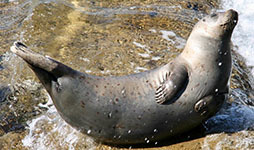 10/13 – Saugerties, HRM 113: Patrick Landewe, Saugerties Lighthouse Keeper, reported a seal near the mouth of Esopus Creek today. Guests at the lighthouse saw the seal at sunrise and then again near sunset. Patrick suspects that this might be the same seal, a harbor seal (Phoca vitulina), spotted here on August 21 and again on September 1. (Photo of harbor seal courtesy of Fran Ursitti)
[For a seal, the Hudson River is like a 24-hour-a-day buffet. Harbor seals are one of four seal species found in the estuary, the others being hooded seal, gray seal, and harp seal. While seals at a distance all look superficially the same, harbor seals are by far the most common seal found in the river at any time of the year. Tom Lake]
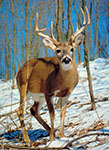 10/13 – Hudson River Valley: This was the night of the full moon, the Hunter’s Moon, the first full moon following the Harvest Moon (September 13). Indigenous hunters, our ancestral Hudson Valley residents, traditionally used the full moon of October to stalk white-tailed deer at night both for their own winter provisions and to take advantage of deer fattening up for the deep snows to come. With the leaves in the forest having fallen, the deer were likely far easier to find. It is not only a guess that Hudson Valley native people preferred white-tailed deer. Across twenty years of excavating Hudson Valley prehistoric archaeological sites, white-tailed deer bones have been by far the most common organic refuse found in hearths and middens. (Photo of white-tailed deer courtesy of Roy Saplin)
- Tom Lake
10/13 – Bedford, HRM 35: It was a good day at the Bedford Audubon Chestnut Ridge Hawkwatch for sharp-shinned hawks (30) and Cooper’s hawks (24). Red-shouldered hawks (4) also made a good showing. Non-raptor observations included eight monarch butterflies.
- Richard Aracil, Jason Tellone, Karen Troche, Megan Owens, Pedro Troche, Tony Wilkinson
10/13 – Hook Mountain, HRM 31: The first migrating raptor at the Hook Mountain Hawkwatch today was a sharp-shinned hawk that stooped [dived] on a raven. The hawk was high enough to be at the limit of binocular resolution. Thirty of the 39 migrating raptors were sharp-shinned hawks. Non-raptor observations included an immature red-headed woodpecker flying past, two common ravens, and 125 Canada geese.
- Ajit I. Antony, Liza Antony
10/14 – Bedford, HRM 35: There was very light movement today at the Bedford Audubon Chestnut Ridge Hawkwatch, just a trickle of migrating raptors (21). Turkey vultures led the overall count with 15 birds. I had my first black vulture that I could confidently call migrating. Non-raptor observations included eight monarch butterflies.
- Richard Aracil
10/14 – Yonkers, HRM 18: The education staff at the Sarah Lawrence Center for the Urban River at Beczak conducted a practice seine today to investigate the effects of the recent storm surge and high tide mix on the river. This morning’s residual tide was still quite high, and it appeared that the storm surge had been enough to dislodge one of the wooden planks from our marsh dock. Our marsh was also littered with lots of driftwood including a shipping pallet. Our salinity jumped from 13 ppt four days ago to a peak of 16 ppt yesterday. The river’s fauna seemed intact as our net caught Atlantic Silverside, comb jellies, and moon jellyfish.
- Jason Muller, Evelyn Huntington and Ryland Cullen
10/15 – Esopus Meadows, HRM 87: It was a rising tide for Clearwater's Tideline program at Esopus Meadows which usually means good fishing (seining). With Highland first-graders in attendance, it was the chaperones who were in the waders. Several willing grown-ups helped us catch 26 fish of seven species: bluegills, young-of-year striped bass, white perch, spottail shiners, young-of-year largemouth bass, brown bullhead, and goldfish. The fish were "scooped and covered" by the students into the bucket to be identified. All fish were healthy and released at the end of the program.
- Eli Schloss
10/15 – Bedford, HRM 35: It was very slow today at the Bedford Audubon Chestnut Ridge Hawkwatch with only 19 raptors and ten turkey vultures counted. Non-raptor observations included ten monarch butterflies.
- Richard Aracil, Megan Owens, Pedro Troche
10/15 – Hook Mountain, HRM 31: It was an exceptionally quiet day at the Hook Mountain Hawkwatch. It was clear, with small scattered clouds along the horizon and a weak north breeze, but the conditions did not produce migrants. On arrival at the summit, I glimpsed a winter wren close by in low tangle. When I “pished” [called] the tiny bird into the open, a pair of scolding house wrens materialized as well. I was joined in late morning by sharp-eyed Tom Fuller and his young daughter, Phoebe, who called in our first sharp-shinned hawk. Most sightings were of distant birds, but one sharp-shinned hawk came past high over the summit. Non-raptor observations included two monarch butterflies.
- John Phillips
10/15 – Manhattan, HRM 1: We checked our research sampling gear today in Hudson River Park at The River Project's sampling station on the lighthouse tender Lilac at Pier 25. While the usual blue crabs were in the pots and traps, the fish caught our attention right away. The most impressive was a robust tautog (225 mm). Young-of-year included an oyster toadfish (25 mm), and a lovely black sea bass (70 mm).
- Siddhartha Hayes, Chelsea Quaies, Ashlee Zhang
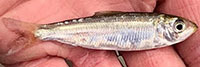 10/16 – Norrie Point, HRM 85: Students from Poughkeepsie High School visited the Norrie Point Environmental Education Center today to go seining. Among the nine species of fish we caught, the most noteworthy were three blueback herring, a species (Alosa aestivalis), and at an age (young-of-year) that has been conspicuous by their absence this summer and fall. (Photo of blueback herring courtesy of Chris Bowser)
- Jim Herrington and Maija Niemisto
10/16 – Kowawese, HRM 59: As the tide turned to flood in mid-morning, a strong south wind, edging toward the southeast, was blowing up the river through the Hudson Highlands – a serious nor’easter was coming. The clouds over Storm King Mountain were thickening, the wind as rising, the river was rising, and Professor Ted Fink’s Environmental Explorations of the Hudson students from Marist College seined with some urgency. The students waded through chest-high rollers hauling the jacks with the wind but against the current, an arduous task. Our seine caught young-of-year striped bass (64-76 mm) and, in a reminder of summer, Atlantic silverside (84-93 mm). The river was 63 degrees F, and the salinity was 2.0 ppt.
- Tom Lake, Ted Fink
10/16 – Bedford, HRM 35: The day was overcast with strong southeast winds at the Bedford Audubon Chestnut Ridge Hawkwatch. The count was rained out at 2:00 PM. Of the 20 migrating raptors, sharp-shinned hawks were high count with nine. Non-raptor observations included 128 American robins.
- Richard Aracil, Megan Owens
10/16 – Yonkers, HRM 18: The education staff at the Sarah Lawrence Center for the Urban River at Beczak welcomed fifth-grade students from the Eugenio Maria de Hostos Microsociety School in Yonkers. The students were excited to go seining, and our net produced many wonders for them, including three-dozen Atlantic silverside, an amazing 80 moon jellyfish, and 59 comb jellies.
- Katie Lamboy, Jason Muller
*** Fish of the Week ***
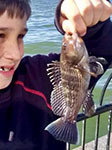 10/17 – Hudson River Watershed: Fish-of-the-Week for Week 44 is the black sea bass (Centropristis striata), number 144 (of 230) on our watershed list of fishes. If you would like a copy of our list, e-mail - trlake7@aol.com.
Black sea bass are a gaudy, dark, thinly-striped salt water fish that range from Cape Cod to Florida where they tend to frequent inshore waters with rocky bottoms. They can reach 16-inches but most that we see in the watershed are a foot or less. Back sea bass are protogynous hermaphrodites, in that they begin life as females. Once they reach maturity (8-10 inches), they spawn, and then many if not most become males. This is theorized as a possible survival adaption to ensure an adequate supply of males for spawning. (Photo of black sea bass courtesy of Tom Lake)
- Tom Lake
10/17 – Bedford, HRM 35: Today’s migration was fairly slow at the Bedford Audubon Chestnut Ridge Hawkwatch. We counted only nine raptors with sharp-shinned hawks high count with four. The major focus in migration was with vultures, including turkey vultures (68) and black vultures (8). Non-raptor observations included eleven monarch butterflies.
- Richard Aracil
10/17 – Manhattan, HRM 1: We checked our research sampling gear in Hudson River Park at The River Project's sampling station on the lighthouse tender Lilac at Pier 25 and found two large, seasonally resident, fishes: a black sea bass (200 mm) and a tautog (245 mm). As the river continues to cool down, these and other fishes will become less common.
- Toland Kister, Melissa Rex, Ashlee Zhang, Chelsea Quaies
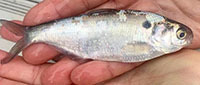 10/18 – Schodack Island State Park, HRM 135: Second-grade students on a seining field trip from Albany’s Thomas O’Brien Academy of Science and Technology brought good luck with them as our net filled with fishes. Across three hauls in the dropping tide at the park’s boat launch, our seine captured 262 fish. We found river herring, white perch, bluegill sunfish, striped bass, and a lovely young-of-year gizzard shad (140 mm). (Photo of gizzard shad courtesy of Fran Martino)
- Fran Martino
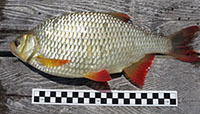 10/18 – Beacon, HRM 61: In what had to be the best rod and reel fishing day of the season, I caught, measured, and released five species of fish: common carp (5), channel catfish, rudd, golden shiner, and brown bullhead. The largest carp measured 29-inches and weighed an estimated 13-pounds. The lone rudd – robust body, small mouth, deep gold color, and bright red tail and fins – was more than a foot-long. (Photo of rudd courtesy of Tom Lake)
- Bill Greene
[Rudd (Scardinius erythrophthalmus) are a large, introduced European minnow that has been in the Hudson watershed since the 1920s and seems to be getting more common in the estuary. It is a stubby, deep-bodied fish, with really bright red fins including the tail. Bob Schmidt]
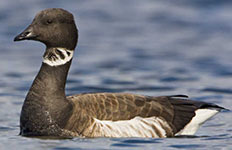 10/18 – Bedford, HRM 35: There was good movement of Accipiters today at the Bedford Audubon Chestnut Ridge Hawkwatch. Sharp-shinned hawks were high count with 28. Turkey vultures led all migrants with 46 birds. Non-raptor observations included one monarch butterfly, and 719 brant, 43 of which appeared to be migrating. (Photo of brant courtesy of Doug Wechsler)
- Richard Aracil, Jack Kozuchowski, Megan Owens, Pedro Troche
[Brant, a small species of goose, are seen in our area almost entirely during spring and fall migration. They winter in Mid-Atlantic coastal areas, including Sandy Hook, NJ. They breed in the Canadian Arctic where they fledge young and then return through the Hudson Valley in the fall. Legendary ecologist Dery Bennett used to mark the seasons by noting how brant return to Sandy Hook (NJ) each autumn around Columbus Day to spend the winter. They then leave Sandy Hook in late May of the following year, “shoving off for the Canadian Arctic where they breed and fledge young.” Tom Lake]
10/18 – Croton Bay, HRM 34: I was on Metro North this morning heading to Manhattan. As we sped by Croton Bay, where it was low tide, I counted five bald eagles, mixed adults and immatures, crowded on a single snag.
- Jimmy Miller
[“Snag” usually describes a fallen tree or a large branch in the water that has become “snagged,” in this instance, on the bottom of the bay. Tom Lake]
10/18 – Hook Mountain, HRM 31: It was a very slow day at the Hook Mountain Hawkwatch with only ten raptors counted. Sharp-shinned hawks and red-tailed hawks had four birds each. The latter appeared to quarter into the wind toward the northwest, gain altitude, and then head due west. We also had an immature northern harrier that flew very low past the summit. Non-raptor observations included a red-headed woodpecker that flew directly over the summit, and common ravens, seen several times throughout the day.
- Trudy Battaly, Drew Panko
Autumn 2019 Natural History Programs
Wednesday, December 4
DEC Now Accepting Applications for Urban Forestry Projects
DEC Now Accepting Applications for Urban Forestry Projects
- Up to $1.2 million in grant funding is available for urban forestry projects across New York State. Grants are available for tree planting, maintenance, tree inventory, community forest management plans and for educating those who care for public trees. https://www.dec.ny.gov/lands/5285.html
Eligible applicants include municipalities, public benefit corporations, public authorities, soil and water conservation districts, community colleges, not-for-profit organizations and Indian nations or tribes. Awards will range from $11,000 to $75,000, depending on municipal population. Tree inventories and community forest management plans require no match. Tree planting, maintenance and education projects have a 25 percent match requirement.
Interested applicants must apply for the grant in Grants Gateway. Not-for-profit applicants are required to pre-qualify in the Grants Gateway system, so DEC recommends that applicants start the process well in advance of the grant application due date. DEC will not accept paper or hand delivered grant applications. The deadline for applications in Grants Gateway is December 4, 2019 at 2 p.m.
DEC’s Urban and Community Forestry Program will host a webinar on October 10 at 9:30 a.m. to educate potential applicants on the grants process and answer questions. Application instructions and information about the October 10 webinar are available on the Grants Gateway website.
Hudson River Miles
The Hudson is measured north from Hudson River Mile 0 at the Battery at the southern tip of Manhattan. The George Washington Bridge is at HRM 12, the Tappan Zee 28, Bear Mountain 47, Beacon-Newburgh 62, Mid-Hudson 75, Kingston-Rhinecliff 95, Rip Van Winkle 114, and the Federal Dam at Troy, the head of tidewater, at 153. The tidal section of the Hudson constitutes a bit less than half the total distance – 315 miles – from Lake Tear of the Clouds to the Battery. Entries from points east and west in the watershed reference the corresponding river mile on the mainstem.
To Contribute Your Observations or to Subscribe
The Hudson River Almanac is compiled and edited by Tom Lake and emailed weekly by DEC's Hudson River Estuary Program. Share your observations by e-mailing them to trlake7@aol.com.
To subscribe to the Almanac (or to unsubscribe), use the links on DEC's Hudson River Almanac or DEC Delivers web pages.
Discover New York State Conservationist - the award-winning, advertisement-free magazine focusing on New York State's great outdoors and natural resources. Conservationist features stunning photography, informative articles and around-the-state coverage. Visit the Conservationist webpage for more information.
Useful Links
National Oceanic and Atmospheric Administration online tide and tidal current predictions are invaluable when planning Hudson River field trips.
For real-time information on Hudson River tides, weather and water conditions from sixteen monitoring stations, visit the Hudson River Environmental Conditions Observing System website.
DEC's Smartphone app for iPhone and Android is now available at: New York Fishing, Hunting & Wildlife App.
Adventure NY
Under Governor Cuomo's Adventure NY initiative, DEC is making strategic investments to expand access to healthy, active outdoor recreation, connect more New Yorkers and visitors to nature and the outdoors, protect natural resources, and boost local economies. This initiative will support the completion of more than 75 projects over the next three years, ranging from improvements to youth camps and environmental education centers to new boat launches, duck blinds, and hiking trails. Read more about the Adventure NY initiative. For more information on planning an outdoor adventure in New York State, visit DEC's website at http://www.dec.ny.gov/outdoor.
Information about the Hudson River Estuary Program is available on DEC's website at http://www.dec.ny.gov/lands/4920.html.
|