A Project of the Hudson River Estuary Program
Compiled by Tom Lake, Consulting Naturalist
Overview
True to the season, our Hawkwatches documented impressive numbers of raptors, hummingbirds, and monarch butterflies. A rarely seen kingbird wandered here from points west. In the river, moon jellyfish and a plethora of blue crabs held the attention of hundreds of students.
Highlight of the Week
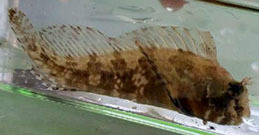 9/21 – Queens, New York City: When we hauled up one of our oyster cages from the East River today at Pier 4 in Gantry Plaza State Park, we found we had captured a 53-millimeter (mm) feather blenny. (Photo of feather blenny courtesy of Michael Chen) 9/21 – Queens, New York City: When we hauled up one of our oyster cages from the East River today at Pier 4 in Gantry Plaza State Park, we found we had captured a 53-millimeter (mm) feather blenny. (Photo of feather blenny courtesy of Michael Chen)
- Devin Gorsen
[The feather blenny (Hypsoblennius hentz) is a small, scaleless fish with fleshy cirri (“feathers”) on their head. Their lower jaw has a row of small, close-set teeth like those of a comb, thus their family name, combtooth blennies (Blenniidae). Blennies are benthic dwellers where they often burrow in the soft bottom or find refuge in old mollusk shells. They were added to our watershed fish list in August 1994 from a feather blenny caught at The River Project (Pier 41) in Manhattan. Tom Lake]
[Note: one inch = 25.4 millimeters (mm)]
Natural History Entries
9/21 – Newcomb, HRM 302: The weather was very summer-like this week, dry and in the 70’s Fahrenheit (F) during the day. The fall foliage colors had begun but were not near peak as yet.
- Dave Olbert
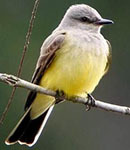 9/21 – Albany County, HRM 143: Walking west this evening on Hennessy Road through the Black Creek Marsh Wildlife Management Area, I came upon a western kingbird flycatching from the tops of dead trees. (Photo of western kingbird courtesy of Gerrit Vyn) 9/21 – Albany County, HRM 143: Walking west this evening on Hennessy Road through the Black Creek Marsh Wildlife Management Area, I came upon a western kingbird flycatching from the tops of dead trees. (Photo of western kingbird courtesy of Gerrit Vyn)
- Frank Mitchell
[This occurrence comes almost exactly two years after I spotted a western kingbird off Meadowdale Road just about a mile from Frank’s sighting. - Larry Alden]
[We used to call these “Arkansas Kingbirds” back in the day - shortened to "Arkies." A western kingbird or two is expected along our barrier beaches from Nova Scotia to the Carolinas and south each fall. Vagrants drift easterly until they reach the ocean and have to turn back to the nearest land - the barrier beaches. This happens to tens of thousands of birds, not just wandering westerners, and is why preserving a healthy vegetative cover along the shore is important for these birds to find food and shelter. As they pass through our area, the westerners (like this one) may turn up almost anywhere. Rich Guthrie]
9/21 – Stockport Flats to Catskill, HRM 121-112: In the last few weeks, NYSDEC Region 4 Fisheries has teamed up with the lower Great Lakes U.S. Fish & Wildlife Service office to sample the Hudson River fish community. Our goal was to collect data in front of anticipated new invasive species en route to the river (e.g., the round goby). Using our electro-shocker vessel, we captured 29 fish species, including Atlantic needlefish.
- Scott Wells
[Electro-fishing (or shocking) gear uses high voltage pulsed DC (direct current) passing from a cathode to an anode which temporarily stuns fish for capture. Fish experience galvanotaxis which causes the fish to involuntarily swim towards the electrical field. The size of fish being targeted determines the amount of voltage and amperage applied to the water. Smaller fish tend to be more difficult to stun than larger fish due to the fact that the smaller fish have less surface area that can be affected by the electrical field. Generally, fish are released unharmed. Wes Eakin (DEC)]
[The literature has described Atlantic needlefish (Strongylura marina) as a marine species that occasionally enters brackish water. J.R. Greeley’s A Biological Survey of the Lower Hudson Watershed (1937) lists Atlantic needlefish as "rare" in the lower estuary. By the 1980s, they were quite common 60 miles upriver. By the 1990s, we began to find them at Kingston (river mile 92). By the 2000's, we were catching larval needlefish even farther upriver. Were these adaptations to a changing climate or had the literature been too conservative? They are presently listed as a permanent/seasonally resident marine species. Tom Lake]
9/21 – Beacon, HRM 61: I managed to catch, measure, and release two channel catfish (12-15-inches) today at Long Dock. It was a very slow four-hour fishing session. I did not see a single carp jump or do a surface-roll. Hopefully, better autumn fishing days are ahead.
- Bill Greene
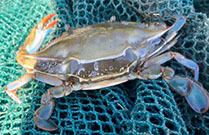 9/21 – Kowawese, HRM 59: Seventeen of us were gathered on the beach for our contribution to the 20th annual Hudson River Valley Ramble. The water was a delightfully warm 72 degrees F. When added to the chattering cicadas, the stillness of the river, a warm breeze, and the blue sky, it became the perfect summer tide. Monarch butterflies, six-a-minute, passed us heading south. Across the river, helicopters were dropping water balloons on a wildfire burning on Sugar Loaf. Our seine haul seemed secondary to the setting. Among the fishes we caught were young-of-year striped bass (71-81 mm), white perch, tessellated darters, and many Atlantic silverside. Our most impressive catch was blue crabs, easily more than 100, from penny-size to full-blown adults into their last moult – we had one softshell crab. Yet another blue crab was in the process of moulting – we quickly put it back. The salinity was 3.5 parts-per-thousand (ppt.). (Photo of blue crab courtesy of Amanda Higgs) 9/21 – Kowawese, HRM 59: Seventeen of us were gathered on the beach for our contribution to the 20th annual Hudson River Valley Ramble. The water was a delightfully warm 72 degrees F. When added to the chattering cicadas, the stillness of the river, a warm breeze, and the blue sky, it became the perfect summer tide. Monarch butterflies, six-a-minute, passed us heading south. Across the river, helicopters were dropping water balloons on a wildfire burning on Sugar Loaf. Our seine haul seemed secondary to the setting. Among the fishes we caught were young-of-year striped bass (71-81 mm), white perch, tessellated darters, and many Atlantic silverside. Our most impressive catch was blue crabs, easily more than 100, from penny-size to full-blown adults into their last moult – we had one softshell crab. Yet another blue crab was in the process of moulting – we quickly put it back. The salinity was 3.5 parts-per-thousand (ppt.). (Photo of blue crab courtesy of Amanda Higgs)
- Tom Lake, Bob Anderson, Marley Anderson, Oliver Higgs
[Blue crabs, as crustaceans, have an exoskeleton that they must shed periodically in order to grow. A shed exoskeleton, or moult, is an exact replica of the crab except that when you open the carapace, you find it is empty. The new crab is now a softshell, noticeably larger, waiting for its new shell to harden, a process that can take up to twenty-four-hours depending on water temperature. Blue crabs have several colloquial names known mainly to crabbers: Adult males are called “Jimmies,” mature females are called “Sooks,” and immature females are known as “Sallys.” Tom Lake]
9/21 – Bedford, HRM 35: There was some good broad-winged hawk movement with small kettles coming in from the northeast this morning at the Bedford Audubon Chestnut Ridge Hawkwatch. However, by midday they were gone. Overall, broad-winged hawks were high count today (135 birds, 54% of the day’s total). Non-raptor observations included good movement of monarch butterflies (70). Toward the end of the day, green darners dragonflies were very abundant.
- Richard Aracil, Bob Julia, Jack Kozuchowski, Kevin Rowling, Mary Helen Lewis, Megan Owens, Russ Kline, Steve Tulchin, Tony Wilkinson
9/21 – Hook Mountain, HRM 31: Three of the four migrating bald eagles at the Hook Mountain Hawkwatch today were adults. Sharp-shinned hawks accounted for 28 of the 63 migrating raptors. Non-raptor observations included seven monarch butterflies.
- Trudy Battaly, Drew Panko, Carl Howard
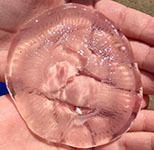 9/21 – Yonkers, HRM 18: High school volunteers Danielly Zurita, Kriss Xolocotzi, Taylor Jackson, and Camaron Green joined the Sarah Lawrence Center for the Urban River at Beczak staff and a dozen participants for the last River Explorers Program of the year. Moon jellyfish had become a reliable catch, and we caught 136 of them today along with several similarly near-transparent comb jellies. Atlantic silverside was high count among the fishes. (Photo of moon jellyfish courtesy of TR Jackson) 9/21 – Yonkers, HRM 18: High school volunteers Danielly Zurita, Kriss Xolocotzi, Taylor Jackson, and Camaron Green joined the Sarah Lawrence Center for the Urban River at Beczak staff and a dozen participants for the last River Explorers Program of the year. Moon jellyfish had become a reliable catch, and we caught 136 of them today along with several similarly near-transparent comb jellies. Atlantic silverside was high count among the fishes. (Photo of moon jellyfish courtesy of TR Jackson)
- Katie Lamboy
[Young medusae (umbrella-shaped) moon jellyfish (Aurelia aurita) appear in the lower estuary in late summer and early fall. They are true jellyfish, plankton feeders, with several hundred fringed tentacles that serve as sticky collectors of both phytoplankton and zooplankton. Adult moon jellyfish, with a pinkish umbrella up to ten-inches-across, are most commonly associated with ocean beaches. They are frequently stranded at the high-tide line and, while non-stinging, have startled many a beach walker who happened to step on one. Tom Lake]
9/21 – Manhattan, HRM 0: Battery Park City Parks hosted a public catch-and-release “Go Fish” program this morning in Wagner Park in Battery Park City. Using bloodworms and sandworms, the catch of an estimated 800 anglers reflected the complex makeup of the fishes of the Upper Bay of New York Harbor. Most were residents, either permanent or seasonal, such as black sea bass, oyster toadfish, cunner, tautog, scup, and striped sea robins. High hook among the fishes was black sea bass (60). The river temperature was 71 degrees F.
- Doug Van Horn
 9/21 – Brooklyn, New York City: Twenty-five of us were netting at Plumb Beach near Canarsie Pier with our 30-foot-long seine for a marine ecology lesson. On one haul we caught a (100 mm) lookdown (Selene vomer), an uncommon tropical-looking jack classified as a temperate marine stray in the watershed. (Photo of lookdown courtesy of Matt Malina) 9/21 – Brooklyn, New York City: Twenty-five of us were netting at Plumb Beach near Canarsie Pier with our 30-foot-long seine for a marine ecology lesson. On one haul we caught a (100 mm) lookdown (Selene vomer), an uncommon tropical-looking jack classified as a temperate marine stray in the watershed. (Photo of lookdown courtesy of Matt Malina)
- Matt Malina
9/22 – Hyde Park, HRM 82: This was the twentieth anniversary of the serendipitous discovery (while deepening a backyard pond) of the Hyde Park mastodon. The extinct “elephant” was radiocarbon dated to nearly 12,000 years ago. For those of us who participated, the excavation was not unlike entering a time machine.
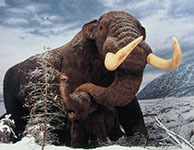 Mastodons roamed the Hudson Valley in the Late Pleistocene during the time when the first of us arrived here. This was also the time when the Hudson River was becoming an estuary. The American mastodon (Mammut americanum) was part of a faunal community, many of which are now extinct, that included American elk, ground sloth, woodland caribou, giant beaver, horse, flat-headed peccary, and stag-moose. An exact replica cast of the Hyde Park mastodon is on permanent display at the Mid-Hudson Children’s Museum in Poughkeepsie. Mastodons roamed the Hudson Valley in the Late Pleistocene during the time when the first of us arrived here. This was also the time when the Hudson River was becoming an estuary. The American mastodon (Mammut americanum) was part of a faunal community, many of which are now extinct, that included American elk, ground sloth, woodland caribou, giant beaver, horse, flat-headed peccary, and stag-moose. An exact replica cast of the Hyde Park mastodon is on permanent display at the Mid-Hudson Children’s Museum in Poughkeepsie.
Another of the Late Pleistocene elephants that roamed New York State at that time, particularly coastal grasslands, was the woolly mammoth (Mammuthus primigenius). Both of these proboscideans, each ten-feet-high at the withers, skulls the size of refrigerators, and weighing 10,000 pounds, became extinct in our area, likely from failing to adapt to climate change, about 10,900 years ago. (Photo of mastodon courtesy of New York State Museum)
- Tom Lake
[To be, or not to be ...
Extant means populations that are still found in a specific area, such as black bears and bobcats.
Extirpated means a species that is no longer found in a specific area but does exist elsewhere, for example the gray wolf and mountain lions. Extinct means they no longer exist, gone forever, like the American mastodon, woolly mammoth, and the passenger pigeon. Tom Lake]
9/22 – Kowawese, HRM 59: Forty students from my Queens College General Ecology class joined with me to set our 30-foot seine in the upriver shadow of Storm King Mountain. Owing to the tepid salinity in the river (roughly 10% seawater) our catch of 75 bay anchovies was not surprising. Among the other fish we caught were young-of-year striped bass and white sucker, white perch, and spottail shiners.
- John Waldman
9/22 – Bedford, HRM 35: It was a strange flight today at the Bedford Audubon Chestnut Ridge Hawkwatch with only one broad-winged hawk. Sharp-shinned hawks were high count with 57. American kestrel made a good showing as well with 17. Non-raptor observations included 72 monarch butterflies and three ruby-throated hummingbirds.
- Tait Johansson, Karen Troche, Megan Owens, Pedro Troche, Tony Loomis
9/22 – Hook Mountain, HRM 31: All of the birds at the Hook Mountain Hawkwatch today (eleven migrating raptors) came from the Tappan Zee side of the mountain. Sharp-shined hawks were high count with seven. Twelve black vultures hung around much of the day. Non-raptor observations included nine monarch butterflies and eleven chimney swifts.
- Felicia Napier
9/23 – Bedford, HRM 35: We saw a very light migration today at the Bedford Audubon Chestnut Ridge Hawkwatch. There was a small flight of sharp-shinned hawks (14 birds) passing throughout the day, while American kestrel and merlin were also noticeably on the move (nine each). We also had three northern harriers, one of which was my first “gray ghost” of the season. Non-raptor observations included 29 monarch butterflies and two ruby-throated hummingbirds.
- Richard Aracil, Matt Altz, Megan Owens
[The male northern harrier, or marsh hawk, pale with black wing tips, is a light-colored raptor that birders often refer to as the “gray ghost.” Tom Lake]
9/23 – Hook Mountain, HRM 31: Very few raptors were migrating today at the Hook Mountain Hawkwatch. High count among the 20 raptors was seven sharp-shinned hawks. We also had a male northern harrier, or a “gray ghost.”
- Tim Brew, Steve Miller
9/23 – Yonkers, HRM 18: Third-graders from Riverdale Country School visited the Sarah Lawrence Center for the Urban River at Beczak on the Autumnal Equinox. They joined our staff to seine the river to see what was home today. The most eye-catching part of our catch for the eight-year-olds was the dazzling and plentiful Atlantic Silverside (212). Complementing the fishes were blue crabs, moon jellyfish, and comb jellies.
- Jason Muller, Katie Lamboy
9/24 – Bedford, HRM 35: Due to prime weather conditions at the Bedford Audubon Chestnut Ridge Hawkwatch today, we were expecting more birds, but only saw a modest movement (149 raptors). Sharp-shinned hawks were high count with 69. We had a kettle of 22 broad-winged hawks spiraling upwards until they disappeared in the clouds. Non-raptor observations included 64 monarch butterflies and three ruby-throated hummingbirds.
- Richard Aracil, Dave Med, Jack Kozuchowski, Marianne Loomis, Matt Altz, Megan Owens, Tony Loomis
9/24 – Hook Mountain, HRM 31: We recorded 58 migrating raptors today at the Hook Mountain Hawkwatch. Sharp-shinned hawks were high count with 37. Non-raptor observations included 16 monarch butterflies.
- Andy Gershon, Carl Howard, Christian Degenhardt, Marty Wyenn, David Anderson, Wil Scheck, Judy Myerson, Ronald Wyenn
9/24 – Yonkers, HRM 18: Another third-grade class from Riverdale Country School visited the Sarah Lawrence Center for the Urban River at Beczac today. Seining with our staff at low tide, we had a bounty of moon jellyfish (322). Among the fishes were American eel, bay anchovies, mummichogs, northern pipefish, young-of-year striped bass, a naked goby, and a lovely 10-inch summer flounder that brought smiles to the students’ faces. Blue crabs (33) were scurrying all over the net, comb jellies were trying to hide, and shore shrimp were jumping like popcorn.
- Jason Muller, Katie Lamboy, Evelyn Huntington, Ryland Cullen
9/24 – Manhattan, New York City: This was pollinator-monitoring day for the Randall's Island Park Alliance staff educators. Many of the flowers had died back, leaving us with mostly goldenrod, asters, chicory, and mugwort blooms. We noted a sharp decline in the number of blue-winged scoliid wasps that used to cover our sunken, meadow site. Instead, we saw five pairs of mating lady beetles, a mantis, a couple of jumping spiders, some bees of various species, and many different species of flies.
- Jackie Wu
9/25 – Minerva, HRM 284: I took a little walk out to the back forty just to see what was out and about. There was not much in the way of birds or insects, but things were fruiting and flowering. The most spectacular was the winterberry holly, having a great season of bright red berries. Beautiful northern arrowwood was also fruiting and remnants of boneset, tall white aster, and New England aster were flowering. Fall had arrived.
- Mike Corey
[“Back forty” is a colloquial expression meant to convey wild or rough terrain adjacent to a developed area. In the instance of a farm, for example, it might be a small percentage of the land left uncultivated or natural, frequently in the “back forty acres” of the property. Tom Lake]
 9/25 – Beacon, HRM 61: It had been a very dry month. The chattering cicadas reminded us of that. We had only 0.13 inches of rain over the last 35 days (drought numbers). The ocean ought to be marching up the river, but it did not seem to be in a hurry – the salinity was holding steady at 3.0 ppt. Our seine filled with young-of-year striped bass (59-68 mm) but the show was the blue crabs. One palm-size crab had only nine functioning “legs.” A swim fin was missing, and in its place was a nub of new growth. The river was 74 degrees F. (Photo of periodical cicada courtesy of Terry Hardy) 9/25 – Beacon, HRM 61: It had been a very dry month. The chattering cicadas reminded us of that. We had only 0.13 inches of rain over the last 35 days (drought numbers). The ocean ought to be marching up the river, but it did not seem to be in a hurry – the salinity was holding steady at 3.0 ppt. Our seine filled with young-of-year striped bass (59-68 mm) but the show was the blue crabs. One palm-size crab had only nine functioning “legs.” A swim fin was missing, and in its place was a nub of new growth. The river was 74 degrees F. (Photo of periodical cicada courtesy of Terry Hardy)
- Tom Lake, B.J. Jackson
[Blue crab are decapods, Latin for ten feet or ten legs in this instance. Ours was going through a process called regeneration, when a leg (one of its appendages) is lost, often from a “release” called autonomy. Blue crabs frequently conduct territorial battle with other crabs or find themselves in the bill of a heron, at which point they can release the leg and escape. Eventually, through many moults, blue crabs have the ability to grow a new leg. Tom Lake]
9/25 – Bedford, HRM 35: Sharp-shinned hawks continued in good numbers (75) at the Bedford Audubon Chestnut Ridge Hawkwatch and was by far the most abundant (69%) raptor. American kestrel migration (12) was also noticeable. Non-raptor observations included 115 monarch butterflies and two ruby-throated hummingbirds. There were many warblers and other small passerines in flight during the morning. They were flying fast and distant, and unfortunately, almost all went unidentified.
- Richard Aracil, Megan Owens, Pedro Troche
9/25 – Scarborough, HRM 32: In mid-afternoon, my wife and I were walking along the river toward Scarborough Station when we came upon a large blue crab slowly swimming in three-inches of water in the low tide shallows. The crab looked to be six-inches point-to-point across its carapace [a Number One Jimmie crab]. After a few seconds, it moved out into deeper water.
- Lee Hemphill
[Commercial blue crabbers follow a size regime based on point-to-point carapace size for marketability:
- Jumbos are the biggest and the best of the catch, the prime market crab (7-inches-plus)
- Number One Jimmies are the next largest crab and most commonly caught size (6-inches-plus)
- Number Two are smaller crabs, but marketable; the minimum market size (5-5½-inches).
- DEC regulations call for a minimum of 4.5-inches for a hard-shell crab. Tom Lake]
9/25 – Hook Mountain, HRM 31: We counted 31 migrating raptors at the Hook Mountain Hawkwatch today. Sharp-shinned hawk was the high count with 22. American kestrel made a good showing (5 birds) as well.
- Steve Sachs, Tim Brew
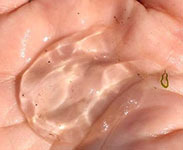 9/25 – Yonkers, HRM 18: Students from Stuyvesant High School in Manhattan spent a day of discovery at the Sarah Lawrence Center for the Urban River at Beczak investigating the Hudson River fauna. We caught three species of fish that epitomized the various ecological niches of the river in Yonkers: the pelagic free-swimming bay anchovy, the marsh-dweller mummichog, and the rocky and shell-strewn substrate naked goby. Invertebrates included blue crabs (33), moon jellyfish, comb jellies, and sand shrimp. Salinity was a tad high today at 15.0 ppt. (Photo of Leidy's comb jelly courtesy of Elisa Caref) 9/25 – Yonkers, HRM 18: Students from Stuyvesant High School in Manhattan spent a day of discovery at the Sarah Lawrence Center for the Urban River at Beczak investigating the Hudson River fauna. We caught three species of fish that epitomized the various ecological niches of the river in Yonkers: the pelagic free-swimming bay anchovy, the marsh-dweller mummichog, and the rocky and shell-strewn substrate naked goby. Invertebrates included blue crabs (33), moon jellyfish, comb jellies, and sand shrimp. Salinity was a tad high today at 15.0 ppt. (Photo of Leidy's comb jelly courtesy of Elisa Caref)
- Kate Lamboy
9/25 – Manhattan, New York City: The Randall's Island Park Alliance staff educators conducted two seining sessions today, first at the Little Hell Gate Salt Marsh and later at the Water’s Edge Garden site.
We made three seine hauls at the Little Hell Gate Salt Marsh in the last of the ebb tide. High count among the seven species of fish were mummichogs (61). Others included Atlantic silverside, Atlantic menhaden, striped killifish, white perch, young-of-year striped bass, and a northern pipefish (50 mm) that was long and thin like al dente spaghetti.
Non fishes included sand shrimp, mud dog whelk snails, comb jellies, and 23 penny-to-dinner-plate size blue crabs. Most of the shore shrimp (112) were tiny enough that they could be fully encapsulated in a Good ‘n Plenty candy. The water was 75 degrees F, and the salinity was 18.0 ppt.
We made three seine hauls at the Water’s Edge Garden site during the first of the flood tide. High count among the four species of fish were Atlantic silverside (86). Others included silver perch, oyster toadfish, and northern pipefish. Non fishes included shore shrimp, sand shrimp, comb jellies, and 27 blue crabs. The water was 75 degrees F, and the salinity was 25.0 ppt.
- Jackie Wu
*** Fish of the Week ***
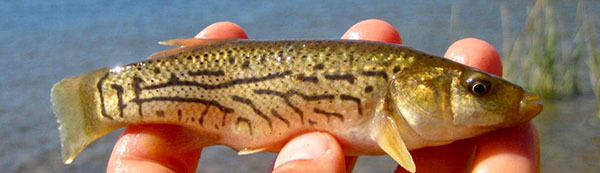
9/26 – Hudson River Watershed: Fish-of-the-Week for Week 41 is the goldfish (Carassius auratus), number 34 (of 230) on our watershed list of fishes. If you would like a copy of our list, e-mail trlake7@aol.com.
 Goldfish are an introduced species, one of 34 minnows (Cyprinidae) in the watershed. They arrived in North America from eastern Asia in the early 19th century. In J.R. Greeley’s A Biological Survey of the Lower Hudson Watershed (1937), the author describes his true feelings with regard to goldfish: “This species, in the wild state, constitutes a worthless, although apparently not seriously destructive addition to the fish population.” Goldfish are an introduced species, one of 34 minnows (Cyprinidae) in the watershed. They arrived in North America from eastern Asia in the early 19th century. In J.R. Greeley’s A Biological Survey of the Lower Hudson Watershed (1937), the author describes his true feelings with regard to goldfish: “This species, in the wild state, constitutes a worthless, although apparently not seriously destructive addition to the fish population.”
That may be a narrow definition of the worth of goldfish. In winter, it seems as though a day does not go by when we do not see a bald eagle flying over with a bright orange goldfish in its talons. Foot-long goldfish in the river are not rare. Entrepreneurs with a gillnet or seine capture goldfish for sale to wholesale aquarium fish dealers or owners of backyard pools and ponds. Goldfish have also been used as live bait fish by anglers, releasing their leftovers at the end of the day. In the wild, goldfish can hybridize with common carp (Cyprinus carpio). To tell the juveniles apart in the field, goldfish have no barbels on their upper jaw, carp have four barbels, and goldfish-carp hybrids have 1-3 barbels.
An urban legend that I believe is true, states that many 5 &10 Cent Store-bought goldfish made their way into the river via flushed toilets. There was a time, not all that long ago, when a flushed toilet had a nearly uninhibited path to the river. The backstory to the flush would have parents warning their children to “clean the fish bowl, or else.” Eventually the “or else” was a ride to the river via the toilet, or a visit to the river where the goldfish bowl got emptied. (Photo of goldfish courtesy of Amanda Higgs)
- Tom Lake
9/26 – Bedford, HRM 35: I was caught completely by surprise by this morning’s impressive flight of broad-winged hawks (447 birds) at the Bedford Audubon Chestnut Ridge Hawkwatch (86% of the day’s count). Kettles were materializing in the east-northeast sky and drifting southwest. The birds were quite low and many passed close to the platform. The birds looked to be skirting the edge of the clouds that were rolling in. During this time, 22 turkey vultures were also migrating. Non-raptor observations included 53 monarch butterflies.
- Richard Aracil
9/26 – Hook Mountain, HRM 31: Three young red-tailed hawks chased around the summit of the Hook Mountain Hawkwatch and swooped down to harass our owl decoy. Non-raptor observations included 27 monarch butterflies.
- Anne Swaim, Nigel Bark
9/26 – Yonkers, HRM 18: Students from academic partner Sarah Lawrence College visited the Sarah Lawrence Center for the Urban River at Beczak today to go seining with our staff. We had a good comb jelly catch (29), of both Beroe’s and Leidy’s comb jellies. Moon jellyfish were also well represented (21) as were blue crabs (14). Among the fishes were bay anchovies, white perch, and young-of-year striped bass.
- Elisa Caref, Evelyn Huntington, Ryland Cullen
9/27 – Beacon, HRM 61: I had a good fishing session today with two carp and eight channel catfish. The weather change had taken hold, and the floating water chestnuts were gone for the year. I had the two carp on simultaneously – it was difficult to stay focused – but I landed them both. I also lost a third, larger carp. The hook pulled free as it was getting close to the rock where I was fishing.
- Bill Greene
9/27 – Bedford, HRM 35: There were mainly sharp-shinned hawks (47) and a trickle of broad-winged hawks (45) today at the Bedford Audubon Chestnut Ridge Hawkwatch. Osprey (10) and American kestrel (9) were moving in small numbers. Non-raptor observations included 43 monarch butterflies and two ruby-throated hummingbirds.
- Richard Aracil, Amir Balaban, David Bamonte, David Burg, Kent Pritchard, Megan Owens, Steve Bauer, Tony Wilkinson
9/27 – Hook Mountain, HRM 31: We noted 23 migrating raptors at the Hook Mountain Hawkwatch today with sharp-shinned hawks high count with seven. For about fifteen minutes in midday, three red-tailed hawks performed their often-seen ballet that includes a swoosh over the decoy owl with talons down, a zoom through the trees bordering the summit, a roller-coaster chase after each other around the southeast side of the mountain, and then a final swing back over the top. It is great fun to watch. Non-raptor observations included 3 monarch butterflies.
- Trudy Battaly, Drew Panko
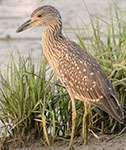 9/27 – Manhattan, New York City: The Randall's Island Park Alliance staff educators were busy all day with our Harbor Heron monitoring. However, we barely saw any birds, including our normal gulls and cormorants. But, we did find two immature yellow-crowned night herons sitting in the scrub-shrub by our Little Hell Gate Salt Marsh. (Photo of yellow-crowned night heron courtesy of Christine Fusco) 9/27 – Manhattan, New York City: The Randall's Island Park Alliance staff educators were busy all day with our Harbor Heron monitoring. However, we barely saw any birds, including our normal gulls and cormorants. But, we did find two immature yellow-crowned night herons sitting in the scrub-shrub by our Little Hell Gate Salt Marsh. (Photo of yellow-crowned night heron courtesy of Christine Fusco)
- Jackie Wu
9/27 – Sandy Hook, NJ: We found the beach and the water perfect for seining on the Raritan Bay side of Sand Hook. Each of our hauls produced more striped killifish than we could count (hundreds). Their numbers were evenly split males/females, each markedly different by their horizontal broken stripes (females) and black bars (males). The several hundred Atlantic silverside added an incredible sparkle to the seine. The water was 74 degrees F.
- Tom Lake, T.R. Jackson
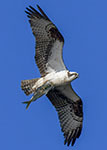 9/27 – Sandy Hook, NJ: We walked the beach in the evening on the ocean side of Sandy Hook looking out at a rising tide and calm water. The sun had set, and dusk was setting up for nightfall. At last light, gulls and terns showed up, and the water took on a nervous ripple. Bluefish. For the next half-hour, they tore into small bait fish and took our offering of cut white mullet. Then, just as suddenly, it all stopped. The gulls and terns left, and the ocean returned to its calmness. As a final remembrance of the day, we watched an osprey fly over carrying a menhaden. The ocean was 71 degrees F. (Photo of osprey courtesy of Deborah Tracy Kral) 9/27 – Sandy Hook, NJ: We walked the beach in the evening on the ocean side of Sandy Hook looking out at a rising tide and calm water. The sun had set, and dusk was setting up for nightfall. At last light, gulls and terns showed up, and the water took on a nervous ripple. Bluefish. For the next half-hour, they tore into small bait fish and took our offering of cut white mullet. Then, just as suddenly, it all stopped. The gulls and terns left, and the ocean returned to its calmness. As a final remembrance of the day, we watched an osprey fly over carrying a menhaden. The ocean was 71 degrees F. (Photo of osprey courtesy of Deborah Tracy Kral)
- Tom Lake, T.R. Jackson
[Sandy Hook borders on the Lower Bay of New York Harbor and is either the beginning or the end of the Hudson River watershed, depending upon your perspective. Migrants, from fish to songbird to raptors to butterflies, closely follow the coastline in autumn and springtime, making Sandy Hook an important way-station in and out of the watershed. Tom Lake]
Fall 2019 Natural History Programs
Tuesday, October 22
17th Annual Day in the Life of the Hudson River
Last year’s Day-in-the-Life of the River engaged nearly 6,000 students and educators at 86 sites from the Mohawk River to New York Harbor.
For more information:
https://www.ldeo.columbia.edu/dayinthelife/ and https://www.dec.ny.gov/lands/47285.html
The Hudson River Valley Ramble offers programs throughout the month of September. For more information, visit: https://www.hudsonrivervalleyramble.com/ramble
Hudson River: Striped Bass Cooperative Angler Program
You can share your fishing trip information and help biologists understand and manage our Hudson River striped bass fishery.
Here’s how it works: Fill out a logbook provided by us whenever you fish on the Hudson River (by boat or from shore). Record general location, time, gear used, what you caught (or if you didn’t catch anything) and return the logbook when you are done fishing for the season. You’ll receive an annual newsletter summarizing the information in addition to the latest news regarding regulations and the river. Whether you catch-and-release or take home a keeper, you can be part of the Cooperative Angler Program.
Join today by contacting: jessica.best@dec.ny.gov, or call 845-256-3009
- Jessica Best
Hudson River Miles
The Hudson is measured north from Hudson River Mile 0 at the Battery at the southern tip of Manhattan. The George Washington Bridge is at HRM 12, the Tappan Zee 28, Bear Mountain 47, Beacon-Newburgh 62, Mid-Hudson 75, Kingston-Rhinecliff 95, Rip Van Winkle 114, and the Federal Dam at Troy, the head of tidewater, at 153. The tidal section of the Hudson constitutes a bit less than half the total distance – 315 miles – from Lake Tear of the Clouds to the Battery. Entries from points east and west in the watershed reference the corresponding river mile on the mainstem.
To Contribute Your Observations or to Subscribe
The Hudson River Almanac is compiled and edited by Tom Lake and emailed weekly by DEC's Hudson River Estuary Program. Share your observations by e-mailing them to trlake7@aol.com.
To subscribe to the Almanac (or to unsubscribe), use the links on DEC's Hudson River Almanac or DEC Delivers web pages.
Discover New York State Conservationist - the award-winning, advertisement-free magazine focusing on New York State's great outdoors and natural resources. Conservationist features stunning photography, informative articles and around-the-state coverage. Visit the Conservationist webpage for more information.
Useful Links
National Oceanic and Atmospheric Administration online tide and tidal current predictions are invaluable when planning Hudson River field trips.
For real-time information on Hudson River tides, weather and water conditions from sixteen monitoring stations, visit the Hudson River Environmental Conditions Observing System website.
DEC's Smartphone app for iPhone and Android is now available at: New York Fishing, Hunting & Wildlife App.
Adventure NY
Under Governor Cuomo's Adventure NY initiative, DEC is making strategic investments to expand access to healthy, active outdoor recreation, connect more New Yorkers and visitors to nature and the outdoors, protect natural resources, and boost local economies. This initiative will support the completion of more than 75 projects over the next three years, ranging from improvements to youth camps and environmental education centers to new boat launches, duck blinds, and hiking trails. Read more about the Adventure NY initiative. For more information on planning an outdoor adventure in New York State, visit DEC's website at http://www.dec.ny.gov/outdoor.
Information about the Hudson River Estuary Program is available on DEC's website at http://www.dec.ny.gov/lands/4920.html.
|