A Project of the Hudson River Estuary Program
Compiled by Tom Lake, Consulting Naturalist
Overview
The late summer raptor migration picked up significantly this week with impressive numbers of broad-winged hawks. The late summer hatch of blue crabs seemed to fill the lower river with penny-to-quarter size crabs. And, the highlight of the week was a gorgeous, uncommon-to-rare, marine stray from tropical waters.
Highlight of the Week
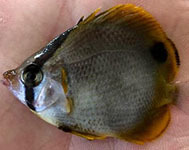 9/18 – Manhattan, HRM 1: Staff from the Lower East Side Ecology Center pulled up an oyster research station (collection device) this afternoon at the Fire Boat House in East River Park and found it had caught an unfamiliar fish. It was almost a hilarious coincidence, as we had been explaining to students the huge variety of life in the East River, and how regularly new species show up. One of the students pointed to the new fish and said, "Like that tropical fish?" It did not take long for us to identify the fish (confirmed by Peter Park) as a very uncommon-to-rare visitor, a 45 millimeter (mm), young-of-year spotfin butterflyfish. (Photo of spotfin butterflyfish courtesy of Kellan Stanner)
- Kellan Stanner
[The spotfin butterflyfish (Chaetodon ocellatus) look every bit the tropical fish. It is a common reef fish in the West Indies and their center of abundance seems to be the Bahamas. It is believed that young-of-year butterflyfish that appear in the estuary in late summer were transported to the New York Bight as larvae by the north-flowing Gulf stream, a river in the ocean that flows north from the tropics. Historical records in the estuary are few; most having been recorded at The River Project Pier 41 on Manhattan’s west side. Adults can get to 200 mm. Tom Lake]
[Note: one inch = 25.4 millimeters (mm)]
Natural History Entries
Note: In last week’s Almanac Overview, we stated the 9-11 attack on the World Trade Center was 20 years ago. It was 18 years ago. Later, in the heading for the 9-11 entry, we correctly stated the anniversary as 18 years.
- Tom Lake
9/13 – Hudson Valley: Tonight's full moon was this autumn's Harvest Moon, the full moon nearest the Autumnal Equinox that will occur on 9/23. The next time Friday the 13th will coincide with a Harvest Moon will be 2049.
- Tom Lake
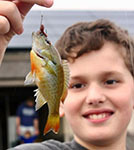 9/14 – Norrie Point, HRM 85: An array of researchers, educators, and anglers (Cameron Czajkowski caught the fish–of-the-day, a gorgeous redbreast sunfish), converged at the Norrie Point Environmental Education Center today for our Science on the River in celebration of National Estuaries Day. We were there to celebrate our ecosystem and help describe how it works through interactive displays, live animals, and research demonstrations. Today also reminded everyone of our environment’s life-enabling connection to all of us. (Photo of redbreast sunfish courtesy of Chris Bowser)
- Tom Lake
[One of the major topics of discussion for the day revolved around the Hudson River watershed and what exactly that meant. The United States Environmental Protection Agency (US EPA) defines a watershed as an area of land where all of the water that is under it or drains off of it goes to the same place. For the Hudson River watershed, the origin includes the Mohawk system as well as tributaries from Vermont, Massachusetts, Connecticut, and northern New Jersey. The terminus of the Hudson River watershed includes the eleven miles of the Upper Bay of New York Harbor from the Battery to the Narrows. Tom Lake]
9/14 – Bedford, HRM 35: There was no appreciable raptor migration flight today at the Bedford Audubon Chestnut Ridge Hawkwatch, just a handful of birds for the entire day. The five we counted included two each sharp-shined hawk and osprey. The last raptor was an American kestrel. Non-raptor observations included a couple of monarch butterflies and six ruby-throated hummingbirds.
- Richard Aracil, Conrad Bahlke, Jason Tellone, Karen Troche, Megan Owens, Pedro Troche, Tait Johansson, Tony Loomis
9/14 – Hook Mountain, HRM 31: We counted just five migrating raptors today at the Hook Mountain Hawkwatch. American kestrel accounted for three of them along with an osprey and a northern harrier.
- Mary Iorizzo, Steve Bauer
9/14 – Yonkers, HRM 18: We held our public River Explorer’s program today at the Sarah Lawrence Center for the Urban River at Beczak. Attendees helped us make six hauls of our seine. Moon jellyfish (not fish) were an amazing high count with 288. Blue crabs were next with 29. Thirty of the 33 fish we caught were mummichogs; the others, one each, were Atlantic silverside, naked goby and striped bass.
- Katie Lamboy
9/15 – Albany County, HRM 150: Tucked under Exit 1 of the Adirondack Northway (I87), near the hustle and bustle of shoppers heading for the exit to the mall, is a shallow, narrow channel that connects two basins of Lake Rensselaer. This is the Six-Mile Waterworks of the Albany Pine Bush Preserve, and headwaters of Patroon Creek. This tiny channel is a favorite spot for ducks because of an abundance of wild celery (Vallesneria americana) that thrives there. Three hen mallards were so engrossed with their dabbling that they allowed my kayak to get within inches of their feeding spot in this narrow waterway. Six Mile Waterworks never lets me down: I counted 24 turtles – mostly painted, a few sliders, and fewer map turtle – dragonflies and damselflies of all colors, sunfishes including pumpkinseed, bluegill and largemouth bass, a great blue heron, three green herons, two belted-kingfishers, and two woodchucks getting their feet wet as they enjoyed shoreline vegetation.
- Fran Martino
9/15 – Bedford, HRM 35: There was just a trickle of migrants at the Bedford Audubon Chestnut Ridge Hawkwatch until mid-afternoon when an impressive late flight of broad-winged hawks materialized (452 birds, 89% of the total day’s count). They formed large kettles heading southwest and west-southwest. The most notable sighting was an adult and an immature peregrine falcon that passed near the platform twice during the watch. Non-raptor observations included 100 monarch butterflies and 38 ruby-throated hummingbirds.
- Richard Aracil, Karen Troche, Megan Owens, Pedro Troche, Steve Walter
9/15 – Hook Mountain, HRM 31: The largest broad-winged hawk group of the day at the Hook Mountain Hawkwatch was two birds, an unusual way to see these raptors. We counted 70 raptors with broad-winged hawks high count with 24. Most birds were flying high. Non-raptor observations included 36 monarch butterflies and two ruby-throated hummingbirds.
- Felicia Napier, Brad Klein, Danielle Gustafson, Steve Bauer, Steve Sachs
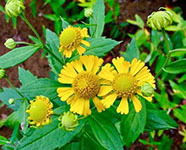 9/16 – Stockport Creek, HRM 121.5: It is that time of year when the cardinal flowers (Lobelia cardinalis) along the shoreline of Stockport Creek are replaced by sneezeweed (Helenium autumnale). Choose the lore you like best about this flower: the common name, sneezeweed, coming from its use by Native Americans and early settlers as a sort of snuff to induce sneezing to help ward off evil spirits and break up congestion. Another legend relates to Helen of Troy (hence the name Helenium) whose tears watered the ground from which the plant first flourished. A hint for your decision making: sneezeweed is a plant native to North America. The resident Muscovy duck (Cairina moschata) remained calm as I paddled my pack canoe toward the log it was perched on. Only until I was inches away did it raise the crest of feathers on its head in a show of nervousness. (Photo of sneezeweed with permission from SeedBalls.com)
- Fran Martino
9/16 – Bear Mountain, HRM 46: From the top of Bear Mountain, visitors are rewarded with breath-taking scenic vistas of our beautiful Hudson River Valley. It was also the place, today, to watch one of nature's grandest spectacles. Hawk watchers – Doris Metraux, Carol Weiss, Tracy Patsch and I – counted 3,786 migrating hawks. Among them were eight bald eagles, four osprey, two sharp-shinned hawks, two Cooper's hawks, four American Kestrels, a red-shouldered hawk, a merlin, and an amazing 3,764 broad-winged hawks (99% of the total count). From mid-afternoon to early evening, we witnessed a "river of raptors" streaming overhead toward the setting sun in the southwest.
- Gerhard Patsch
9/16 – Bedford, HRM 35: Despite the cloudy skies for most of the day at the Bedford Audubon Chestnut Ridge Hawkwatch, it was an excellent day for broad-winged hawk migration (876 birds, 90% of the total day’s count). Similar to yesterday, there was an impressive push of broad-wings that suddenly materialized in the late afternoon when 344 were counted, mainly in large kettles headed west-southwest over the platform. There was also a good push of sharp-shinned hawks (66 hawks) during the day. Non-raptor observations included 35 monarch butterflies and 12 ruby-throated hummingbirds.
- Richard Aracil, Megan Owens, Pedro Troche
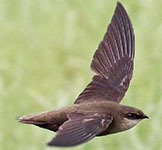 9/16 – Hook Mountain, HRM 31: The first raptor at the Hook Mountain Hawkwatch today was a male Cooper's hawk at 8:35 AM; the last raptor, a sharp-shinned hawk, appeared at 2:50 PM. The largest kettle was of 87 broad-winged hawks flying south. Broad-winged hawks (390 birds) comprised 89% of the total day’s count. An adult and immature bald eagle were spotted together in mid-morning flying south. Surprisingly, none of the raptors were interested in our newly refurbished real-feathered decoy owl. Non-raptor observations included 130 chimney swifts, all in the first two hours. (Photo of chimney swift courtesy of Steve Calver)
- Ajit I. Antony, Liza Antony
9/16 – Yonkers, HRM 18: We conducted our last training day at the Sarah Lawrence Center for the Urban River at Beczak today for Sarah Lawrence College ISY students, Evelyn Huntington and Ryland Cullen. We seined the river to see to see what was home and encountered a common theme this summer: Atlantic silverside. Additionally, there were white perch, a handsome northern kingfish, and young-of-year striped bass.
- Jason Muller and Elisa Caref
9/16 – Manhattan, HRM 1: We began our research week by checking our sampling gear in Hudson River Park at The River Project's sampling station on the lighthouse tender Lilac at Pier 25. The presence of small blue crabs continued to be impressive. We found we had collected 54 this morning. The young-of-summer crabs ranged in size from 10-45 mm, while one adult female was 90 mm point-to-point. We wondered how many more small crabs the oyster toadfish had taken. The nine oyster toads ranged in size from 30-205 mm. The tiniest fish of the day was a (10 mm) skilletfish.
- Siddhartha Hayes, Isabel Pryor, Evelyn Stelman
[Like all crustaceans, blue crabs have an exoskeleton. One of the features of the blue crab’s exoskeleton is its carapace with two sharp lateral points. It is possible that these are an evolutionary adaptation to help avoid predation. For researchers and crabbers, it is a handy way to gauge the crab’s overall size and age, by measuring the distance between the two point-to-points. Tom Lake]
9/17 – Bedford, HRM 35: The broad-winged flight today (944 birds, 90% of the day’s count) at the Bedford Audubon Chestnut Ridge Hawkwatch was mostly very high, with the birds frustratingly winking in and out of sight. The largest kettle/stream was about 140 birds. Non-raptor observations included 24 monarch butterflies, six ruby-throated hummingbirds, 38 cedar waxwings, and a common nighthawk.
- Tait Johansson, Allen Kurtz, Jeff Greenwald, Megan Owens, Pedro Troche, Tony Wilkinson
9/17 – Hook Mountain, HRM 31: Migrating Raptors were pouring through in mid-morning at the Hook Mountain Hawkwatch, and then they just stopped. Chief among them were broad-winged hawks (244 birds, 77% of the day’s count). Non-raptor observations included 17 monarch butterflies and several ruby-throated hummingbirds.
- John Phillips, Frank Bonano, Judy Myerson, Sean Frederick
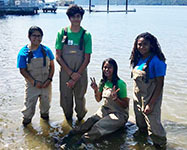 9/17 – Yonkers, HRM 18: Kindergarten to sixth-grade students from The Hudson Lab School visited the Sarah Lawrence Center for the Urban River at Beczak today to learn about life in the Hudson River. While our seine haul was modest – Atlantic Silverside, striped bass, white perch, blue crabs, comb jellies, and moon jellyfish – to the students, many of whom had never seen Hudson River aquatic life, it was magic. (Photo of Beczak staff courtesy of Katie Lamboy)
- Elisa Caref, Katie Lamboy, Jason Muller, Evelyn Huntington, Ryland Cullen
*** Fish of the Week ***
9/18 – Hudson River Watershed: Fish-of-the-Week for Week 40 is the inshore lizardfish (Synodus foetens) number 99 (of 230) on our watershed list of fishes. If you would like a copy of our list, e-mail trlake7@aol.com.
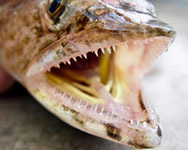 The inshore lizardfish is a temperate marine stray in the estuary. While only reaching 18-inches, they have the countenance of an apex predator with tooth-studded jaws and a reptilian look. Inshore lizardfish lurk in sandy shallows, burrowing in the bottom sediments to ambush passing prey. They favor the inshore marine waters of the Atlantic from Cape Cod to Brazil. Young-of-year lizardfish are carried into the brackish waters of the Hudson River on summer tides and currents and are found as far upriver as Croton Point (river mile 35). (Photo of inshore lizardfish courtesy of the Chesapeake Bay Foundation)Tom Lake
9/18 – Bedford, HRM 35: Given today’s conditions and yesterday’s big numbers, we were surprised by the low numbers today at the Bedford Audubon Chestnut Ridge Hawkwatch, especially for broad-winged hawks (44 birds). Sharped-shinned hawks (68) were high count. Non-raptor observations included 51 monarch butterflies and two ruby-throated hummingbirds.
- Richard Aracil, Allen Kurtz, Linda Kurtz, Megan Owens, Tony Loomis
9/18 – Hook Mountain, HRM 31: We counted 68 migrating raptors today at the Hook Mountain Hawkwatch half of which were sharp-shinned hawks. American kestrels made a good showing with 14 birds. There were no non-raptor observations of note.
- Steve Sachs, Frank Bonano
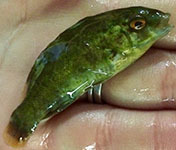 9/18 – Manhattan, HRM 1: We returned to check our research sampling gear in Hudson River Park at The River Project's sampling station on the lighthouse tender Lilac at Pier 25. Blue crabs were once again plentiful (31). The young-of-summer crabs ranged in size from 10-45 mm while two adults were both 125 mm (point-to-point). When we find blue crabs, there are bound to be oyster toadfish, and we caught four (30-190 mm). Our most impressive fishes, however, were the four (235-330 mm) tautog, or “blackfish”. (Photo of tautog courtesy of Jackie Wu)
- Siddhartha Hayes, Chelsea Quaies
[“Blackfish” is another name for tautog (Tautoga onitis), a rather common, bottom-dwelling fish of New York Harbor. This colloquial name refers to the adults as they attain a deep, coal black color. Among their favorite foods are shellfish that they find in abundance in near-shore rocky areas. In the spirit of “you are what you eat,” blackfish, perhaps owing to their shellfish diet, are a sought-after food fish. Tom Lake]
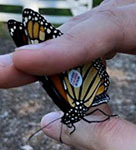 9/18 – Manhattan, New York City: The Natural Areas team of the Randall's Island Park Alliance staff dug around the Little Hell Gate Salt Marsh today and caught three penny-size blue crab. We saw a good number more swim away from us.
We also continued our Monarch Watch's butterfly tagging efforts. Despite our late start this year, we caught and tagged six monarch butterflies today raising our season total to 18. We also hosted a group for International Coastal Clean Up, collecting 13 bags of trash (457 pounds) from our Bronx Kill Salt Marsh. (Photo of Monarch courtesy of Jackie Wu)
- Jacqueline Wu
9/19 – Newcomb, HRM 302: Our first frost of the season occurred this morning with the temperature dipping to 30 degrees Fahrenheit (F). Despite the calendar still saying it is summer, our foliage is about 40% color. There were a lot of orange-red mountain ash berries and apples available this fall for the wildlife. The jury is still out on American beech nuts. There were lots of hulls seen on the trees in late summer, but it seems like most of them were not falling to the ground and were not sound (that is to say, no nut inside).
- Charlotte Demers
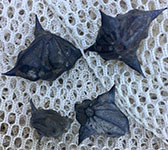 9/19 – Beacon, HRM 61: We circled clouds of banded killifish with our seine, missing most but netting more than 100. Many were males replete in their lavender bands (known colloquially as “blue-banded mudminnows”). Rather than assuming all were banded killifish (Fundulus diaphanus), we sorted through them and found a single male mummichog (F. heteroclitus). Mummichog are more common in brackish water although they are not rare this far upriver. The only other time I found both species together was in Iona Marsh, sixteen miles downriver.
In the final tally, we had caught hundreds more water chestnut seeds than fish. Later, when I cleared the net, I counted 247 seeds, each one equipped with three sharp barbs ready to stab my hands. The water was 75 degrees F, and the salinity was 3.0 parts-per-thousand (ppt). (Photo of trapa natans courtesy of Tom Lake)
- Tom Lake, B,J, Jackson
[Eurasian water chestnut (Trapa natans) is an invasive, floating-leaved aquatic plant native to Eurasia and Africa. The species has been present in the watershed since it was intentionally introduced into Sander’s Lake (now Collins Lake, Scotia, Schenectady County) in 1884. Mature seeds are an ominous black with three prominent spiky horns, leading some to call them “Devil’s Heads.”
In many places, water chestnut has out-competed native aquatic vegetation, especially in bays, marshes, and tributaries. Water chestnut is most abundant in shallow sheltered bodies of water with soft, muddy bottoms but is restricted to fresh water because its seeds fail to germinate in brackish to salt water. As a result, it is rarely found in the lower estuary below the Hudson Highlands.
J.R. Greeley’s A Biological Survey of the Lower Hudson Watershed (1937) notes that, “Fishermen at New Hamburg reported finding two water chestnut plants growing at the mouth of the Wappinger Creek in 1935. The plants were destroyed.”
For a detailed look at Trapa natans, see Hummel and Kiviat (2004) Review of World Literature on Water Chestnut with Implications for Management in North America
http://aquaticcommons.org/1664/1/water_chestnut.pdf Tom Lake]
9/19 – Bedford, HRM 35: The flight was very slow today at the Bedford Audubon Chestnut Ridge Hawkwatch, just a trickle of birds. Sharp-shined hawks accounted for 20 of the 34 birds. Non-raptor observations included 14 monarch butterflies and three ruby-throated hummingbirds.
- Richard Aracil, Charles Bobelis
9/19 – Hook Mountain, HRM 31: There was some fun action on our newly refurbished real-feathered decoy owl at the Hook Mountain Hawkwatch today, with attacks by both red-tailed and sharp-shinned hawks. The flight was slow with only 40 raptors noted. Sharp-shinned hawks were high count with 15. Non-raptor observations included a single monarch butterfly.
- Trudy Battaly, Drew Panko, Nancy Single, Steve Sachs
9/20 – Bedford, HRM 35: It was another very slow day at the Bedford Audubon Chestnut Ridge Hawkwatch despite conditions seeming conducive to migration. Sharp-shinned hawks made another decent showing with 46 birds; broad-winged hawks were surprisingly lacking with only 80 on the day. Non-raptor observations included 56 monarch butterflies and nine ruby-throated hummingbirds.
- Richard Aracil, Megan Owens, Tony Loomis
9/20 – Hook Mountain, HRM 31: There was a modest flight today at the Hook Mountain Hawkwatch with 81 raptors counted. High counts went to broad-winged hawks (34) and sharp-shined hawks (30). Non-raptor observations included 37 monarch butterflies.
- Mary Iorizzo
9/20 – Yonkers, HRM 18: Students from the Bronxville middle and high school visited the Sarah Lawrence Center for the Urban River at Beczak and helped us seine the river with a focus on studying plankton and “jellies” (moon jellyfish and comb jellies). Our effort produced 13 moon jellyfish and three comb jellies. Atlantic silverside (22) and blue crabs (150 mm) managed to work their way into our net as well.
- Elisa Caref, Katie Lamboy
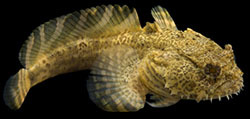 9/20 – Manhattan, HRM 1: Closing out our research week, we checked our sampling gear in Hudson River Park at The River Project's research station on the lighthouse tender Lilac at Pier 25. We found more blue crabs today (41), mostly palm-sized young-of-summer crabs. Not surprisingly, we also found eight oyster toadfish (35-210 mm) and a new favorite, a handsome black sea bass (190 mm). (Photo of oyster toadfish courtesy of Joel Sartore)
- Siddhartha Hayes, Nina Hitchings, Huy Nguyen, Isabel Pryor, Gianluca Astudillo
Fall 2019 Natural History Programs
Tuesday, October 22
17th Annual Day in the Life of the Hudson River
Last year’s Day-in-the-Life of the River engaged nearly 6,000 students and educators at 86 sites from the Mohawk River to New York Harbor.
For more information:
https://www.ldeo.columbia.edu/dayinthelife/ and https://www.dec.ny.gov/lands/47285.html
The Hudson River Valley Ramble offers programs throughout the month of September. For more information, visit: https://www.hudsonrivervalleyramble.com/ramble
Hudson River: Striped Bass Cooperative Angler Program
You can share your fishing trip information and help biologists understand and manage our Hudson River striped bass fishery.
Here’s how it works: Fill out a logbook provided by us whenever you fish on the Hudson River (by boat or from shore). Record general location, time, gear used, what you caught (or if you didn’t catch anything) and return the logbook when you are done fishing for the season. You’ll receive an annual newsletter summarizing the information in addition to the latest news regarding regulations and the river. Whether you catch-and-release or take home a keeper, you can be part of the Cooperative Angler Program.
Join today by contacting: jessica.best@dec.ny.gov, or call 845-256-3009
- Jessica Best
Hudson River Miles
The Hudson is measured north from Hudson River Mile 0 at the Battery at the southern tip of Manhattan. The George Washington Bridge is at HRM 12, the Tappan Zee 28, Bear Mountain 47, Beacon-Newburgh 62, Mid-Hudson 75, Kingston-Rhinecliff 95, Rip Van Winkle 114, and the Federal Dam at Troy, the head of tidewater, at 153. The tidal section of the Hudson constitutes a bit less than half the total distance – 315 miles – from Lake Tear of the Clouds to the Battery. Entries from points east and west in the watershed reference the corresponding river mile on the mainstem.
To Contribute Your Observations or to Subscribe
The Hudson River Almanac is compiled and edited by Tom Lake and emailed weekly by DEC's Hudson River Estuary Program. Share your observations by e-mailing them to trlake7@aol.com.
To subscribe to the Almanac (or to unsubscribe), use the links on DEC's Hudson River Almanac or DEC Delivers web pages.
Discover New York State Conservationist - the award-winning, advertisement-free magazine focusing on New York State's great outdoors and natural resources. Conservationist features stunning photography, informative articles and around-the-state coverage. Visit the Conservationist webpage for more information.
Useful Links
National Oceanic and Atmospheric Administration online tide and tidal current predictions are invaluable when planning Hudson River field trips.
For real-time information on Hudson River tides, weather and water conditions from sixteen monitoring stations, visit the Hudson River Environmental Conditions Observing System website.
DEC's Smartphone app for iPhone and Android is now available at: New York Fishing, Hunting & Wildlife App.
Adventure NY
Under Governor Cuomo's Adventure NY initiative, DEC is making strategic investments to expand access to healthy, active outdoor recreation, connect more New Yorkers and visitors to nature and the outdoors, protect natural resources, and boost local economies. This initiative will support the completion of more than 75 projects over the next three years, ranging from improvements to youth camps and environmental education centers to new boat launches, duck blinds, and hiking trails. Read more about the Adventure NY initiative. For more information on planning an outdoor adventure in New York State, visit DEC's website at http://www.dec.ny.gov/outdoor.
Information about the Hudson River Estuary Program is available on DEC's website at http://www.dec.ny.gov/lands/4920.html.
|