A Project of the Hudson River Estuary Program
Compiled by Tom Lake, Consulting Naturalist
Overview
It was a week of highlights, including a new fish species for the watershed, another string of exotic fishes, a mystery fish, a harbor seal, a look back into the incredible time depth of human occupation in the Hudson River Valley, and the arrival of a worrisome invasive insect.
Highlight of the Week
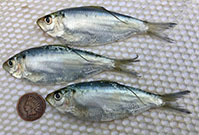 9/3 – Philipse Manor, HRM 28: Our DEC Region 3 Hudson River Fisheries Unit deployed our 200 x 10-foot seine today and caught a myriad of interesting and rather exotic fishes, including five Spanish mackerel, a lookdown, and an inshore lizardfish. But, the prize was 779 young-of-year Atlantic thread herring (60-97 mm), a new species (number 230) for the Hudson River Watershed. The salinity was 8.4 parts-per-thousand (ppt). (Photo of Atlantic thread herring courtesy of Tom Lake) 9/3 – Philipse Manor, HRM 28: Our DEC Region 3 Hudson River Fisheries Unit deployed our 200 x 10-foot seine today and caught a myriad of interesting and rather exotic fishes, including five Spanish mackerel, a lookdown, and an inshore lizardfish. But, the prize was 779 young-of-year Atlantic thread herring (60-97 mm), a new species (number 230) for the Hudson River Watershed. The salinity was 8.4 parts-per-thousand (ppt). (Photo of Atlantic thread herring courtesy of Tom Lake)
- Robert Adams Russ Berdan, Emilie Hickox, Justin Herne, Colleen Parker
[Atlantic thread herring (Opisthonema oglinum) is a marine herring (Clupeidae), one of nine documented for the watershed. They are native to subtropical and temperate inshore waters of the western Atlantic Ocean and the Gulf of Mexico. They feed mainly on plankton, but also take small fish and crustaceans, and can get to be 230 millimeters (mm) in length. - Tom Lake]
[Note: one inch = 25.4 millimeters (mm)]
Natural History Entries
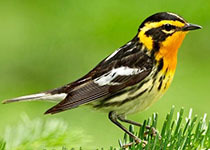 8/31 – Bedford, HRM 35: There was surprisingly little movement today at the Bedford Audubon Chestnut Ridge Hawkwatch. An adult and an immature broad-winged hawk, seen in both morning and afternoon, appeared not to be migrating. Other seemingly non-migrating raptors included a young red-shouldered hawk, a Cooper's hawk, an osprey headed north with a fish in midday, and an immature bald eagle headed east in mid-afternoon. Non-raptor observations included two monarch butterflies, eleven ruby-throated hummingbirds, ten cedar waxwings and a Blackburnian warbler. (Photo of Blackburnian warbler courtesy of Greg Schneider) 8/31 – Bedford, HRM 35: There was surprisingly little movement today at the Bedford Audubon Chestnut Ridge Hawkwatch. An adult and an immature broad-winged hawk, seen in both morning and afternoon, appeared not to be migrating. Other seemingly non-migrating raptors included a young red-shouldered hawk, a Cooper's hawk, an osprey headed north with a fish in midday, and an immature bald eagle headed east in mid-afternoon. Non-raptor observations included two monarch butterflies, eleven ruby-throated hummingbirds, ten cedar waxwings and a Blackburnian warbler. (Photo of Blackburnian warbler courtesy of Greg Schneider)
- Tait Johansson, Charlotte Catalano, Karen Troche, Pedro Troche
8/31 – Hook Mountain, HRM 31: We spotted our first migrants – a sharp-shinned hawk and two bald eagles – of the season at the Hook Mountain Hawkwatch. Non-migrating red-tailed hawks were “sky-hooking” regularly [lazy circles in the sky]. However, we saw no ravens today. Non-raptor observations included a dozen cedar waxwings, a ruby-throated hummingbird, monarch, black swallowtail, eastern swallowtail, four red-spotted purple, and hackberry emperor butterflies.
- Trudy Battay, Drew Panko
[The Hook Mountain Hawkwatch began in 1971 as an all-volunteer endeavor, an independent group of raptor enthusiasts. The Hawkwatch is located on the Long Path north of Nyack and we welcome new participants and visitors. Groups should contact us at merlin@pipeline.com for introductory materials and possible volunteer scheduling. Trudy Battay]
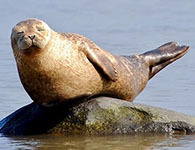 9/1 – Saugerties, HRM 102: In midday, a seal was spotted swimming in the shallows just north of the Saugerties Lighthouse. It appeared to be the same seal that visited here two weeks ago. We lost sight of it later in the day at the head of tide a mile up Esopus Creek. (Photo of harbor seal courtesy of Tom Lake) 9/1 – Saugerties, HRM 102: In midday, a seal was spotted swimming in the shallows just north of the Saugerties Lighthouse. It appeared to be the same seal that visited here two weeks ago. We lost sight of it later in the day at the head of tide a mile up Esopus Creek. (Photo of harbor seal courtesy of Tom Lake)
- Patrick Landewe
[Photos indicated it was a harbor seal (Phoca vitulina). They are one of four seal species found in the estuary, the others being hooded, gray, and harp seal. While seals at a distance all look superficially the same, harbor seals are by far the most common. While seals can be found in the river at any time of the year, spring seems to be their peak as they arrive to feed on the enormous schools of shad and river herring that are migrating in from the sea to spawn. Tom Lake]
9/1 – Wappinger Falls, HRM 68: An hour earlier in the day, David Chernack (river mile 82) counted 32 common nighthawks over his backyard. Just now, I counted 17 of David’s nighthawks flying south over my house high in the clouds.
- Debbie van Zyl
9/1 – Kowawese, HRM 59: A strong south wind was threatening to go southeast and bring rain. As it blew up through the Hudson Highlands, rollers carrying duckweed, Eurasian watermilfoil, and wild celery crashed on the beach tossing the shallows into a turbid foam. We eased our net into the river and caught many young-of-year striped bass and banded killifish. The highlight, however, was watching a quarter-size blue crab complete its moult, wriggling out of its shed shell and emerging as a tiny soft-shell crab. In its weakened state, it needed our help getting safely back into the water. The river was 80 degrees Fahrenheit (F), and the salinity was holding at 4.0 ppt.
- Tom Lake, T.R. Jackson
9/1 – Verplanck, HRM 40.5: We have been watching an osprey nest on the channel marker off Old Steamboat Dock for several months now. The three nestlings were finally fledged, but one of them was still returning to the nest crying out, we assume, for some parental attention. Double-crested cormorants have been swimming and diving nearby waiting to regain their perch when the nest is finally empty.
- Dianne Picciano, Phil Picciano
9/1 – Bedford, HRM 35: A few raptors were moving today, particularly in early afternoon, at the Bedford Audubon Chestnut Ridge Hawkwatch. These included our first-of-season sharp-shinned hawks. Osprey and red-tailed hawks were high count among 13 raptors with four each. Non-raptor observations included four migrating ruby-throated hummingbirds.
- Richard Aracil, Pedro Troche, Walt Fowler
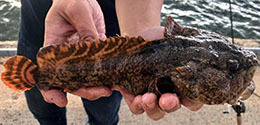 9/1 – Manhattan, HRM 1: New York City dwellers are known to flee the city on Labor Day Weekend, so the Hudson River Park Estuary Lab staff were excited that today’s Big City Fishing program on Pier 25 drew more than 200 participants! During the free catch-and-release fishing program, three oyster toadfish were caught on rod and reel (50.8 - 241.3 mm). (Photo of oyster toadfish courtesy of Peter Park) 9/1 – Manhattan, HRM 1: New York City dwellers are known to flee the city on Labor Day Weekend, so the Hudson River Park Estuary Lab staff were excited that today’s Big City Fishing program on Pier 25 drew more than 200 participants! During the free catch-and-release fishing program, three oyster toadfish were caught on rod and reel (50.8 - 241.3 mm). (Photo of oyster toadfish courtesy of Peter Park)
- Olivia Radick
9/2 – Ulster County: This summer a first-grader, walking across a Hudson River pebble beach, reached down and picked up a small stone to skip across the water, but then noticed that it resembled an “arrowhead.” The small stone (35 mm) was a projectile point, an artifact of considerable antiquity and had washed out of the river bank by wind, waves and weather. The student was delighted, realizing that this treasured find made a connection to ancient peoples who called this valley home. That made it an unforgettable day. This discovery can be attributed to the fact that six-year-olds are nearer to the ground, their eyes are open, and their minds are uncluttered and ready for discovery!
- Mario Meier
[This was an Adena point, a stone knife, spear or dart point, dating to about 2,800 years ago. The point was fashioned from local stone (chert) from a quarry in Greene County. The Adena culture arose in the greater Mississippi Valley and spread its influence and tool kit across the Northeast and elsewhere through trade. Archaeologists call this period the Early Woodland, a time before pottery and more than a thousand years before the introduction of the bow-and-arrow (and arrowheads). Discoveries like these from long ago provide great time depth and help put a face on the ancestral human occupation in the Hudson River Valley. Tom Lake]
9/2 – Bedford, HRM 35: We could not see any raptor migration at the Bedford Audubon Chestnut Ridge Hawkwatch today. Local, non-migrants included turkey vultures and red-tailed hawks. Non-raptor observations included a "kettle" of 22 cliff swallows with a tree swallow mixed in flying over the observation platform.
- Karen Troche, Pedro Troche
9/3 – Albany, HRM 153: We had 30 killdeer this morning spread out in the farm field along the east side of The Crossings in Colonie. We also spotted five double-crested cormorants at the large pond and a mixed flock of about 600 brown-headed cowbirds and starlings.
- Scott Stoner, Denise Stoner
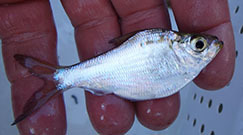 9/3 – Catskill, HRM 113: Our DEC Region Fisheries Unit was electro-shocking (investigating the fish population) in the Hudson River off Catskill today when up popped a stunned herring. We got a nice photo, but before we could do any in-depth, on the spot identification, the fish eluded us back into the river. (Photo of herring courtesy of Scott Wells) 9/3 – Catskill, HRM 113: Our DEC Region Fisheries Unit was electro-shocking (investigating the fish population) in the Hudson River off Catskill today when up popped a stunned herring. We got a nice photo, but before we could do any in-depth, on the spot identification, the fish eluded us back into the river. (Photo of herring courtesy of Scott Wells)
- Scott Wells
[Subsequently, we have been unable to come to a consensus as to its species. If you have an idea (see photo) please e-mail: trlake7@aol.com. Tom Lake]
9/3 – Little Stony Point, HRM 55: In late afternoon, I spotted a rather large, hefty, bobcat ambling over the Metro North railroad tracks, from east to west, and onto Little Stony Point. Little Stony Point, part of the Hudson Highlands State Park, is popular with visitors and I was surprised it did not seem bothered.
- Chris Kostek
9/3 – Bedford, HRM 35: There was some migration in evidence today at the Bedford Audubon Chestnut Ridge Hawkwatch with birds mostly distant and flying high to the southwest. Among the 23 raptors, broad-winged-hawks and red-tailed hawks were high count with six each. Non-raptor observations included seven ruby-throated hummingbirds seen bee-lining southwest. Eight monarch butterflies were counted throughout the watch.
- Richard Aracil, Pedro Troche
9/3 – Hook Mountain, HRM 31: The dozen migrating raptors at the Hook Mountain Hawkwatch today included seven osprey and five broad-winged hawks. The three non-migrating raptors were bald eagle, peregrine falcon, and an osprey.
- John Phillips
9/3 – Piermont, HRM 25: I took a walk on Piermont Pier on a sunny, breezy, and warm morning. Highlights of my walk included 14 osprey, mostly in trees, eight great blue herons in the waters skirting the marsh, about 40 “peeps,” and a large peregrine falcon flying low over the north shore agitating the gulls and ducks. I was surprised to see six diamond back terrapin of varying size on the breakwater rocks.
- Linda Pistolesi
[“Peep” is a collective noun describing several small shorebird species whose exact names, due to ambiguous field marks, often defy casual identification. These can include, but are not limited to, several species of sandpipers, dunlins, sanderlings, and even plovers. Tom Lake]
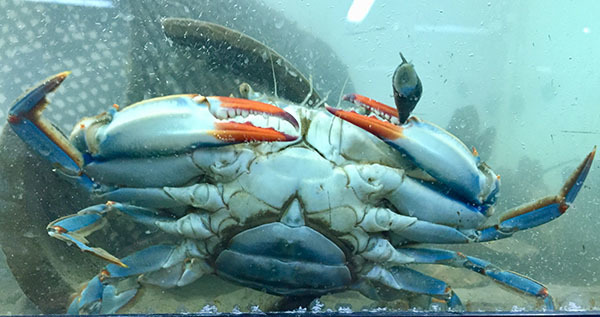
9/3 – Manhattan, HRM 1: Blue crab season was not over, the babies were just getting bigger (and feistier!) We checked our research sampling gear in Hudson River Park at The River Project's sampling station on the lighthouse tender Lilac at Pier 25 today and collected 48 juvenile blue crabs (10-60 mm carapace width) and five adults (100-160 mm). There were also 20 oyster toadfish, all juveniles (20-90 mm), six tautog (175-310 mm), and one black sea bass (55 mm).
- Siddhartha Hayes, Zoe Zakrzewska, Gabrielle Mazza
9/4 – North Germantown, HRM 109: We seined with some urgency: thunderstorms were on their way with a message in the stiff east wind. We were still searching for the expected young-of-year river herring, but again our efforts failed. After many hauls of our small seine in the boat launch that resulted in hundreds of spottail shiners, banded killifish, and a handful of young-of-year striped bass, one last haul caught three gorgeous young-of-year American shad (109-111 mm). The river was 74 degrees F.
- Tom Lake, Bob Schmidt
9/4 – Bedford, HRM 35: There was essentially no raptor migration today at the Bedford Audubon Chestnut Ridge Hawkwatch. The lone exception was a red-tailed hawk. Non-raptor observations included six ruby-throated hummingbirds and six monarch butterflies.
- Richard Aracil
9/4 – Hook Mountain, HRM 31: We counted four migrating raptors today at the Hook Mountain Hawkwatch, two each bald eagle and osprey. Non-raptor observations included two ruby-throated hummingbirds.
- Steve Sachs
** Fish of the Week **
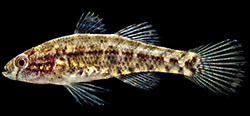 9/4 – Hudson River Watershed: Fish-of-the-Week for Week 38 is the Fat sleeper (Dormitator maculatus), number 205 (of 230) on our watershed list of fishes. If you would like a copy of our list, e-mail trlake7@aol.com. 9/4 – Hudson River Watershed: Fish-of-the-Week for Week 38 is the Fat sleeper (Dormitator maculatus), number 205 (of 230) on our watershed list of fishes. If you would like a copy of our list, e-mail trlake7@aol.com.
The fat sleeper is the only member of its family (Eleotridae) in our watershed. Their common name is not a case of body-shaming, but rather an accurate description of their roly-poly body. Their genus, Dormitator, comes from the Latin Dormio, meaning sleeper. Its trivial name, maculatus, comes from Latin macula, meaning spotted. C. Lavett Smith calls the fat sleeper “a stubby little fish ... somber brown with lighter spots.” They can reach 20-inches, but most are smaller. Classified as a tropical marine stray, the fat sleeper in known in the estuary only from a handful of records. They are closely related to the gobies, but are so drably uncommon to rare, that if you caught one, you might not recognize it. The fat sleeper favors brackish water but is found in either end of the range from saltwater to freshwater. (Photo of Fat sleeper courtesy of N.C. Fishes)
- Tom Lake
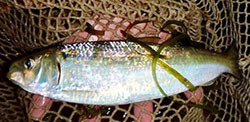 9/5 – Stillwater, HRM 172: Using our DEC Region 4 electro-shocker, we captured an adult blueback herring this evening just below the Hudson-Champlain Canal Lock C4. This was a very unusual catch. Blueback herring, migrating inland from the sea to spawn in April, either enter some of the upper estuary tributaries or ascend the Waterford Flight of locks after passing the Federal Dam at Troy to access the Mohawk River to spawn. This herring was 14 miles farther up-river from Waterford and had to pass three more locks to get here. This blueback herring should have been back in the sea by now. (Photo of blueback herring courtesy of Scott Wells) 9/5 – Stillwater, HRM 172: Using our DEC Region 4 electro-shocker, we captured an adult blueback herring this evening just below the Hudson-Champlain Canal Lock C4. This was a very unusual catch. Blueback herring, migrating inland from the sea to spawn in April, either enter some of the upper estuary tributaries or ascend the Waterford Flight of locks after passing the Federal Dam at Troy to access the Mohawk River to spawn. This herring was 14 miles farther up-river from Waterford and had to pass three more locks to get here. This blueback herring should have been back in the sea by now. (Photo of blueback herring courtesy of Scott Wells)
- Scott Wells
9/5 – Bedford, HRM 35: Very light migration was in evidence at the Bedford Audubon Chestnut Ridge Hawkwatch today. Of the 17 raptors sighted, broad-winged hawk was high count with seven. Non-raptor observations included 70 cedar waxwings, 14 ruby-throated hummingbirds, and seven monarch butterflies.
- Richard Aracil, Megan Owens, Pedro Troche, Tait Johansson
9/5– Hook Mountain, HRM 31: A large female peregrine falcon zoomed in from the south at the Hook Mountain Hawkwatch today, to attack an owl. The falcon circled the owl, flew off, and then circled back around at the owl again. Non-raptor observations included many butterflies, including monarchs (3), black swallowtail (4), eastern tiger swallowtail (3), red-spotted purple (3), hackberry emperor (1), cloudless sulfur (1), cabbage white (4), little wood satyr (11), and a ruby-throated hummingbird.
- Trudy Battaly, Drew Panko
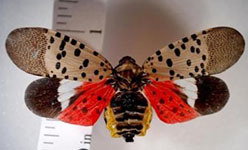 9/5 – Manhattan, HRM 7.5: In mid-afternoon, a live, invasive spotted lanternfly (Lycorma delicatula) was captured and photographed by Natural Areas Stewards Lisa Kozlowski and Daniel Molinaro of the Riverside Park Conservancy near the intersection of 115th Street and Riverside Drive. Riverside Park is situated at the furthest west extent of Manhattan's coastline making up nearly six miles of mixed habitats from 59th Street to 180th Street. 9/5 – Manhattan, HRM 7.5: In mid-afternoon, a live, invasive spotted lanternfly (Lycorma delicatula) was captured and photographed by Natural Areas Stewards Lisa Kozlowski and Daniel Molinaro of the Riverside Park Conservancy near the intersection of 115th Street and Riverside Drive. Riverside Park is situated at the furthest west extent of Manhattan's coastline making up nearly six miles of mixed habitats from 59th Street to 180th Street.
The spotted lanternfly appeared to be on the move as it was discovered after strong westerly winds from the prior night’s cold front. We immediately reported online to the NYSDEC with the pertinent information. The specimen was then frozen awaiting its collection from NYSDEC. (Photo of spotted lanternfly courtesy of NYS DEC)
- Daniel Molinaro
[The spotted laternfly is native to China, India, and southeast Asia. They feed primarily on tree of heaven (Ailanthus altissima) – there are some small populations of tree-of-heaven at and nearby the discovery site. They can also feed on a wide variety of plants such as grapevine, hops, maple, walnut, and fruit trees. Their presence could impact New York's forests as well as agricultural and tourism industries. Daniel Molinaro]
[If you come upon a spotted lanternfly, contact the Bureau of Invasive Species and Ecosystem Health Division of Lands and Forests, NYSDEC at: spottedlanternfly@dec.ny.gov.]
9/6 – Rhinebeck, HRM 90: For several hours this afternoon, as many as 75 cedar waxwings flew into the trees and across the pond beyond my deck. There were many juveniles amongst them and all of them appeared to be eating insects before they took off.
- Phyllis Marsteller
9/6 – Kowawese, HRM 59: Thankfully, the tide was low and made negotiating the multitude of cannonball to basketball-size rocks in the shallows easier. Young-of-year river herring were still mysteriously absent; in recent seasons we’d fill the net with alewives and blueback herring in late summer. Today, it was young-of-year striped bass (70-87 mm), dozens on every haul. We were content with the usual until the final haul produced a large school of sparkling Atlantic silverside (62-84 mm). The river was 74 degrees F, and the salinity was 2.5 ppt.
- Tom Lake, Phyllis Lake
9/6 – Bedford, HRM 35: There was some light migration noted at the Bedford Audubon Chestnut Ridge Hawkwatch today with birds moving south-southwest at fairly low altitudes. Of the 23 raptors noted, osprey was high count with nine. Non-raptor observations included 125 cedar waxwings moving throughout the day as well as six ruby-throated hummingbirds and one monarch butterfly.
- Richard Aracil, Megan Owens
9/6 – Yonkers, HRM 18: Sarah Lawrence College students, as part of the Intensive Yonkers Semester program, seined the beach today at the Sarah Lawrence Center for the Urban River at Beczak. Our tally was 132 river creatures of various species. Non-fishes included moon jellyfish (88, high count), blue crabs and shore shrimp. Among the eight fishes were Atlantic silverside, Atlantic menhaden, bay anchovy, banded killifish, white perch, naked goby, mummichog, and summer flounder.
- Katie Lamboy, Jason Muller
9/6 – Manhattan, HRM 1: We checked our research sampling gear in Hudson River Park at The River Project's sampling station on the lighthouse tender Lilac at Pier 25 today, and once again caught a veritable horde of blue crabs: 45 juveniles (10-60 mm carapace width), as well as five adults (120-165 mm). In addition, there were eight oyster toadfish of varying ages (20-275 mm), four tautog (260-340 mm), a black sea bass (60 mm), a white perch (215 mm), and a tiny little spider crab with a sponge on its head!
-Siddhartha Hayes, Toland Kister
Summer 2019 Natural History Programs
Saturday, September 14 (1:00- 4:00 PM)
Science on the River
Norrie Point Environmental Education Center, Staatsburg
We would like to invite you to our open house featuring hands-on, interactive demonstrations, displaying scientific research and discovery on the estuary and in the Hudson Valley. Activities, with educational games and crafts, will be targeted towards both young and adult audiences.
For more information, email maija.niemisto@dec.ny.gov or call 845-889-4745 x109.
Saturday, September 21 (10:00 AM)
20th annual Hudson River Valley Ramble
Kowawese Unique Area, New Windsor (off Route 9W)
Join us on the beach at low tide as we investigate through sampling (with nets), Hudson River aquatic life in the shadow of Storm King Mountain at the northern gateway to the Hudson Highlands.
For more information, e-mail: trlake7@aol.com
The Hudson River Valley Ramble offers programs throughout the month of September. For more information, visit: https://www.hudsonrivervalleyramble.com/ramble
Hudson River: Striped Bass Cooperative Angler Program
You can share your fishing trip information and help biologists understand and manage our Hudson River striped bass fishery.
Here’s how it works: Fill out a logbook provided by us whenever you fish on the Hudson River (by boat or from shore). Record general location, time, gear used, what you caught (or if you didn’t catch anything) and return the logbook when you are done fishing for the season. You’ll receive an annual newsletter summarizing the information in addition to the latest news regarding regulations and the river. Whether you catch-and-release or take home a keeper, you can be part of the Cooperative Angler Program.
Join today by contacting: jessica.best@dec.ny.gov, or call 845-256-3009
- Jessica Best
Hudson River Miles
The Hudson is measured north from Hudson River Mile 0 at the Battery at the southern tip of Manhattan. The George Washington Bridge is at HRM 12, the Tappan Zee 28, Bear Mountain 47, Beacon-Newburgh 62, Mid-Hudson 75, Kingston-Rhinecliff 95, Rip Van Winkle 114, and the Federal Dam at Troy, the head of tidewater, at 153. The tidal section of the Hudson constitutes a bit less than half the total distance – 315 miles – from Lake Tear of the Clouds to the Battery. Entries from points east and west in the watershed reference the corresponding river mile on the mainstem.
To Contribute Your Observations or to Subscribe
The Hudson River Almanac is compiled and edited by Tom Lake and emailed weekly by DEC's Hudson River Estuary Program. Share your observations by e-mailing them to trlake7@aol.com.
To subscribe to the Almanac (or to unsubscribe), use the links on DEC's Hudson River Almanac or DEC Delivers web pages.
Discover New York State Conservationist - the award-winning, advertisement-free magazine focusing on New York State's great outdoors and natural resources. Conservationist features stunning photography, informative articles and around-the-state coverage. Visit the Conservationist webpage for more information.
Useful Links
National Oceanic and Atmospheric Administration online tide and tidal current predictions are invaluable when planning Hudson River field trips.
For real-time information on Hudson River tides, weather and water conditions from sixteen monitoring stations, visit the Hudson River Environmental Conditions Observing System website.
DEC's Smartphone app for iPhone and Android is now available at: New York Fishing, Hunting & Wildlife App.
Adventure NY
Under Governor Cuomo's Adventure NY initiative, DEC is making strategic investments to expand access to healthy, active outdoor recreation, connect more New Yorkers and visitors to nature and the outdoors, protect natural resources, and boost local economies. This initiative will support the completion of more than 75 projects over the next three years, ranging from improvements to youth camps and environmental education centers to new boat launches, duck blinds, and hiking trails. Read more about the Adventure NY initiative. For more information on planning an outdoor adventure in New York State, visit DEC's website at http://www.dec.ny.gov/outdoor.
Information about the Hudson River Estuary Program is available on DEC's website at http://www.dec.ny.gov/lands/4920.html.
|