A Project of the Hudson River Estuary Program
Compiled by Tom Lake, Consulting Naturalist
Overview
Spring became summer this week with eagle nestlings teetering on first flights and young-of-year fishes filling the nets of teachers and scientists. Venomous snakes and talk of barracudas livened up an array of common stories.
Highlight of the Week
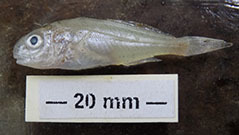 6/15 – Croton, HRM 35: It was a perfect afternoon to be in the river, which we did with our 110-foot seine on the swimming beach at Croton Point. A group of 60, many up to their waists in the warm 73-degree Fahrenheit (F) water, were helping us sample the inshore shallows for the Clearwater’s 42nd annual Great Hudson River Revival. Our catch was modest, a product of the season (many fewer young-of-year fishes around) and the low salinity, 3.0 parts-per-thousand (ppt.). Among our catch were small American eels, spottail shiners, hogchokers, a 92-millimeter (mm) striped bass, white perch, a yearling alewife (116 mm), and one surprise, a young-of-year Atlantic croaker (37 mm). (Photo of Atlantic croaker courtesy of Tom Lake) 6/15 – Croton, HRM 35: It was a perfect afternoon to be in the river, which we did with our 110-foot seine on the swimming beach at Croton Point. A group of 60, many up to their waists in the warm 73-degree Fahrenheit (F) water, were helping us sample the inshore shallows for the Clearwater’s 42nd annual Great Hudson River Revival. Our catch was modest, a product of the season (many fewer young-of-year fishes around) and the low salinity, 3.0 parts-per-thousand (ppt.). Among our catch were small American eels, spottail shiners, hogchokers, a 92-millimeter (mm) striped bass, white perch, a yearling alewife (116 mm), and one surprise, a young-of-year Atlantic croaker (37 mm). (Photo of Atlantic croaker courtesy of Tom Lake)
- Tom Lake, T.R. Jackson, Eli Schloss
[The Atlantic croaker (Micropogonias undulatus) is one of seven members of the drum family (Sciaenidae) found in our watershed, some of which have specially-developed swim or air bladders that can produce a “croaking” or “drum” sound. They are found along the Atlantic coast from Massachusetts to the Gulf of Mexico and are much more common in the southern end of their range. They spawn offshore, after which their young-of-year move to inshore waters and estuaries in summer and fall when they are not uncommon in the lower estuary. The largest adults can reach 18-24-inches and weigh just over two pounds. Their trivial name undulatus translates from Latin as “wavy,” a tribute to their subtle, squiggly color pattern, an adaption of concealment that allows them to dissolve into background shadows. Tom Lake]
[Note: one inch = 25.4 millimeters (mm)]
Natural History Entries
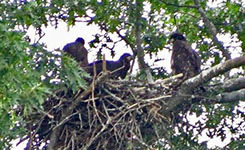 6/15 – Town of Wappinger, HRM 67.5: For the last week, the increased greenery around bald eagle nest NY457A had made it difficult to see if the three nestlings were still there or had fledged. Today, with patience, and a good angle, I photographed all three nestlings in silhouetted profile making the nest look very crowded. (Photo of bald eagle nestlings courtesy of Dana Layton) 6/15 – Town of Wappinger, HRM 67.5: For the last week, the increased greenery around bald eagle nest NY457A had made it difficult to see if the three nestlings were still there or had fledged. Today, with patience, and a good angle, I photographed all three nestlings in silhouetted profile making the nest look very crowded. (Photo of bald eagle nestlings courtesy of Dana Layton)
- Dana Layton
6/15 – Newburgh, HRM 61: I have been frequently watching bald eagle nest NY488 this spring. The nest is in its second season; last year the pair fledged two nestlings. They have two more again this year, and both are beginning to “branch.” This is an expression we use to describe when the nestlings’ curiosity is more than they can ignore, and they begin to flap their wings and roam, taking practice mini-flights and branch hopping. They looked to be the size of the adults which meant they were only days from taking their first real flight.
- Jeremy Baracca
6/15 – Beacon, HRM 61: Due to special events at Long Dock Park, I had to fish the river just north of the train station. It seemed like some of the fish followed me as I managed to catch three channel catfish, two goldfish, and a carp. The catfish were small (14-16-inches) as was the carp (19-inches). One of the two goldfish (13.5-inches) was a brilliant deep red. The other was a foot-long and brassy gold. Along the river, it seemed as though the carp spawning season had ended, or at least had slackened off.
- Bill Greene
6/15 – Yonkers, HRM 18: We held our first public seining event at the Sarah Lawrence Center for the Urban River at Beczak today as part of our River Explorers series. Our modest group of 13 plus educators caught an impressive seven fish species, including American eel, bay anchovies, mummichogs, hogchokers, striped bass, white perch, and a darling little naked goby. Crustaceans, however, were high count with shore shrimp (31) and blue crabs (19).
- Katie Lamboy, Eli Caref, Jay Muller
[Naked gobies (Gobiosoma bosc) are small estuarine fish, usually less than 75 (mm) long, found in shallow, sandy inshore areas of the lower estuary. They lack scales on their body, hence the common name "naked." Their pectoral fins form a disk on their abdomen and when kept in aquaria, will often "stick" themselves to the side of the glass. In the distant past when the river had extensive oyster beds – their preferred habitat – it is likely that the naked goby was much more common. Tom Lake]
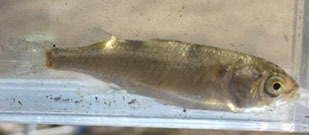 6/15 – Queens, New York City: While seining Little Bay this afternoon, adjacent to the Throgs Neck Bridge, the Alley Pond Park Environmental Center teachers (Kaitlyn and Anna) caught, measured, and released a young-of-year white mullet (Mugil curema) (42 mm). Also found in their net were mummichogs, shore shrimp, and eastern mud snails. The water temperature was 67 degrees F and the salinity was 25.0 ppt. (Photo of white mullet courtesy of Peter Park) 6/15 – Queens, New York City: While seining Little Bay this afternoon, adjacent to the Throgs Neck Bridge, the Alley Pond Park Environmental Center teachers (Kaitlyn and Anna) caught, measured, and released a young-of-year white mullet (Mugil curema) (42 mm). Also found in their net were mummichogs, shore shrimp, and eastern mud snails. The water temperature was 67 degrees F and the salinity was 25.0 ppt. (Photo of white mullet courtesy of Peter Park)
- Peter Park
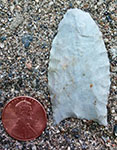 6/16 – Wallkill River, HRM 77: It was twenty years ago today, as I walked along the edge of a fallow cornfield listening to the “witchity-witchity-witchity” song of the common yellowthroat, that I spotted a piece of gray stone (chert) slightly protruding from a crack in the dry earth. It was the thin edge of a small projectile point, 47 x 25 (mm), staring up at me having partially eroded from the soil. I had found a very old Indian spear point that was later stylistically-dated to c. 12,500 years ago. The implications reconfirmed our sense of the incredible time-depth of our Hudson Valley. (Photo barnes point courtesy of Tom Lake) 6/16 – Wallkill River, HRM 77: It was twenty years ago today, as I walked along the edge of a fallow cornfield listening to the “witchity-witchity-witchity” song of the common yellowthroat, that I spotted a piece of gray stone (chert) slightly protruding from a crack in the dry earth. It was the thin edge of a small projectile point, 47 x 25 (mm), staring up at me having partially eroded from the soil. I had found a very old Indian spear point that was later stylistically-dated to c. 12,500 years ago. The implications reconfirmed our sense of the incredible time-depth of our Hudson Valley. (Photo barnes point courtesy of Tom Lake)
- Tom Lake
[This stone artifact was a Barnes-type fluted spear point, a style that originated in southwestern Ontario about 12,500 calendar years ago. However, the lithic material came from a bedrock quarry in Sussex County, NJ, nearly 500 miles to the southeast. These fluted points predate “arrowheads” by eleven thousand years and are a diagnostic tool of what archaeologists believe were the first of us, called Paleoindian, to enter the Hudson Valley. The Wallkill River Valley was a seasonal passageway for these hunter-gatherers from Ontario, through the Mohawk River Valley, then south along the Hudson River, stopping at stone quarries along the way and following game herds into northern New Jersey. Tom Lake]
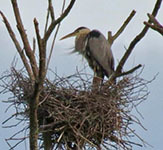 6/16 – Bedford: HRM 35: The nestlings at the great blue heron rookery continued to grow and look more like their parents. As I watched today, they spent much time preening their new feathers. There were two adults standing on the edge of two nests that appeared empty. There may be nestlings that I could not see, but I counted 16 nestlings in eight nests. This period of continuous rain may have been a cause for the loss of several nestlings. (Photo of great blue heron courtesy of Jim Steck) 6/16 – Bedford: HRM 35: The nestlings at the great blue heron rookery continued to grow and look more like their parents. As I watched today, they spent much time preening their new feathers. There were two adults standing on the edge of two nests that appeared empty. There may be nestlings that I could not see, but I counted 16 nestlings in eight nests. This period of continuous rain may have been a cause for the loss of several nestlings. (Photo of great blue heron courtesy of Jim Steck)
- Jim Steck
6/17 – Fort Montgomery, HRM 46.5: At the head of a popular hiking trail in Fort Montgomery, I came upon a large copperhead snake attempting to warm itself on a cool, cloudy morning. The snake was calm as I stayed my distance, and it allowed me to watch and take photos. (Photo of copperhead courtesy of William Sherwood)
- William Sherwood
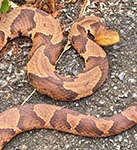 [The northern copperhead (Agkistrodon contortrix) is not a state-listed species like the timber rattlesnake (that is to say not a species of Special Concern, Threatened, or Endangered). However, it is listed as a New York State Species of Greatest Conservation Need: The status of these species is known, and conservation action is needed. These species are experiencing some level of population decline, have identified threats that may put them in jeopardy, and need conservation actions to maintain stable population levels or sustain recovery. Jesse Jaycox] [The northern copperhead (Agkistrodon contortrix) is not a state-listed species like the timber rattlesnake (that is to say not a species of Special Concern, Threatened, or Endangered). However, it is listed as a New York State Species of Greatest Conservation Need: The status of these species is known, and conservation action is needed. These species are experiencing some level of population decline, have identified threats that may put them in jeopardy, and need conservation actions to maintain stable population levels or sustain recovery. Jesse Jaycox]
6/17 – Yonkers, HRM 18: From time to time, our interns at the Sarah Lawrence Center for the Urban River at Beczak conduct “practice programs” to hone their techniques and teaching skills. Today’s hauls caught mummichogs, bay anchovies, and blue crabs.
- Sam Macaluso, Natalia Benejam, Lucy Jurina
*** Fish of the Week ***
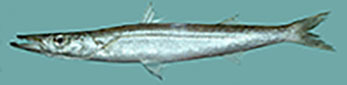 6/18– Hudson River Watershed: Week 27 for Fish-of-the-Week is the northern sennet (Sphyraena borealis), number 195 (of 228) on our watershed list of fishes. (If you would like a copy of our list, e-mail: trlake7@aol.com.) 6/18– Hudson River Watershed: Week 27 for Fish-of-the-Week is the northern sennet (Sphyraena borealis), number 195 (of 228) on our watershed list of fishes. (If you would like a copy of our list, e-mail: trlake7@aol.com.)
A sure-fire way to regain the attention of students, while seining in the river, is to calmly mention that “We have barracuda in the Hudson!” The northern sennet is, in fact, a barracuda, one of two members of that family (Sphyraenidae) in the estuary (we will cover the other attention-getting member next week). Unless they ask, we generally don’t tell that these barracudas max out at 18-inches-long, hardly the great barracuda (S. barracuda) that can grow to more than six-feet-long. Northern sennet are found in coastal waters from Cape Cod to Florida and are an apex predator in their own right. Those we catch in beach seines, however rarely, are usually young-of-year measuring just 3-5-inches. (Photo of northern sennet courtesy of Brandi Noble)
- Tom Lake
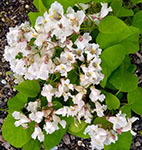 6/19 – Beacon, HRM 61: A sharp south wind had built a strong chop that was striking the beach, creating a turbid high-energy zone. We expected to see white perch in our seine since they seem drawn to such opportunities to forage. When our net came in, we thought we had caught a school of small white perch – the net was filled with many small, bright-white shapes. Peeling back the top seam-line, we discovered a seine full of white flowers. Looking just down the beach, we saw that we had netted not far from a northern catalpa tree in full bloom. The strong wind had sent the flowers into the water. Our next haul caught the expected: eight white perch. With tacit approval from one of them, we inspected its gut. It was fairly filled with amphipods (Gammarus sp.). The river was 71 degrees F. (Photo of northern catalpa courtesy of Tom Lake) 6/19 – Beacon, HRM 61: A sharp south wind had built a strong chop that was striking the beach, creating a turbid high-energy zone. We expected to see white perch in our seine since they seem drawn to such opportunities to forage. When our net came in, we thought we had caught a school of small white perch – the net was filled with many small, bright-white shapes. Peeling back the top seam-line, we discovered a seine full of white flowers. Looking just down the beach, we saw that we had netted not far from a northern catalpa tree in full bloom. The strong wind had sent the flowers into the water. Our next haul caught the expected: eight white perch. With tacit approval from one of them, we inspected its gut. It was fairly filled with amphipods (Gammarus sp.). The river was 71 degrees F. (Photo of northern catalpa courtesy of Tom Lake)
- Tom Lake, T.R. Jackson B.J. Jackson
[Northern catalpa (Catalpa speciosa) is a showy tree with gorgeous trumpet-shaped flowers, white with yellow stripes and purple spots. They are native to the American Midwest and have been introduced into the Hudson Valley as ornamentals. Tom Lake]
6/19 – Croton Bay, HRM 34: Aboard the 7:15 AM Metro North train to Manhattan’s Grand Central Station, I watched five great blue herons wading and fishing in the river off Crawbuckie Beach along Croton Bay. The two-day total of great blue herons I counted was ten.
- Hugh McLean
[When we read reports from Jim Steck and Rick Stafford of adult great blue herons being away from their rookery in Bedford, presumably hunting to feed their nestlings, this may be one of their stops along the way. Tom Lake]
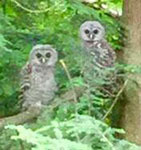 6/20 –Town of Poughkeepsie, HRM 70: A day hardly goes by that I don't look out my window or step into the yard without seeing or hearing owls. Today, two barred owls were perched together keeping a close eye on the ground under our bird feeders where chipmunks were usually scurrying around. (Photo of barred owls courtesy of Doreen Tinganelli) 6/20 –Town of Poughkeepsie, HRM 70: A day hardly goes by that I don't look out my window or step into the yard without seeing or hearing owls. Today, two barred owls were perched together keeping a close eye on the ground under our bird feeders where chipmunks were usually scurrying around. (Photo of barred owls courtesy of Doreen Tinganelli)
- Doreen Tignanelli
6/20 – Kowawese, HRM 59: Storm King Mountain was shrouded in clouds. Fittingly, a thunderstorm was forecast. What our catch lacked in numbers was made up with diversity, including spottail shiners, tessellated darters, white perch, hogchokers, American eels, pumpkinseed sunfish, and male banded killifish sporting their lavender breeding colors. The river was 79 degrees F.
- Tom Lake, A. Danforth
6/20 – Croton-on-Hudson, HRM 34.5: While waiting for the 7:15 AM train to Manhattan’s Grand Central Terminal, I was able to see an adventurous osprey nestling perched on an antenna beside the cell tower nest loudly calling for “room service.” I waited as long as I could, but alas, my train left before breakfast was delivered.
- Hugh McLean
6/21 – Kowawese, HRM 59: At 11:54 AM, the Summer Solstice arrived at the river. The flood tide had just begun, and after a steady rain for what seemed like days, the sun poked through the clouds over Storm King Mountain and the northern gateway to the Hudson Highlands. In a few spots, the river’s surface was dimpled with what may have been tiny young-of-year fishes; a hundred feet out in the river a large fish breached the surface and splashed back – carp? striped bass? An immature bald eagle cruised past, looking not at us, but down into the near-shore shallows – low tide is always hunting time for eagles. We had come to fish but decided to just take in the warm summer air and consider how often our language is inadequate to describe the wonders of the world. We also wondered what the patron saint of wilderness philosophers would have to say about this:
“...any good poet, in our age at least, must begin with the scientific view of the world; and any scientist worth listening to must be something of a poet, must possess the ability to communicate to the rest of us his sense of love and wonder at what his work discovers.” Edward Abbey, The Journey Home
Cooled by a soft south breeze, we stood in the river up to our knees and took in the onset of summer – the nature of the scene blended seamlessly with the science of its parts.
- Tom Lake, B.J. Jackson
6/21 – Yonkers, HRM 18: More than 60 third-grade students from Dos Puentes Elementary visited the Sarah Lawrence Center for the Urban River at Beczak to go seining with our staff. We had an exciting morning despite some rain. Our fish catch was nicely diverse and included American eels, bay anchovies, striped bass, white perch, and mummichogs. Among the crustaceans were shore shrimp and 33 small blue crabs.
- Eli Caref, Katie Lamboy, Jay Muller, Natalia Benejam, Sam Macaluso, George Scott, Delphine Griffith
Spring-Summer 2019 Natural History Programs
Wednesday, July 10 - Thursday July 11 (9:00 AM - 5:00 PM)
2019 Teachers on the Estuary and Living Environment Institute
Wonders of Wetlands (15 credit hours for NYS certified teachers and administrators)
Five Rivers Environmental Education Center, 56 Game Farm Road, Delmar, New York
Join us this summer as we explore the Wonders of Wetlands. Teachers will spend two days gaining valuable knowledge and learning new curricula. We will use interdisciplinary approaches with the guidance of experts like EPA Award Winner Chris Bowser.
Cost: $50.00 for materials, supplies, and refreshments (light dinner on Thursday)
To register, e-mail drew.hopkins@dec.ny.gov
Tuesday, August 20 - Thursday August 22 (9:00 AM - 4:00 PM)
2019 Teachers on the Estuary and Living Environment Institute
Amazing Watersheds (22 credit hours for NYS certified teachers and administrators)
Five Rivers Environmental Education Center, 56 Game Farm Road, Delmar, New York
Join us this summer as we explore amazing watersheds. Teachers will spend three days gaining valuable knowledge and learning new curricula while using interdisciplinary approaches to explore watersheds. Some easy hiking on trails is involved.
Cost: $60.00 for materials, supplies, and refreshments (dinner provided on Wednesday)
To register, e-mail drew.hopkins@dec.ny.gov
Saturday, September 14 - 1:00- 4:00 PM
Science on the River
Norrie Point Environmental Education Center, Staatsburg
We would like to invite you to our open house featuring hands-on, interactive demonstrations, displaying scientific research and discovery on the estuary and in the Hudson Valley. Activities, with educational games and crafts, will be targeted towards both young and adult audiences.
For more information, email maija.niemisto@dec.ny.gov or call 845-889-4745 x109.
Hudson River: Striped Bass Cooperative Angler Program
You can share your fishing trip information and help biologists understand and manage our Hudson River striped bass fishery.
Here’s how it works: Fill out a logbook provided by us whenever you fish on the Hudson River (by boat or from shore). Record general location, time, gear used, what you caught (or if you didn’t catch anything) and return the logbook when you are done fishing for the season. You’ll receive an annual newsletter summarizing the information in addition to the latest news regarding regulations and the river. Whether you catch-and-release or take home a keeper, you can be part of the Cooperative Angler Program.
Join today by contacting: jessica.best@dec.ny.gov, or call 845-256-3009
- Jessica Best
Hudson River Miles
The Hudson is measured north from Hudson River Mile 0 at the Battery at the southern tip of Manhattan. The George Washington Bridge is at HRM 12, the Tappan Zee 28, Bear Mountain 47, Beacon-Newburgh 62, Mid-Hudson 75, Kingston-Rhinecliff 95, Rip Van Winkle 114, and the Federal Dam at Troy, the head of tidewater, at 153. The tidal section of the Hudson constitutes a bit less than half the total distance – 315 miles – from Lake Tear of the Clouds to the Battery. Entries from points east and west in the watershed reference the corresponding river mile on the mainstem.
To Contribute Your Observations or to Subscribe
The Hudson River Almanac is compiled and edited by Tom Lake and emailed weekly by DEC's Hudson River Estuary Program. Share your observations by e-mailing them to trlake7@aol.com.
To subscribe to the Almanac (or to unsubscribe), use the links on DEC's Hudson River Almanacor DEC Delivers web pages.
Discover New York State Conservationist - the award-winning, advertisement-free magazine focusing on New York State's great outdoors and natural resources. Conservationist features stunning photography, informative articles and around-the-state coverage. Visit the Conservationist webpage for more information.
Useful Links
National Oceanic and Atmospheric Administration online tide and tidal current predictions are invaluable when planning Hudson River field trips.
For real-time information on Hudson River tides, weather and water conditions from sixteen monitoring stations, visit the Hudson River Environmental Conditions Observing System website.
DEC's Smartphone app for iPhone and Android is now available at: New York Fishing, Hunting & Wildlife App.
Adventure NY
Under Governor Cuomo's Adventure NY initiative, DEC is making strategic investments to expand access to healthy, active outdoor recreation, connect more New Yorkers and visitors to nature and the outdoors, protect natural resources, and boost local economies. This initiative will support the completion of more than 75 projects over the next three years, ranging from improvements to youth camps and environmental education centers to new boat launches, duck blinds, and hiking trails. Read more about the Adventure NY initiative. For more information on planning an outdoor adventure in New York State, visit DEC's website at http://www.dec.ny.gov/outdoor.
Information about the Hudson River Estuary Program is available on DEC's website at http://www.dec.ny.gov/lands/4920.html.
|