A Project of the Hudson River Estuary Program
Compiled by Tom Lake, Consulting Naturalist
Overview
This was a week of highlights – any one of several could have made the grade – from the High Peaks of the Adirondacks to the East River and Sandy Hook (NJ). Investigation and exploration by skilled naturalists created memorable moments for students of the Hudson River.
Highlight of the Week
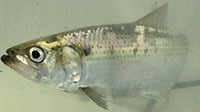 6/7 – Manhattan, HRM 0: Three days ago, sixth-grade students from Intermediate School 77 in Queens participated in our Battery Park City Authority Marine Education Catch-and-Release Fishing Program off the esplanade in Wagner Park at Battery Park City. The students fished with rod and reel using bloodworms for bait. 6/7 – Manhattan, HRM 0: Three days ago, sixth-grade students from Intermediate School 77 in Queens participated in our Battery Park City Authority Marine Education Catch-and-Release Fishing Program off the esplanade in Wagner Park at Battery Park City. The students fished with rod and reel using bloodworms for bait.
In late morning, a student hooked and landed a large herring that we temporarily placed in a tank with aerated river water prior to releasing. The fish measured eleven-inches, and after much consideration, we identified it as a hickory shad, a somewhat uncommon species in the estuary. After taking photos, the hickory shad was successfully released. The students caught one other fish that day, a small black sea bass. (Photo of hickory shad courtesy of Laken Fournier)
- Doug Van Horn, Laken Fournier, Gamal Jones
Natural History Entries
[Correction: The osprey photo and entry for June 4 in last week’s Almanac, incorrectly attributed to Jim Yates, stated that the nest image was of an adult and two nestlings. It should have stated three adult osprey, the third one being an interloper. The mistake was ours, not Jim’s. Tom Lake]
6/7 – Ulster County, HRM 76: At 10:15 PM this evening, on a road in Kerhonkson, we encountered a two-foot-long timber rattlesnake (photo confirmed by Jesse Jaycox) as it moved slowly across the road. The snake held the end of its tail up slightly (not unusual for a rattlesnake). A barred owl also was watching. As the snake disappeared at the edge of the road, the owl's vocalizations changed raucously. We wondered if our headlights had interrupted the owl's late-night meal.
- Sarah Underhill, Betty Boomer.
[Many populations of timber rattlesnake (Crotalus horridus) have been depleted or extirpated due to human persecution, collection, and habitat loss, which is why they are listed as a New York State Threatened Species. Because of this, entries such as this one are intentionally left vague other than to note its general presence in an area. Jesse Jaycox]
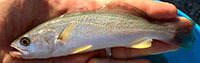 6/7 – Piermont, HRM 25: We hauled our otter trawl aboard the deck of the Hudson River Sloop Clearwater in mid-morning just offshore of the dock in Piermont. Eighth-graders from Whitney Houston Academy in East Orange (NJ) waited in anticipation as though a present would be unwrapped. In the cod end of the net where the fish collect, we found a 15-inch American shad, probably headed back to the sea as the spawning season was about over. Other fishes in the net, to the delight of the students, included a weakfish and a striped bass, as well as Atlantic tomcod, white perch, hogchokers, and blue crabs. (Photo of weakfish courtesy of Peter Park) 6/7 – Piermont, HRM 25: We hauled our otter trawl aboard the deck of the Hudson River Sloop Clearwater in mid-morning just offshore of the dock in Piermont. Eighth-graders from Whitney Houston Academy in East Orange (NJ) waited in anticipation as though a present would be unwrapped. In the cod end of the net where the fish collect, we found a 15-inch American shad, probably headed back to the sea as the spawning season was about over. Other fishes in the net, to the delight of the students, included a weakfish and a striped bass, as well as Atlantic tomcod, white perch, hogchokers, and blue crabs. (Photo of weakfish courtesy of Peter Park)
- Samuel Nadell
[Weakfish (Cynoscion regalis) are one of seven members of the drum family (Sciaenidae) found in our watershed. Their slender form and often colorful, spotted appearance accounts for their colloquial common name of “sea trout.” It is possible that weakfish may have been the unfamiliar species that confused Henry Hudson’s crew in September 1609, when they reported seeing “great stores of salmon” in the Hudson River. The common name "weakfish," refers to the thin and easily-torn membrane of their mouth, that coupled with their tenacious fighting skills, tends to shed fish hooks. Tom Lake]
6/7 – Yonkers, HRM 18: The Sarah Lawrence Center for the Urban River at Beczak hosted a small reunion tour of Sarah Lawrence College graduates. A seining demonstration was performed by current Sarah Lawrence College students, Delphine Griffith and George Scott, working as Research Fellows. Their catch included bay anchovy, white perch, and blue crabs.
- Katie Lamboy
6/8 – Newcomb, HRM 302: Our lilacs were blooming, and they looked and smelled wonderful. Four different butterflies visited the flowers today: tiger swallowtail, red admiral, painted lady, and mourning cloak.
- Charlotte Demers
 6/8 – New Paltz, HRM 76: The blooming of the shadbush (Amelanchier sp.) may herald the arrival of shad in the Hudson River, but the bloom does not directly cause them to arrive. Not so with the ripening shadbush berries. They cause the cedar waxwings to arrive at their branches and perform acrobatics to pull the berries off the stems. The berries on our big shadbush ripen over a good number of days, and the tree was now alive with birds going after the berries. Sometimes, the cedar waxwings hover by a spray of berries and pluck them while in the air. As landscape plants, shadbush is not only beautiful but is entertaining. (Photo of cedar waxwing courtesy of Wendy Kuehner) 6/8 – New Paltz, HRM 76: The blooming of the shadbush (Amelanchier sp.) may herald the arrival of shad in the Hudson River, but the bloom does not directly cause them to arrive. Not so with the ripening shadbush berries. They cause the cedar waxwings to arrive at their branches and perform acrobatics to pull the berries off the stems. The berries on our big shadbush ripen over a good number of days, and the tree was now alive with birds going after the berries. Sometimes, the cedar waxwings hover by a spray of berries and pluck them while in the air. As landscape plants, shadbush is not only beautiful but is entertaining. (Photo of cedar waxwing courtesy of Wendy Kuehner)
- Lynn Bowdery, Allan Bowdery
6/8 – New Paltz, HRM 76: I hiked with friends today on the Gertrude’s Nose trail at Minnewaska State Park. The mountain laurel was just starting to bloom, and a couple of monarch butterflies were spotted. While admiring the views along the cliff faces, black vultures soared overhead. After our nine-mile hike, we rested at the southern end of the formerly fish-less Lake Minnewaska. A pH of 4.5. had contributed to that condition, but recently the pH has begun to rise to a level closer to neutral, making the lake more inhabitable for fish (introduced golden shiners and largemouth bass). What does seem to thrive very well are red-spotted newts. We saw many today swimming and walking on the bottom of the lake.
- Jim Steck
6/9 – Schoharie County, HRM 129: How encouraging it was to see bald eagle action at the headwaters of Catskill Creek at the Franklinton Vlaie Wildlife Management Area. Two adult bald eagles soared around before perching along the shoreline. I could see the yellow legs of the flyover bird through the white of its tail feathers. I was so intrigued watching this eagle fly over my kayak that I didn’t notice the other one perched in a tree peering down at me. The eagles were kept alert by an immature red-tailed hawk demonstrating territorial behavior. I watched a red-winged blackbird play hopscotch on the lily pads while paddling toward two large boulders that serve as a natural fishing platform for anglers. The water hitting the outcrop sounded like a thirsty dog eagerly lapping from its water dish.
- Fran Martino
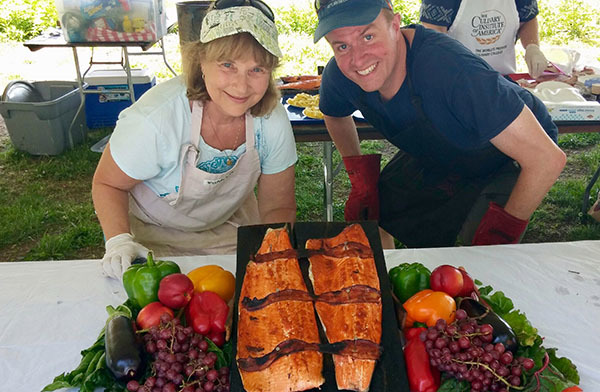
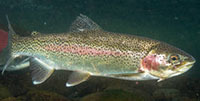 6/9 – Beacon, HRM 61: Many hundreds of river-lovers gathered at Pete and Toshi Seeger Park today to celebrate the Beacon Sloop Club’s annual Strawberry Festival. For our “shad bake,” we smoked, planked (baked), and served free samples of no fewer than fifty rainbow trout, a labor-intensive but true labor of love. The American shad fishery was closed in 2010. Today, we cook steelhead, or rainbow trout (Oncorhynchus mykiss), an introduced species in the Hudson River. Our steelhead were provided by a Hudson River Valley aquaculture facility in Hudson, as the spirit of the original shad bake lives on. Planking and smoking produces a specialty food. However, in the time before modern preservation, smoking allowed the abundance of springtime protein from the sea to be stretched well into summer. (Photo of rainbow trout courtesy of US Fish and Wildlife Service) 6/9 – Beacon, HRM 61: Many hundreds of river-lovers gathered at Pete and Toshi Seeger Park today to celebrate the Beacon Sloop Club’s annual Strawberry Festival. For our “shad bake,” we smoked, planked (baked), and served free samples of no fewer than fifty rainbow trout, a labor-intensive but true labor of love. The American shad fishery was closed in 2010. Today, we cook steelhead, or rainbow trout (Oncorhynchus mykiss), an introduced species in the Hudson River. Our steelhead were provided by a Hudson River Valley aquaculture facility in Hudson, as the spirit of the original shad bake lives on. Planking and smoking produces a specialty food. However, in the time before modern preservation, smoking allowed the abundance of springtime protein from the sea to be stretched well into summer. (Photo of rainbow trout courtesy of US Fish and Wildlife Service)
- Chris Bowser, Tom Lake, Phyllis Lake, T.R. Jackson
[This was our thirty-fifth consecutive year of Hudson River Foundation-sponsored “shad bakes” at many locations along the river from Troy to Manhattan and Liberty Island State Park. Our shad bakes have their origin in pre-Colonial times. Native Americans baked fish on huge riverside roasting platforms, some of which were a half-acre in size. Fires, hot coals, and fire-heated cobbles were set around huge flat rocks upon which shad and other fish were placed for slow cooking and hot smoking. We have always wondered if they saw this as a festive occasion with song and dance and laughter. How could they not? Our modern “shad bake” serves a dual purpose: while we celebrate the springtime, we also hope to reconnect people to the river. Tom Lake]
6/9 – Bedford, HRM 35: The great blue heron rookery had two nest guardians on duty today. I saw one heron circle around, but it did not stop at a nest. The nestlings were getting larger with the oldest starting to look like their parents, with their wing feathers nearly grown out, their bills taking on a yellow color, but their tail feathers had yet to appear. The youngest were still down-covered with bills that were almost black. While it was still difficult to get an accurate total count of nestlings, today I counted 22, with one nest having five.
- Jim Steck
6/10 – Town of Athens, HRM 119: Murderers Creek, a Hudson River tributary, is short, but sweet. It is always worth taking a short paddle off the main stem in my 10-foot Hornbeck pack canoe, and today was no exception. Four bald eagles, three adults and one immature, joined me as I escaped the hustle and bustle of a busy boating day on the river. I watched the immature make an attempt to catch a fish but came up with empty talons. The carp in the shallow water were longer than the blade of my kayak paddle.
- Fran Martino
6/10 – Yonkers, HRM 18: The newest addition to our staff at the Sarah Lawrence Center for the Urban River at Beczak was Sarah Lawrence College student Lucy Jurina. Before rain appeared along the river, Lucy joined high school interns Taylor Childs and Brandon Restler in six haul seines for training purposes. They caught blue crabs, shore shrimp, and white perch.
- Katie Lamboy
** Fish of the Week**
6/11– Hudson River Watershed: Week 26 for our Fish-of-the-Week is the hickory shad (Alosa mediocris), number 23 (of 228) on our watershed list of fishes. (If you would like a copy of our list, e-mail: trlake7@aol.com.)
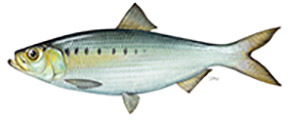 Hickory shad, like American shad, are anadromous, in that they are ocean fish that return to their natal rivers in spring to spawn. In their home range, from Chesapeake to Georgia, they also have a small fall spawning run. Their trivial name (mediocris) translates from Latin as “ordinary, mediocre.” This refers to the opinion of Samuel L. Mitchill (1814), the ichthyologist who named the hickory shad. Mitchill was referring to their supposed poor culinary quality. At points south along the Atlantic Coast, such as Chesapeake Bay, commercial operations used to separate hickory shad from American shad and river herring because their market price was much less. I have smoked hickory shad and would rate them below American shad for taste, but considerably above gizzard shad and Atlantic menhaden. Hickory shad, like American shad, are anadromous, in that they are ocean fish that return to their natal rivers in spring to spawn. In their home range, from Chesapeake to Georgia, they also have a small fall spawning run. Their trivial name (mediocris) translates from Latin as “ordinary, mediocre.” This refers to the opinion of Samuel L. Mitchill (1814), the ichthyologist who named the hickory shad. Mitchill was referring to their supposed poor culinary quality. At points south along the Atlantic Coast, such as Chesapeake Bay, commercial operations used to separate hickory shad from American shad and river herring because their market price was much less. I have smoked hickory shad and would rate them below American shad for taste, but considerably above gizzard shad and Atlantic menhaden.
When we commercially fished on the Hudson River in the spring more than a decade ago, we'd see 2-3 hickory shad each spring mixed in with the immense run of American shad. Then, on occasion, we'd see a small "fall run" of hickory shad in the river as far upstream as New Hamburg. They are a wonderful sport fish. (Photo of hickory shad courtesy of ASMFC)
- Tom Lake
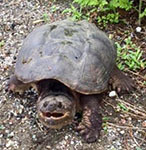 6/11 – Westchester County, HRM 40: This is the season for snapping turtles laying eggs, and unfortunately, crossing highways. I encountered a large female trying to cross Route 684 at Golden’s Bridge. With assistance from two others, we managed to divert her back into the brush. She did not want to go back and got nasty about it. Quite likely our rescue would not stick. (Photo of snapping turtle courtesy of Rick Stafford) 6/11 – Westchester County, HRM 40: This is the season for snapping turtles laying eggs, and unfortunately, crossing highways. I encountered a large female trying to cross Route 684 at Golden’s Bridge. With assistance from two others, we managed to divert her back into the brush. She did not want to go back and got nasty about it. Quite likely our rescue would not stick. (Photo of snapping turtle courtesy of Rick Stafford)
- Rick Stafford
6/11 – Manhattan, New York City: The Randall's Island Park Alliance conducted a public seining clinic today. Twenty-three participants helped us haul our 30-foot seine in the Harlem River. The fish among our catch included an impressive 18 Atlantic tomcod, 28 bay anchovies, and three northern pipefish. Other in the net were sand shrimp, shore shrimp, blue crabs, isopods, golden star tunicates (Botryllus schlosseri), and 148 mud snails.
- Chris Girgenti (Natural Areas Manager)
6/12 – Newcomb, HRM 302: Female snapping turtles were now laying eggs. They are frequently seen along the road edges, where they dig in the soft dirt on the shoulders and lay their eggs. The beautiful orchid lady's slipper was in bloom along with tiny twinflowers, spring avens (Rose family), bunchberry and Clintonia, just to name a few.
- Charlotte Demers
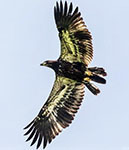 6/12 – Town of Poughkeepsie: On Day 81, at bald eagle nest NY2, both nestlings took their first flight as fledglings. NY62 has been at its present location for nine years, and across eight of those years (the nest failed one year), the adults have fledged ten young. The average fledge date has been 81.2 days, making this year exactly on average. Overall in 19 years, NY62, at three different nest locations, has fledged 20 young. (Photo of bald eagle courtesy of Bob Rightmyer) 6/12 – Town of Poughkeepsie: On Day 81, at bald eagle nest NY2, both nestlings took their first flight as fledglings. NY62 has been at its present location for nine years, and across eight of those years (the nest failed one year), the adults have fledged ten young. The average fledge date has been 81.2 days, making this year exactly on average. Overall in 19 years, NY62, at three different nest locations, has fledged 20 young. (Photo of bald eagle courtesy of Bob Rightmyer)
- Bob Rightmyer
6/12 – Yonkers, HRM 18: We conducted a beach-seine program today at the Sarah Lawrence Center for the Urban River with 4th grade students from Seely Place School in Scarsdale. They caught a favorable low tide and netted American eels, bay anchovies, mummichogs, striped bass, white perch, a bluegill sunfish, and a soft-shelled clam. Among crustaceans were shore shrimp and blue crabs, one which measured 150 millimeter(mm) carapace width.
- Katie Lamboy, Taylor Childs, Sam Macaluso, Brandon Restler
[Carol Hoffman (Biologist, DEC Region 2) reminds us that while the 9-14-inch slot-size requirement for possession of American eel as baitfish applies to the tidewater Hudson from the Battery to the federal dam at Troy, it also applies to the Harlem and East rivers. Tom Lake]
[Note: one inch = 25.4 millimeters (mm)]
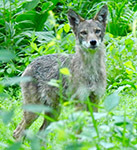 6/13 – Town of Wappinger, HRM 68: There was big drama in our yard this morning. I was listening to our bird monitor, when I heard a couple of short cries. Then, I heard something crashing through shrubs in our yard and looked out to see a white-tailed deer doe chasing a coyote. A few minutes later, the coyote was nosing all around the yard, including in the shrubs about 30 feet from my window. The coyote eventually settled down in some tall weeds and was eating something out of sight. I wondered if it was a fawn and that was the cries I heard. After the coyote finally left, the doe wandered all around that area, presumably looking for her fawn. (Photo of coyote courtesy of Stephen Fischer) 6/13 – Town of Wappinger, HRM 68: There was big drama in our yard this morning. I was listening to our bird monitor, when I heard a couple of short cries. Then, I heard something crashing through shrubs in our yard and looked out to see a white-tailed deer doe chasing a coyote. A few minutes later, the coyote was nosing all around the yard, including in the shrubs about 30 feet from my window. The coyote eventually settled down in some tall weeds and was eating something out of sight. I wondered if it was a fawn and that was the cries I heard. After the coyote finally left, the doe wandered all around that area, presumably looking for her fawn. (Photo of coyote courtesy of Stephen Fischer)
- Melissa Fischer, Stephen Fischer
6/13 – Yonkers, HRM 18: We conducted a second beach seine program today, on a rainy morning, at the Sarah Lawrence Center for the Urban River at Beczak with 4th grade students from Seely Place School in Scarsdale (two-day total of 44 students). Our catch included some impressive diversity, including American eel, bay anchovy, Atlantic tomcod, mummichog, striped bass, and young-of-year bluefish. In the back of the net, we also found blue crabs and shore shrimp.
- Jay Muller, Natalia Benejam, Sam Macaluso, Lucy Jurina, Katie Lamboy
6/13 – Manhattan, HR 1: We checked our research sampling gear today in Hudson River Park at The River Project's sampling station on the lighthouse tender Lilac at Pier 25. Overnight, we had collected eight memorable fishes, five of them hefty tautog (195-265 mm) in our crab pot. They shared the space with two oyster toadfish, one a young-of-year (40 mm) and the other an adult (205 mm). The final fish was an exciting surprise, a scup, better known by its alternate common name, porgy (Stenotomus chrysops).
- Toland Kister
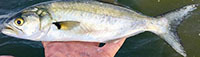 6/13 – Sandy Hook, NJ: It was a withering experience on the beach this morning with two hours of hard, driving rain (my Rite-in-the-Rain note pad was overmatched). The wind was blowing a gale out of the northeast, 30-35 miles-per-hour (mph). Even with the surf at 10-feet and the blowing sand stinging my legs, I stayed a long time because there was a “bunker party” going on. All over the surf, small fish were leaping out of the foam trying to avoid predators. I snapped on a silver jig (lure) and cast into the wind as well as I could. At first, no one was interested. Then, I hooked and beached a 15-inch bluefish. The aft-end of a menhaden (“bunker”) was stuck in its jaws. After a while, I caught second one. This one spit up a half of a menhaden. But overall, there was far too much bait in the water to compete with, and the wind wore me down. The ocean was 63 degrees Fahrenheit (F). (Photo of bluefish courtesy of Tom Lake) 6/13 – Sandy Hook, NJ: It was a withering experience on the beach this morning with two hours of hard, driving rain (my Rite-in-the-Rain note pad was overmatched). The wind was blowing a gale out of the northeast, 30-35 miles-per-hour (mph). Even with the surf at 10-feet and the blowing sand stinging my legs, I stayed a long time because there was a “bunker party” going on. All over the surf, small fish were leaping out of the foam trying to avoid predators. I snapped on a silver jig (lure) and cast into the wind as well as I could. At first, no one was interested. Then, I hooked and beached a 15-inch bluefish. The aft-end of a menhaden (“bunker”) was stuck in its jaws. After a while, I caught second one. This one spit up a half of a menhaden. But overall, there was far too much bait in the water to compete with, and the wind wore me down. The ocean was 63 degrees Fahrenheit (F). (Photo of bluefish courtesy of Tom Lake)
- Tom Lake
6/14 – Manhattan, HRM 0: Sixth-grade students from PS 20’s Anna Silver School in Manhattan’s District 1 participated in our Battery Park City Authority Marine Education Catch-and-Release Fishing Program off the esplanade in Wagner Park at Battery Park City. The students fished with rod and reel using bloodworms for bait and caught an impressive array of fish, including black sea bass, oyster toadfish, cunner (bergall), and striped bass.
- Doug Van Horn, Marieke Bender, Annalise Warren, Gamal Jones, Polly Faust, Gabriel Santos, Alexis Julio
6/14 – Manhattan, New York City: Our first-ever Intermediate Fishing Clinic was hosted this evening on Randall's Island Park through the Randall's Island Park Alliance. The clinic was held on the south side of the island where the Harlem River meets the East River. We had on hand experienced angler friends from the Poseidon Fishing Association to assist us. Using sandworms and cut bait (menhaden), 14 participants caught four striped bass ranging from ten to 24-inches-long and a 32-inch American eel. This was a very, very big eel. All fish were safely released. The East River was 66 degrees F, and the salinity was 22.0 parts-per-thousand (ppt.).
- Peter Park, Chris Girgenti, Jen Adams
[Isa Del Bello (Brooklyn Bridge Park Conservancy), Chris Girgenti (Randall's Island Park Alliance), and I (Nyack College Fishing Club) have teamed up to create Intermediate Fishing Clinics in Randall's Island. We are grateful to NYSDEC for modelling how to facilitate clinics and for waiving the requirement for fishing licenses. We are very excited about these clinics because they are aimed at turning participants into lifelong independent anglers. We are also establishing Beginner's Fishing Clinics in Brooklyn Bridge Park and a site to be determined in northeast Queens. Stay tuned. Peter Park]
Spring-Summer 2019 Natural History Programs
Wednesday, July 10 - Thursday July 11 (9:00 AM - 5:00 PM)
2019 Teachers on the Estuary and Living Environment Institute
Wonders of Wetlands (15 credit hours for NYS certified teachers and administrators)
Five Rivers Environmental Education Center, 56 Game Farm Road, Delmar, New York
Join us this summer as we explore the Wonders of Wetlands. Teachers will spend two days gaining valuable knowledge and learning new curricula. We will use interdisciplinary approaches with the guidance of experts like EPA Award Winner Chris Bowser.
Cost: $50.00 for materials, supplies, and refreshments (light dinner on Thursday)
To register, e-mail drew.hopkins@dec.ny.gov
Tuesday, August 20 - Thursday August 22 (9:00 AM - 4:00 PM)
2019 Teachers on the Estuary and Living Environment Institute
Amazing Watersheds (22 credit hours for NYS certified teachers and administrators)
Five Rivers Environmental Education Center, 56 Game Farm Road, Delmar, New York
Join us this summer as we explore amazing watersheds. Teachers will spend three days gaining valuable knowledge and learning new curricula while using interdisciplinary approaches to explore watersheds. Some easy hiking on trails is involved.
Cost: $60.00 for materials, supplies, and refreshments (dinner provided on Wednesday)
To register, e-mail drew.hopkins@dec.ny.gov
Saturday, September 14 - 1:00- 4:00 PM
Science on the River
Norrie Point Environmental Education Center, Staatsburg
We would like to invite you to our open house featuring hands-on, interactive demonstrations, displaying scientific research and discovery on the estuary and in the Hudson Valley. Activities, with educational games and crafts, will be targeted towards both young and adult audiences.
For more information, email maija.niemisto@dec.ny.gov or call 845-889-4745 x109.
Hudson River: Striped Bass Cooperative Angler Program
You can share your fishing trip information and help biologists understand and manage our Hudson River striped bass fishery.
Here’s how it works: Fill out a logbook provided by us whenever you fish on the Hudson River (by boat or from shore). Record general location, time, gear used, what you caught (or if you didn’t catch anything) and return the logbook when you are done fishing for the season. You’ll receive an annual newsletter summarizing the information in addition to the latest news regarding regulations and the river. Whether you catch-and-release or take home a keeper, you can be part of the Cooperative Angler Program.
Join today by contacting: jessica.best@dec.ny.gov, or call 845-256-3009
- Jessica Best
Hudson River Miles
The Hudson is measured north from Hudson River Mile 0 at the Battery at the southern tip of Manhattan. The George Washington Bridge is at HRM 12, the Tappan Zee 28, Bear Mountain 47, Beacon-Newburgh 62, Mid-Hudson 75, Kingston-Rhinecliff 95, Rip Van Winkle 114, and the Federal Dam at Troy, the head of tidewater, at 153. The tidal section of the Hudson constitutes a bit less than half the total distance – 315 miles – from Lake Tear of the Clouds to the Battery. Entries from points east and west in the watershed reference the corresponding river mile on the mainstem.
To Contribute Your Observations or to Subscribe
The Hudson River Almanac is compiled and edited by Tom Lake and emailed weekly by DEC's Hudson River Estuary Program. Share your observations by e-mailing them to trlake7@aol.com.
To subscribe to the Almanac (or to unsubscribe), use the links on DEC's Hudson River Almanacor DEC Delivers web pages.
Discover New York State Conservationist - the award-winning, advertisement-free magazine focusing on New York State's great outdoors and natural resources. Conservationist features stunning photography, informative articles and around-the-state coverage. Visit the Conservationist webpage for more information.
Useful Links
National Oceanic and Atmospheric Administration online tide and tidal current predictions are invaluable when planning Hudson River field trips.
For real-time information on Hudson River tides, weather and water conditions from sixteen monitoring stations, visit the Hudson River Environmental Conditions Observing System website.
DEC's Smartphone app for iPhone and Android is now available at: New York Fishing, Hunting & Wildlife App.
Adventure NY
Under Governor Cuomo's Adventure NY initiative, DEC is making strategic investments to expand access to healthy, active outdoor recreation, connect more New Yorkers and visitors to nature and the outdoors, protect natural resources, and boost local economies. This initiative will support the completion of more than 75 projects over the next three years, ranging from improvements to youth camps and environmental education centers to new boat launches, duck blinds, and hiking trails. Read more about the Adventure NY initiative. For more information on planning an outdoor adventure in New York State, visit DEC's website at http://www.dec.ny.gov/outdoor.
Information about the Hudson River Estuary Program is available on DEC's website at http://www.dec.ny.gov/lands/4920.html.
|