A Project of the Hudson River Estuary Program
Compiled by Tom Lake, Consulting Naturalist
Overview
Any week that includes a seal in the estuary is bound to be a classic. The collective highlight of the week was the compilation of data and the stories of adventure for the 5th annual World Science Festival’s Great Fish Count. Both osprey and bald eagle nestlings were on their way to fledgling, and carp began their raucous spawning ritual.
Highlight of the Week
6/3 – Peekskill, HRM 44: I was walking my dog at the Peekskill riverfront today and spotted what I thought was a seal surfacing and submerging in the river. But, it was much too fast to get a real good look. I waited patiently for it to reappear. Less than a minute later, there it was, gliding through the water with its head up and whiskers glistening. It was a harbor seal, and I managed to get a ten second video of it as it cruised past me before diving again. They can move so quickly.
- Kevin Scully
Natural History Entries
Correction: In last week’s Almanac (see 5/26), we incorrectly stated that the 9-14-inch slot-size for possession of American eel for baitfish was a New York State regulation applicable state-wide. That was incorrect. The regulation applies only to the tidal Hudson River, from the Battery to the Troy dam and all tributaries upstream to the first barrier impassable by fish. Tom Lake
6/1 – Newcomb, HRM 302: Our very wet spring continued through the month of May. We received close to 3.5-inches above our average rainfall of 3.86. The black flies must be thrilled because squadrons of them were out in full force. We were thrilled that we had already found a loon nest on one of the nearby lakes. They had been incubating the nest for about two weeks already. Red-bellied woodpeckers and Baltimore orioles, an uncommon sight in Newcomb, were frequent visitors to local bird feeders in mid-month.
- Charlotte Demers
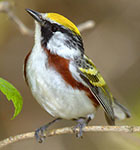 6/1 – Minerva, HRM 284: I was out this morning wandering in the woods behind our house and heard a most fabulous chestnut-sided warbler singing big-time. There was also an ovenbird, a yellow-rumped warbler, and some phoebes that had been singing for a while. However, I think the chestnut-sided is my favorite warbler right now. (Photo of chestnut-sided warbler courtesy of Bill Wayman) 6/1 – Minerva, HRM 284: I was out this morning wandering in the woods behind our house and heard a most fabulous chestnut-sided warbler singing big-time. There was also an ovenbird, a yellow-rumped warbler, and some phoebes that had been singing for a while. However, I think the chestnut-sided is my favorite warbler right now. (Photo of chestnut-sided warbler courtesy of Bill Wayman)
- Mike Corey
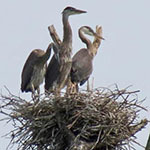 6/1 – Bedford, HRM 35: The Great Blue Heron rookery was noisy today with the combined vocalizations of the nestlings. Many of the nests have a guardian present. The younger nestlings are still covered with down while the older nestlings have feathers replacing their down. These older nestlings are now being left alone with the adults off hunting for the food to feed the hungry youngsters. There are still some nests with a guardian, but the nestlings are not visible yet. (Photo of great blue heron with nestlings courtesy of Jim Steck) 6/1 – Bedford, HRM 35: The Great Blue Heron rookery was noisy today with the combined vocalizations of the nestlings. Many of the nests have a guardian present. The younger nestlings are still covered with down while the older nestlings have feathers replacing their down. These older nestlings are now being left alone with the adults off hunting for the food to feed the hungry youngsters. There are still some nests with a guardian, but the nestlings are not visible yet. (Photo of great blue heron with nestlings courtesy of Jim Steck)
- Jim Steck
6/1 – Hudson River Tidewater: Today’s 5th annual World Science Festival’s Great Fish Count was held at 18 different locations along the greater New York City waterways. Participation totaled 1,637 attendees, along with our scientists and educators.
This year, we added four new species to our event’s four-year total that now stands at 42: golden shiner from Fort Washington Park, bluegill sunfish at Yonkers, naked goby at Bush Terminal, Brooklyn, and northern puffer from Kaiser Beach, Brooklyn. Altogether, our field teams caught 803 fishes from 26 species. Noteworthy were 58 young-of-year winter flounder, 20 spot, and 109 young-of-year Atlantic tomcod. Across the 18 sites, salinity ranged from 30.0 parts-per-thousand (ppt) at Kaiser Beach in Coney Island to lightly brackish 6.0 ppt at Englewood (NJ). Water temperature ranged from a low of 63 degrees Fahrenheit (F) at both Englewood and Pier 5 on the East River, to a high of 75 degrees F in a tidal pond off Lemon Creek in Staten Island.
- Margie Turrin, Laurel Zaima (Lamont-Doherty Earth Observatory)
[Young-of-year (YOY) is a label we frequently use to describe the multitude of recently hatched fauna found in the Hudson River each spring-through-fall. The progeny of shad, river herring, striped bass, white perch, blue crabs, shrimp, jellyfish, and many others, are present by the many millions. We note young-of-year fishes as a way of creating a historic record of length-at-age, often measuring their dimensions as millimeters (mm). Collectively, these data are a good measure of recruitment success and the health of fish populations. Tom Lake]
6/1 – Yonkers, HRM 18: We invited the public to join us (19 accepted) at the Sarah Lawrence Center for the Urban River at Beczak for our seining program for the annual Great Fish Count. The event provided us with a new aquarium friend, a white perch, that will now live with our exclusive oyster toadfish. Highlights of our catch included American eel, bay anchovies, mummichogs, white perch, bluegills, and shore shrimp.
- Katie Lamboy, Ivan Gilbert
6/1 – Englewood, NJ, HRM 13.5: For the World Science Festival’s Great Fish Count, we chose Bloomer’s Beach, a tricky place for those of us who seine the low-gradient shallows. We were aware of the dropping tide today and netted with some urgency. Once the water level falls beyond mid-tide, the inshore shallows become knee-deep with sediments that can make seining impossible.
With a resolute Rick Delehanty hauling the outboard end, we made as many passes as we could until the clock ran out. Our haul was modest but interesting: Nine YOY Atlantic tomcod (44-68 millimeters (mm)) were a surprise. They were born upriver under the ice in deep winter and were now here maturing on their way to being breeding adults by next winter. Less of a surprise were bay anchovies (67 mm) and striped bass (82 mm).
We also caught many penny-to-palm-sized blue crabs, mostly females, and a similar number of shore shrimp. Some beach combing revealed many empty shells of balthic macoma clams (Macoma balthica), striped mussels (Geukensia demissa), quahog (Mercenaria mercenaria), and oysters (Crassostrea virginica). The strangest catch in our net was a female red slider turtle (Trachemys scripta elegans) with a 7-inch carapace length. The salinity was 6.0 ppt., and the water temperature read 66 degrees F.
- Tom Lake, T.R. Jackson
[Note: one inch = 25.4 millimeters (mm)]
6/1 – Manhattan, HRM 11: Our seining at Fort Washington Park for the Great Fish Count was very productive. We netted an assortment of YOY winter flounder, summer flounder, an Atlantic silverside, many bay anchovies, YOY bluefish, and small striped bass. We found a dead adult Atlantic menhaden on the beach showing claw marks, indicating a likely osprey drop. Salinity was 10.0 ppt.
- Margie Turrin
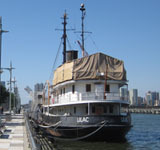 6/1 - Manhattan, HRM 1: For the Great Fish Count, we invited the public to help us check our research sampling gear in Hudson River Park at The River Project's sampling station on the lighthouse tender Lilac at Pier 25. While the catch lacked diversity, it did not lack quality. We had collected four large tautog (blackfish), measuring 235, 250, 315, and 320 mm in length. (Photo of Lilac at NYC Pier 25 courtesy of Nancy Beard) 6/1 - Manhattan, HRM 1: For the Great Fish Count, we invited the public to help us check our research sampling gear in Hudson River Park at The River Project's sampling station on the lighthouse tender Lilac at Pier 25. While the catch lacked diversity, it did not lack quality. We had collected four large tautog (blackfish), measuring 235, 250, 315, and 320 mm in length. (Photo of Lilac at NYC Pier 25 courtesy of Nancy Beard)
- Siddhartha Hayes, Toland Kister
6/1 – Brooklyn, New York City: For the Great Fish Count, my students and I used a tried-and-true approach: rod and reel fishing off Pier 5 in the East River at the Brooklyn Bridge Conservancy Park. In 90 minutes of hook-and-line angling with sandworms, we caught and released three remarkable fish, a foot-long bluefish and two striped bass (16.5-17.5-inches). All were released. The water was 63 degrees F, and the salinity was 17.0 ppt.
- Peter Park
6/1 – Brooklyn, New York City: Our seining effort in the East River at the Brooklyn Bridge Conservancy Park for the Great Fish Count resulted in our first northern pipefish and bluefish of the season. Other highlights included tautog, Atlantic tomcod, and a surprise alewife. It was also unexpected that we caught no bay anchovies or Atlantic silverside. We did catch six YOY herring that we decided were Atlantic menhaden. Invertebrates included YOY blue crab, ribbed mussels, soft shell clam, periwinkle, mud snail, shore shrimp, and sand shrimp. Salinity was 17.51 ppt.
- Peter Park, Haley McClanahan, Isa Del Bello, Christina Tobitsch
6/1 – Staten Island, New York City: We seined at two different habitats at Lemon Creek Park today for the Great Fish Count. We made three hauls off a beach, and among our catch were YOY herring (80), possibly a mix of Atlantic menhaden and river herring, bay anchovies, Atlantic silverside, small blue crabs, sand shrimp (Crangon septemspinosa), and hermit crabs. The water was 70 degrees F, and the salinity was 18.0 ppt.
We also made three hauls in a tidal pond adjacent to the beach. There, the water was 75 degrees F, and the salinity was 19.0 ppt. Our catch included four-spine sticklebacks (Apeltes quadracus), mummichogs, striped killifish, Atlantic silverside, blue crabs, shore shrimp (Palaemonetes sp.), and two very interesting American eels. Both were small (50 mm), very dark, and relatively plump. They had been eating well.
- Chris Bowser, Carl Alderson, Lisa Rosman
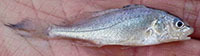 6/1 – Queens, New York City: Our seining contribution to the Great Fish Count was held at Fort Totten, at Little Bay, just east of the Throgs Neck Bridge. We netted six species of fish, including 48 YOY Atlantic Tomcod (60-82 mm), 45 Atlantic silverside (80-100 mm), two northern pipefish, a tautog, and a mummichog. However, the sixth species was the most exciting: two YOY (22-30 mm) Atlantic croakers (Micropogonias undulates). Croakers are one of seven members of the drum family (Sciaenidae) found in our watershed. Others included northern kingfish, spot, black drum, freshwater drum, silver perch, and weakfish. The water temperature was 65 degrees F, and the salinity was 25.0 ppt. 6/1 – Queens, New York City: Our seining contribution to the Great Fish Count was held at Fort Totten, at Little Bay, just east of the Throgs Neck Bridge. We netted six species of fish, including 48 YOY Atlantic Tomcod (60-82 mm), 45 Atlantic silverside (80-100 mm), two northern pipefish, a tautog, and a mummichog. However, the sixth species was the most exciting: two YOY (22-30 mm) Atlantic croakers (Micropogonias undulates). Croakers are one of seven members of the drum family (Sciaenidae) found in our watershed. Others included northern kingfish, spot, black drum, freshwater drum, silver perch, and weakfish. The water temperature was 65 degrees F, and the salinity was 25.0 ppt.
Invertebrates collected included blue crab (some were soft-shelled), shore shrimp, sand shrimp, long-wristed hermit crab, and eastern mud snail. (Photo of Atlantic croaker courtesy of Peter Park)
- Peter Park
6/2 – Englewood, NJ, HRM 13.5: As I was walking along the beach at Englewood, I came upon a dead fish that had floated up and been stranded by the receding tide. It was a black drum, all of 27-inches-long.
- Rick Delehanty
*** Fish of the Week ***
6/2 – Hudson River Watershed: Week 25 for Fish-of-the-Week is the black drum (Pogonias cromis), number 190 (of 228) on our watershed list of fishes. (If you would like a copy of our list, e-mail: trlake7@aol.com.)
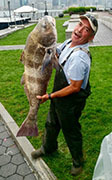 Black drum is found in coastal waters and estuaries from Massachusetts to Argentina but are considered uncommon north of Delaware Bay. While black drum was not unknown from the lower river and New York Harbor, their presence had diminished significantly in the last century. Black drum is found in coastal waters and estuaries from Massachusetts to Argentina but are considered uncommon north of Delaware Bay. While black drum was not unknown from the lower river and New York Harbor, their presence had diminished significantly in the last century.
Black drum feed largely on mollusks and crustaceans using their many, long, chin barbels to navigate and find prospective food items. They favor shellfish beds; perhaps their resurrection in the estuary is a subtle indication of the return and vitality of oysters in the lower river and New York Harbor. Hildebrand and Schroder (Fishes of Chesapeake Bay) comment that schools of black drum have been known to cause great damage to oyster beds.
A black drum presence was confirmed and added to our watershed fish list in August 2010 when an adult, weighing nearly 30 pounds, was found on a beach at Piermont, river mile 25 (black drum can reach 111 pounds). Since then, we have collected several juvenile black drum in the estuary, from Piermont to Staten Island, for the first time in at least the last half-century. (Photo of black drum courtesy of Peter Park)
- Tom Lake
6/2 – Sleepy Hollow, HRM 28: This morning, I watched a double-crested cormorant dive, catch, and swallow a foot-long American eel. It impressed me just how long they can stay submerged. It has been suggested by some ornithologists that cormorants are equally adept at flying as they are swimming underwater.
- Doug Maass
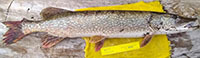 6/3 – Green Island, HRM 153: The quickly rising tide was threatening to reclaim the narrow beach at Green Island. This location, at the head of tide, just below the federal dam and 165 miles from the open sea, may be one of the best sportfishing spots on the estuary. Across many years, my fishing colleagues and I have caught no fewer than 21 species of fish here, including American shad, striped bass, smallmouth bass, largemouth bass, and northern pike. The few that have eluded us so far include walleye and tiger muskellunge. 6/3 – Green Island, HRM 153: The quickly rising tide was threatening to reclaim the narrow beach at Green Island. This location, at the head of tide, just below the federal dam and 165 miles from the open sea, may be one of the best sportfishing spots on the estuary. Across many years, my fishing colleagues and I have caught no fewer than 21 species of fish here, including American shad, striped bass, smallmouth bass, largemouth bass, and northern pike. The few that have eluded us so far include walleye and tiger muskellunge.
However, it seemed that today was not destined to be a blue-ribbon outing. After a flurry of fifteen-inch striped bass, I was ready to leave. Then, on the obligatory “last cast,” it felt as though I was hung down. Seconds later, a large fish skittered across the water ending with a gracious end-over-end leap and loud splash. The next five minutes were tenuous as I considered all the ways I might lose this fish without ever seeing it – a common malady among anglers. Then, I successfully beached the most beautiful northern pike (30-inches) I had ever seen. After a quick photo, and working to revive it in the shallow water, it lunged away. The river was 65 degrees F. (Photo of northern pike courtesy of Tom Lake)
- Tom Lake
6/3 – Manhattan, HRM 1: Just before our big summer kickoff event, “Meet the Fishes”, we checked our research sampling gear in Hudson River Park at The River Project's sampling station on the lighthouse tender Lilac at Pier 25. Our catch was a study of opposites: a husky (195 mm) tautog and a rather tiny (50 mm) and adorable skilletfish.
- Siddhartha Hayes
6/4 – Saugerties, HRM 102: As I watched the osprey nest on Hudson River channel marker 93, just south of the Saugerties Lighthouse, I was pleased to see that a nestling had hatched, the tiny head appeared quite wobbly. An adult was perched exactly where it was observed on my previous visit, eating a fish on a snag just southwest of the nest.
- Deb Weltsch
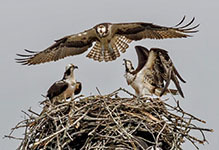 6/4 – Ulster County, HRM 92: Osprey nestlings of a variety of ages were appearing in nests along the river. In some instances, like with the two large nestlings in this nest, there was evidence that there had been some early hatches. (Photo of osprey with nestlings courtesy of Jim Yates) 6/4 – Ulster County, HRM 92: Osprey nestlings of a variety of ages were appearing in nests along the river. In some instances, like with the two large nestlings in this nest, there was evidence that there had been some early hatches. (Photo of osprey with nestlings courtesy of Jim Yates)
- Jim Yates
6/4 – Norrie Point, HRM 85: I got lucky this morning. I had been watching the boldest nestling (of two) at bald eagle nest NY142 (Mount Saint Alphonsus) perch on a south-side horizontal branch since May 20. As soon as I set up at Norrie Point this morning, I saw the eaglet take two flaps out of the nest onto a north-side branch. It faced into the breeze for less than a minute, then took flight northbound. It circled clockwise over the river, turned north into the breeze, and in less than a minute, successfully landed back onto the nest. I cannot be certain if this was truly its maiden flight, but at Day 85, it was right on average for eagles in our area to fledge.
- Dave Lindemann
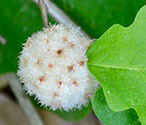 6/4 – Hyde Park, HRM 82: I was taking a stroll in the woods by my house today when I looked down at the right moment to see a fuzzy gall of the wool sower gall wasp wrapped around the base of a white oak leaf on a sapling. I do not know if they are unusual here, but I had never seen one before. (Photo of wool sower gall courtesy of Peter Fanelli) 6/4 – Hyde Park, HRM 82: I was taking a stroll in the woods by my house today when I looked down at the right moment to see a fuzzy gall of the wool sower gall wasp wrapped around the base of a white oak leaf on a sapling. I do not know if they are unusual here, but I had never seen one before. (Photo of wool sower gall courtesy of Peter Fanelli)
- Pete Fanelli
6/4 – Yonkers, HRM 18: Students from the Hudson River Community Sailing navigated four sailboats into the Yonkers Paddling and Rowing Club today to join us for a late morning of seining fun! Our bounty of 96 aquatic animals included more mummichogs (63) than we had caught all season. Blue crabs (31) were also common in the catch, as well as shore shrimp.
- Elisa Caref, Sam Macaluso, Taylor Childs
6/5 – Town of Poughkeepsie: On day 74 for the two nestlings in bald eagle nest NY62, they were trying out their new wings, flapping and taking mini-hops along the tulip tree branches near the nest. Their fledging moment was not far off.
- Bob Rightmyer
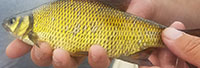 6/6 – Schodack Island State Park, HRM 136: “Here fishy, fishy” chanted the first-grade students from Castleton Elementary as we hauled our seine net in the river at Schodack Island. The highlight of our catch was a beautiful golden shiner, its color shimmering in the bright sunshine. As they flew overhead, several hundred Canada geese competed with the noise level of the excited students. (Photo of golden shiner courtesy of Cornell Department of Natural Resources) 6/6 – Schodack Island State Park, HRM 136: “Here fishy, fishy” chanted the first-grade students from Castleton Elementary as we hauled our seine net in the river at Schodack Island. The highlight of our catch was a beautiful golden shiner, its color shimmering in the bright sunshine. As they flew overhead, several hundred Canada geese competed with the noise level of the excited students. (Photo of golden shiner courtesy of Cornell Department of Natural Resources)
- Fran Martino
6/6 – Yonkers, HRM 18: Our 9-11 grade students from the Bio-Chem program at Saunders High School in Yonkers checked our two (glass) eel mops this afternoon. With the season all but over, it was no surprise to find that the first mop held only eleven former “glass” eels, now darkly pigmented. These were the only glass eels collected. Otherwise, the mops held three elvers and two shore shrimp. The river was 68 degrees F.
- Brenda Jandres
6/7 – Coxsackie, HRM 124: Hudson Cruises “Spirit of the Hudson” paddlewheel boat was boarded by 72 enthusiastic fourth-grade students from Coxsackie Elementary for their field trip to the Hudson River. Students participated in learning stations about birds and fish. Using binoculars, students on the upper deck saw lots of flapping action with two adult bald eagles at their nest site. Below deck, students learned about sturgeon and other fish species. The children seemed to delight in using their measuring skills to discover which was longer: the fiberglass model of a sturgeon brought on board, or one of the dads who came along on the trip as chaperone.
- Fran Martino
6/7 – Beacon, HRM 61: This was a day of furious carp spawning viewed from Long Dock. The spawning carp were churning it up with big splashes in the water chestnut along the shore. (I saw the same action at Cold Spring in the tidal marsh next to the railroad tracks earlier on my way north). While my catch for the day was a meager two channel catfish (13 and 19-inches), measured and released, the spawning carp assured me of productive fishing days ahead.
- Bill Greene
[Spawning carp can be a spectacle. At its height, when they are exploding holes in the water in a spawning frenzy, the loud eruptions sound like someone is dropping cement blocks into the water. Tom Lake]
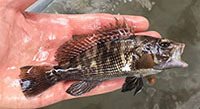 6/7 – Manhattan, HRM 1: To close out our sampling week, we returned to check our research gear in Hudson River Park at The River Project's sampling station on the lighthouse tender Lilac at Pier 25. The traps and pots were brimming with fish! Among the highlights were four oyster toadfish (47.5 - 260 mm), two tautog (180 and 310 mm), two white perch (225 and 255 mm), and one feisty, little, black sea bass (55 mm). (Photo of black sea bass courtesy of The River Project) 6/7 – Manhattan, HRM 1: To close out our sampling week, we returned to check our research gear in Hudson River Park at The River Project's sampling station on the lighthouse tender Lilac at Pier 25. The traps and pots were brimming with fish! Among the highlights were four oyster toadfish (47.5 - 260 mm), two tautog (180 and 310 mm), two white perch (225 and 255 mm), and one feisty, little, black sea bass (55 mm). (Photo of black sea bass courtesy of The River Project)
- Siddhartha Hayes, Melissa Rex, Toland Kister
Spring-Summer 2019 Natural History Programs
Wednesday, July 10 - Thursday July 11 (9:00 AM - 5:00 PM)
2019 Teachers on the Estuary and Living Environment Institute
Wonders of Wetlands (15 credit hours for NYS certified teachers and administrators)
Five Rivers Environmental Education Center, 56 Game Farm Road, Delmar, New York
Join us this summer as we explore the Wonders of Wetlands. Teachers will spend two days gaining valuable knowledge and learning new curricula. We will use interdisciplinary approaches with the guidance of experts like EPA Award Winner Chris Bowser.
Cost: $50.00 for materials, supplies, and refreshments (light dinner on Thursday)
To register, e-mail drew.hopkins@dec.ny.gov
Tuesday, August 20 - Thursday August 22 (9:00 AM - 4:00 PM)
2019 Teachers on the Estuary and Living Environment Institute
Amazing Watersheds (22 credit hours for NYS certified teachers and administrators)
Five Rivers Environmental Education Center, 56 Game Farm Road, Delmar, New York
Join us this summer as we explore amazing watersheds. Teachers will spend three days gaining valuable knowledge and learning new curricula while using interdisciplinary approaches to explore watersheds. Some easy hiking on trails is involved.
Cost: $60.00 for materials, supplies, and refreshments (dinner provided on Wednesday)
To register, e-mail drew.hopkins@dec.ny.gov
Saturday, September 14 - 1:00- 4:00 PM
Science on the River
Norrie Point Environmental Education Center, Staatsburg
We would like to invite you to our open house featuring hands-on, interactive demonstrations, displaying scientific research and discovery on the estuary and in the Hudson Valley. Activities, with educational games and crafts, will be targeted towards both young and adult audiences.
For more information, email maija.niemisto@dec.ny.gov or call 845-889-4745 x109.
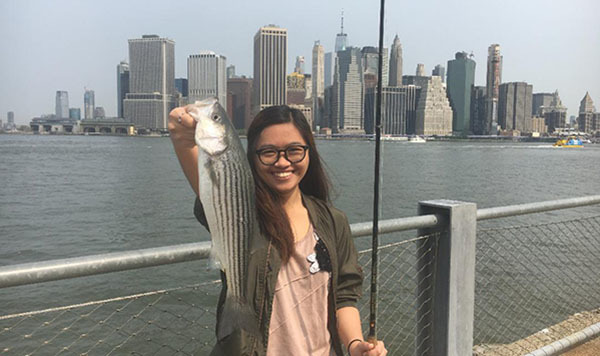
Hudson River: Striped Bass Cooperative Angler Program
You can share your fishing trip information and help biologists understand and manage our Hudson River striped bass fishery.
Here’s how it works: Fill out a logbook provided by us whenever you fish on the Hudson River (by boat or from shore). Record general location, time, gear used, what you caught (or if you didn’t catch anything) and return the logbook when you are done fishing for the season. You’ll receive an annual newsletter summarizing the information in addition to the latest news regarding regulations and the river. Whether you catch-and-release or take home a keeper, you can be part of the Cooperative Angler Program.
Join today by contacting: jessica.best@dec.ny.gov, or call 845-256-3009
- Jessica Best
Hudson River Miles
The Hudson is measured north from Hudson River Mile 0 at the Battery at the southern tip of Manhattan. The George Washington Bridge is at HRM 12, the Tappan Zee 28, Bear Mountain 47, Beacon-Newburgh 62, Mid-Hudson 75, Kingston-Rhinecliff 95, Rip Van Winkle 114, and the Federal Dam at Troy, the head of tidewater, at 153. The tidal section of the Hudson constitutes a bit less than half the total distance – 315 miles – from Lake Tear of the Clouds to the Battery. Entries from points east and west in the watershed reference the corresponding river mile on the mainstem.
To Contribute Your Observations or to Subscribe
The Hudson River Almanac is compiled and edited by Tom Lake and emailed weekly by DEC's Hudson River Estuary Program. Share your observations by e-mailing them to trlake7@aol.com.
To subscribe to the Almanac (or to unsubscribe), use the links on DEC's Hudson River Almanacor DEC Delivers web pages.
Discover New York State Conservationist - the award-winning, advertisement-free magazine focusing on New York State's great outdoors and natural resources. Conservationist features stunning photography, informative articles and around-the-state coverage. Visit the Conservationist webpage for more information.
Useful Links
National Oceanic and Atmospheric Administration online tide and tidal current predictions are invaluable when planning Hudson River field trips.
For real-time information on Hudson River tides, weather and water conditions from sixteen monitoring stations, visit the Hudson River Environmental Conditions Observing System website.
DEC's Smartphone app for iPhone and Android is now available at: New York Fishing, Hunting & Wildlife App.
Adventure NY
Under Governor Cuomo's Adventure NY initiative, DEC is making strategic investments to expand access to healthy, active outdoor recreation, connect more New Yorkers and visitors to nature and the outdoors, protect natural resources, and boost local economies. This initiative will support the completion of more than 75 projects over the next three years, ranging from improvements to youth camps and environmental education centers to new boat launches, duck blinds, and hiking trails. Read more about the Adventure NY initiative. For more information on planning an outdoor adventure in New York State, visit DEC's website at http://www.dec.ny.gov/outdoor.
Information about the Hudson River Estuary Program is available on DEC's website at http://www.dec.ny.gov/lands/4920.html.
|