A project of the Hudson River Estuary Program,
compiled by Tom Lake, Consulting Naturalist
Overview
The Overview of the week could also have been a collective Highlight, as on-river education by a broad cadre of skilled educators gave students real life experiences. In a world that often lacks hands-on opportunities, many Hudson Valley students, from a range of ages, had the opportunity to get a little wet and interact with the river’s wildlife.
Highlight of the Week
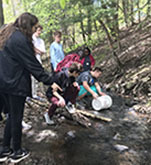 5/16 – Rensselaer County, HRM 144: The Averill Park High School Environmental Science classes, along with the Averill Park Angler’s Club, released six brown trout (Salmo trutta) in Wynantskill Creek today. The water temperature was 60 degrees Fahrenheit (F) 5/16 – Rensselaer County, HRM 144: The Averill Park High School Environmental Science classes, along with the Averill Park Angler’s Club, released six brown trout (Salmo trutta) in Wynantskill Creek today. The water temperature was 60 degrees Fahrenheit (F)
The release of these small (64 millimeter (mm)) trout was the culmination of a school-year-long effort by the students. We acquired the eggs through the Trout in the Classroom program in early October, and the students raised them in the months since learning about the life cycle of the brown trout, collecting data, making observations, and accruing knowledge. (Photo of brown trout release courtesy of Darlene Hunter)
- Darlene Hunter
[Note: one inch = 25.4 millimeters (mm)]
Natural History Entries
5/9 – Rensselaer County, HRM 136: Nineteen high-school students and staff from the City of Hudson School District explored Schodack Island State Park with us and that included seining. Blueback herring (Alosa aestivalis) were on the run, and they found their way into our net at the boat launch. Students also conducted water quality tests. They found the water temperature to be 12.0 degrees centigrade (54 degrees F), dissolved oxygen at 6.0 parts-per-million (ppm), the pH at 7.0, turbidity at 40 JTU’s (Jackson Turbidity Unit), and the smiles measured 100%. Officer Jeff Cox joined the group for the traditional kissing-of-the-fish experience and spoke with students about his career as an Environmental Conservation Officer for the DEC.
- Fran Martino, Pamela Price
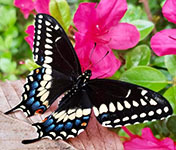 5/10 – Croton-on-Hudson, HR 35: Every year I plant bronze fennel for the black swallowtail caterpillars. Early last October, I put a black swallowtail caterpillar on a pot of fennel and then into a netted butterfly cage that I keep outdoors. In that way, it is subject to natural conditions but is safe from predators. Through metamorphosis, the caterpillar transformed into a chrysalis and then spent the winter in the butterfly cage. Today, the black swallowtail butterfly emerged from its chrysalis and was released. (Photo of black swallowtail butterfly courtesy of Ricki Roe) 5/10 – Croton-on-Hudson, HR 35: Every year I plant bronze fennel for the black swallowtail caterpillars. Early last October, I put a black swallowtail caterpillar on a pot of fennel and then into a netted butterfly cage that I keep outdoors. In that way, it is subject to natural conditions but is safe from predators. Through metamorphosis, the caterpillar transformed into a chrysalis and then spent the winter in the butterfly cage. Today, the black swallowtail butterfly emerged from its chrysalis and was released. (Photo of black swallowtail butterfly courtesy of Ricki Roe)
- Ricki Roe
5/11 – Town of Wappinger, HRM 67: Our spruces and pines were showing their response to the warmth of spring; a couple of inches of downy, new growth appeared on the tip of each branch. Known as the meristem, this new growth always reminds me of legendary naturalist Aldo Leopold, considered the father of modern wildlife ecology. Leopold tracked a year in the life of a pine beginning in May when the new growth bud or “candle” at the tip of the branches began to grow. He saw a flame, pent up energy, in the tip of that candle. This blends well with Chinese philosopher Lao Tzu and his thoughts on the intensity in the tip of a candle’s flame, seemingly still, yet having great vibrancy, like a candle burning in a windless place. Today, all that philosophy was erupting in the ecology of our conifers.
- Tom Lake
*** Fish of the Week ***
Spring is here, and consequently, there is no shortage of incredible stories to tell. And, while there is no longer an excuse to run our Fish-of-the-Week feature as a filler, we have received nice comments and much encouragement to continue. This is our 21st week, and until a good reason pops up ...
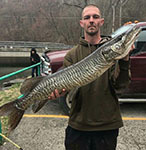 5/10 – Hudson River Watershed: This week’s entry is the tiger muskellunge (Esox lucius x E. masquinongy). Tiger muskellunge is a hybrid, a cross between a male northern pike and a female muskellunge. As such, the tiger muskellunge, also known as “norlunge,” does not have its own number on our checklist of Hudson River Watershed Fishes, but rather resides directly after the northern pike (number 84). Both the northern pike and the muskellunge are native species. However, the latter has not been documented for the watershed. If you would like a copy of our list, e-mail: trlake7@aol.com. 5/10 – Hudson River Watershed: This week’s entry is the tiger muskellunge (Esox lucius x E. masquinongy). Tiger muskellunge is a hybrid, a cross between a male northern pike and a female muskellunge. As such, the tiger muskellunge, also known as “norlunge,” does not have its own number on our checklist of Hudson River Watershed Fishes, but rather resides directly after the northern pike (number 84). Both the northern pike and the muskellunge are native species. However, the latter has not been documented for the watershed. If you would like a copy of our list, e-mail: trlake7@aol.com.
Tiger muskellunge have been introduced as a sportfish into many of New York's large lakes and rivers by the NYS Department of Environmental Conservation since the 1970s. Tiger muskellunge are hatched and raised at the DEC South Otselic hatchery in Chenango County, and roughly 10,000 are stocked in the Hudson River watershed each year. About 6,000 are stocked in the Mohawk River between Rome and Saint Johnsville. DEC used to stock the lower Mohawk River (1981-2011) but stopped due to lower than expected returns in subsequent sampling. Most Hudson River estuary records, in particular those near the Federal Dam at Troy, were likely from those stocked in the lower Mohawk (Jeff Loukmas, Scott Wells).
Tiger muskellunge are the “boss” of any water where they are found. They are large, fast, toothy, and relentless predators whose menu includes other fish, reptiles and amphibians, small mammals, and baby ducks. The New York State record size for tiger muskellunge is 35 pounds 8 ounces. (Photo of tiger muskellunge courtesy of Jesse Jaycox) Tom Lake
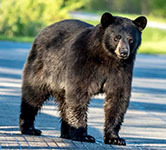 5/11 – Millbrook, HRM 82: I sent out a word of warning this evening for those walkers and birders frequenting the North Bridge at the Cary Institute of Ecosystem Studies. In the late afternoon, as I was standing on the bridge, an adult black bear walked up the road toward me. I actually did not hear the bear until it was less than the bridge-length away. I backed off and headed toward the front of the park. The bear did follow me for a while (or it was going the same way as I was going) before heading off to a field and into the underbrush. (Photo of black bear courtesy of Jodie Preuss) 5/11 – Millbrook, HRM 82: I sent out a word of warning this evening for those walkers and birders frequenting the North Bridge at the Cary Institute of Ecosystem Studies. In the late afternoon, as I was standing on the bridge, an adult black bear walked up the road toward me. I actually did not hear the bear until it was less than the bridge-length away. I backed off and headed toward the front of the park. The bear did follow me for a while (or it was going the same way as I was going) before heading off to a field and into the underbrush. (Photo of black bear courtesy of Jodie Preuss)
- Jodie Preuss (Ralph T. Waterman Bird Club)
The DEC Website offers advice on black bear encounters: https://www.dec.ny.gov/animals/94710.html
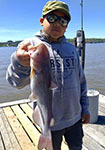 5/11 – Beacon, HRM 61: It seemed like a “Catfish Derby” at Long Dock today. While more prestigious species were the aim, four species of catfish comprised the entire catch of those fishing. Channel catfish were most common, but brown bullheads were a close second, and even a single yellow bullhead was taken and released. The biggest catfish surprise, however, was a 14-inch white catfish taken by Yosef Sanchez. White catfish have become uncommon to rare in this reach of the Hudson River. (Photo of white catfish courtesy of Tom Lake) 5/11 – Beacon, HRM 61: It seemed like a “Catfish Derby” at Long Dock today. While more prestigious species were the aim, four species of catfish comprised the entire catch of those fishing. Channel catfish were most common, but brown bullheads were a close second, and even a single yellow bullhead was taken and released. The biggest catfish surprise, however, was a 14-inch white catfish taken by Yosef Sanchez. White catfish have become uncommon to rare in this reach of the Hudson River. (Photo of white catfish courtesy of Tom Lake)
- Tom Lake, B.J. Jackson
5/12 – Bedford, HRM 35: There were more nestlings visible today at the great blue heron rookery. A pair of nests had a single nestling in each, and another pair of nests had two nestlings. Six nests had a heron standing guard, which would indicate that all of the eggs had hatched. The remaining nests still had a heron sitting, and that could mean not all of the eggs had hatched or nestlings were being kept warm. The nestlings were still vulnerable and needed protection from the weather and predators.
- Jim Steck
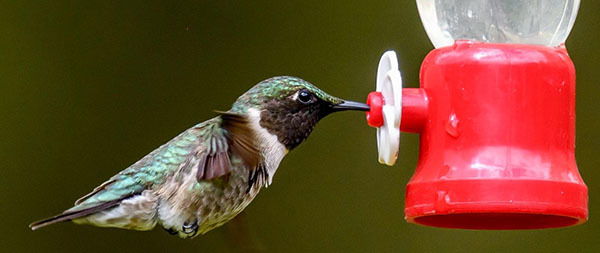
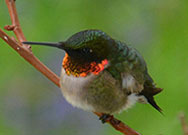 5/13 – Hyde Park, HRM 82: Our first ruby-throated hummingbird arrived one day “late” this year (May 1 instead of April 30). We now have a female and two males around, one of which had already begun guarding the feeder. (Photo of ruby-throated hummingbird courtesy of Peter Fanelli) 5/13 – Hyde Park, HRM 82: Our first ruby-throated hummingbird arrived one day “late” this year (May 1 instead of April 30). We now have a female and two males around, one of which had already begun guarding the feeder. (Photo of ruby-throated hummingbird courtesy of Peter Fanelli)
- Peter Fanelli
5/13 – Yonkers, HRM 18: We began our week hosting 23 preschoolers from the Eliza Corwin Frost School at the Sarah Lawrence Center for the Urban River at Beczak. We went seining with our little friends and caught both fish and shellfish, including nine immature blue crabs (25-40 mm), six shore shrimp, and our first northern pipefish of the season (150 mm). The pipefish, related to the seahorse, is now on display for students at the Beczak Environmental Education Center.
- Eli Caref, Katie Lamboy, Natalia Bengiam
5/13 - Manhattan, HRM 1: Students from PS18 Park Terrace Middle School in Manhattan helped us check our research sampling gear in Hudson River Park at The River Project's sampling station on the lighthouse tender Lilac at Pier 25. They were rewarded by two lined seahorses (Hippocampus erectus). One was a male (65 mm), with a breeding pouch, and the other was a female (75 mm). But, their amazement did not end there. They also found a juvenile tautog (85 mm) and a gorgeous little skilletfish (50 mm).
- Toland Kister, Siddhartha Hayes
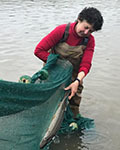 5/14 – Town of Bethlehem, HRM 135: On a recent seining adventure at the Henry Hudson Park boat launch with 75 seventh-grade students from Ravena-Coeymans-Selkirk Middle School, we were treated to an 18-inch chain pickerel that left our net with damage from this toothy apex predator. Today was day two for the remaining 100 students, and this time our net captured a 14-inch smallmouth bass. Students also participated in water quality, bird, and fish stations. The school’s field trips were funded through the Connect Kids Transportation Grant Program. (Photo of netted chain pickerel courtesy of Fran Martino) 5/14 – Town of Bethlehem, HRM 135: On a recent seining adventure at the Henry Hudson Park boat launch with 75 seventh-grade students from Ravena-Coeymans-Selkirk Middle School, we were treated to an 18-inch chain pickerel that left our net with damage from this toothy apex predator. Today was day two for the remaining 100 students, and this time our net captured a 14-inch smallmouth bass. Students also participated in water quality, bird, and fish stations. The school’s field trips were funded through the Connect Kids Transportation Grant Program. (Photo of netted chain pickerel courtesy of Fran Martino)
- Fran Martino
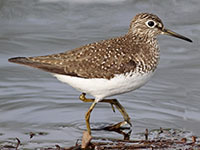 5/14 – Norrie Point, HR 85: Today was a two-sandpiper-day at Norrie Point. I found a spotted sandpiper foraging along the edge of the high tide in the mouth of the Indian Kill and a solitary sandpiper wading around a large puddle in the Environmental Education Center’s parking lot. I doubt it found good hunting there. (Photo of solitary sandpiper courtesy of Jay McGowan) 5/14 – Norrie Point, HR 85: Today was a two-sandpiper-day at Norrie Point. I found a spotted sandpiper foraging along the edge of the high tide in the mouth of the Indian Kill and a solitary sandpiper wading around a large puddle in the Environmental Education Center’s parking lot. I doubt it found good hunting there. (Photo of solitary sandpiper courtesy of Jay McGowan)
- David Lund
5/14 – Yonkers, HRM 18: Third and fourth-graders (29 students) from Corlears School came to the Sarah Lawrence Center for the Urban River at Beczak today to help us seine in the river. It was a chilly day, and the catch was small, but the diversity was excellent. The student’s catch included three bay anchovies (65-80 mm), four immature blue crabs, and four shore shrimp.
- Eli Caref, Katie Lamboy, Jan Manogca, Natalia Bengiam
5/15 – Fort Miller, HRM 192: I came upon a gorgeous adult red-necked grebe on the Hudson River off River Road this afternoon. It was awesome to see the full breeding plumage as well as a full-on vocalization that included some crazy weird grunting and hissing sounds. I ran back to my car to get my recorder but missed my chance. I then waited for half-an-hour in record mode, but no dice.
- Scott Varney (Hudson-Mohawk Bird Club)
5/15 – Beacon, HRM 61: Foot-long striped bass were the fare of the day at Long Dock. Anglers were baiting up with expensive bloodworms and cut river herring, but their payoff was a succession of 12-inch stripers. As one angler noted, “These are a beautiful fish!” Another mollified his disappointment in not catching a trophy by saying, “Well, these are striped bass, you know!” The rest of us were content with a rather steady run of obliging catfish.
- Tom Lake, T.R. Jackson
[In the Hudson River north of the George Washington Bridge, anglers are permitted one striped bass per day, 18-28 inches-long, or one fish over 40-inches. The season runs April 1 through November 30. NYSDEC]
5/15 - Manhattan, HRM 1: We checked our research sampling gear in Hudson River Park at The River Project's sampling station on the lighthouse tender Lilac at Pier 25 and found in our crab pot a hefty oyster toadfish (220 mm) and a beautiful white perch (210 mm).
-Siddhartha Hayes
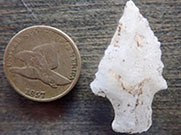 5/15 – Western Long Island: I was walking uphill through a wooded area following a wide gully that had created a natural funnel. Heavy rainfall had drained into the gully etching the earth and causing a sliver of white quartz to be exposed (a heavy rainstorm can “excavate” several millimeters of soil). Right away, I knew it was a projectile point embedded in the dirt. (Photo of a neville point courtesy of George Jackman) 5/15 – Western Long Island: I was walking uphill through a wooded area following a wide gully that had created a natural funnel. Heavy rainfall had drained into the gully etching the earth and causing a sliver of white quartz to be exposed (a heavy rainstorm can “excavate” several millimeters of soil). Right away, I knew it was a projectile point embedded in the dirt. (Photo of a neville point courtesy of George Jackman)
- George Jackman
[This location, like Jamaica Bay and Sandy Hook, NJ, is tangential to the watershed and is close enough as a contiguous extension to qualify for the Almanac. The cultural circumstances of the find connect us as well.
George Jackman’s find was an ancient Neville-stemmed spear or dart point (32 x 23 mm). Neville is not the name of a particular Indian group but rather a name given by archaeologists to represent a culture identifiable by its artifacts. For several centuries, about 7,000 years ago, Native Americans living in the northeast made stone tools designed for hunting and food processing that archaeologists have stylistically-labeled as “Neville,” after its original type site along the Merrimack River in New Hampshire (Dincauze 1968). They were mobile hunters and gatherers, fishers and foragers. However, other than analyzing their stone tools and the various components of their campsites, we know very little of the people who made them.
There are several Neville sites in the Hudson Valley. Notable among them are the Sylvan Lake Rockshelter (Funk 1966), Mohonk Rockshelter (Eisenberg 1977), and the North Bowdoin Park Rockshelter (Funk 1985). All three sites date their Neville occupation to c. 6,800 to 7,200 years ago.
5/16 – North Germantown, HRM 109: The recent rainy weeks led to consistently high tides, and last night the high tide flooded my low-lying yard, leaving behind large puddles. This morning, in a muddy patch that was earlier a puddle, I spotted a foot-long catfish moving its gills slowly. It had floated in with the high tide, but it was still alive several hours after the puddle had drained. I gently carried it to the river where it righted itself and darted away. Thinking there could be more stranded fish, I found another catfish in a puddle that was still a puddle, perhaps four-inches deep. When I approached, it splashed away, but with nowhere to go, I easily captured it and released it into the river.
- Kaare Christian
5/16 – Town of Wappinger, HRM 67.5: Today, we discovered that bald eagle nest NY459A, at the mouth of Wappinger Creek, had two nestlings. What a success story. In their first two years, this mated pair has had two nestlings each season.
- Mauricette Char Potthast, Dana Layton
[Town of Wappinger - May 16, 2018: A day to remember. A microburst with 95 mph winds came barreling through our neighborhood, snapping off several 90-foot white pines, telephone poles, and collapsing power lines. It roared through our yard demolishing a 50-foot-wide path, snapping two silver maples, one a 40-footer, like matchsticks. Two homes in the neighborhood had large trees crash through their roofs. [Microburst is a localized column of sinking air (downdraft) within a thunderstorm that can cause extensive damage.]
The high winds from the storm destroyed the bald eagle nest NY459A that was in its first season. A pair of 42-day-old nestlings had fallen 75 feet to the ground during the massive storm. Wildlife rehabilitators rescued the nestlings, and the birds survived. Undeterred, forty days later, the adult pair of bald eagles from NY459A began the rebuilding process. We often speak of how tough bald eagles seem to be, and this is one more good example. Their genes of resiliency must be passed on. Tom Lake]
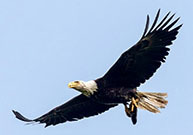 5/16 – Town of Poughkeepsie: The two 54-day-old nestlings in bald eagle nest NY62 continued to eat well. For nearly eight weeks, the adults had been supplying them with all manner of fish and fowl. Today’s choice was a familiar one, goldfish. But, rather than the typical bright orange goldfish, this was one of the less-common bronze-colored goldfish. The nestlings seemed to be on schedule for a predicted fledge between June 3-21. (Photo of bald eagle courtesy of Bob Rightmyer) 5/16 – Town of Poughkeepsie: The two 54-day-old nestlings in bald eagle nest NY62 continued to eat well. For nearly eight weeks, the adults had been supplying them with all manner of fish and fowl. Today’s choice was a familiar one, goldfish. But, rather than the typical bright orange goldfish, this was one of the less-common bronze-colored goldfish. The nestlings seemed to be on schedule for a predicted fledge between June 3-21. (Photo of bald eagle courtesy of Bob Rightmyer)
- Bob Rightmyer
5/17 – Yonkers, HRM 18: For five afternoons in the last ten days, our 9-11 grade students from the Bio-Chem program at Saunders High School in Yonkers have checked their eel mops in the Hudson River in search of glass eels. Across those ten days, the water temperature was quite steady averaging 60 degrees F. Other fauna in the eel mops included an elver and two mud crabs. On those five afternoons, the students collected 215 glass eels with a high of 116 on May 7 to a low of two on May 14. The final 38 glass eels, collected on May 16, were showing a darkening color change, an adaptation to being in the estuary where blending in is favored over translucency. .
- Brenda Jandres
5/17 – Yonkers, HRM 18: We welcomed 30 second-graders today from St. Ignatius Loyola School to the Sarah Lawrence Center for the Urban River at Beczak. Our efforts resulted in our largest catch of the week, including 10 mummichog (killifish) and 14 immature blue crabs.
- Eli Caref, Katie Samantha Macaluso
Spring-Summer 2019 Natural History Programs
Wednesday, July 10 - Thursday July 11 (9:00 AM - 5:00 PM)
2019 Teachers on the Estuary and Living Environment Institute
Wonders of Wetlands (15 credit hours for NYS certified teachers and administrators)
Five Rivers Environmental Education Center, 56 Game Farm Road, Delmar, New York
Join us this summer as we explore the Wonders of Wetlands. Teachers will spend two days gaining valuable knowledge and learning new curricula. We will use interdisciplinary approaches with the guidance of experts like EPA Award Winner Chris Bowser.
Cost: $50.00 for materials, supplies, and refreshments (light dinner on Thursday)
To register, e-mail drew.hopkins@dec.ny.gov
Tuesday, August 20 - Thursday August 22 (9:00 AM - 4:00 PM)
2019 Teachers on the Estuary and Living Environment Institute
Amazing Watersheds (22 credit hours for NYS certified teachers and administrators)
Five Rivers Environmental Education Center, 56 Game Farm Road, Delmar, New York
Join us this summer as we explore amazing watersheds. Teachers will spend three days gaining valuable knowledge and learning new curricula while using interdisciplinary approaches to explore watersheds. Some easy hiking on trails is involved.
Cost: $60.00 for materials, supplies, and refreshments (dinner provided on Wednesday)
To register, e-mail drew.hopkins@dec.ny.gov
Saturday, September 14 - 1:00- 4:00 PM
Science on the River
Norrie Point Environmental Education Center, Staatsburg
We would like to invite you to our open house featuring hands-on, interactive demonstrations, displaying scientific research and discovery on the estuary and in the Hudson Valley. Activities, with educational games and crafts, will be targeted towards both young and adult audiences.
For more information, email maija.niemisto@dec.ny.gov or call 845-889-4745 x109.
Hudson River: Striped Bass Cooperative Angler Program
You can share your fishing trip information and help biologists understand and manage our Hudson River striped bass fishery.
Here’s how it works: Fill out a logbook provided by us whenever you fish on the Hudson River (by boat or from shore). Record general location, time, gear used, what you caught (or if you didn’t catch anything) and return the logbook when you are done fishing for the season. You’ll receive an annual newsletter summarizing the information in addition to the latest news regarding regulations and the river. Whether you catch-and-release or take home a keeper, you can be part of the Cooperative Angler Program.
Join today by contacting: jessica.best@dec.ny.gov, or call 845-256-3009
- Jessica Best
Hudson River Miles
The Hudson is measured north from Hudson River Mile 0 at the Battery at the southern tip of Manhattan. The George Washington Bridge is at HRM 12, the Tappan Zee 28, Bear Mountain 47, Beacon-Newburgh 62, Mid-Hudson 75, Kingston-Rhinecliff 95, Rip Van Winkle 114, and the Federal Dam at Troy, the head of tidewater, at 153. The tidal section of the Hudson constitutes a bit less than half the total distance – 315 miles – from Lake Tear of the Clouds to the Battery. Entries from points east and west in the watershed reference the corresponding river mile on the mainstem.
To Contribute Your Observations or to Subscribe
The Hudson River Almanac is compiled and edited by Tom Lake and emailed weekly by DEC's Hudson River Estuary Program. Share your observations by e-mailing them to trlake7@aol.com.
To subscribe to the Almanac (or to unsubscribe), use the links on DEC's Hudson River Almanacor DEC Delivers web pages.
Discover New York State Conservationist - the award-winning, advertisement-free magazine focusing on New York State's great outdoors and natural resources. Conservationist features stunning photography, informative articles and around-the-state coverage. Visit the Conservationist webpage for more information.
Useful Links
National Oceanic and Atmospheric Administration online tide and tidal current predictions are invaluable when planning Hudson River field trips.
For real-time information on Hudson River tides, weather and water conditions from sixteen monitoring stations, visit the Hudson River Environmental Conditions Observing System website.
DEC's Smartphone app for iPhone and Android is now available at: New York Fishing, Hunting & Wildlife App.
Adventure NY
Under Governor Cuomo's Adventure NY initiative, DEC is making strategic investments to expand access to healthy, active outdoor recreation, connect more New Yorkers and visitors to nature and the outdoors, protect natural resources, and boost local economies. This initiative will support the completion of more than 75 projects over the next three years, ranging from improvements to youth camps and environmental education centers to new boat launches, duck blinds, and hiking trails. Read more about the Adventure NY initiative. For more information on planning an outdoor adventure in New York State, visit DEC's website at http://www.dec.ny.gov/outdoor.
Information about the Hudson River Estuary Program is available on DEC's website at http://www.dec.ny.gov/lands/4920.html.
|