A project of the Hudson River Estuary Program,
compiled by Tom Lake, Consulting Naturalist
Overview
A large, near-record fish was caught in the river this week. But, it was not, as you might suspect, a striped bass. As spring moved on, the forests and uplands were getting greener, and a new splash of white was replacing the shadbush. Nestlings were plentiful from herons to eagles to ducks and geese.
Highlight of the Week
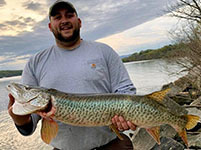 5/4 – Dutchess County, HRM 86: Flood tide had just begun this evening, and I was fishing with ten-pound test line for striped bass with a live river herring. Before long, I received a strong hit on my line that was like no striped bass I had ever encountered. Once landed, I realized that it was a tiger muskellunge. With no scale to weigh it, the best I could do was measure the fish: 48-inches-long. The tiger musky was released in good condition. (Photo of tiger muskellunge courtesy of William Doyle) 5/4 – Dutchess County, HRM 86: Flood tide had just begun this evening, and I was fishing with ten-pound test line for striped bass with a live river herring. Before long, I received a strong hit on my line that was like no striped bass I had ever encountered. Once landed, I realized that it was a tiger muskellunge. With no scale to weigh it, the best I could do was measure the fish: 48-inches-long. The tiger musky was released in good condition. (Photo of tiger muskellunge courtesy of William Doyle)
-William Doyle
[Our best guess is that William’s tiger musky weighed about 32 pounds. The New York State angling record is 35 pounds 8 ounces, and 50-inches-long. Tom Lake]
Natural History Entries
5/4 – Town of New Scotland, HRM 145: We had an exciting new “yard bird” today. We were outside, and I heard an unfamiliar bird calling. My granddaughter, Elara, pointed up and said, "there it is." It was a sandhill crane flying directly above us heading toward the southeast. We could still hear its call even after it disappeared.
- Alvin Breisch
5/4 – Delmar, HRM 143: We counted ten different warblers today at the Five Rivers Environmental Education Center, including Blackburnian, black-and-white, black throated blue, black-throated green, blue-winged, magnolia, chestnut-sided, common yellowthroat, yellow, and yellow-rumped. Others among the 55 bird species we found were Baltimore Orioles and rose-breasted grosbeaks.
- Scott Stoner, Denise Hackert-Stoner (Hudson-Mohawk Bird Club)
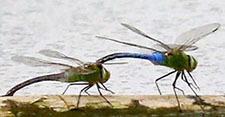 5/4 – Croton Point, HRM 35: I was amazed today to see my first dragonflies – several common green darners. It was only the beginning of May, and they were already mating and laying eggs. According to Nikula, Ryan, and Burne’s Field Guide to Dragonflies and Damselflies, migrant green darners from the south are some of the first dragonflies seen in the spring and are around from May through November. (Photo of green darner courtesy of Edward Mertz) 5/4 – Croton Point, HRM 35: I was amazed today to see my first dragonflies – several common green darners. It was only the beginning of May, and they were already mating and laying eggs. According to Nikula, Ryan, and Burne’s Field Guide to Dragonflies and Damselflies, migrant green darners from the south are some of the first dragonflies seen in the spring and are around from May through November. (Photo of green darner courtesy of Edward Mertz)
- Edward Mertz
5/4 – Bedford, HRM 35: The great blue heron rookery was quiet with some signs that hatching had begun. Eight nests had a heron standing guard. At three of those nests, I was able to see a nestling through openings in the nest twigs. At this point, about all that can be seen is just a bit of a fuzzy head. A guardian will always be present to protect the young nestlings while its mate is off hunting. The nestlings grow fast, and only when they are large enough will both parents be off hunting. The rest of the nests had a heron settled down in the nest either incubating or keeping the newly hatched nestlings warm.
- Jim Steck
5/5 – North River, HRM 263: The ruby-throated hummingbirds were back. I saw my first one this evening, four days earlier than last year. I have their feeders filled and suet for other birds. There are seed feeders out for the time being. I understand the black bears woke up hungry!- Marion Fuller
[The DEC released a Guidance to Homeowners on how to avoid problems with black bears.
http://www.dec.ny.gov/press/113258.html]
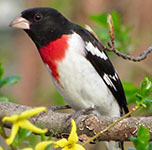 5/5 – Ulster County, HRM 90: I watched for 15 minutes this morning as a loose flock of 200-300 blue jays made it through my yard heading south to north. Today also brought my first Baltimore oriole of the year as well as a pair of rose-breasted grosbeaks. (Photo of rose-breasted grosbeak courtesy of Caroline McDonald) 5/5 – Ulster County, HRM 90: I watched for 15 minutes this morning as a loose flock of 200-300 blue jays made it through my yard heading south to north. Today also brought my first Baltimore oriole of the year as well as a pair of rose-breasted grosbeaks. (Photo of rose-breasted grosbeak courtesy of Caroline McDonald)
- Chris Bowser
5/5 – Hunter’s Brook, HRM 67.5: When you set your gear, you are obligated to tend to it. In our case, it was research gear, a fyke net set for glass eels. In a driving rain, we collected 69 glass eels and three elvers (probably last year’s glass eels). Hunter’s Brook is a rather small tributary of the tidal Wappinger, a mile from the Hudson River. River herring, in from the sea, had found their way here to the head of tide, and we watched and heard them splashing and spawning along the rocky shoreline. The brook was 57 degrees Fahrenheit (F).
- Tom McDowell, Mark Delaney, Tom Lake
5/5 – Yonkers, HRM18: We hosted a second-grade class from Fieldston Lower School in the Bronx today at the Sarah Lawrence Center for the Urban River at Beczak. We took them seining to our marsh, and across ten hauls of our net, caught four striped bass, a white perch, and a silver-dollar-sized blue crab.
- Elisa Caref, Katie Lamboy
*** Fish of the Week ***
Spring has brought many fish stories, and while there it is no urgency to run our Fish-of-the-Week feature, we have received many good comments and much encouragement to continue. This is our 21st week, and until we run out of species ...
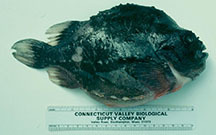 5/5 – Hudson River Watershed: This week’s entry is the lumpfish (Cyclopterus lumpus). Lumpfish are classified as a temperate marine stray and is the only member of its family (Cyclopteridae) found, albeit rarely, in our watershed. Lumpfish are number 138 (of 228) on our watershed list of fishes. If you would like a copy of the list, e-mail: trlake7@aol.com. 5/5 – Hudson River Watershed: This week’s entry is the lumpfish (Cyclopterus lumpus). Lumpfish are classified as a temperate marine stray and is the only member of its family (Cyclopteridae) found, albeit rarely, in our watershed. Lumpfish are number 138 (of 228) on our watershed list of fishes. If you would like a copy of the list, e-mail: trlake7@aol.com.
There are very few forms of wildlife whose common name is a better fit. Bigelow and Schroeder’s 1953 classic, The Fishes of the Gulf of Maine, describes them as “ungainly” and refers to them simply as “Lump.” They are a fish of the North Atlantic, ranging from Hudson Bay south to northern New Jersey. The only lumpfish I have ever caught was in 1992 from Ron Ingold’s commercial boat out of Edgewater (NJ) as we picked his shad net at midnight under the George Washington Bridge. Most lumpfish average a foot-long or less but can reach 23-inches. While they are rarely eaten, their roe is marketed as caviar to those who cannot afford, or feel ethically compelled to avoid, sturgeon caviar. (Photo of lumpfish courtesy of Tom Lake)
- Tom Lake
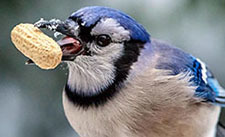 5/6 – Columbia County, HR 124: I estimated that no fewer than 150 blue jays, in varying sized groups, were flying north over my house in Austerlitz. Eventually, I quit counting. (Photo of blue jay courtesy of Debbie Quick) 5/6 – Columbia County, HR 124: I estimated that no fewer than 150 blue jays, in varying sized groups, were flying north over my house in Austerlitz. Eventually, I quit counting. (Photo of blue jay courtesy of Debbie Quick)
- Nancy Kern (Hudson-Mohawk Bird Club)
5/6 – Beacon, HRM 61: As a backdrop to my carp fishing during the day at Long Dock, I counted 25 small sportfishing craft out in the main channel drifting bait for striped bass. I ended up with three carp and two brown bullheads for my effort, caught and released. The carp measured 19.5-inches, 21-inches, and 27-inches. I did not weigh them, but these measurements would translate to approximately 3 to 9 pounds in weight. The bullheads were the usual 10-inch fish.
- Bill Greene
5/6 – Yonkers, HRM 18: We had another group of second-grade students today from Fieldston Lower School in the Bronx at the Sarah Lawrence Center for the Urban River at Beczak. Seining in our marsh, we caught 13 mummichogs and four striped bass in nine hauls of our net. To the second-graders, these were prized fish indeed.
- Elisa Caref, Katie Lamboy
5/7 – Red Hook, HRM 98: We have been feeding birds for five years. Three years ago, a male rose-breasted grosbeak stayed the summer. Since then, we have had two breeding pairs with their fledglings. A month ago, a pair of eastern bluebirds started showing up feeding on our suet and nesting in a box just down the street. Today, I was surprised to see the bluebirds, a female rose-breasted grosbeak, and a male and female evening grosbeak together on the feeders.
- Bob Gramling
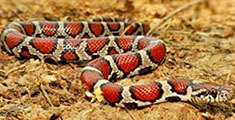 5/7 – New Paltz, HRM 78: With warming temperatures in midday, I walked the new Mohonk Foothills trail in New Paltz. Along the edge of the crushed shale path, I spied a nearly three-foot-long eastern milk snake basking in the diffused sunlight. It did not move as I drew closer, seemingly not aware of my approach. I skirted around it, but less than fifty feet away, I came across a larger, nearly four-feet-long, milk snake. This snake was also on the edge of the trail but moving slowly forward with a lot of tongue flicking. These are beautiful snakes that, unfortunately, are often misidentified as copperheads. (Photo of eastern milk snake courtesy of Lisa Powers) 5/7 – New Paltz, HRM 78: With warming temperatures in midday, I walked the new Mohonk Foothills trail in New Paltz. Along the edge of the crushed shale path, I spied a nearly three-foot-long eastern milk snake basking in the diffused sunlight. It did not move as I drew closer, seemingly not aware of my approach. I skirted around it, but less than fifty feet away, I came across a larger, nearly four-feet-long, milk snake. This snake was also on the edge of the trail but moving slowly forward with a lot of tongue flicking. These are beautiful snakes that, unfortunately, are often misidentified as copperheads. (Photo of eastern milk snake courtesy of Lisa Powers)
- Bob Ottens
5/7 – Town of Wappinger, HRM 67: Flowering dogwood (Cornus florida), a native species, was in full bloom acting as a brilliantly colorful segue to the last of the shadbush in the forest. A cursory check showed that the new oak leaves were now “the size of a squirrel’s ear.” (Photo of gray squirrel courtesy of Jim Yates)
- Tom Lake
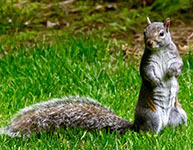 [In the time before the arrival of Europeans to the Hudson Valley, the cultivation of maize, or corn, was important for Native People – in our watershed, Algonquian and Iroquoian-speakers. There is much lore regarding the time to plant corn. Ethnographic (oral) tradition among many Northeast Indian tribes suggested planting corn when the new oak leaves were the size of a squirrel's ear. But, what is the size of a squirrel’s ear? One spring, I decided to find out. I spent the month of April driving around the Hudson Valley measuring the ears of road-killed gray squirrels. I measured 116 x 2 ears each. It turned out that the average “ear size” was 20.6 millimeters (mm), or 0.82 inches-long. This might apply to different oaks in different areas, but for the Hudson Valley, it may have been the white oak (Quercus alba). In most years, the prime date arrives in early May and is probably related to soil temperature, rainfall, and perhaps other factors. Tom Lake] [In the time before the arrival of Europeans to the Hudson Valley, the cultivation of maize, or corn, was important for Native People – in our watershed, Algonquian and Iroquoian-speakers. There is much lore regarding the time to plant corn. Ethnographic (oral) tradition among many Northeast Indian tribes suggested planting corn when the new oak leaves were the size of a squirrel's ear. But, what is the size of a squirrel’s ear? One spring, I decided to find out. I spent the month of April driving around the Hudson Valley measuring the ears of road-killed gray squirrels. I measured 116 x 2 ears each. It turned out that the average “ear size” was 20.6 millimeters (mm), or 0.82 inches-long. This might apply to different oaks in different areas, but for the Hudson Valley, it may have been the white oak (Quercus alba). In most years, the prime date arrives in early May and is probably related to soil temperature, rainfall, and perhaps other factors. Tom Lake]
[Note: one inch = 25.4 millimeters (mm)]
5/7 – Manhattan, HRM 1: With the river getting warmer, our expectations were rising as we checked our research sampling gear in Hudson River Park at The River Project's sampling station on the lighthouse tender Lilac at Pier 25. While our catch lacked numbers, it excelled in quality fishes. Our crab pot had three tautog (blackfish) measuring 200, 210, and a whopping 365 mm-long male (nearly 15-inches!).
-Siddhartha Hayes
5/8 – Croton Point, HRM 35: Fifty-four fifth-graders from the Friends Seminary School in Manhattan joined us on the beach at Croton Point this morning to help us investigate life in the Hudson River. Altogether, we made five hauls of our 30-foot seine and were not disappointed when our total catch was just five fish. Those five represented five different species: spottail shiner, white perch, a breeding male banded killifish (112 mm), resplendent with his purple-lavender bands, a blueback herring (80 mm), probably last year’s hatch and possibly a late-season emigre from the Mohawk River, and a holdover (last year’s hatch as well), alewife (115 mm). The river was a warm 60 degrees F, and the salinity was 2.0 parts-per-thousand (ppt).
- John Phillips, Tom Lake
[At the end of our day, we held our traditional Eel Race. The eel race is best held on a sandy beach, preferably with a gentle slope to the water. Five-gallon buckets, a quarter-filled with water, are lined up a short distance apart, parallel to and several feet from the water’s edge. An American eel (“racing eels”) is placed in each. A group of eager students are assigned to each entry. Competing groups can be boys/girls, teachers/students, blue eyes/brown eyes, earth signs/sun signs, or any other meaningful assemblage. The eels are given honorary names like Eelie, Slimy, Snakey, or Fred, which makes cheering much easier.
Today’s eels were named Bobert, Shock, and Slimy. At the chosen moment, the buckets were tipped over and the race was on. The length of the race is a product of factors such as distance to travel, gradient of the beach, wind velocity, barometric pressure, relative humidity, enthusiasm of the cheering students, and the individual eel’s competitive nature. With luck, and about ten seconds, there is a winner. At the start today, Slimy had a difficult time getting out of the gate, and as a result, trailed throughout. Bobert had the lead until the very last second when Shock squirmed past to win by a short nose. Tom Lake]
5/8 – Yorktown, HRM 42: This was one of the most amazing birding days we ever had. We saw seven solitary sandpipers, a clapper rail (my first in Westchester County), two Baltimore orioles, and a ruby-throated hummingbird, all less than a half-mile from the Rail Trail in Yorktown.
- Walter Fowler, Jacqueline Fowler, Steve Rappaport
5/9 – Stony Creek, HRM 225: There is a small overflow pond by me next to the Hudson River, a result of the recent flooding. It is also being fed by a cold-water stream. While watching some small fish, I spotted what I thought was a dark stick. But, I soon recognized it as a fish with the head of a pike or pickerel. I touched it with a stick, and to my astonishment, it swam under the vegetation covering the small pond. It was a foot-long northern pike. I hope to be able to scoop it up in a net and return it to the Hudson River before the dissolved oxygen, or the pond itself, disappears.
- Pete Loch
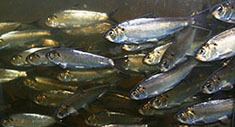 5/9 – Norrie Point, HRM 85: A class of Marist College Biology students joined us today in light rain to seine the inshore shallows at Norrie Point. Our catch was quite predictable for mid-spring in cool water (53 degrees F) with yellow perch, spottail shiners, and tessellated darters. The one surprise was two adult male alewives, river herring (260-265 mm), in from the sea to spawn. River herring are known to be very delicate in that they do not survive well in captivity, as in our ten-gallon tank. Yet these two, with the aid of an aerator and cool water, did well as the class was able to get a good look and learn a bit about their life history. We then released them back into the river, and they swam away. (Photo of alewives courtesy of John Burrows) 5/9 – Norrie Point, HRM 85: A class of Marist College Biology students joined us today in light rain to seine the inshore shallows at Norrie Point. Our catch was quite predictable for mid-spring in cool water (53 degrees F) with yellow perch, spottail shiners, and tessellated darters. The one surprise was two adult male alewives, river herring (260-265 mm), in from the sea to spawn. River herring are known to be very delicate in that they do not survive well in captivity, as in our ten-gallon tank. Yet these two, with the aid of an aerator and cool water, did well as the class was able to get a good look and learn a bit about their life history. We then released them back into the river, and they swam away. (Photo of alewives courtesy of John Burrows)
- Amanda Simmons, Tom Lake
5/9 – Town of Wappinger, HRM 67: In late afternoon today, I was amazed to see a very sleek and well-fed looking bobcat stalking prey (our big black cat) in our backyard. I was able to open the door and make enough noise for it to look up before it turned and took off into the woods.
- Renee Klein
5/9 – Yonkers, HRM 18: We went seining today at our Sarah Lawrence Center for the Urban River at Beczak marsh with a group of second-graders from St Ignatius Loyola School in Manhattan. Across 14 hauls of our seine, we caught an American eel, two quarter-sized blue crabs, 14 mummichogs, and two white perch.
- Jay Muller, Elisa Caref
5/10 – Battenkill, HRM 193: I hit a record number of warblers (12) in my front yard in Salem early this morning. They were all viewed and recorded in a one-hour session. The warblers were moving in mixed-species waves, working the trees and consistently moving across my yard. They included American redstart, yellow-rumped, magnolia, Nashville, black-and-white, black-throated green, black-throated blue, blackpoll, northern parula, yellow, northern waterthrush, and ovenbird. There were also several Baltimore orioles, two ruby-throated hummingbirds, and a pair of nesting Carolina wrens.
- Scott Varney (Hudson-Mohawk Bird Club)
5/10 – Norrie Point, HRM 85: This was day 2 with another Marist College Biology class, and with thunderstorms in the forecast, we seined with a bit of urgency. We chose an alternate beach so as to not disturb a pair of Canada geese and their five goslings.
None of the students had ever been to Norrie Pont before let alone gone seining. While the catch seemed extra ordinary to us – spottail shiners, yellow perch, and tessellate darters – it was special for them. What also made it special, and a good teaching point, was that in a world that is becoming more and more affected by invasive species, these fish were all native to the Hudson River. All of them were here long before the first of us arrived to catch them.
- Maija Niemisto, Tom Lake
[“Native” as opposed to “introduced,” is a theme we often discuss with students. Our New York State fish, the brook trout, along with northern pike and lake trout, are some of our first native species whose presence in the watershed dates to about 16,000 years ago. “Introduced” can range from intentional stockings such as brown and rainbow trout, largemouth and smallmouth bass, common carp, grass carp, and goldfish, to canal immigrants such as freshwater drum, gizzard shad, and channel catfish. The benchmark for this bifurcation came in the early 17th century. If a species was here when the first Europeans arrived, it was almost certainly native. Of the 228 species of fish documented for the Hudson River watershed, 175 pass that test and are considered native (0.77). Tom Lake]
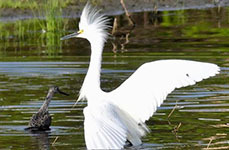 5/10 – Croton Point, HRM 34.5: In early evening, we counted more than 80 shorebirds in the puddles of the athletic fields. Most of the “peeps” (72) were least sandpipers. There were also four lesser and two greater yellowlegs, a solitary sandpiper, three semipalmated plovers, and a killdeer. The highlight was a “plumaged” snowy egret in company with a lesser yellowlegs. After a while, an adult male peregrine falcon took two passes and scattered all the shorebirds. (Photo of snowy egret courtesy of Karalyn Lamb) 5/10 – Croton Point, HRM 34.5: In early evening, we counted more than 80 shorebirds in the puddles of the athletic fields. Most of the “peeps” (72) were least sandpipers. There were also four lesser and two greater yellowlegs, a solitary sandpiper, three semipalmated plovers, and a killdeer. The highlight was a “plumaged” snowy egret in company with a lesser yellowlegs. After a while, an adult male peregrine falcon took two passes and scattered all the shorebirds. (Photo of snowy egret courtesy of Karalyn Lamb)
- Larry Trachtenberg
[“Peep” sandpiper is a collective noun describing many small shorebird species whose exact names, due to ambiguous field marks, often defy casual identification. These can include, but is not limited to, several species of sandpipers, dunlins, sanderlings, and even plovers. Tom Lake]
5/10 - Manhattan, HRM 1: We had tautog on our mind again when we checked our research sampling gear in Hudson River Park at The River Project's sampling station on the lighthouse tender Lilac at Pier 25. This time, we had collected two more, 305 and 30 (mm). In our killifish trap we found an adorable (40 mm) skilletfish!
-Melissa Rex, Toland Kister
Spring-Summer 2019 Natural History Programs
Wednesday, July 10 - Thursday July 11 (9:00 AM - 5:00 PM)
2019 Teachers on the Estuary and Living Environment Institute
Wonders of Wetlands (15 credit hours for NYS certified teachers and administrators)
Five Rivers Environmental Education Center, 56 Game Farm Road, Delmar, New York
Join us this summer as we explore the Wonders of Wetlands. Teachers will spend two days gaining valuable knowledge and learning new curricula. We will use interdisciplinary approaches with the guidance of experts like EPA Award Winner Chris Bowser.
Cost: $50.00 for materials, supplies, and refreshments (light dinner on Thursday)
To register, e-mail drew.hopkins@dec.ny.gov
Tuesday, August 20 - Thursday August 22 (9:00 AM - 4:00 PM)
2019 Teachers on the Estuary and Living Environment Institute
Amazing Watersheds (22 credit hours for NYS certified teachers and administrators)
Five Rivers Environmental Education Center, 56 Game Farm Road, Delmar, New York
Join us this summer as we explore amazing watersheds. Teachers will spend three days gaining valuable knowledge and learning new curricula while using interdisciplinary approaches to explore watersheds. Some easy hiking on trails is involved.
Cost: $60.00 for materials, supplies, and refreshments (dinner provided on Wednesday)
To register, e-mail drew.hopkins@dec.ny.gov
Saturday, September 14 - 1:00- 4:00 PM
Science on the River
Norrie Point Environmental Education Center, Staatsburg
We would like to invite you to our open house featuring hands-on, interactive demonstrations, displaying scientific research and discovery on the estuary and in the Hudson Valley. Activities, with educational games and crafts, will be targeted towards both young and adult audiences.
For more information, email maija.niemisto@dec.ny.gov or call 845-889-4745 x109.
Hudson River: Striped Bass Cooperative Angler Program
You can share your fishing trip information and help biologists understand and manage our Hudson River striped bass fishery.
Here’s how it works: Fill out a logbook provided by us whenever you fish on the Hudson River (by boat or from shore). Record general location, time, gear used, what you caught (or if you didn’t catch anything) and return the logbook when you are done fishing for the season. You’ll receive an annual newsletter summarizing the information in addition to the latest news regarding regulations and the river. Whether you catch-and-release or take home a keeper, you can be part of the Cooperative Angler Program.
Join today by contacting: jessica.best@dec.ny.gov, or call 845-256-3009
- Jessica Best
Hudson River Miles
The Hudson is measured north from Hudson River Mile 0 at the Battery at the southern tip of Manhattan. The George Washington Bridge is at HRM 12, the Tappan Zee 28, Bear Mountain 47, Beacon-Newburgh 62, Mid-Hudson 75, Kingston-Rhinecliff 95, Rip Van Winkle 114, and the Federal Dam at Troy, the head of tidewater, at 153. The tidal section of the Hudson constitutes a bit less than half the total distance – 315 miles – from Lake Tear of the Clouds to the Battery. Entries from points east and west in the watershed reference the corresponding river mile on the mainstem.
To Contribute Your Observations or to Subscribe
The Hudson River Almanac is compiled and edited by Tom Lake and emailed weekly by DEC's Hudson River Estuary Program. Share your observations by e-mailing them to trlake7@aol.com.
To subscribe to the Almanac (or to unsubscribe), use the links on DEC's Hudson River Almanacor DEC Delivers web pages.
Discover New York State Conservationist - the award-winning, advertisement-free magazine focusing on New York State's great outdoors and natural resources. Conservationist features stunning photography, informative articles and around-the-state coverage. Visit the Conservationist webpage for more information.
Useful Links
National Oceanic and Atmospheric Administration online tide and tidal current predictions are invaluable when planning Hudson River field trips.
For real-time information on Hudson River tides, weather and water conditions from sixteen monitoring stations, visit the Hudson River Environmental Conditions Observing System website.
DEC's Smartphone app for iPhone and Android is now available at: New York Fishing, Hunting & Wildlife App.
Adventure NY
Under Governor Cuomo's Adventure NY initiative, DEC is making strategic investments to expand access to healthy, active outdoor recreation, connect more New Yorkers and visitors to nature and the outdoors, protect natural resources, and boost local economies. This initiative will support the completion of more than 75 projects over the next three years, ranging from improvements to youth camps and environmental education centers to new boat launches, duck blinds, and hiking trails. Read more about the Adventure NY initiative. For more information on planning an outdoor adventure in New York State, visit DEC's website at http://www.dec.ny.gov/outdoor.
Information about the Hudson River Estuary Program is available on DEC's website at http://www.dec.ny.gov/lands/4920.html.
|