
Hudson River Almanac 2/9/19 - 2/15/19
The New York State Department of Environmental Conservation sent this bulletin on 02/22/2019 02:00 PM EST |
| DEC Delivers - Information to keep you connected and informed from the NYS Department of Environmental Conservation |
| Share or view as a web page || Update preferences or unsubscribe |
Hudson River Almanac
|
Compiled by Tom Lake, Hudson River Estuary Program Consulting NaturalistOverviewA rare-for-our-area songbird visited this week, and through pure serendipity, it was noticed, photographed, and recorded. When an event like this occurs, it makes you wonder how much rare-to-uncommon wildlife slips past us when we are not looking. The dozens of bald eagle nests in the watershed were primed, and the adults seemed quite on edge to begin the nesting season. Highlight of the Week
[Townsend's solitaire (Myadestes townsendi) is a gray, long-tailed thrush. They breed in the west and occasionally stray to the northeast when they retreat from their montane habitat. There are numerous, widely scattered, records in the east, but this thrush has been consistently rare in our area at any time of the year. The most recent records from Ulster County, for example, were single birds seen on 12 November 2005 in East Kingston, and 21 March 2010 at Mohonk Preserve. Ulster County is overdue for another visit, but Columbia County is close enough for this rare vagrant. Steve Chorvas] Natural History Entries2/9 – Fort Edward, HRM: 202: On a bitterly cold afternoon, a dozen birders visited the Fort Edward Grasslands and nearby riverine areas in search of wintering raptors, field birds, and waterfowl. We found redhead, ring-necked duck, hooded merganser, and common goldeneye in the Hudson River. Raptors were abundant in the grasslands with a full dozen rough-legged hawks (mainly light morph), five northern harriers, six red-tailed hawks, two adult bald eagles, and one immature eagle. We had no luck with short-eared owls in the usually reliable areas. 2/9 – Stillwater, HRM 171.5: We surveyed the Hudson River in mid-afternoon and found six species of waterfowl, including 41 common goldeneye, four hooded and two common mergansers, and three buffleheads. The light was perfect for bringing out the purple head color on the drakes. We spent more time than usual and got to see common goldeneye behavior that we hadn't seen before. We watched the usual head-tilting and stretching with the accompanying “ka-ching,” but this time we saw the smaller rafts swim offshore to get away from us, then turn around and swim back when we turned away. They seemed curious.
2/10 – Schuylerville, HRM 186: I checked out the waterfowl at Fish Creek in mid-afternoon. Having already looked over 37 common mergansers, many mallards, and Canada geese, I was about to leave when I spotted a pair of canvasbacks pop out from behind a dock at the Fish Creek Marina. Two more canvasback drakes, with their heads tucked in, were also there resting with the other ducks.
2/10 – New Paltz, HRM 78: I had one more banded house finch, a male, at my feeders this morning. This one, however, had only a single band. [See 2/2 for Pam Plummer’s two other banded house finches and their origins. This finch could be as much as five-years-old, making him an “elder” of his House Finch tribe.]
2/10 – Bronx, New York City: We were walking out to Twin Island Orchard Beach in Pelham Bay Park when we spotted a distant diving bird. We first thought it a cormorant but settled on a loon. It was too far away to see diagnostic markings on its back, but when it stretched, the bird’s white throat and chest glowed in the early sun. In the background was a very large flock of brant, whose wings and landings had broken the stillness only moments before. After reading last week’s Almanac, I now wonder if the loon we saw was the very uncommon-to-rare Pacific loon. 2/11 – Town of LaGrange, HRM 69: Up to a dozen redheads, as well as other diving ducks, have been frequenting two small ponds about a half-mile apart in the Noxon-Stringham Road area for more than a week. Four redheads were initially discovered there by Barbara Butler and me on February 3. 2/11 – Town of Poughkeepsie: The adults in bald eagle nest NY62, have begun showing their fidelity to their nest in a 100-foot-high tulip tree. They have begun alternate coverage of the nest, acting as though incubating of eggs might be close. 2/12 – Sleepy Hollow, HRM 28: Captaining several ice islands in the middle of the river this morning were twelve bald eagles – three adults and nine immatures. With much flapping and careening they seemed to be contesting for the best perch (a place to sit, not fish). By noon, they all had flown elsewhere. 2/13 – Albany, HRM 147: We had a fisher (Martes pennanti) run across the road in front of our car this evening as we were slowing down to turn off the very south end of the Northway. The critter was so dark that it barely showed in the headlights. When it went up the snow-covered bank along the road, we got a better look – long and low with quite the bushy tail!
2/13 – Ulster County, HRM 76: This past week, coyotes have been whipping up a racket down in the swamp and up on the ridge out back in Kerhonkson. One night, a lone coyote was heard moving steadily across the ridge howling every few yards, most likely in search of a mate. The barred owls and red-shouldered hawks were starting to sound off their spring-time rituals. 2/13 – Oscawana, HRM 38.5: The cove at Oscawana Point was encrusted with ice after yesterday’s snow and ice storm. It was a peaceful scene as we enjoyed the river view and watched two bald eagles flying over the point. Then, from out of nowhere, an immature bald eagle appeared right in front of us. It circled around over the ice before finally flying off to the south. As we approached the bridge over to Oscawana Point, we unwittingly frightened a great blue heron that was wading under the bridge. We watched as it flew across the road and landed near a small waterfall on the opposite side of the bridge. 2/14 – Hudson River Valley: On this day in 2014, many parts of the Hudson Valley received 22-inches of snow. 2/14 – Greene County, HRM 115: I found a cluster of 25 black vultures in a wood lot just north of Catskill, near the Greene County transfer station. [Such a grouping of black vultures always conjures up an image of a convocation of undertakers. Thus, it seems fitting that a collective noun for them would be “a wake” of vultures. Tom Lake] 2/14 – Eastern Dutchess County, HRM 96: I watched an immature golden eagle as it got closer but still high overhead in Pine Plains. The eagle was circling with a small kettle of six red-tailed hawks, an adult bald eagle, and a raven. 2/14 – Town of Poughkeepsie: It was Valentine’s Day, and the mated pair from bald eagle nest NY62 was out on the river ice. From their body language you could almost tell that the nesting season was at hand. 2/15 – Columbia County, HRM 129: I was hiking around River Street Park in Valatie and got to thinking about the fish in Kinderhook Creek. There are a few fish that can leave the water and travel on land. Some use their strong pectoral fins, while others just kind of wriggle around to maneuver over rocks or in the mud. American eels come to mind. The brown trout that live in Kinderhook Creek would have had a feast today if they were one of these occasionally terrestrial creatures. The fast-melting snow was littered with adult winter stoneflies, one of my personal barometers that tells me spring is just around the corner. 2/15 – Columbia County, HRM 108: We went to Copake Falls today seeking the surprisingly present Townsend's solitaire, and we found it. The context in which we found this rare-in-this-area songbird, included a merlin crossing the sky and two golden eagles, one quite close and low. [Townsend’s solitaire sightings in our area are extremely rare – maybe once in five years in New York State, perhaps even fewer. However, I would guess that some are overlooked because they are somewhat reclusive, inactive for lengthy periods, and do not come to feeders. This Townsend’s solitaire was found quite by accident as it flew across a road just as a group of birders happened to be at that unlikely location at that exact moment. Even with that, there happened to be a good young birder, Mike Nicosia, who recognized it and appreciated its rarity. Rich Guthrie]
2/15 – One of the many benefits of being the editor of a natural history journal, that has many readers, is that there is no shortage of checks-and-balances on the veracity of the reports of wildlife. On occasion, we will use a report, that upon closer examination, becomes debatable, even questionable. One of the most important tenets of science, as expressed so well by Carl Sagan, demands that extraordinary claims require extraordinary evidence. Or, put another way, make it happen again. ● On January 26, we reported in the Almanac a lone snow goose amid a huge flock of Canada geese at West Point. Several readers viewed the accompanying photo, recognized the white goose, and suggested that the bird was a hybrid of a different, not clearly distinguishable, species and not a snow goose after all. ● On February 3, we reported in the Almanac a flock of 25 rose-breasted grosbeaks in the Town of Fishkill. Some readers questioned the presence of so many of these songbirds in Dutchess County in winter – rose-breasted grosbeaks winter much farther to the south. As a result, the initial identification becomes debatable at best. *** Fish of the Week***
The banded rudderfish was one of those marine species that we have always thought might be here, but their presence was so sporadic that finding one had proved difficult. That is until August 7, 2014, when Chris Anderson of The River Project spotted a school of silvery fish with black vertical bands swimming just off Pier 40 in the Hudson River. Chris took several high-quality photographs that allowed us to identify them as banded rudderfish. All were estimated to be about 250 millimeters (mm). We added the banded rudderfish to our watershed list of fishes. Four years and four days later, Peter Park and his Brooklyn Bridge Park colleagues came upon a school of banded rudderfish in the East River along Pier 5 at Brooklyn Bridge Park. They counted five fish all about 180 mm. Peter hoped to catch one on rod-and-reel. That came eight days later in the East River at the Brooklyn Bridge Conservancy. Using frozen “spearing” fillets (Atlantic Silversides), he and Isa Del Bello caught seven ranging in size from 200-240 mm. (Photo of banded rudderfish courtesy of Peter Park) If you would like a copy of our watershed fish list, e-mail: trlake7@aol.com. [Note: one inch = 25.4 millimeters (mm)] Winter 2019 Natural History ProgramsVolunteer Opportunity: Hudson River Eel Project Hudson River: Striped Bass Cooperative Angler Program Here’s how it works: Fill out a logbook provided by us whenever you fish on the Hudson River (by boat or from shore). Record general location, time, gear used, what you caught (or if you didn’t catch anything) and return the logbook when you are done fishing for the season. You’ll receive an annual newsletter summarizing the information in addition to the latest news regarding regulations and the river. Whether you catch-and-release or take home a keeper, you can be part of the Cooperative Angler Program. Free Trees for Streamside Planting The Hudson River Estuary Program’s Trees for Tribs program offers free native trees and shrubs for planting along the tributary streams in the Hudson River Estuary watershed. Our staff can help you with a planting plan and work with your volunteers. Since 2007, Trees for Tribs has provided more than 40,000 native trees and shrubs for planting along 20 miles of stream with the help of more than 9,000 local volunteers. We are now accepting applications for planting projects. For more information about the program or to download an application, please visit the DEC website at: https://www.dec.ny.gov/lands/43668.html. If you have questions about a potential planting site, please contact Beth Roessler at (845) 256-2253 or HudsonEstuaryTFT@dec.ny.gov. Hudson River MilesThe Hudson is measured north from Hudson River Mile 0 at the Battery at the southern tip of Manhattan. The George Washington Bridge is at HRM 12, the Tappan Zee 28, Bear Mountain 47, Beacon-Newburgh 62, Mid-Hudson 75, Kingston-Rhinecliff 95, Rip Van Winkle 114, and the Federal Dam at Troy, the head of tidewater, at 153. The tidal section of the Hudson constitutes a bit less than half the total distance – 315 miles – from Lake Tear of the Clouds to the Battery. Entries from points east and west in the watershed reference the corresponding river mile on the mainstem. To Contribute Your Observations or to SubscribeThe Hudson River Almanac is compiled and edited by Tom Lake and emailed weekly by DEC's Hudson River Estuary Program. Share your observations by e-mailing them to trlake7@aol.com.
|
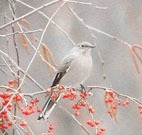 2/14 – Columbia County, HRM 108: I came upon a Townsend's solitaire today at Copake Falls. The bird appeared twice in bittersweet vines in a hedgerow separating two cornfields. The bird passed all the diagnostic questions: gray thrush, prominent white eye-ring, white outer tail feathers. (Photo of Townsend's solitaire courtesy of Gail Benson)
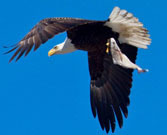 2/9 – Town of Poughkeepsie: One of the adults at bald eagle nest NY62 seemed to explode from its tulip tree perch carrying a large gizzard shad. Gizzard shad are often a meal of opportunity in winter. Being a nonnative species, they are prone to winter kill in icy northern waters. (Photo of bald eagle with gizzard shad courtesy of Mauricette Char Potthast)
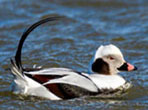 2/10 – Kingston Point, HRM 93: A beautiful drake long-tailed duck was fishing right near shore today along with a drake canvasback as well as both a greater and lesser scaup – all diver ducks. (Photo of long-tailed duck courtesy of Jim Yates)
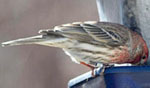 [This, the third of Pam Plummer’s banded house finches, carried only a silver U.S. Geological Survey band. That USGS band alone means that my SUNY New Paltz students and I banded the bird between 2014-2016, before we began color banding. It is too difficult to identify birds just by a USGS band with a partial number. Kara Belinsky] (Photo of house finch courtesy of Pam Plummer)
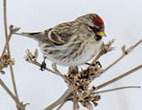 2/13 – Dutchess County, HRM 85: I was photographing three common redpolls foraging in some roadside weeds when they suddenly flew off, chased by an American kestrel. (Photo of common redpoll courtesy of Deborah Tracy-Kral)
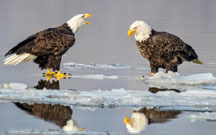 2/15 – Dutchess County, HRM 67.5; We stopped by New Hamburg in midday on our daily circuit checking bald eagle nests to see what the adults were up to. The dropping tide – shallower inshore water – probably signaled good hunting as we counted seven bald eagles, six adults, out on the downriver-bound ice floes. At least two of them appeared to be tearing a fish apart. When you see a number of eagles out on the ice this time of the year, it is almost impossible to distinguish the resident birds from those that are wintering from points north. (Photo of bald eagles courtesy of John Badura)
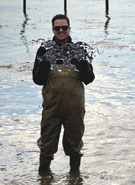 2/15 – Yonkers, HRM 18: Along with a new intern (Jan) from Bronx Collaborative High School, we tried winter seining again today. With no expectations, we were not disappointed. We did not catch a living thing, but the impressive ice “sculptures” collected in the seine had us enthralled. The river was a bit warmer than we’d guessed (39 degrees Fahrenheit) and the low salinity (2.0 parts-per-thousand) reflected the upriver melt from the recent warm days. (Photo of sculpted river ice at Beczak Center courtesy of Elisa Caref)
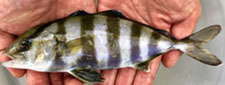 2/15 – Hudson Valley Estuary: This week’s fish is the banded rudderfish (Seriola zonata), a marine species number 175 (of 228) on our watershed list of fishes. Banded rudderfish are not large – generally a foot-long or less – and are one of six members of the jack family (Carangidae) found in the estuary. A few of the others are crevalle jack, lookdown, moonfish, and permit.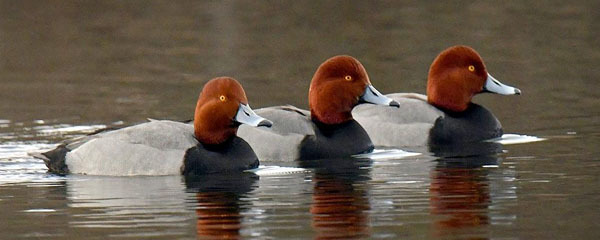
|
The New York State Department of Environmental Conservation respects your right to privacy and welcomes your feedback | Update preferences or unsubscribe | Learn more about DEC Delivers. |
|
Connect with DEC:    
|
|
| Basil Seggos, Commissioner | |