
Hudson River Almanac 1/12/19 - 1/18/19
The New York State Department of Environmental Conservation sent this bulletin on 01/25/2019 02:00 PM EST |
| DEC Delivers - Information to keep you connected and informed from the NYS Department of Environmental Conservation |
| Share or view as a web page || Update preferences or unsubscribe |
|
Compiled by Tom Lake, Hudson River Estuary Program Consulting NaturalistOverviewArctic air worked its way down the watershed this week with the High Peaks seeing air temperatures as low as -21 degrees Fahrenheit (F). Highlight of the Week
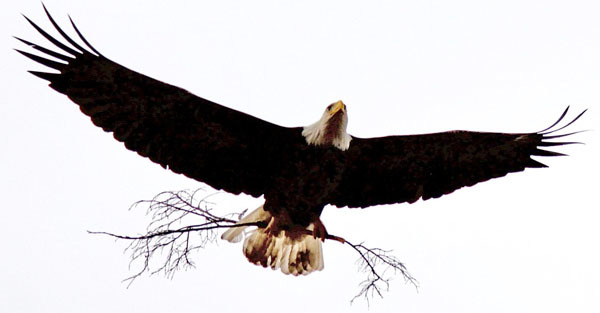
[Stooping is a term that is used by birders, primarily for raptors, to describe a dive. Webster’s Dictionary defines it as “to dive down swiftly usually to attack prey.” Tom Lake] Natural History Entries1/12 – Newcomb, HRM 300: The heart of winter was upon us. We had -17 degrees F this morning. Every day, the rising sun casts a dim red light offering something new from our home at the top of the Hudson. The river was mostly frozen, and we have been seeing white-tailed deer crossing the river below the Route 28N bridge where the river widens. It is uncanny how they know if the ice is safe. The females (does) move out slowly on the ice with last year’s young ones behind her. If she determines it is unsafe, they return to the shore line. Otherwise, they make their way to an island and then to the eastern side. We have seen deer fall through the ice in the spring, but all of the ones we saw were able to dig their front hooves in and hop back out, quite remarkably. We are also seeing bobcat tracks on a regular basis. 1/12 – Westchester County, HRM 42: A month ago, I spotted an osprey flying along Croton Reservoir. Today, an osprey was again sighted (and photographed) along the Croton Reservoir just south of the entrance to Muscoot Farm in Yorktown. I wondered if it may have been the same bird. This is very late in the season for an osprey. By now most have migrated south, some to South America. *** Fish of the Week ***
[The terete-shaped body of the inshore lizardfish looks like a brightly striped and mottled cigar. They grow to 18-inches and favor the temperate and tropical marine waters of the Atlantic. Inshore lizardfish, with tooth-studded jaws, are voracious predators. They lurk in sandy shallows, burrowing in the bottom sediments, to ambush passing prey. Larval lizardfish are carried into the Hudson Estuary on summer flood tide currents; juvenile lizardfish are found in late summer and fall in brackish water as far upriver as Croton Point (HRM 35). Tom Lake] 1/12 – Dutchess County, HRM 68: Sylvan Lake was brimming with waterfowl in midday, including ringed-neck ducks (92), lesser scaup (6), common goldeneye (2 hens), and one hen canvasback. 1/13 – Dutchess County: Today’s Ralph T. Waterman Bird Club Winter Waterfowl Count for Dutchess County documented 18 species. Among them were four species of geese: snow goose (1), greater white-fronted goose (1), cackling goose (2), and Canada geese (10,193). Common merganser (251) were high count among ducks, with ring-necked ducks (74), and American black ducks (57) also showing good numbers. Others included one canvasback, two northern pintails, three long-tailed ducks, and one common loon. 1/13 – Rockland County, HRM 33: I feel as eager as the eagles! I checked bald eagle nest NY336 in Conger several times today. An adult was perched near the nest this morning, and later in the day. I came upon several eagles, both adults and an immature hanging around. Around dusk, I could hear the adults calling to each other. 1/14 – Saratoga County, HRM 201: We headed over to Lake Desolation this morning to see if the winter finch irruption had taken place. From what we could tell, it had not. The air temperature was -2 degrees F. There was a foot of snow on the ground, and the sky was pure blue. Our best bird among twelve species was a “Roughed” ruffed grouse 35 feet up a tree just outside Lake Desolation.
How can you help? Sightings and/or photographs of color bands and birds with transmitters are very helpful to the study. If you see a brant with either type of colored leg band, please report the observation to the Patuxent Bird Banding Laboratory website: When you complete the report, the bird banding lab will e-mail you a certificate of appreciation for your time and assistance. If you see a bird with a transmitter on its back, but no color leg bands, please e-mail (Joshua.Stiller@dec.ny.gov) to report your observation. Pictures of the bird would be greatly appreciated. (Photo of brant courtesy of Doug Wechsler) [Brant, a small species of goose, are seen almost entirely in our area during spring and fall migration. They winter in Mid-Atlantic coastal areas, including Sandy Hook, NJ. They breed in the Canadian Arctic where they fledge young and then return through the Hudson Valley in late fall. Tom Lake] 1/15 – Town of Poughkeepsie: Bald eagle nest NY372 has a new pair of mated adults this season. After several years of failed attempts by a previous pair, the present adults moved in last spring, albeit too late to successfully hatch. This winter, both adults have been bringing sticks and other materials to the nest, and then hanging out in an adjacent tree, perched closer and closer together as the days pass. They appear eager. 1/15 – Hudson River: Our list of fishes for our Hudson River Watershed currently has 228 species (we are certain there are others out there just waiting to be discovered). While the Almanac notes additions to the list, for example April 2018 when we added the smooth hammerhead (Sphyrna zygaena) after analyzing data from 1898, there are times when changes are made to the entries and the taxonomy of the fishes.
The net of this is a replacement of the Atlantic snailfish with the Inquiline snailfish (Able, 1973) on our fishes of the watershed list as species number 139. There is also a change in its taxonomic family from Cyclopteridae to Lipardidae (the snailfishes). These changes may seem like esoterica, but science requires a modicum of order in the midst of biological chaos. (Photo of inquiline snailfish courtesy of Andrew J. Martinez) [Taxonomy: Carolus Linnaeus (1707– 1778), a Swedish scientist, introduced a system of binomial nomenclature (two names) as a system of naming organisms. His system was a step toward organizing the use of common names for organisms through the application of agreed upon scientific names, usually Latin or Greek. He is considered to be the “father of modern taxonomy." His masterpiece on the topic was Systema Naturae (1735). Binomial nomenclature is based on many measurable aspects of an organism including morphology and behavior. For example, the bald eagle, Haliaeetus leucocephalus, where Haliaeetus is the genus, Haliaeetus leucocephalus is the species, and leucocephalus is considered the trivial name. Even with all of its organization in principle, taxonomy is an unsettled discipline. Some scientists see commonalty where others see differences – we call the two sides “lumpers” and “splitters.” Tom Lake] 1/16 – Albany County, HRM 152: I came upon a flock of 27 common redpolls on the Mohawk-Hudson bike path this morning. They were feeding on seedpods, traveling along from tree-to-tree, making a trilled “jit-jit-jit” vocalization. [Common redpoll (Acanthis flammea) are winter finches in our area. They breed in the Arctic and migrate south in winter. Their species name translates from Latin as fiery red finch, owing to what Roger Tory Peterson calls the “bright red cap on their forehead.” Tom Lake] 1/16 – Buchanan, HRM 42: The gray surface of Lake Meahagh was covered with a thin layer of ice matching the dark clouds overhead. What I thought to be a group of four turkey vultures flying high over the ice turned out to be three vultures and an immature bald eagle. I watched as they flew off together toward the river.
[At this latitude on the east coast of North America, seawater salinity averages 32-36 parts-per-thousand. Throughout the year, the Hudson estuary’s salinity is diluted or enhanced depending upon the vagaries of weather, wind, tide and current, as well as the volume of freshwater flow from the upland watershed. Tom Lake] 1/16 – Manhattan, HRM 1: We carried a below freezing air temperature with us as we checked our research sampling gear in Hudson River Park at The River Project's sampling station on the lighthouse tender Lilac at Pier 25. As it has been recently, we caught no fish, but other wildlife graced our killifish pots, including several dozen shore shrimp (Palaemonetes sp.), isopods, a blue mussel (Mytilus edulis), and one mud crab (Panopeidae). 1/17 – Newcomb, HRM 302: Overnight, the air temperature fell to -21 degrees Fahrenheit.
1/18 – Saratoga County, HRM 200: We explored the Northumberland farmlands this morning for “field birds” [songbirds] and found a dozen snow buntings right away among ten species. Goff Road was even better with an estimated 250 snow buntings picking at corn stubble. At last 30 horned larks and at a Lapland longspur were in the manure-coated corn stubble. Just around the corner on Grange Road was a female northern harrier with a very clear flight pattern, white rump, and owlish face. 1/18 – Wappinger Creek, HRM 675: After a week of frigid nights, open water was shrinking over the 1.6-mile reach of the tidewater creek. In a steady but gentle snowfall, we investigated the patchwork of open leads. Most were comfortably filled with common mergansers, both hens and gorgeous drakes, perhaps the most handsome duck on the river. A serious snow storm was not far beyond the horizon and these waterfowl would likely be moving soon down river to find consistently open water. [The hen common merganser is also quite gorgeous. With her fly-away red-feathered head, she always reminds me of Elsa Lanchester in Mary Shelley’s “Bride of Frankenstein.” Tom Lake] Winter 2019 Natural History ProgramsTBA Hudson River MilesThe Hudson is measured north from Hudson River Mile 0 at the Battery at the southern tip of Manhattan. The George Washington Bridge is at HRM 12, the Tappan Zee 28, Bear Mountain 47, Beacon-Newburgh 62, Mid-Hudson 75, Kingston-Rhinecliff 95, Rip Van Winkle 114, and the Federal Dam at Troy, the head of tidewater, at 153. The tidal section of the Hudson constitutes a bit less than half the total distance – 315 miles – from Lake Tear of the Clouds to the Battery. Entries from points east and west in the watershed reference the corresponding river mile on the mainstem. To Contribute Your Observations or to SubscribeThe Hudson River Almanac is compiled and edited by Tom Lake and emailed weekly by DEC's Hudson River Estuary Program. Share your observations by e-mailing them to trlake7@aol.com.
National Oceanic and Atmospheric Administration online tide and tidal current predictions are invaluable when planning Hudson River field trips. |
 Hudson River Almanac
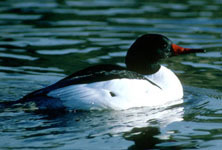 1/14 – Norrie Point, HRM 85: We watched a drake common merganser catch a catfish in the river off shore from the Norrie Point Environmental Education Center. The merganser was having trouble arranging the fish just right in order to swallow. For five minutes the merganser manipulated the catfish every which way, but nothing quite worked. Then, an immature bald eagle materialized out of the air stooping on the merganser. As the duck dove, the eagle snatched the catfish in its talons and flew away. Seconds later, the merganser surfaced, quite fishless. (Photo of common merganser courtesy of U.S. Fish and Wildlife Service)
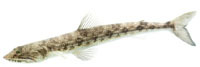 1/12 – Hudson Valley Estuary: This week’s selection is the inshore lizardfish (Synodus foetens), species number 99 (of 228) on our watershed list of fishes. (If you would like a copy of our list, e-mail me:
 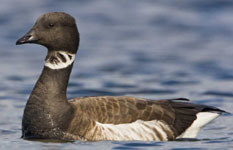 1/14 – Hudson Valley: In 2018, DEC began a five-year Atlantic brant (Branta bernicla) migration and breeding ecology study with the New Jersey Department of Environmental Protection and the Canadian Wildlife Service. Crews began marking brant with geo-locators attached to red and white plastic-colored leg bands that have a three-digit code of letters and numbers on them. The geolocators themselves are clear, plastic electronics about the size of a “fat nickel” and have a plastic cable lock tie. In addition, crews will begin marking brant with two smaller colored leg bands, one on each leg. These bands will consist of one letter or number on a white background. Some birds also have GPS transmitters on their backs.
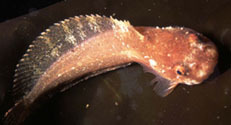 Ichthyologists Bob Schmidt, Jeremy Wright, and Bryan Weatherwax examined three snailfish specimens (Liparis sp.), species 139 on our watershed list, at the New York State Museum that were collected from the lower estuary (Manhattan and Queens). Two of the fishes were adults while the third was an immature (10 millimeters). They also discovered that all three were Inquiline snailfish (Liparis inquilinus), rather than the Atlantic snailfish (L. atlanticus), currently on our list of watershed fishes.
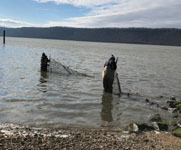 1/16 – Yonkers, HRM 18: Our Sarah Lawrence Center for the Urban River at Beczak education team braved a frigid river (39 degrees F) to see what was home in the river. The answer was, nothing, at least nothing that we were clever enough or fast enough to capture. We made six hauls with a seine that was empty of river life but rather filled with plastic refuse. Salinity measured 2.0 parts-per-thousand. (Winter seining at Beczak courtesy Elisa Caref)
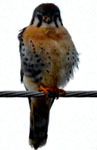 1/17 – Saratoga County, HRM 200: I did the grand tour of the Northumberland farmlands adjacent to the Hudson River in early afternoon and counted 25 species of birds. It was a good day for raptors. I found two falcons: an American kestrel and a peregrine falcon feasting on unidentified prey on Peters Road. Beyond that, I spotted a rough-legged hawk, a pair of adult bald eagles, and an immature bald eagle near a nest on the river. Lastly, there were three black vultures in the same place I saw them a couple of weeks ago. As for songbirds, I found 35 horned larks skittering around in a manure-covered field. Waterfowl included 75 Canada geese in two large flocks. (Photo of an American kestrel courtesy of Dawn Renee Newlander)
|
The New York State Department of Environmental Conservation respects your right to privacy and welcomes your feedback | Update preferences or unsubscribe | Learn more about DEC Delivers. |
|
Connect with DEC:    
|
|
| Basil Seggos, Commissioner | |