
Hudson River Almanac 12/01/18 - 12/07/18
The New York State Department of Environmental Conservation sent this bulletin on 12/14/2018 02:00 PM EST |
| DEC Delivers - Information to keep you connected and informed from the NYS Department of Environmental Conservation |
| Share or view as a web page || Update preferences or unsubscribe |
|
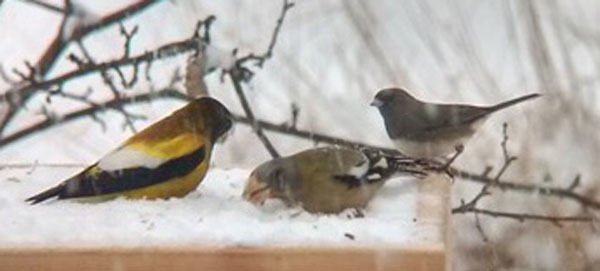
Compiled by Tom Lake, Hudson River Estuary Program Consulting NaturalistOverviewOn November 16, we suggested that daylight bobcat sightings were uncommon. Since then, our estimation has been challenged by several strolling bobcats in near full daylight. Our hypothesis will have to be reevaluated. The evening grosbeak irruption continued this week, and an unexpected thrush showed up in Staten Island. Highlight of the Week
Natural History Entries12/1 – Hudson River: The largest-ever oil spill off the coast of Newfoundland occurred on November 16. An estimated 250 cubic meters of oil leaked into the sea southeast of St. John’s, Newfoundland, from the Sea Rose oil platform. Recognizing how autumn avian migration connects the Canadian Maritimes with the New York Bight, we should keep an eye out for oiled sea birds (ducks, geese, loons, gulls, cormorants, etc.) that may have traveled south into our area. If you come upon oiled seabirds, contact your local NYSDEC Regional office. They will send a spill-response team to investigate and coordinate a response. 12/1 – Gardiner, HRM 73: I had twenty or more mixed male and female evening grosbeaks at my feeders today. They seemed to stick to the black oil sunflower seeds. It had been at least thirty years since I last had them here.
[Surf scoters (Melanitta perspicillata) are marine birds that breed in the Arctic and winter along the Atlantic coast. They are seen in the watershed almost exclusively in migration. Surf scoters are sea ducks; the males have white bills and a white patch on the back of their heads. When seen through binoculars, in the dim light of dawn, bobbing between swells a few hundred yards away, they look like “double-faced” ducks. Their presence reminds us of how we are connected to faraway places by the Atlantic Coastal flyway. Tom Lake]
12/3 – Beacon, HRM 61: Typical of my late-season fishing experience, larger channel catfish appeared to be the only species around today – there was no bait stealing. There were no carp or golden shiners in evidence. The water temperature was 37 degrees Fahrenheit (F). In a five-hour fishing session, I caught and released five channel catfish. The two largest were 23-inches, 3 pounds 8 ounces and 27-inches, 4 pounds 13 ounces. The latter was what I call a “racer,” a word I've seen used to describe some bluefish caught by anglers early in the spring: large head with the body yet to fill out by subsequent feeding. Ordinarily, a 27-inch channel catfish would weigh at least 7.0 pounds. [Presently, I am in the lead in the carp category for the annual Hudson River Fishermen’s Association fishing contest, with a 25 pound 9-ounce carp I caught at Beacon on 3/31. After 24 years of carp fishing, including 13 years at Beacon, on that day, I landed my largest carp ever, and after a fifteen-minute struggle, I netted and weighed the big carp and then slipped it back into the river. Bill Greene] 12/3 – Manhattan, HRM 1: While we only collected two fish when we checked our research sampling gear in Hudson River Park at The River Project's sampling station on the lighthouse tender Lilac at Pier 25, they were special species: 25 millimeter (mm) skilletfish and a 90 (mm) young-of-year striped bass! [Note: one inch = 25.4 millimeters (mm)] 12/4 – Hamilton County: There was a huge flock (more than one hundred) of evening grosbeaks visiting a feeder location in Long Lake today. They had been there for two days. I had not seen a winter flock that large in years. Evening grosbeaks were now showing up all over New York and Vermont. It would be interesting to know where they are coming from. 12/4 –Milan, HRM 90: An adult bobcat strolled across the field in front of our barn this morning. We had never seen the big cat here before. At the time, he was stalking a great blue heron that hangs out at our pond. The big cat went for the heron, but the big bird lifted off like a cargo helicopter and hovered over the pond. After the miss, the cat headed for the woods across the road, and that was the last time we saw it. It was a very exciting experience. 12/4 – Rockland County, HRM 31: From the Hook Mountain Hawkwatch today, we spotted a juvenile golden eagle at the north end of Rockland Lake. In late morning, we heard several noisy common ravens. Looking up, we saw three birds: two common ravens harassing a third much larger bird. The third bird was the juvenile golden eagle. The gold nape, white wing patches, and black-and-white tail of a juvenile were clearly apparent. 12/5 – Town of Wappinger, HRM 67: Seeing a black, or melanistic, squirrel is not big news. But watching such a squirrel and noting its behavior over time as it becomes part of your immediate environment, is memorable. Ours is a black eastern gray squirrel (Sciurus carolinensis). Avoiding the urge to give it a sexual identify, we refer to the squirrel as “Blackie.” We spotted the squirrel in late March when it looked barely larger than a black chipmunk but with a longer tail. Blackie was always in company with other gray squirrels, and they cavorted through the trees at the edge of our woods through spring into summer. As summer turned to autumn, the black squirrel had grown to adult size and found interest in every corner of our acre. Blackie stood out against the backdrop of trees, grass, and shrubs, and had us wondering where the raptors were? As winter approaches, the black squirrel continues to show its cleverness and grit doing battle with blue jays over unshelled peanuts. As of now, the melanistic squirrel seems to have become one of only a few local gray squirrels. And, when the snow comes, Blackie will be scarcely able to hide on the winter landscape. [Melanistic or “black” squirrels have increased melanin, resulting in black fur. They share this trait with chipmunks (Tamias striatus), also family Sciuridae. Biologists have suggested that black squirrels may have a selective advantage (natural selection) over gray squirrels due to an increased cold tolerance resulting from their black, heat-absorbing, fur. It is also thought that black squirrels may have been predominant throughout North America prior to the arrival of Europeans in the 16th century, when America's old growth forests were still abundant and thick. The black squirrels’ dark color helped with better concealment from its natural predators (owls and hawks) in these very dense and shaded old growth forests. While overall, they are not particularly rare in the Hudson Valley – they are common in parts of Canada – it is estimated that only about one in 10,000 gray squirrels is melanistic. Tom Lake]
[The northern fence lizard (Sceloporus undulatus) is listed as a threatened species in New York State and are only known from a few sites in the lower Hudson Valley. Jesse Jaycox] 12/5 – Hudson River Estuary: With the cold weather and subsequent cold-water season upon us, Kim Durham (New York State Sea Turtle Coordinator, Atlantic Marine Conservation Society) urges us to be on the lookout for stranded sea turtles. If you come upon a sea turtle, whether you think it's alive or dead, immediately call the New York State Stranding Hotline at (631) 369-9829. Some sea turtles become paralyzed when “cold stunned,” giving the appearance of death but are actually in dire need of recovery and resuscitation. If you have photos or video, please send them to sightings@amseas.org. [Records of sea turtles in the lower estuary have been limited to Kemp’s ridley (Lepidochelys kempii). Juvenile Kemp’s ridleys (2-3-year-olds) have been documented using Long Island Sound as an intermediate habitat and occasionally, but rarely, we find one in the lower estuary. The most recent Kemp’s ridley occurrence was last July when beach-walkers at Rockaway Peninsula noticed a Kemp’s ridley sea turtle in need of rescuing. The last report in the estuary was August 1995, when Buddy Long, trolling for bluefish, collected a prop-injured sea turtle in the river off Spuyten Duyvil (river mile 14). Tom Lake]
This is the third nest location for NY62; the first two were not far away in the Town of Wappinger. They have been in their present nest site, in the crown of a huge tulip tree suffering from heart rot due to an old lightning strike, for eight years. In those eight years, they have fledged eleven young. The pair has already been “on station” for the 2019 nesting season and are seen almost daily perched in the nest tree. (Photo of bald eagles courtesy of Bob Rightmyer) [The Soul of NY62 is a loosely organized group of birders, photographers, naturalists, and perhaps most of all, bald eagle lovers. The group formed eight years ago and serves in many capacities, from nest monitors, to docents, to chroniclers of the drama surrounding the hatching, rearing, and fledging of baby eagles. Tom Lake]
[Sand shrimp (Crangon septemspinosa) are delightful little crustaceans, generally less than 50 mm long. As their common name implies, they are brown, and their camouflage allows them to “dissolve” into sandy bottoms. Along with a few species of Palaemontes, they are colloquially called “grass shrimp,” owing to a preference for the hidden safety and security of aquatic vegetation. (They are the M&M’s of the river for the myriad of predators with which they share the river bottom.) When captured in numbers, they can be very frenetic, bouncing all over. Our students on the beach like to call them “popcorn shrimp.” Tom Lake] 12/7 – Albany, HRM 145: Last week’s Hudson River Almanac mentioned the woolly bear caterpillar, so I thought I’d send in my own experience. As I was doing my daily run around Buckingham Pond in Albany, I came across a woolly bear caterpillar lying in the path. I could not remember seeing one this late in the season before. This one also had a fairly large brown band, possibly foreshadowing a mild winter. 12/7 – Saugerties, HRM 102: When we first came to this area in 1971, there were few black bears to worry about, and I fed the birds freely. Our platform feeder pulled in lots of birds including a flock of evening grosbeaks that came every day for most of the winter. Coming from Pennsylvania, this species was new to me, and I assumed they were a common bird here. They consumed sunflower seed! I was a bit fearful that it was going to be too expensive to keep up with them. This phenomenon continued for several years, and not realizing the rarity of all this, I expected it to go on forever. Today, I don’t think I’ve seen an evening grosbeak in 30-40 years. 12/7 – Wappingers Falls, HRM 67: I counted 17 black vultures late this afternoon in a spinning kettle over a wooded area. I figured there had to be a night roost in there somewhere, but I have not been able to find it. 12/7 – Manhattan, HRM 7.5: A birding survey of Central Park today resulted in 40 species. Among the highlights were rusty blackbird, pied-billed grebe, barred owl and northern saw-whet owl. Notables at The Reservoir included Canada Geese (75), northern shoveler (43), gadwall, bufflehead, ruddy duck, and American coot. Raptors included the two owls, an immature Cooper’s hawk, and an American kestrel on The Great Lawn. There were four woodpeckers: red-bellied, male yellow-bellied sapsucker, downy, and a northern flicker. Both red-breasted and white-breasted nuthatches were found, along with brown creeper. Elsewhere in the park, there was a hermit thrush, northern mockingbird, and 40 common grackles in Mugger's Woods, including a leucistic individual with a white head. Autumn 2018 Natural History ProgramsTBA Hudson River Miles DEC's Smartphone app for iPhone and Android is now available at: New York Fishing, Hunting & Wildlife App. Adventure NYUnder Governor Cuomo's Adventure NY initiative, DEC is making strategic investments to expand access to healthy, active outdoor recreation, connect more New Yorkers and visitors to nature and the outdoors, protect natural resources, and boost local economies. This initiative will support the completion of more than 75 projects over the next three years, ranging from improvements to youth camps and environmental education centers to new boat launches, duck blinds, and hiking trails. Read more about the Adventure NY initiative. For more information on planning an outdoor adventure in New York State, visit DEC's website at http://www.dec.ny.gov/outdoor. |
 Hudson River Almanac
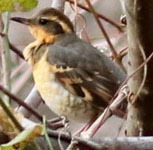 12/5 – Staten Island, New York City: In late morning, on the east side of Brooks Pond in Clove Lakes Park in northern Staten Island, I spotted a varied thrush. It was robin-size with a dark bill, prominent orange eyebrows, an orange breast with a dark band, and its breast feathers were rough, not smooth. I saw it again twice more into mid-afternoon. The area is comprised of lawn with large oaks, sweet gum trees, brushy hedgerows with fruiting bittersweet, and multiflora rose along the pond. (Photo of varied thrush courtesy of Catherine Barron)
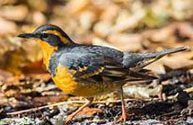 [A record such as this one is accorded the description of an “Accidental.” In the parlance of Stan DeOrsey, these are birds that are found far out of their normal range, and while known to wander great distances, were not expected. The varied thrush (Ixoreus naevius) breeds in the evergreen forests of northwestern North America, from Alaska to northern California. While there have been several dozen records of varied thrush state-wide, the last known sighting on Staten Island was in November 1936. Tom Lake] (Photo of varied thrush courtesy of Birds of New York)
 12/1 – Rhinecliff, HRM 89: We spotted two female surf scoters in the river this morning. At first, they were off the Ulster County shoreline just north of the Esopus Meadows Lighthouse but later moved over to the Duchess County side. (Photo of surf scoter courtesy of Dorain Anderson)
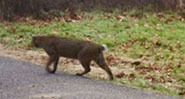 12/2 – Westchester County, HRM 34: Big cats are rare and a very special treat. It was just the other night at dusk, when I spotted a strange shape on one of our fire roads in Pound Ridge. I grabbed my binoculars. There it was, a big, gorgeous cat sitting and staring at me from 100 yards. After a while, the bobcat stood up, stretched all fours, one at a time, and then slowly moved off. I have three night-cameras on my property, and that night there was second one, a big orange bobcat. The orange cat is a resident I have seen before. It was on my camera last year and the year before. (Photo of bobcat courtesy of Mike Byrne)
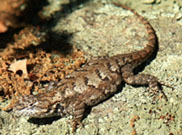 12/5 – Hudson Highlands, HRM 56: I was hiking at Breakneck Ridge today and came across six northern fence lizards. They were lounging in the sun, out of the wind, dozing on and off. It made my day seeing them. What awesome little creatures. I spotted them once before,10 years ago, also on Breakneck. (Photo of northern fence lizard courtesy of Steve Stanne)
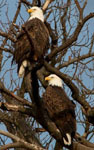 12/6 – Town of Poughkeepsie: Bald eagle nest NY62, so designated by the NYSDEC, will begin its 19th year in January. For longevity, it is one of the oldest established nests in New York State. The original female remains in the nest, and she has fledged 18 young in 18 years. The original male lasted 16 years before being struck and killed by a train just a couple of miles south of the nest at New Hamburg. In spring 2018, the new male helped produce two fledglings.
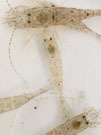 12/6 – Manhattan, HRM 1: When we checked our research sampling gear in Hudson River Park at The River Project's sampling station on the lighthouse tender Lilac at Pier 25, we thought our pots and traps were empty. But there it was, our first sand shrimp of the season! (Photo of sand shrimp courtesy of Amy Lorenz)
|
The New York State Department of Environmental Conservation respects your right to privacy and welcomes your feedback | Update preferences or unsubscribe | Learn more about DEC Delivers. |
|
Connect with DEC:    
|
|
| Basil Seggos, Commissioner | |