
Hudson River Almanac 10/19/18 - 10/26/18
The New York State Department of Environmental Conservation sent this bulletin on 11/02/2018 02:00 PM EDT |
| DEC Delivers - Information to keep you connected and informed from the NYS Department of Environmental Conservation |
| Share or view as a web page || Update preferences or unsubscribe |
|
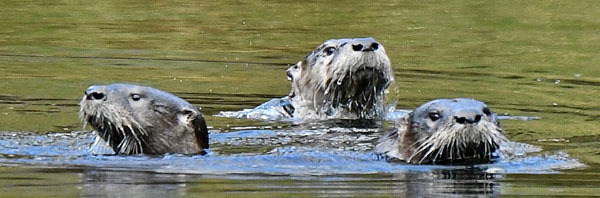
Compiled by Tom Lake, Hudson River Estuary Program Consulting NaturalistOverviewWe were charmed this week by black bear cubs and a family of river otters. Given the data-driven entries that often frequent the Almanac, it was nice to take a deep breath and remember that the Almanac is all about the wildlife. Highlight of the Week
Natural History Entries10/20 – Schaghticoke, HRM 168: From the south side of Fisherman’s Lane, a dirt-road causeway, I spotted a single greater white-fronted goose in among about 650 Canada geese. [The greater white-fronted goose (Anser albifrons), an Arctic breeder, appears once or twice most years during the fall or winter. They are usually found in large flocks of Canada geese, a reward for the patient birder who checks them carefully. Barbara Butler] 10/20 – Eastern Dutchess County, HRM 96: I watched an adult golden eagle soaring with a kettle of turkey vultures near the Stissing Mountain summit, a long-standing wintering ground for them. I noted its small head, tidy bill and tawny-colored head as identifiers. Immature golden eagles, on the other hand, will usually show distinct white wing patches and a white band on their tail. 10/20 – Millbrook, HRM 82: We counted two dozen black vultures on the flat roof of a building just west of the village. In small groups, they took off, flew over our heads, and over the Tribute Gardens toward Franklin Avenue. Ten minutes later, they all few back, their silvery wing tips glowing stark white in the face of the sun. This see-saw flight occurred twice more until they finally settled on the roof top. We wondered if they were negotiating a location for their coming winter night roost. 10/20 – Bedford, HRM 35: It was another very impressive turkey vulture flight (403) at the Bedford Audubon Chestnut Ridge Hawkwatch today. When we added in two black vultures, they accounted for 72% of today’s migrants. There was a steady movement for most of the day, with groups up to 34 birds streaming by, mostly off to our south. Way off to the south, we had a golden eagle. Sharp-shinned hawk (75) was high count among raptors. Non-raptor observations included 90 American robins, 51 cedar waxwing, six monarch butterflies, and 139 Canada geese. 10/20 – Rockland County, HRM 31: A 10-15 mile-per-hour (mph) wind from the southwest may have stymied the flight today at the Hook Mountain Hawkwatch. I counted just 21 raptors across nine hours with sharp-shinned hawk (14) in the lead.
The dominant mammal in the Hudson Valley today is Homo sapiens. At 13,000 years ago, the dominant mammal, in terms of sheer biomass, were the several species of extinct elephants (mastodons and mammoths), some of which stood ten feet at the shoulder and weighed 10,000 pounds. (Photo of mastodon bonepit courtesy of Tom Lake)
[To be, or not to be: Extant means populations that are still found in a specific area, such as black bears and bobcats. Extirpated means a species that is no longer found in a specific area but does exist elsewhere, for example the gray wolf. Extinct means they no longer exist, gone forever, like the American mastodon, woolly mammoth, and the passenger pigeon. Tom Lake] 10/21 – Bedford, HRM 35: We had northwest winds up to 17 mph today at the Bedford Audubon Chestnut Ridge Hawkwatch. We counted 284 migrants of nine species, including 131 turkey vultures and 100 sharp-shinned hawks. Most of the flight was to the west at variable heights. Non-raptor observations included 94 American robins, 80 Canada geese, and a monarch butterfly. 10/22 – Bedford, HRM 35: At the Bedford Audubon Chestnut Ridge Hawkwatch today, we counted 290 migrants of eleven species, including 150 turkey vultures and 94 sharp-shinned hawks. Most of the flight was to the west at variable heights. Non-raptor observations included 377 American robins. 10/22 – Rockland County, HRM 31: We had a good day at the Hook Mountain Hawkwatch considering the heavy cloud cover. We spotted a golden eagle in mid-morning and had great views of it to the north of the summit as it continued west. We were surprised that we did not see more Cooper’s hawks (6); with so many sharp-shinned hawks (179) moving through, perhaps the Cooper’s did not feel enough wind in their wings. The track of the clearly-migrating kettles and streams of turkey vultures was almost all coming from the east side of the Hudson River. They were moving in distinct flocks, not all at once, but with long intervals between their group-passages, with groups of 8-32 birds. Non-raptor observations included more than 100 Canada geese, over 200 American robins, and at least three ravens. 10/22 – Bronx, New York City: I encountered a pair of red-tailed hawks and their prey (pigeons) on the mean streets of the South Bronx not far from Yankee Stadium and the Harlem River. I was amazed by the boldness of the birds standing right in the middle of the sidewalk.
[Note: one inch = 25.4 millimeters (mm)] 10/23 – Ulster Park, HRM 87: Ripples on our pond are most often created by muskrats. But, this time they were due to a family of river otter, at least three, maybe four. Perhaps the pair of otters who had visited briefly in the early spring brought their young back. On that earlier visit, however, it seemed they had pretty much cleared out the fish in the pond. 10/23 – Beacon, HRM 61: With lessening daylight, you could almost feel a coming sunset on our season. This seems to be the time in the fall when the seaward-bound herring are off on their way. Thus, no migrant fishes today in our net, just residents: American eel, tessellated darter, spottail shiner, banded killifish, and a gorgeous little goldfish (85 mm). The river was 62 degrees Fahrenheit (F). [C.L. Smith’s Inland Fishes of New York notes that goldfish (Carassius auratus) are native to eastern Asia and were introduced into North America sometime before 1832. J.R. Greeley, in his A Biological Survey of the Lower Hudson Watershed (1937), calls goldfish “moderately common” in the Hudson River watershed and allows that, “this species in the wild, constitutes a worthless, although apparently not seriously destructive addition to the fish population.” Greeley also notes that goldfish are, “... sold in winter for a small price for food; but are rarely purchased twice by the same individual, they are so exceedingly boney.” - Tom Lake] 10/23 – Bedford, HRM 35: Red-shouldered hawks (7) made a good showing today at the Bedford Audubon Chestnut Ridge Hawkwatch. Many of them are migrating to southeast Mexico to spend the winter. Otherwise, we counted 204 migrants of 11 species, including 112 turkey vultures and 50 sharp-shinned hawks. Most of the flight was to the southwest at heights easily seen with the naked eye. Non-raptor observations included a monarch butterfly, also heading toward Mexico. 10/23 – Rockland County, HRM 31: Most of the sharp-shinned hawks (109) viewed from the Hook Mountain Hawkwatch followed an identical track throughout the day. Red-shouldered hawks (10) made a good showing as well. Non-raptor observations included a skein of more than 100 brant. 10/23 – Yonkers, HRM 18: We hosted 56 fifth-grade students from the Windward School at the Sarah Lawrence College Center for the Urban River at Beczak today. Dividing the class in half, some went seining in the Beczak Marsh at high tide, and later, the others went seining in the river at low tide. They demonstrated their interest and inquisitiveness and were extremely excited. While our catches were similar in both locations, ten hauls of our seine in the marsh included the expected marsh-loving mummichog. Also, in the marsh, we found Atlantic silverside, blue crabs, and young-of-year alewives, blueback herring, and striped bass. Our river tally of fishes after eight hauls included the river-loving bay anchovy, blue crabs, comb jellies, moon jellyfish, as well as young-of-year alewives and striped bass. 10/24 – Saratoga County, HRM 182: The first bird I saw on Saratoga Lake during my visit was a red-necked grebe close to shore just outside Riley Cove. A red-throated loon was off Silver Beach where buffleheads were playing. Altogether, I counted 14 species, including greater and lesser scaup, horned grebe, red-throated loon and common loon, and 800 Canada geese. 10/24 – Bedford, HRM 35: Winds were primarily from the northwest shifting to the north at about 18 mph today at the Bedford Audubon Chestnut Ridge Hawkwatch. That may have aided the 169 migrants of nine species that we counted today. This included 83 turkey vultures and 47 sharp-shinned hawks. Most of the flight was toward the west at variable heights. Non-raptor observations included 71 Canada geese.
10/24 – Yonkers, HRM 18: Seniors from the High School Environmental Science in Manhattan visited the Sarah Lawrence College Center for the Urban River at Beczak today. Some of them were thinking about college applications as biology majors and were eager to learn about the ecology of the estuary. Off we went to seine the river at an incredibly low tide, the lowest I had ever seen at Beczak. Nevertheless, in seven hauls of our seine, we caught 89 young-of-year striped bass. Other river life in the net included blue crabs, sand shrimp, shore shrimp, comb jellies, and a gravid white-fingered mud crab. [Seines are commonly mentioned in Almanac observations pertaining to fisheries research and education. A seine is a net with a float-line on top, a lead-line on the bottom, and tight meshes in between. The word seine is French, from the Latin sagëna, which means a fishing net designed to hang vertically in the water, the ends of which are drawn together to enclose the fish. Those referenced in the Almanac range in length from 15 to 200 feet long, four to eight feet in depth, and mesh size from quarter-inch to three-inches, depending upon the target fish. They are an excellent tool used to sample an area and collect aquatic animals without injuring the catch. Haul seines, long nets that require a boat to set and many strong arms help haul, were used in Hudson River commercial fishing from Colonial times until the last decade of the 20th century. They have since been outlawed; in the hands of competent fishers, they are simply too efficient. Tom Lake]
A native of China and Southeast Asia, it was first discovered in Pennsylvania in 2014. The spotted lanternfly is now confirmed in Virginia, New Jersey, Delaware, and New York. For a description of the issues surrounding this high priority invasive species please visit: https://www.dec.ny.gov/animals/113303.html. (Photo of spotted lanternfly courtesy of Kristopher Williams)
[Wedge rangia (Rangia cuneata) are a bivalve mollusk native to more southerly brackish coastal and inshore waters like Delaware Bay and Chesapeake Bay. Christopher Letts and I first found them in the lower estuary in the 1980s. It is believed that they were inadvertently introduced to the lower Hudson River through the ballast water of commercial vessels. They are now found as far upriver as Newburgh. Tom Lake] 10/26 – Buchanan, HRM42: Our feeders have been a hit with the tufted titmice, black-capped chickadees, white-breasted nuthatches, blue jays, mourning doves and various sparrows, but we were surprised to see a half-dozen dark-eyed juncos foraging under the feeders today. We thought it was a bit early for these “snow birds” to be around. However, the biggest surprise was the small flock of late migrating male red-winged blackbirds that flew in. 10/26 – Bedford, HRM 35: We had a big push of turkey vultures (283) today at the Bedford Audubon Chestnut Ridge Hawkwatch. Overall, we counted 423 migrants of eight species. Buteos showed well with 44 red-shouldered hawks and 43 red-tailed hawks. An immature northern goshawk came by in midday. 10/26 – Rockland County, HRM 31: It was a slow and cold start today at the Hook Mountain Hawkwatch, and we were doubting any good numbers, but as a slight southeast wind formed, there was a steady stream of hawks all day. Two of the three northern harriers we counted were gorgeous adult males (gray ghosts), and we had fantastic looks at many adult red-shouldered hawks (78). Sharp-shinned hawk (95) was high count among raptors. Non-raptor observations included the yellow billed cuckoo Tom Fiore found yesterday. The bird spent the entire day at the summit. We had the pleasure of watching it catch and eat a praying mantis, swallowing it whole, headfirst. 10/26 – Manhattan, HRM 1: We hauled up our research collection gear this morning in Hudson River Park at The River Project's sampling station on the lighthouse tender Lilac at Pier 25, where we found fewer fish, but decidedly more interesting. They included an oyster toadfish (60 mm), a black sea bass (45 mm), and a handsome feather blenny (65 mm). [Feather blenny (Hypsoblennius hentz), a tropical marine stray, is a small, scaleless fish with fleshy cirri (“feathers”) on their head. Their lower jaw has a row of small, close-set teeth like those of a comb, thus their family name, combtooth blennies (Blenniidae). Blennies are benthic dwellers where they often burrow in the soft bottom or find refuge in old mollusk shells. C. Lavett Smith] Autumn 2018 Natural History Programs Hudson River Miles DEC's Smartphone app for iPhone and Android is now available at: New York Fishing, Hunting & Wildlife App. Adventure NYUnder Governor Cuomo's Adventure NY initiative, DEC is making strategic investments to expand access to healthy, active outdoor recreation, connect more New Yorkers and visitors to nature and the outdoors, protect natural resources, and boost local economies. This initiative will support the completion of more than 75 projects over the next three years, ranging from improvements to youth camps and environmental education centers to new boat launches, duck blinds, and hiking trails. Read more about the Adventure NY initiative. For more information on planning an outdoor adventure in New York State, visit DEC's website at http://www.dec.ny.gov/outdoor. |
 Hudson River Almanac
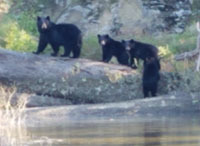 10/19 – Stockport Creek, HRM 121: Our DEC marsh ecology program hosted Roy C. Ketcham High School seniors from Mitch Manzo’s AP Environmental Science class on a canoe paddle into the tidewater Stockport Creek. There, they had the opportunity to watch a female (sow) black bear and her three cubs jump into the creek ten feet from Ashawna Abbott in the bow of our lead canoe. The three cubs looked in good health as Mama led them onto a small island. (Photo of black bears courtesy of Mitch Manzo)
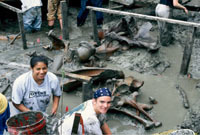 10/21 – Hyde Park, HRM 82: Nineteen years ago, today, Cornell University paleontologists discovered long bones (humerus and ulna) of a mastodon (Mammut americanum) buried in the matrix adjacent to the Fall Kill. Radiocarbon analysis of the tusks of this now-extinct form of elephant would later return a radiocarbon date of 11,500 years ago, just past the dawn of human presence in the Hudson Valley.
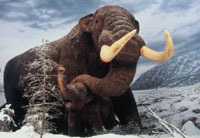 [An exact replica cast of the nearly 12,000-year-old Hyde Park mastodon is on permanent display at the Mid-Hudson Children’s Museum in Poughkeepsie. The original animal stood ten-feet-high at the shoulder and weighed 10,000 pounds. The 1999-2000 excavation was not unlike entering a time machine, and the museum display gives us a great appreciation of the tremendous time-depth of our Hudson Valley region. Tom Lake] (Photo of mastodon replica courtesy of Tom Lake)
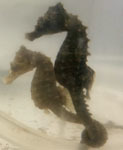 10/22 – Manhattan, HRM 1: We checked our research sampling gear in Hudson River Park at The River Project's sampling station on the lighthouse tender Lilac at Pier 25 where we found our collection pots and traps quite full. The overnight catch included a 140-millimeter (mm) point-to-point blue crab, two oyster toadfish (45, 55 mm), four adult tautog (230-240 mm), and a gorgeous lined seahorse (150 mm)! (Photo of lined seahorse courtesy of The River Project)
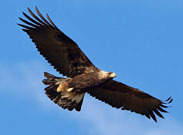 10/24 – Rockland County, HRM 31: In midday I was treated to a classic “October golden” at the Hook Mountain Hawkwatch. Fifteen turkey vultures came up in a hurry over the water on the south-east side of the watch, and there, at the bottom, was the immature golden eagle. This was our third golden eagle of the season. Sharp-shinned hawk (31) was high count among raptors. (Photo of golden eagle courtesy of Terry Hardy)
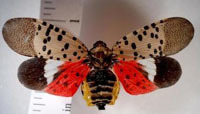 10/25 – Albany HRM 145: The NYS Department of Environmental Conservation (DEC), NYS Department of Agriculture & Markets (DAM), the US Department of Agriculture Animal and Plant Health Inspection Service (USDA-APHIS) and the NYS Office of Parks, Recreation and Historic Preservation (OPRHP) have coordinated a multi-agency effort to prevent, detect, and respond to the threat of the spotted lanternfly (Lycorma delicatula).
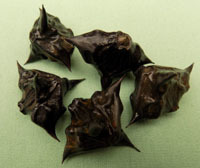 10/26 – Beacon, HRM 61: Each autumn, the seining season at Long Dock in Beacon ends during the last of October when the haul of Eurasian water chestnut seeds far exceeds the numbers of fish. Today, the ratio was hundreds to a handful. (These seeds are why we do not walk barefoot on the beach.) We caught a few spottail shiners and tessellated darters that we safely returned back to the river within minutes. Then, it took us more than half an hour to clear our short seine of the black, spiky seeds. Mixed in with the beach glass were several wedge clam shells. The river was 56 degrees F, nine degrees cooler than this day a year ago. (Photo of water chestnut seeds courtesy of Tom Lake)
|
The New York State Department of Environmental Conservation respects your right to privacy and welcomes your feedback | Update preferences or unsubscribe | Learn more about DEC Delivers. |
|
Connect with DEC:    
|
|
| Basil Seggos, Commissioner | |