Duck and Goose Seasons Open in Western NY
Saturday, October 27, marks opening day of duck season in the Western Zone and several Canada goose hunting areas across the state. With the recent cold fronts, hunters can expect good numbers of American wigeon, northern pintail, and gadwall, as well as wood ducks, green-winged teal, and mallards.
Although some waterfowl hunting areas require special reservations and permit lotteries to hunt, several public properties provide waterfowl hunting access opportunities without the additional requirements. For more information, visit Public Places to Hunt Waterfowl.
DEC reminds waterfowl hunters that they must register for the New York State Harvest Information Program and that all hunters 16 years of age or older must have 2018-2019 Migratory Bird Hunting and Conservation Stamp signed across the face of the stamp prior to going afield. Additional information can be found at Migratory Game Bird Hunting Regulations.
NYSDEC WMA Habitat Conditions on Managed Marshes
Northern Montezuma WMA
There are more than 40 wetland impoundments on DEC's Northern Montezuma Wildlife Management Area (located in the Montezuma Wetlands Complex in central NY). In these restored wetlands, DEC staff raise and lower water levels to produce food and cover for waterfowl and marsh wildlife. Annual plants are encouraged to grow within the marshes by lowering water levels and exposing soils in the Spring. These plants produce an abundance of seeds that provide food for waterfowl and other marshbirds. Water depths are gradually increased in time for Fall waterfowl migration. NMWMA’s managed marshes are also supplemented by floodplain wetlands found along the Seneca River and Crusoe Creek.
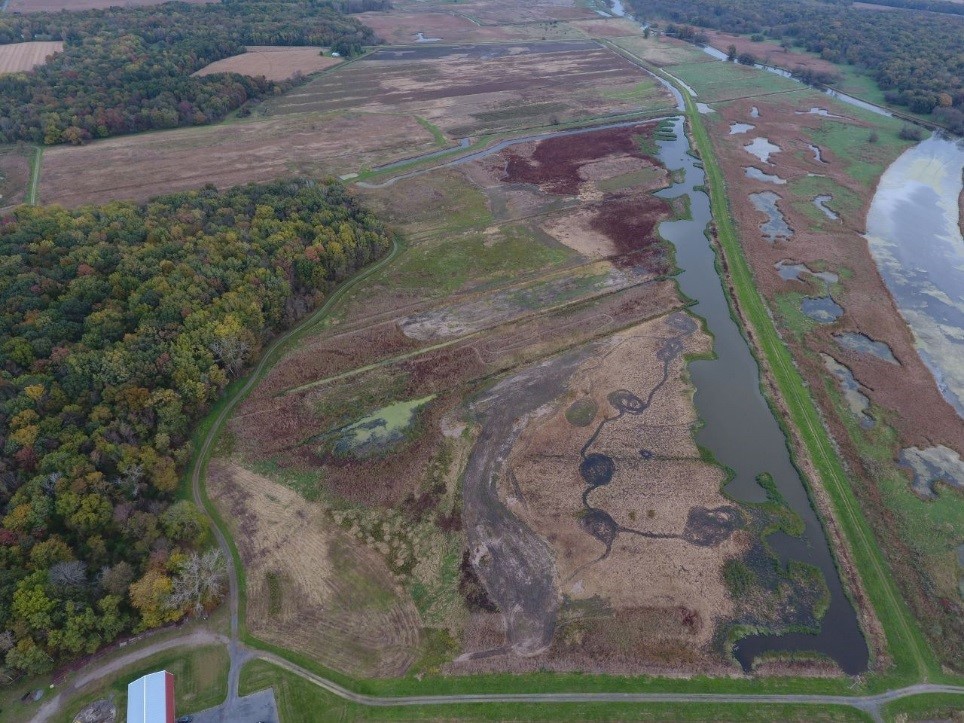
Current conditions at Northern Montezuma WMA, with Howland Island marshes being the exception, are generally dryer than normal. Seneca River water levels are low but rising, and some adjacent wetland impoundments still provide excellent waterfowl hunting opportunities, but water levels are 1' or less - lower than usual. Most have pockets of water providing hunting opportunity, but they have yet to be re-watered completely. Please consider scouting the WMA prior to the opening of waterfowl hunting season to check for current conditions. DEC staff also provide aerial images of many of the wetland impoundments to help waterfowlers scout for preferred sites and access to those sites. Images are posted and updated on Friends of the Montezuma Wetlands Complex.
Tonawanda and Oak Orchard WMAs
After a hot and abnormally dry summer at Tonawanda and Oak Orchard Wildlife Management Areas, water levels remain low, and impoundments that were drawn down to provide moist soil annual seeds for migrating waterfowl have not been adequately reflooded due to a continued lack of sufficient precipitation. Recent rains are helping, and impoundments will continue to be refilled as more water becomes available. In addition to the dry conditions, many of the marshes have dense emergent vegetation due to drought conditions in both 2016 and 2018. There are open water areas in many of the marshes, but access will be more difficult - scouting ahead of time is extremely important this year! As a result of the lower water levels and the dense vegetation, we issued fewer permits for opening weekend of duck season (Tonawanda WMA - 60 permits per day and Oak Orchard WMA - 30 permits per day). Drawdowns this year included Cinnamon Marsh, Paddy 2, and Finks Paddy on Tonawanda WMA and North Marsh and Belson Paddy on Oak Orchard WMA. Other work included dike repair, control of invasive phragmites, continued work to transition Finks Paddy on Tonawanda WMA to a moist soil annual unit, mowing of dense cattail in Paddy 2, and the installation of an accessible waterfowl hunt blind. Future projects on these areas include creation of a ditch within Windmill Marsh on Oak Orchard WMA to improve water management capabilities in order to help control water lily and possible plans to create channels and potholes in dense cattail areas on West Ruddy Marsh on Tonawanda WMA.
Atlantic Brant Research Update
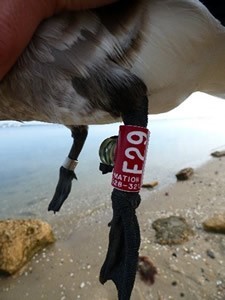
Last winter, DEC began a multi-year cooperative research effort with the New Jersey Department of Environmental Protection and Canadian Wildlife Service to better understand Atlantic brant migration chronology and breeding propensity. In total, DEC staff and research cooperators have put out 30 GPS transmitters and nearly 400 “geolocators”.
What should I do if I encounter a marked Atlantic brant and how can I help?
1. Birds with tarsal band or backpack transmitter shot or found dead: Please contact Ted Nichols (NJDEP) at 609-628-3218 or e-mail Josh Stiller at: joshua.stiller@dec.ny.gov. In order to obtain any previous location data from a geolocator or backpack transmitter, we need to get the device in hand. The information obtained from these marking units is vital to the success of the study. Further, if not damaged, the devices can be reused on new birds. Hunters who want to retain one of the marking devices as a "keepsake" will be provided with a "dummy" unit which will be a casing of the real device.
2. Sight record of live birds with color leg bands: If you see colored bands in the field, please report the observation to the Patuxent Wildlife Research Center Bird Banding Laboratory. The bands will have a one or three-digit alphanumeric code. These re-sighting records of the colored leg bands is very helpful to the project.
3. Birds with leg band only, shot or found dead: Report to Patuxent Wildlife Research Center Bird Banding Laboratory.
|