
Hudson River Almanac 10/13/18 - 10/19/18
The New York State Department of Environmental Conservation sent this bulletin on 10/26/2018 02:00 PM EDT |
| DEC Delivers - Information to keep you connected and informed from the NYS Department of Environmental Conservation |
| Share or view as a web page || Update preferences or unsubscribe |
|
Compiled by Tom Lake, Hudson River Estuary Program Consulting NaturalistOverviewThis week was the 16th annual Day-in-the-Life of the Hudson and Harbor engaging nearly 6,000 students and educators at more than 90 sites from the Mohawk River to New York Harbor. On this one day in the year, we invite educators, teachers, their staff, and their students to come to the Hudson River and New York Harbor to sample one special spot for a series of ecological measurements. From this shared effort emerges an estuary-long snapshot of the Hudson River for that day. Highlight of the Week
[Riverman Chris Letts notes that “Brant will not lift; they fly right on the deck. They even fly under bridges rather than lifting over them.” Tom Lake] Natural History Entries
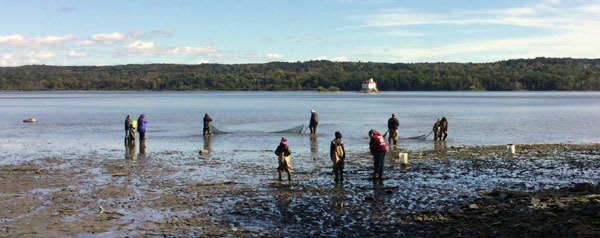
[Birders revel on the many species and colors of the myriad of wood warblers we see from April through October. Our various and colorful mushrooms are the "warblers" of the mycologists. Christopher Letts has commented that, “In half-a-century of foraging for mushrooms in the lower Hudson Valley, nothing I have experienced even comes close to this year’s mushroom bounty.” Tom Lake] [Eating some species of wild mushrooms can cause sickness and even death. Despite widespread beliefs to the contrary, there is no general rule that allows you to distinguish between a poisonous mushroom and one that is safe to eat. Wild mushrooms should only be considered for consumption after being identified by an expert mycologist, and even then, only in moderation with samples of fresh specimens retained and properly stored to aid in identification whenever poisoning is considered a possibility. Steve Rock] 10/13 – Bedford, HRM 35: We counted 114 individual migrants of 12 species today at the Bedford Audubon Chestnut Ridge Hawkwatch. High count among the raptors was sharp-shinned hawk (62). Most of the birds were flying to the west at variable heights. Non-raptor observations included 21 blue jays and 40 brant. 10/13 – Rockland County, HRM 31: Aided by a bit of a west wind at the Hook Mountain Hawkwatch we counted 194 migrants today, 95 of which were sharp-shined hawks. Seven bald eagles and 13 American kestrels were also of note. Non-raptor observations included two monarch butterflies, a common loon, and 48 double-crested cormorants. 10/13 – Yonkers, HRM 18: We held our free weekly River Explorers Program at the Sarah Lawrence College Center for the Urban River at Beczak. As the weather gets colder in autumn, we find both fewer people at our Saturday programs and generally fewer fish inshore to be caught, but we keep on seining! Today, we had three students, and together we made two hauls of our net. While few in number, our catch was magnificent to the students and included blue crabs, Atlantic silverside, and young-of-year blueback herring and striped bass.
10/14 - Essex County, HRM 302-284: Fall foliage was well past peak; last weekend during what may have been a “peak,” we were socked in with low clouds and fog – everything was fuzzy. Most of the non-evergreen ferns have gone from green to dark purple to brown to gone, without the benefit of a frost. There were snow flurries in the High Peaks of the Adirondacks last night. [When we began The Hudson River Almanac in March 1994, Mike Corey, then chief educator at the Adirondack Park Visitor’s Information Center in Newcomb, near the origin of the Hudson River, was our first Almanac partner. Tom Lake] 10/14 – Beacon, HRM 61: The combination of a rising tide and a strong west wind swamped the first of my eastward-facing shoreline fishing spots, a full two hours before high tide. I had to gather up all of my gear and find another spot. I still managed to catch and release one carp (9 pounds) and six channel catfish (2-4 pounds). [On these windy occasions, a 4-ounce sinker, 20-pound test line, and rods and reels adequate to handle such rigs, are good ideas. The right set-up can make for good fishing under variable conditions and avoid wind and tide movement pushing a fishing line and rig into underwater rocks and snags. Bill Greene] 10/14 – Bedford, HRM 35: It was another day with very light winds aloft at the Bedford Audubon Chestnut Ridge Hawkwatch. Nevertheless, we had a surprising number of migrating raptors (191), especially sharp-shinned hawks (140). Non-raptor observations included 82 blue jays, 715 Canada geese, and 105 American robins. 10/14– Rockland County, HRM 31: Sixty-eight of the 95 raptors (80%) I counted today at the Hook Mountain Hawkwatch were sharp-shinned hawks. The only non-raptor observation of note was a monarch butterfly. 10/15 – Bedford, HRM 35: It was a very lean count today at the Bedford Audubon Chestnut Ridge Hawkwatch. We spotted just two raptors, including a male northern harrier and a male American Kestrel. Non-raptor observations included six blue jays, 32 American robins, and ten wood ducks. 10/15– Rockland County, HRM 31: We counted eleven raptors today at the Hook Mountain Hawkwatch six of which were sharp-shinned hawks. We followed four peregrine falcons as far as we could see them flying actively toward the southwest. Non-raptor observations included two blue jays and eleven chimney swifts. This week was the 16th annual Day-in-the-Life of the Hudson and Harbor, engaging nearly 6,000 students and educators at more than 90 sites from the Mohawk River to New York Harbor. 10/16 – Beacon, HRM 61: Tenth-graders from Newburgh Free Academy came for our Day-in-the-Life of the Hudson and Harbor seining program. Our catch included a mix of migrating young-of-year fishes, such as striped bass, alewives, and blueback herring, as well as resident species like spottail shiner, white perch, pumpkinseed sunfish, bluegills, banded killifish, tessellated darters, and a golden shiner. 10/16 – Cornwall Landing, HRM 57: As we waited in the shadow of Storm King Mountain for several classes of fourth-graders from Willow Avenue Elementary in Cornwall to arrive, we watched several long skeins of brant flying hurriedly past us into the north gate of the Hudson Highlands and on south. A strong westerly wind was giving them a boost as well as a push to the tide as it slipped down the beach. With assistance from Emily Enoch and Jesse Predmore, we seined the mid-tide shallows to see what was home today. The species diversity was low (just seven species), but their stories were memorable. From native species such as river herring and pumpkinseed, to introduced fishes like bluegills and largemouth bass, every fish has a story to tell, stories that put them on equal footing. The alewives and blueback herring (63-70 millimeters (mm)) in the river, the brant in the air, and the tide, as it dissolved our footprints from the sand, were all heading seaward. The river was a refreshingly cool 63 degrees Fahrenheit (F). [“Native” species as opposed to “introduced,” is a theme we often discuss with students. Our state fish, the brook trout, along with northern pike and lake trout, are some of our first native species whose presence in the watershed dates to about 18,000 years ago. “Introduced” can range from intentional stockings such as brown and rainbow trout, largemouth and smallmouth bass, to canal immigrants such as freshwater drum and channel catfish, to intentional invasive species like common carp, and goldfish. The benchmark for this bifurcation is the early 17th century. If a species was here when the first Europeans arrived, it was almost certainly native. If not, it was introduced. Of the 228 species of fish documented for the Hudson River watershed, 177 are considered native (0.77). Tom Lake] [Note: one inch = 25.4 millimeters (mm)] 10/16 – Bedford, HRM 35: As many as 312 individual migrants of 9 species were counted today at the Bedford Audubon Chestnut Ridge Hawkwatch, including 191 turkey vultures and 70 sharp-shinned hawks. Most of the flight was to the west at variable heights. Non-raptor observations included 270 Canada geese and two common loons.
10/16 – Piermont, HRM 25: Lamont-Doherty hosted more than 100 students from four local Rockland County high schools for our Day-in-the-Life of the Hudson and Harbor seining program at Piermont Pier. The day was brisk and windy and full of surprises. Among the fishes we caught in our net were young-of-year striped bass (47) along with an assemblage of white perch, Atlantic silverside, bay anchovy, river herring, and a small American eel. However, the story of the day was the salinity or, more precisely, the lack of. The “salt front,” a theoretical point in the estuary where salinity can be noticeably measured, had been pushed far down river by upland runoff from heavy rains. Ordinarily, the river is brackish at Piermont Pier, but today it posted near fresh water readings at 0.2 parts-per-thousand (ppt.).
[Atlantic croaker (Micropogonias undulates) is a member of the drum family of fishes that also includes freshwater drum, black drum, northern kingfish, spot, weakfish, and silver perch. Most of them have a highly specialized swim bladder that serve as sound-producing organ. This has led to the colloquial family name of “drum.” C. Lavett Smith] 10/16 – Bronx, New York City: Our Day-in-the-Life of the Hudson and Harbor program was held at Ferry Point Park in the Bronx where Westchester Creek meets the East River. We hosted 70 high school students from Renaissance High and West Bronx Academy as well as 89 fourth-graders from Barreto Park. After five hauls of our seine, we had collected seven fish species, including Atlantic silverside (high count with 200), striped killifish, mummichogs, and northern pipefish, as well as young-of-year black sea bass, winter flounder, and striped bass. Blue crabs were numerous as were a mix of sand shrimp and shore shrimp. [When those of my generation were in elementary school, the Hudson River Valley was never on the education menu. We learned of the Nile, the Ganges, the Yangtze, and maybe the Mississippi. Mentions of Native Americans included only the Iroquoian, never Algonquian speakers, the real Hudson River Indians. As for wildlife, native Hudson Valley species were substituted with bison, grizzly bears, New World Monkeys, and fauna of the Serengeti. It is heartening now to read of the intense teaching of this generation by a river-long and watershed-wide cadre of talented educators. Tom Lake] 10/17 – Bedford, HRM 35: A west wind helped our count today at the Bedford Audubon Chestnut Ridge Hawkwatch as 364 birds of eleven species migrated past. Half of them were turkey vultures (183). High count among raptors was sharp-shinned hawk (111). Non-raptor observations included 99 Canada geese, 25 American robins, 20 cedar waxwings, and eleven monarch butterflies. 10/17– Rockland County, HRM 31: A brisk west wind did little to improve my count today at the Hook Mountain Hawkwatch. Of the ten raptors I counted, four were sharp-shinned hawks. There were also two each; bald eagles, northern harriers, and American kestrels. 10/17 – Manhattan, HRM 1: We checked our research sampling gear in Hudson River Park at The River Project's sampling station on the lighthouse tender Lilac at Pier 25, and in what seems like the year of the oyster toadfish, we caught two adorable young-of-year (35, 40 mm). Nearby, eyeing the small toadfish, was an adult male blue crab.
10/18– Rockland County, HRM 31: The raptor of the day at the Hook Mountain Hawkwatch was an adult golden eagle flying west along the ridge north of the summit. Unfortunately, the eagle was too far away for photos. Winds were strong from the northwest and hawks, including six red-shouldered hawks, were all over the place, with most low, some even below the summit. Still others were very high and difficult to see in the solid blue sky. Sharp-shinned hawks (23) were high count. Non-raptor observations included 110 Canada geese, many blue jays that stopped by the summit but then migrated west, and one black-billed cuckoo. 10/18 – Alpine, HRM 18: The Hudson River Sloop Clearwater hosted a sail today for the Environmental Science Class from Ossining High School. We set our otter trawl with a 150-foot head-rope in 22-26 feet of water just upriver from the Alpine Boat Basin. Our net caught an impressive suite of saltwater, brackish water, and freshwater fishes, including spotted hake, weakfish, winter flounder, oyster toadfish, white perch, and hogchokers. Young-of-year fishes included striped bass and Atlantic tomcod. 10/19 – Chelsea, HRM 65.2: We have become fans of seining boat launches, especially those that feature parallel bulkheads where the space is limited and fish can find relative shelter. This morning we shared the Low Point ramp with a lone brant, probably a laggard from the many thousands that had passed by this week. Sheltered from a west wind, we hauled a bottom made up of broken pavement with sudden dips in depth that made the going tricky. Still, we managed to catch “the fish of the season,” such as young-of-year blueback herring and striped bass. High count, however, went to spottail shiners, their silvery deciduous scales sparkled in the net. The river was a warm 61 degrees F. 10/19 – Beacon, HRM 61: I began my fishing day about two hours into the ebb tide and had a good six hours of shoreline fishing. Casting from shore can be productive at all tides, but I’ve found results from the ebb tide at Long Dock to be quite meager on average. Today was an exception. The catch included seven channel catfish and two common carp. The largest catfish weighed 7 pounds, 15 ounces, and the biggest carp was 8.0 pounds. 10/19 – Bedford, HRM 35: This was a big day for migrating turkey vultures (275) at the Bedford Audubon Chestnut Ridge Hawkwatch. The height of flight was variable with most to the west or southwest. Sharp-shinned hawk was high count among raptors with red-shouldered hawk (12) making a good showing. Non-raptor observations included 137 American robins, 38 cedar waxwings, two monarch butterflies, and a common loon. 10/19 – Rockland County, HRM 31: Sharp-shinned hawks (68) comprised 71% of the migrants today at the Hook Mountain Hawkwatch. American kestrel (11) also made a good showing along with red-shouldered hawk (4). 10/19 – Manhattan, HRM 1: We checked our research sampling gear in Hudson River Park at The River Project's sampling station on the lighthouse tender Lilac at Pier 25 and found a fish we do not often see, a beautiful white perch (250 mm). White perch are far more common upriver in brackish and freshwater. Autumn 2018 Natural History Programs Hudson River Miles DEC's Smartphone app for iPhone and Android is now available at: New York Fishing, Hunting & Wildlife App. Adventure NYUnder Governor Cuomo's Adventure NY initiative, DEC is making strategic investments to expand access to healthy, active outdoor recreation, connect more New Yorkers and visitors to nature and the outdoors, protect natural resources, and boost local economies. This initiative will support the completion of more than 75 projects over the next three years, ranging from improvements to youth camps and environmental education centers to new boat launches, duck blinds, and hiking trails. Read more about the Adventure NY initiative. For more information on planning an outdoor adventure in New York State, visit DEC's website at http://www.dec.ny.gov/outdoor. |
 Hudson River Almanac
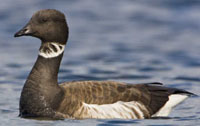 10/16 – Esopus Meadows, HRM 87: Thousands and thousands of brant were moving down the river today. I saw 25 large flocks and a few smaller ones over the course of six hours. Most were flying low to the river, possibly because of a stiff southwest wind. (Photo of brant courtesy of Doug Wechsler)
 10/13 - Dutchess County: It rained this week resulting in more mushrooms. I visited my favorite southern Dutchess County spot just as the day's light rain ended. Accompanied only by the sound of a steady northern breeze through the Norway spruce and the crunch of needles underfoot, I happily noted that the fungi had indeed been active again. A very welcome surprise under some oaks was a fruiting of fresh specimens of what was most likely (the very white) Lactarious piperatus which had been parasitized by (the bright orange) Hypomyces lactiflorum. This combination is commonly referred to as the "lobster mushroom." The Hypomyces transforms the inedible Lactarious into a highly prized edible, so I scooped up much of what I'd found. (Photo of lobster mushroom courtesy of Steve Rock)
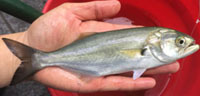 10/13 – Manhattan, HRM 0: Battery Park City Parks hosted a public catch-and-release “Go Fish” program in Wagner Park in Battery Park City. Using bloodworms and sandworms, the catch of an estimated 400 anglers reflected the complex makeup of the fishes of the Upper Bay of New York Harbor. Most were residents, either permanent or seasonal, such as oyster toadfish, summer flounder, cunner, tautog, black sea bass, and striped bass. Certain year-classes of striped bass winter among the piers on the west side of Manhattan. The bluefish we caught was biding its time in the estuary until winter drives it out to sea. High hook among the fishes was black sea bass (10). (Photo of bluefish courtesy of Peter Park)
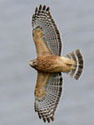 10/16 – Rockland County, HRM 31: Red-shouldered hawks (22) made a strong showing today at the Hook Mountain Hawkwatch. Of the 144 raptors, 92 were sharp-shinned hawks (64%). (Photo of red-shouldered hawk courtesy of Deb Tracy-Kral)
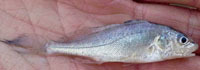 10/16 – Manhattan, HRM 5.5: The Hudson River Sloop Clearwater hosted a sail this afternoon out of the 79th Street Boat Basin for the United Nations International School. We set our 8-foot otter trawl in 25-30 feet of water on the west side of the river between 90th and 95th streets. With a 125-foot-long head-rope, we towed the net for eight minutes. Our catch was rather remarkable and featured hogchokers as well as young-of-year northern kingfish, striped bass, alewives, a 40 (mm) Atlantic croaker, and twenty blue crabs. (Photo of Atlantic croaker courtesy of Krista Norris)
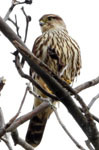 10/18 – Bedford, HRM 35: Most of today’s flight of migrants at the Bedford Audubon Chestnut Ridge Hawkwatch was to the west at distances only observed through a 20X spotting scope. The count included 307 individual birds of nine species, including 185 turkey vultures and 72 sharp-shinned hawks. Other notables were Cooper’s hawks (14) and merlins (6). Non-raptor observations included 817 Canada geese, 25 American robins, 20 cedar waxwings, and two monarch butterflies. (Photo of merlin courtesy of Carina Pooth)
|
The New York State Department of Environmental Conservation respects your right to privacy and welcomes your feedback | Update preferences or unsubscribe | Learn more about DEC Delivers. |
|
Connect with DEC:    
|
|
| Basil Seggos, Commissioner | |