
Hudson River Almanac 9/20/18 - 9/28/18
The New York State Department of Environmental Conservation sent this bulletin on 10/05/2018 02:00 PM EDT |
| DEC Delivers - Information to keep you connected and informed from the NYS Department of Environmental Conservation |
| Share or view as a web page || Update preferences or unsubscribe |
|
Compiled by Tom Lake, Hudson River Estuary Program Consulting NaturalistOverviewThis was the week of the Autumnal Equinox, an obscured Harvest Moon, and finding some seldom-seen animals. Seining continues to be an easy and effective way to introduce students to the wildlife wonders of the Hudson River. And, we had a reminder that autumn can be a prime time for mushroom foragers. Highlight of the Week
[The Atlantic horseshoe crab (Limulus polyphemus) is a relic from a long-ago time. As an arthropod, they look more like a trilobite than a crab – their ancestry dates back 445 million years. They are considered a “vulnerable” species due to harvest pressures. New York State maintains a strict annual harvest quota that is fine-tuned as necessary. Tom Lake] Natural History Entries9/21 – Quassaick Creek, HRM 60: Each fall I take my Fisheries Practicum class from the SUNY College of Environmental Science and Forestry (SUNY-ESF) on a tour of the Hudson River, stopping along the way to sample its aquatic life using various types of collection gear. Our students this year were Paul Czapranski, Matt Dieffenbach, Dan Douglas, Tyler Duby, Yi Huang, Jake Moore, Tyler Muller, Luke Nye-Smith, Lydia Pleasants, and Lindsay Shulock. This evening we electro-shocked Quassaick Creek on the rising tide a short distance upstream from its confluence with the Hudson River. The water exiting the tidal tributary to the river was 68 degrees Fahrenheit (F). We were pleasantly surprised at the eleven species of fish we captured, including a smallmouth bass, bluegill, redbreast and pumpkinseed sunfish, striped bass, banded killifish, a creek chub, young-of-year alewives, and 34 American eels. Along with the fish were five young-of-summer blue crab. 9/21 – Brooklyn, New York City: This was another morning marathon of seining in the East River as curious students watched from the beach at Pier 4 in Brooklyn Bridge Park. The salinity was quite low at 18.0 parts-per-thousand (ppt). We hauled in Atlantic silverside, winter flounder, striped bass, Atlantic menhaden, tautog, scup, and comb jellies. Students explored the shoreline to find our usual invertebrate inhabitants: long clawed hermit crabs, periwinkle snails, blue crabs, and mussels. We have been very surprised by the lack of shrimp (Palaemonetes sp.) in our seines this season. They were a common catch at our old seining location under the Manhattan Bridge. 9/22 – Kowawese, HRM 59: We were on this east-facing beach an hour before first light on the autumnal equinox, one of the two days each year when the sun rises and sets directly over the Equator. The sky was studded with bright points of light, mostly stars. An hour later, the sky began showing first light; the monochrome landscape receded as the soft colors of dawn began to paint the eastern horizon. Sunrise came a while later peeking over Sugarloaf Mountain. Higher up, the bottom of thin, scattered clouds was painted pink. Nearer the horizon, the clouds were shaded in lavender. Artists and photographers have long revered sunsets in their work – the Hudson River School of painting comes to mind. But for me, I’ll take sunrise. The growing glow from first light, to dawn, to sunrise is a study in anticipation, rebirth, renewal, and the dawn of a new day. 9/22 – Kowawese, HRM 59: Karin Limburg and her SUNY-ESF students arrived at the last half of the flood tide to sample the near-shore shallows for aquatic life. The water was a warm 73 degrees F and the salinity was barely measurable. Based on the last few weeks, our catch was predictable. We were still intercepting the seaward run of young-of-year fishes. The total of more than 100 small fish, all not much more than 100 millimeters-long (mm), included American shad (69-90 mm), blueback herring (49-67 mm), and striped bass (60-102 mm). [Note: one inch = 25.4 millimeters (mm)]
[Eating some species of wild mushrooms can cause sickness. Despite widespread beliefs to the contrary, there is no general rule that allows you to distinguish between a poisonous mushroom and one that is safe to eat. Wild mushrooms should only be considered for consumption after being identified by an expert mycologist and even then, only in moderation with samples of fresh specimens retained and properly stored to aid in identification whenever poisoning is considered a possibility. Steve Rock] 9/22 – Rockland County, HRM 31: We had lots of help today at the Hook Mountain Hawkwatch and we worked hard for our counts. Of the 1,816-migrant raptors, 1,709 were broad-winged hawks (94%), coming in sheets across the sky as opposed to neat kettles. Almost lost in the details were 60 sharp-shinned hawks and 20 osprey. Non-raptor observations included 107 monarch butterflies. 9/22 – Alpine, HRM 18: Continuing with our Fisheries Practicum class along the Hudson River, my SUNY-ESF students and I arrived at the Alpine Boat Basin at low tide to see what was home. Under breezy and overcast skies, we seined the warm (74 degrees F) shallows. While our catch was rather unremarkable, it still reflected the early-autumn fish-fauna of the Tappan Zee. Highlights of the fish we caught included bay anchovies (49-70 mm) and young-of-year striped bass (67-120 mm). Crustacea were represented by shore shrimp (Palaemonetes sp.), sand shrimp (Crangon septemspinosa), and 59 blue crabs. 9/23 – Beacon, HRM 61: There was noticeable carp activity in the river today at Long Dock. The onset of cooler nights and gradually lowering water temperatures seems to have produced a nice turnaround in fishing success. I caught and released two carp, eight channel catfish, two brown bullheads, and a golden shiner in the course of a five-hour fishing session. The largest catfish weighed 7 pounds, 1 ounce and measured just short of 28-inches-long. The largest carp also weighed 7.0 pounds. 9/23 – Bedford, HRM 35: Of the 952 broad-winged hawks that passed by the Bedford Audubon Chestnut Ridge Hawkwatch today, 851 came through between noon and 2:00 PM. Sharp-shinned hawks were a distant second in the count with 85. The extensive cloud cover greatly helped with picking out birds that were farther out. Non-raptor observations included 35 monarch butterflies, three common loons, one ruby-throated hummingbird, 336 cedar waxwings, and a remarkable movement of blue jays (2,079). 9/23 – Rockland County, HRM 31: While not reaching yesterday’s high count, it was still another good day at the Hook Mountain Hawkwatch. Of the 716 raptors that passed the Hawkwatch, broad-winged hawks again made the high count at 601 (84%). Sharp-shinned hawks were a distant second with 103 birds. Non-raptor observations included 43 monarch butterflies. 9/24 – Hudson Valley: Tonight's full moon, although obscured by clouds, was this autumn's Harvest Moon, the full moon nearest the Autumnal Equinox which occurred on 9/22. 9/24 – Bedford, HRM 35: Sixty-one raptors of ten species passed by the Bedford Audubon Chestnut Ridge Hawkwatch today. Broad-winged hawks (29) were high count. Most of those came through during the 9:00-10:00 AM hour. Most of the day’s flight was low (seen easily with the naked eye) and centered toward the west. Non-raptor observations included four monarch butterflies, 56 cedar waxwings, and 31 blue jays. 9/25 – North River, HRM 263: Although the feeders were out and flowers were still blooming, we saw our last ruby-throated hummingbird on September 15. Nothing since then. We had our last swim in Schroon Lake (18 miles east) the day before. While there, we counted five common loons together, something we had never seen before – always one or two birds. 9/25 – Yonkers, HRM 18: Students from the Dwight School in Manhattan visited the Sarah Lawrence College Center for the Urban River at Beczak on a rainy day. It was not just raining, it was raining hard, but half of the class still wanted to go seining. The courageous half (11 students) put on rain jackets and chest waders and went out in the rain to seine. Buoyed by good spirits, we encountered an incredibly high tide and opted for the Beczak Marsh. In five hauls we caught 27 Atlantic silverside as well as blue crabs, comb jellies, and moon jellyfish. Meanwhile, the other half of the class did a lesson with water quality and fish identification.
[Our small seine (12 x 6-feet) was a gift from C. Lavett Smith, a mentor, ichthyologist, and one of my professors in grad school (Ohio State University). We used this seine all summer 24 years ago sampling the streams of Ohio and the waters of Lake Erie for their colorful darters (Ethesostoma sp.) Tom Lake] 9/26 – Bedford, HRM 35: Following a rain-out, there was a lull in the count at the Bedford Audubon Chestnut Ridge Hawkwatch. We counted just nine raptors plus three turkey vultures. Sharp-shinned hawks were high count with three birds. Most of the flight was low (easily seen with the naked eye) and focused to the west-southwest. Non-raptor observations included eight monarch butterflies, 40 blue jays, and one chimney swift. [Last week’s Almanac noted that some of our Hudson Valley chimney swifts migrate to winter in Argentina. Upon a closer investigation of the literature, we amend that to say they winter "in Amazonian Peru and western Brazil" (per John Bull, Birds of New York State 1976). Stan Deorsey] 9/26 – Manhattan, HRM 2: At Saint Luke’s Garden in the West Village on Hudson and Barrow streets, I saw among the monarch butterflies two territorial ruby-throated hummingbirds vying for position on a large butterfly bush. There was also a first for me, a hummingbird moth, that looked like a miniature lobster. But, the highlight of the week was watching a family of English house sparrows in a tree-bed on Southern Boulevard in the South Bronx enthusiastically eating dandelion greens! 9/27 – Poughkeepsie, HRM 75: Yesterday’s high winds and recent extraordinarily high tides had flushed duckweed out of marshes and tributaries. The drifting duckweed was most apparent as it collected along the shear-line of tides in the river where the direction of the current was changing. From a bridge over the river, they appeared as long, wavy, green lines snaking their way downstream in the ebb tide. [Common duckweed (Limna minor) is a very small, light green, free-floating, flowering and seed-bearing, aquatic plant. Duckweed grows in water chestnut (Trapa natans) beds and then is released when the water chestnut breaks up in late summer. It cannot handle the currents in the main river but is released from fringing areas, such as tributaries and wetlands. Stuart Findlay] 9/27 – Bedford, HRM 35: We counted 88 raptors of ten species today at the Bedford Audubon Chestnut Ridge Hawkwatch. These included 32 broad-winged hawks, 26 sharp-shinned hawks, and three bald eagles. Most of the flight was to the west or west-southwest at heights that were at the limit of unaided vision. Non-raptor observations included 29 monarch butterflies, 522 blue jays, 54 cedar waxwings, and four chimney swifts. 9/27 – Rockland County, HRM 31: The day started at the Hook Mountain Hawkwatch with two peregrine falcons doing flight maneuvers over the summit. Three bald eagles (two adults and one immature) were spotted several times during the middle of the day, and, on one occasion, they were harassed by a red-tailed hawk. As the hours waned, a few broad-winged and sharp-shinned hawks dropped in elevation for nice views. The day ended with a peregrine falcon flying north across the summit as sharp-shinned hawks continued to pass overhead. Non-raptor observations included 80 monarch butterflies, common ravens, blue jays, and five chimney swifts on the summit. Later in the day, we saw hundreds more to the south of the Hawkwatch.
[Pinfish (Lagodon rhomboides) are one of three species of porgy (Sparidae) in the estuary. The others being scup and sheepshead. Pinfish are a small, palm-sized fish. While they are not unknown from the lower Hudson River as a seasonal temperate marine stray, they are rather uncommon. Most anglers tell of catching them from ocean piers from Maryland, Virginia, the Carolinas, and south to Florida. Tom Lake]
[The common slipper shell (Crepidula fornicata) is a sedentary filter-feeder sea snail or marine gastropod mollusk. Along with C. Plana and C. Convexa, they are native to the east coast of North America ranging from Canada south to Florida. All three species are strictly saltwater mollusks with no documented affinity for low salinity or freshwater. Tom Lake] 9/28 – Bedford, HRM 35: Twenty raptors were counted today at the Bedford Audubon Chestnut Ridge Hawkwatch. High count went to 13 broad-winged hawks. Most of the flight headed toward the west or southwest and at heights easily seen with the naked eye. Non-raptor observations included 11 monarch butterflies and 318 blue jays. Autumn 2018 Natural History Programs Hudson River Miles DEC's Smartphone app for iPhone and Android is now available at: New York Fishing, Hunting & Wildlife App. NY Open for Hunting and Fishing InitiativeUnder Governor Cuomo's Adventure NY initiative, DEC is making strategic investments to expand access to healthy, active outdoor recreation, connect more New Yorkers and visitors to nature and the outdoors, protect natural resources, and boost local economies. This initiative will support the completion of more than 75 projects over the next three years, ranging from improvements to youth camps and environmental education centers to new boat launches, duck blinds, and hiking trails. Read more about the Adventure NY initiative. For more information on planning an outdoor adventure in New York State, visit DEC's website at http://www.dec.ny.gov/outdoor. |
 Hudson River Almanac
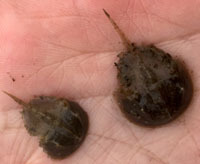 9/20 – Brooklyn, New York City: We had a busy day as second-graders from the Bronx came to Brooklyn Bridge Park to learn about seining in the East River and help identify our catch. We had staff working the nets from 9:30 AM to 12:30 PM completing 22 hauls. Our final tally included striped bass, Atlantic silverside, northern pipefish, Atlantic menhaden, spot, comb jellies, and moon jellyfish. We carefully counted all the schooling fish: 63 silversides and 47 menhaden. The catch of the day, however, did not come out of the seine net, but from along the rocky shoreline where there were several tide pools. As the students beach-combed, they found many small hermit crabs, mussels, and snails. But, the most exciting find was two nickel and dime-sized young-of-summer horseshoe crabs. This marked the first time Conservancy staff have found horseshoe crabs in the Park! (Photo of horseshoe crab courtesy of Christina Tobitsch)
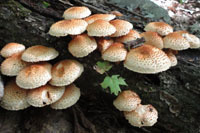 9/22 – Westchester County: Last year I started mushroom foraging too late. Today, following rain and cooler temperatures, I thought it prudent to start checking the oak trees in my favorite northern Westchester County park that have yielded hen-of-the-woods (Grifola frondosa) in years past. One tree in particular, that usually produces 6-8 “hens”, was the first to deliver. The specimen was still immature and are great eating that way, so I collected it. The park was well festooned with clusters of honey (Armillaria) mushrooms in two species: A. tabescens and A. mellea. The presence of these parasitic fungi is not good news for my beloved oaks. I also found my first fruiting this year of Pholiota squarrosoides (commonly referred to as the “onion bagel mushroom”), a sure sign that autumn had arrived. (Photo of "Onion Bagel" mushrooms courtesy of Steve Rock)
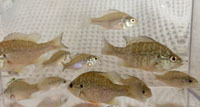 9/26 – North Germantown, HRM 109: After a day of deluge (1.70-inches of rain), the Catskills were shrouded in clouds as black as night. A storm appeared imminent. A strong southeast wind created wind-advisories on the Rip Van Winkle Bridge. Turkey vultures were teetering on their wings like trapeze artists gaining their balance. We chose to seine out of the wind right in the boat launch (the confined dimensions of many boat launches are excellent spots to find fish). The water felt wonderful at 71 degrees F to a pair of Labrador retrievers that were chasing tennis balls in the boat slip. Had they scared the fish away? Our first haul with our small net caught 250 fish, all young-of-year. While the catch included striped bass (55-75 mm), American shad (70-75 mm), and blueback herring (60-65 mm), at least 95% of the fishes were pumpkinseed (42-76 mm), a native sunfish (Lepomis gibbosus). Later, when the storm hit, it came in torrents (1.1 inches). (Photo of pumpkinseed sunfish courtesy of Tom Lake)
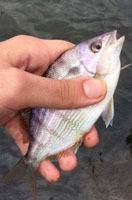 9/27 – Staten Island, New York City: We fished all day, mostly with clams as bait, on Back Bay in Great Kills Harbor. Our catch was a mixed bag and included small bluefish, oyster toadfish, northern puffer, northern kingfish, and summer flounder. In early evening we caught a five-inch-long pinfish, something we had never seen before.(Photo of pinfish courtesy of Anthony Ferino)
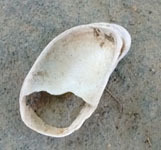 9/28 – New Baltimore, HRM 131.5: I found a common slipper shell on the beach today. That made five I have collected in recent days strewn across the sand. These are a marine gastropod that is totally out of place in freshwater. We are gathering theories as to how they came to be there. (Photo of common slippershell courtesy of Kelly Halloran)
|
The New York State Department of Environmental Conservation respects your right to privacy and welcomes your feedback | Update preferences or unsubscribe | Learn more about DEC Delivers. |
|
Connect with DEC:    
|
|
| Basil Seggos, Commissioner | |