Wildlife, Fish and Marine Life Newsletter
The New York State Department of Environmental Conservation sent this bulletin on 09/25/2018 12:16 PM EDT |
| DEC Delivers - Information to keep you connected and informed from the NYS Department of Environmental Conservation |
| Share or view as a web page || Update preferences or unsubscribe |
Wildlife, Fish, and Marine Life Newsletter |
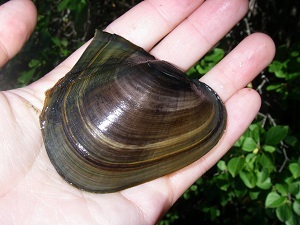
Freshwater Mussel Relocation Project Shows Early Signs of Success
Mussels are important for healthy freshwater ecosystems and can make up a majority of the biomass within an ecosystem. In addition, a healthy mussel population directly benefits the water quality of the area. As filter feeders, mussels obtain their food by filtering out microscopic organisms from the water column. The New York State Museum, St. Regis Mohawk Tribe, and SUNY Cobleskill are collaborating with DEC on the project. 4-Year Bear Study Recently Completed
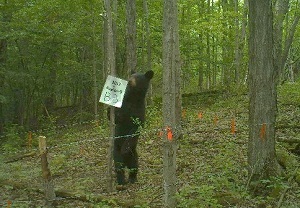
Staff from DEC’s Bureau of Wildlife across the state recently finished up a 4-year black bear population study in collaboration with Cornell University. A total of approximately 240 research sites were deployed on both private and public lands. These sites consisted of a trail camera and barbed wire with bait. The sites were checked every two weeks for photos and hair samples from the barbed wire. The research ended in August. The goal of the study was to collect information to improve management of New York’s bear population. Biologists will use the data to estimate population size, density, growth, and distribution; survival and reproduction rates; and patterns associated with different land cover types. Although DEC has concluded its field efforts, the citizen science project iSeeMammals is still ongoing. Members of the public can contribute data to the research project by submitting pictures and one-time observations of bears and bear sign (scat, tracks, hair, and markings), as well as data from hikes they go on or personal trail cameras they set up. Learn more on the iSeeMammals website. Environmental Conservation Officers Rescue Stranded Sea Turtle
Record-Breaking Fishing in Lake Ontario in 2018DEC announced that fishing for trout and salmon in Lake Ontario has set records this year with anglers reporting some of the best fishing in decades. Read the full article now. If you are interested in more articles like this, you can sign up for the Camping, Wildlife Viewing & Hiking newsletter! |
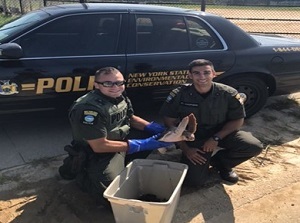 On August 24, Environmental Conservation Officer (ECO) Robert Kaufherr received a call about a
|
The New York State Department of Environmental Conservation respects your right to privacy and welcomes your feedback | Update preferences or unsubscribe | Learn more about DEC Delivers. |
|
Connect with DEC:    
|
|
| Basil Seggos, Commissioner | |