
Hudson River Almanac 8/25/18 - 8/31/18
The New York State Department of Environmental Conservation sent this bulletin on 09/07/2018 03:50 PM EDT |
| DEC Delivers - Information to keep you connected and informed from the NYS Department of Environmental Conservation |
| Share or view as a web page || Update preferences or unsubscribe |
|
Compiled by Tom Lake, Hudson River Estuary Program Consulting NaturalistOverviewThe observations in this week’s Almanac run vertically through the watershed from the headwaters in the Adirondacks 400 miles south through the Hudson Canyon in New York Harbor. The hawk watches noted the late-summer movement of raptors and hummingbirds. Sightings ranged from young-of-year oyster toadfish to a rarely seen seabird. Highlight of the Week8/25 – Hudson Canyon: Aboard the Brooklyn VI out of Point Judith, Rhode Island, we traveled 100 miles offshore of New York Harbor to the brink of the Continental Shelf near the edge of the Gulf Stream. Our vessel was positioned over the Hudson Canyon in 100 fathoms (6,000 feet) where the water temperature was 77.5 degrees Fahrenheit (F.). We laid down a chum slick and then drifted to see what might be attracted. A large pod of Risso's dolphins came by as well as pilot whales, a 16-foot-long blue shark, and a billfish with a long, slender, pinkish dorsal fin – perhaps an Atlantic sailfish (Istiophorus albicans).
[The Hudson Canyon, arguably the ancestral Hudson River, is a submarine canyon that begins from the shallow outlet of the estuary at the Lower Bay of New York Harbor. The canyon extends seaward across the continental shelf finally connecting to the deep ocean basin at a depth more than two miles. The canyon's walls rise three-quarters of a mile from the canyon floor making it comparable to the Grand Canyon of Arizona. Massive inland water discharges in the wake of ice ages, the most recent about 13,000 year ago, carved the Hudson Canyon. Tom Lake] Natural History Entries8/25 – Ulster County, HRM 87: Recently I was on the rail trail in High Falls and heard what sounded like a ferocious tiny chainsaw overhead. I looked up and saw something plummet to the ground. It was a cicada-killer wasp (Sphecius speciosus) attached to the underbelly of a periodical cicada that was trying to defend itself. I kept thinking it was all over for the cicada, but the struggle went on. I had to move on, amazed at the strangeness and complexity of it all.
[Eating some species of wild mushrooms can cause sickness and even death. Despite widespread beliefs to the contrary there is no general rule that allows you to distinguish between a poisonous mushroom and one that is safe to eat. Wild mushrooms should only be considered for consumption after being identified by an expert mycologist and even then only in moderation with samples of fresh specimens retained and properly stored to aid in identification whenever poisoning is considered a possibility. Steve Rock] On our walk we encountered a specimen of the spotted bolete (Xanthoconium affine) enormous enough to have grown in the Adirondacks. It was easily 15-inches-high with a cap the diameter of a salad plate and weighing in at about a pound. We had quite the day. (Photo of cinnabar chanterelle courtesy of Steve Rock) 8/25 – Bedford, HRM 35: Highlights from our first day at the Bedford Audubon Chestnut Ridge Hawkwatch included a small movement of bald eagles (4) and osprey (3), mostly to the southwest. Non-raptor observations included three ruby-throated hummingbirds migrating through. [The observation point for the Hawkwatch at Chestnut Ridge is at an elevation of about 770 feet, with a 180-degree view oriented to the east. Birders have been observing migrating raptors from Chestnut Ridge since at least 1978. Tait Johansson] 8/25 – Yonkers, HRM 18: Eight students showed up for our River Explorers program today at the Sarah Lawrence College Center for the Urban River at Beczak. It was a mixture of students who had been coming each week during the summer as well as some who did not believe there were fish in the Hudson River – our kind of challenge. It was rewarding to see their eyes light up when we caught an American eel, Atlantic silverside, three young-of-year striped bass, and a blue crab. [The Baylander (IX-514) is a Vietnam-era decommissioned U.S. Navy ship that was used to train helicopter pilots to land at sea. It is moored at the West Harlem Piers Park at 125th Street in Manhattan and has become a makeshift museum by the river and a community gathering space and educational resource for the West Harlem community. Ira Gershenhorn] 8/26 – New Baltimore, HRM 131.5: There was a group of 14 common nighthawks milling about over New Baltimore this evening probably all feeding on flying ants. In addition, a flock of seven common mergansers flew by. These were likely the product of successful local nesting. 8/26 – Beacon, HRM 61: For the last month, the river has been quite uneventful for fishing with the heat and wet weather. Today's conditions were passable, but the fishing was still off. The inshore shallows around Long Dock seemed largely barren of significant fish activity. I tried for channel catfish and carp for five hours and caught just two very small catfish, each a pound or less. Completely absent were any carp jumping or rolling anywhere in the shallows or out in the main river. Much of the time I found my bait totally undisturbed. Another angler fishing with his children at the newly-opened Scenic Hudson area just north of Long Dock reported that his sons, using nightcrawlers, caught a white perch and a yellow perch. 8/26 – Bedford, HRM 35: Highlights from our day at the Bedford Audubon Chestnut Ridge Hawkwatch included a small group of black vultures (4) migrating toward the southwest in mid-morning. Afterwards, we counted more bald eagles (2) and osprey (2). Non-raptor observations included two dragonflies migrating through. 8/26 – Manhattan, HRM 7: I've been asking anglers as I come upon them what they were going after and what they were using for bait. Today I saw a family having lunch around two fishing rods in the water at about 100th street. Another group had five rods set it up, each with a line in the water. They were all fishing for American eels and using shrimp as bait. Salinity was very low at 13.0 parts-per-thousand (ppt). [The NYS Department of Health advises that we do not eat more than four meals a month of American eel from the Hudson River at Manhattan. Tom Lake] 8/27 – Newcomb, HRM 300: We have had plenty of action on the Hudson River where it crosses Route 28N including great blue herons, egrets, ducks, Canada geese, beaver, white-tailed deer, and the occasional common loon. Rafting on the river today I spotted a bald eagle flying low overhead near the take-out area below the bridge. Everyone was very impressed. We do not see them very often. 8/27 – Albany, HRM 150: Twenty-five enthusiastic birders brought their chairs and waited patiently in the parking lot of the Albany Pine Bush Preserve Discovery Center on a hot and muggy night. We enjoyed good company and a variety of species flying over including a black vulture. But alas, no common nighthawks until 7:50 p.m. when the one bird of the night flew low overhead offering at least a quick glimpse by those who had stayed for the duration.
8/27 – Manhattan, HRM 1 We kicked off the week by checking our research sampling gear in Hudson River Park at The River Project's sampling station on the lighthouse tender Lilac at Pier 25. Among the fishes we caught was, judging from its length of 60 millimeters (mm), a young-of-year striped bass. Oyster toadfish continued to be featured, however, with two young-of-year (20, 40 mm) and two adults (235, 250 mm). Mixed in was an adult tautog (225 mm), and three blue crabs. 8/28 – Albany, HRM 150: There was a big increase from the single common nighthawk spotted last evening. Despite the 93-degree heat, more than 40 of us scanned the skies tonight at the Albany Pine Bush Preserve Discovery Center and counted eleven common nighthawks coming through between 7:00 and 8:00 p.m. 8/28 – Greene County, HRM 112: My mother-lode of chanterelles was finally in full fruit. In most years they are petering out by now. But after a dry early July and flooding for most of August, the entire patch was fruiting at once. Most years they fruit in a gradual sweep from south to north with the south end beginning about the 4th of July. 8/28 – Bedford, HRM 35: Another early-season slow day at the Bedford Audubon Chestnut Ridge Hawkwatch. Eight migrants were counted including two each osprey, black vulture, and turkey vulture all traveling southwest. Non-raptor observations included two ruby-throated hummingbirds migrating southwest and a red fox seen moving in front of the count site. 8/29 – Ulster Landing Park, HRM 97.2: My fourth-grade teaching colleagues from Red Hook Central School and I honed our seining skills today at Ulster Landing Park for the upcoming October 16 Day-in-the-Life of the Hudson program. The air was tropical at 95 degrees F. and the water temp was 81 degrees. In two hauls of our 30-foot seine we caught nearly 200 young-of-year mixed blueback herring and American shad (62-75 mm). We released them quickly to minimize mortality. Other notables in our net were banded killifish (62 mm) and young-of-year striped bass (75 mm). Visitors came to watch, and we explained how we use morphology to engage students in fish identification by body shape, fin position, and behavior. 8/29 – Beacon, HRM 61: The air was relatively cool at sunrise on a day when the heat would rise to 95 degrees F. The river had cooled a bit to 79 degrees. The salinity was barely measurable at less than 1.0 ppt. We caught a few fish on each haul until our final sweep of the seine along the beach; that was when we got into a large school of young-of-year herring: alewives (51-60 mm), blueback herring (49-55 mm), and American shad (69-70 mm). 8/29 – Bedford, HRM 35: Eight of the 14 migrants sighted today at the Bedford Audubon Chestnut Ridge Hawkwatch were vultures (5 black, 3 turkey). Of the six raptors, osprey was the high-count with three. Non-raptor observations included one monarch butterfly.
8/30 – Cohoes Flats, HRM 157: I spotted two juvenile Baird's sandpipers at Cohoes Flats today. They were foraging along the face of the southern end of the spillway. 8/30 – Waterford, HRM 158: I was with the Thursday Birding Group at Lock 2 of the Old Champlain Canal Trail this morning when Tom William's report of the two juvenile Baird's sandpipers came in. Traveling there, I scanned the flats for general bird numbers but used Tom's report to find the Baird's up on the top of the dam spillway. Other birds spotted included killdeer, least sandpiper, semipalmated sandpiper, and spotted sandpiper.
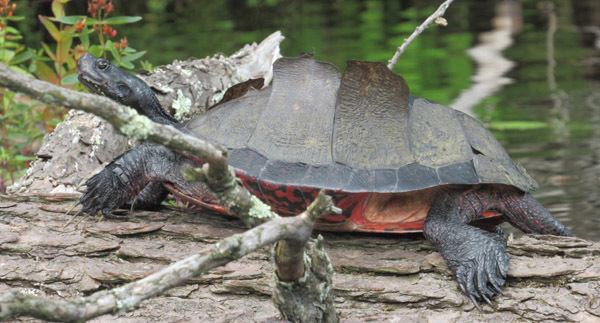
[Redfin pickerel are not common and when they are found it is usually in smaller tributaries. They are one of four members of the pike family, Esocidae, in the Hudson River watershed. The others are northern pike, chain pickerel, and tiger muskellunge, or norlunge, a hybrid cross of northern pike and muskellunge (Esox masquinongy). Muskellunge are present in Lake Champlain but, as far as we can tell, they are not found in the Hudson River watershed. Tom Lake] 8/31 – New Hamburg, HRM 67.5: There was an unusual combination of birds at Rabbit Island (1.3 acres) today. First there was the "resident" great blue heron that fishes regularly on a ridge of New Hamburg basalt that juts out from the island. The heron had company today, an osprey perched in the crown of a mulberry tree not more than 15 feet away. These were two high-end fish predators but there was no apparent interaction between the birds as the heron went about its business of wading toward its favorite fishing spot and, after about ten minutes the osprey took off. 8/31 – Kowawese, HRM 59: There was no sunrise today. The clouds hung in a gray pallor over Storm King Mountain. Out in the shallows we saw at least an acre of calm but dimpled water. River herring, we guessed. Our first and only haul of our 85-foot seine came in pulsing with fish, hundreds of young-of-year herring. We left the net in ankle-deep water to limit mortality, collected a fitting sample, and rinsed the rest out into the river. It was a mixed bag of young-of-year blueback herring (34-59 mm), American shad (68-80 mm), and alewives (69-69 mm). More than 90% were blueback herring. This time of the summer the bluebacks were likely emigres from the Mohawk River. The Hudson was 78 degrees F. [From years of herring research, Karin Limburg suggested that the "dimpling" was due to the herring feeding on emerging insects. Bob Boyle spoke often of his belief that the dimpling river herring were feeding on ants. He even tied tiny #24 dry flies, his "Ant" pattern, to catch them on a fly rod. Some observers have described the dimpling as looking like "a handful of shiny dimes" tossed into the river. Tom Lake] 8/31 – Rockland County: From a kayak on a New York State Park lake, I spotted an adult eastern redbelly turtle (Pseudemys rubriventris) basking on a log. The redbelly turtle is locally common (Rockland County) but regionally (Hudson River watershed) rare. 8/31 – Bedford, HRM 35: Sixteen migrants, including 15 raptors, were counted at the Bedford Audubon Chestnut Ridge Hawkwatch today with most of them heading southwest. Osprey were high count with seven, and our first American kestrels (4) of the season arrived. There were no non-raptor observations of note. 8/31 – Rockland County, HRM 31: This was a delightful day at the Hook Mountain Hawkwatch. We spotted at least three bald eagles each hour totaling 19 for the day. One eagle, an immature, stooped on an adult red-tailed hawk. Both disappeared behind some trees heading down to the Hudson River. Non-raptor observations included chimney swifts that were being seen so close, and so regular that we came up with a new verb: "We've been ‘swifted' again." [This is the 48th season for the Hook Mountain Hawkwatch, an all-volunteer effort started by Stiles Thomas in 1971. If you think you might like to volunteer at the Hawkwatch, or are interested in more information, please e-mail Trudy Battaly: merlin@pipeline.com. Drew Panko] 8/31 – Manhattan, HRM 1: We returned to check our research sampling gear in Hudson River Park at The River Project's sampling station on the lighthouse tender Lilac at Pier 25 and found that our gear had collected five more young-of-year oyster toadfish (30-40 mm), six summer-hatched blue crabs (10 mm carapace width), three tautog (140-190 mm), and a handsome black sea bass (210 mm). Summer 2018 Natural History Programs Hudson River Miles DEC's Smartphone app for iPhone and Android is now available at: New York Fishing, Hunting & Wildlife App. NY Open for Hunting and Fishing InitiativeUnder Governor Cuomo's Adventure NY initiative, DEC is making strategic investments to expand access to healthy, active outdoor recreation, connect more New Yorkers and visitors to nature and the outdoors, protect natural resources, and boost local economies. This initiative will support the completion of more than 75 projects over the next three years, ranging from improvements to youth camps and environmental education centers to new boat launches, duck blinds, and hiking trails. Read more about the Adventure NY initiative. For more information on planning an outdoor adventure in New York State, visit DEC's website at http://www.dec.ny.gov/outdoor.Information about the Hudson River Estuary Program is available on DEC's website at http://www.dec.ny.gov/lands/4920.html. Copies of past issues of the Hudson River Almanac, Volumes II-VIII, are available for purchase from the publisher, Purple Mountain Press, (800) 325-2665, or email purple@catskill.net |
 Hudson River Almanac
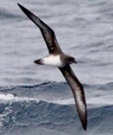 Our prize bird sighting was a Trindade petrel (Pterodroma arminjoniana). These rare seabirds nest on islands off the coast of Brazil. They have been seen in New York waters only twice. We saw several other deep-water seabirds such as Wilson's, band-rump, and Leache's storm-petrels as well as Corey's, Audubon's, and great shearwaters. (Photo of Trindade petrel courtesy of Richard Guthrie)
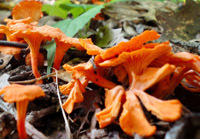 8/25 – Putnam County: We visited our favorite southern Putnam County park looking for fruitings of Lactarius corrugis (corrugated cap milky mushroom). It was a bit early for them, but we were hopeful. Instead, we found good-eating specimens of two blonder Lactarius sp. along with a good deal of the largest specimens of cinnabar chanterelle (Cantherellus cinnabarinus) that we've seen in years. We added them to a small collection of C. cibarius that we also collected.
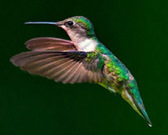 8/27 – Bedford, HRM 35: It was a very slow day at the Bedford Audubon Chestnut Ridge Hawkwatch. The four migrants included two turkey vultures, a red-tailed hawk, and an osprey heading west. Non-raptor observations included two monarch butterflies and four ruby-throated hummingbirds migrating southwest. (Photo of ruby-throated hummingbird courtesy of Tom McDowell)
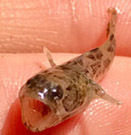 8/29 – Manhattan, HRM 1: We checked our research sampling gear in Hudson River Park at The River Project's sampling station on the lighthouse tender Lilac at Pier 25 where we found 14 adorable young-of-year oyster toadfish (25-40 mm), three feisty summer-hatched blue crabs, all 10 mm carapace width, and one adult male blue crab. (Photo of oyster toadfish courtesy of The River Project)
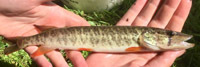 8/30 – Enderkill, HRM 85: Braving the heat and humidity we finished our August round of electro-shocking fish surveys in the Enderkill. We were assisted by four members of No Child Left Inside (A Cornell Cooperative Extension Program). We caught a total of 35 eels, including eleven big enough to be tagged, as well as two recaptures from previous sampling. Three of the eels were in the “silver stage," nearing maturity, heading to the sea to spawn. We caught 42 other fishes of 12 different species the highlight of which was a gorgeous (240 mm) redfin pickerel (Esox americanus americanus). We also caught five native spinycheek crayfish. (Photo of redfin pickerel courtesy of Aidan Mabey)
|
The New York State Department of Environmental Conservation respects your right to privacy and welcomes your feedback | Update preferences or unsubscribe | Learn more about DEC Delivers. |
|
Connect with DEC:    
|
|
| Are you registered to vote? Register to vote or update your information online today or search your voter registration status.. | |
| Andrew M. Cuomo, Governor * Basil Seggos, Commissioner | |