Compiled by Tom Lake, Hudson River Estuary Program Consulting Naturalist
Overview
This was the week of the seventh annual Great Hudson River Fish Count featuring 19 sites throughout the watershed from the Mohawk River to New York City. It is a day when we are all invited to come to the river and discover its incredible aquatic diversity. It was also a soggy week as more than three-inches of rain fell throughout the watershed, and river water temperatures remained high.
Highlight of the Week
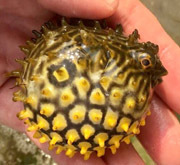 8/16 – Brooklyn, New York City: After getting rained out of participating in the Great Hudson River Fish Count five days ago, our staff from the Brooklyn Bridge Park Conservancy decided to go for an impromptu morning seine at the Pier 4 beach under the Manhattan Bridge in the East River. Our first haul resulted in a gorgeous and unexpected young-of-year striped burrfish (70 millimeters (mm)). This was the first one ever caught at Brooklyn Bridge Park. We also caught a range of young-of-year to adult Atlantic silverside (25-100 mm), northern pipefish (90 mm), young-of-year striped bass (50 mm), moon jellyfish, and a long-clawed hermit crab. (Photo of striped burrfish courtesy of Eliza Phillips) 8/16 – Brooklyn, New York City: After getting rained out of participating in the Great Hudson River Fish Count five days ago, our staff from the Brooklyn Bridge Park Conservancy decided to go for an impromptu morning seine at the Pier 4 beach under the Manhattan Bridge in the East River. Our first haul resulted in a gorgeous and unexpected young-of-year striped burrfish (70 millimeters (mm)). This was the first one ever caught at Brooklyn Bridge Park. We also caught a range of young-of-year to adult Atlantic silverside (25-100 mm), northern pipefish (90 mm), young-of-year striped bass (50 mm), moon jellyfish, and a long-clawed hermit crab. (Photo of striped burrfish courtesy of Eliza Phillips)
-Haley McClanahan, Shad Hopson, Peter Park, Isa Del Bello, Eliza Phillips, Christina Tobitsch
[Striped burrfish (Chilomycterus schoepfi) are a small, yellowish-green, temperate, marine-stray puffer fish covered with short, sharp spines. They can grow to ten inches. Striped burrfish feed on invertebrates such as barnacles and hermit crabs. They fend off predators by puffing up their body with air or water into a spiny ball. Tom Lake]
[Note: one inch = 25.4 millimeters (mm)]
Natural History Entries
8/10 – Hudson River, HRM 166-0: While we counted the numbers of fishes we caught (species density) for The Great Hudson River Fish Count, it was just as important that we noted the number of species present (species richness). Numbers do not tell the whole story. For example, Peter Park caught a single northern puffer in Little Bay Park at Fort Totten, Queens. Yet there were likely many more out there just beyond the sweep of his seine.
- Tom Lake
8/10 – Rensselaer County, HRM 166-157: NYSDEC staff from Region 4 Fisheries as well as the Division of Water and various volunteers teamed up for a fisheries survey on the eve of the annual Great Hudson River Fish Count. We night-sampled the Hudson River with an electro-shocking boat from three sites and collected fishes for display. A total of 28 species were recorded, including 25 captured by electro-fishing (two more species were only observed), and one extra species collected by seine. Overall, we were two species short of our record for the event of 30 fishes captured in 2017.
- Scott Wells
[Electro-shocking gear uses high voltage pulsed DC (direct current), passing from a cathode to an anode, to temporarily stun fish for capture. Fish experience galvanotaxis which causes the fish to involuntarily swim toward the electrical field. The size of fish being targeted determines the amount of voltage and amperage applied to the water. Smaller fish tend to be more difficult to stun than larger fish due to the fact that the smaller fish have less surface area that can be affected by the electrical field. Generally, the fish are released unharmed. Wes Eakin]
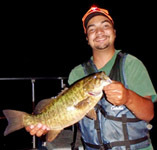 8/10 – Rensselaer County, HRM 166: We electro-fished below Champlain Canal Lock C-2 in the Town of Schaghticoke resulting in the capture of 18 species of fish. Highlights included spotfin shiner, northern hog sucker, shorthead redhorse, smallmouth bass, walleye, and young-of-year blueback herring. We saw a sub-adult sea lamprey (Petromyzon marinus) attached to an adult freshwater drum. Smallmouth bass and channel catfish were the most common species found at this site. One of the smallmouth was more than 18-inches-long and weighed nearly 4 pounds. (Photo of smallmouth bass courtesy of Scott Wells) 8/10 – Rensselaer County, HRM 166: We electro-fished below Champlain Canal Lock C-2 in the Town of Schaghticoke resulting in the capture of 18 species of fish. Highlights included spotfin shiner, northern hog sucker, shorthead redhorse, smallmouth bass, walleye, and young-of-year blueback herring. We saw a sub-adult sea lamprey (Petromyzon marinus) attached to an adult freshwater drum. Smallmouth bass and channel catfish were the most common species found at this site. One of the smallmouth was more than 18-inches-long and weighed nearly 4 pounds. (Photo of smallmouth bass courtesy of Scott Wells)
- Scott Wells, Bryan Weatherwax, Vince Grilli, Jared Parsons, Julian Canavan
8/10 – Rensselaer County, HRM 164: We electro-fished below Champlain Canal Lock C-1 in the Town of Schaghticoke resulting in the capture of 17 species of fish, five of which were not found at Canal Lock C-2: gizzard shad, northern pike, fallfish, striped bass, and northern logperch. The northern pike was a large adult that was seen but not netted. Northern logperch and freshwater drum were the most common species found at this site.
- Scott Wells, Bryan Weatherwax, Vince Grilli, Jared Parsons, Julian Canavan
8/10 – Rensselaer County, HRM 157: For our final night-sampling effort for the Great Fish Count, we electro-fished at the Lansingburg Boat launch at Schaghticoke resulting in the capture of 21 species of fish, five of which were not found at the two previous sites: bowfin, white perch, rock bass, tessellated darter, and yellow perch. Northern pike (another large adult) was the only species seen but not netted. We collected one of the two bowfin we caught not long after arriving. This native species is well established in the watershed and had been found in each of the last four years of this survey.
- Scott Wells, Bryan Weatherwax, Vince Grilli, Jared Parsons, Julian Canavan
[Bowfin (Amia calva) are an ancient and rugged predator species in the taxonomic realm of sharks and sturgeon. Their order (Amiiformes) arose in the Triassic Period, 250 million years ago; their family (Amiidae) is known from the Cretaceous, 100 million years ago. The bowfin lineage has endured many global cataclysms. It carries an adaptation from those times in its ability to breathe atmospheric oxygen by using its swim bladder to survive in waters with very low dissolved oxygen. Bowfin are a native species that are found throughout the lowlands of the eastern United States. They are well established in the upper Hudson River having possibly migrated down the Hudson-Champlain Canal from Lake Champlain and have extended their range downriver to at least Coxsackie (river mile 124). Tom Lake]
8/11 – Kowawese, HRM 59: Although the beach faced the mountains at the northern gateway to the Hudson Highlands, they were shrouded with storm clouds. We were racing an approaching front that promised to bring thunder, lightning, and heavy rain. Ten of us gathered to make our contribution to the annual Great Hudson River Fish Count. We hauled our net for an hour, closed up shop, and barely made it off the beach before the first deluge arrived. We caught nothing unexpected as young-of-year fishes dominated, including striped bass (62-73 mm), alewives (48-56 mm), blueback herring (45-57 mm), and American shad (72-88 mm). The river was 83 degrees Fahrenheit (F); salinity was not measurable.
- Sylas Houser, Rebecca Houser, Ameesah Cotten, Tom Lake, Kai Meier
[Kowawese is a 102-acre passive-use park on the Hudson River in New Windsor. The park is owned by New York State and managed by Orange County. Kowawese is one of the premier viewpoints to see the northern entrance to the Hudson Highlands between Storm King Mountain and Breakneck Ridge. Stone netsinkers, knives, and scrapers that have been found on the beach are attributable to ancient seiners and are likely associated with an archaeological site in the park that dates to 5,000 years ago. Tom Lake]
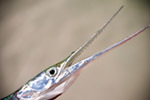 8/11 – Little Stony Point, HRM 55: Seven onlookers showed up for our annual Great Hudson River Fish Count program. Their enthusiasm made up for the lack of turnout. We made seven passes with the seine, four off the main beach and three in a cove at the north end of the beach resulting in eleven species, the highlight of which was a young-of-year Atlantic needlefish (Strongylura marina). The water temperature was 79 degrees F and the salinity was undetectable. (Photo of Atlantic needlefish courtesy of Tom Lake) 8/11 – Little Stony Point, HRM 55: Seven onlookers showed up for our annual Great Hudson River Fish Count program. Their enthusiasm made up for the lack of turnout. We made seven passes with the seine, four off the main beach and three in a cove at the north end of the beach resulting in eleven species, the highlight of which was a young-of-year Atlantic needlefish (Strongylura marina). The water temperature was 79 degrees F and the salinity was undetectable. (Photo of Atlantic needlefish courtesy of Tom Lake)
- Steve Stanne, Martice Smith
8/11 – Piermont, HRM 25: Thirty-eight enthusiastic seiners joined the Lamont Doherty team to help in hauling our net for the annual Great Hudson River Fish Count at Piermont Pier. The group of young and old alike were charmed by a small summer flounder (180 mm), a yellow-bellied male mummichog, more than a dozen young-of-year striped bass, many Atlantic Silverside (210), and two feisty male blue crabs. The water was a warm 80 degrees F and salinity hovered around 6.0 parts-per-thousand (ppt.).
- Margie Turrin, Laurel Zaima, Kathy Galione and Kelly Machold
8/11 – Yonkers, HRM 18: Seven students, ages 5-12, joined our River Explorer seining program at the Sarah Lawrence College Center for the Urban River at Beczak this morning. This was also the day of the annual Great Hudson River Fish Count. Local media covered the event, and the students were excited to be called “scientists.” The tide was low, and that gave us prime conditions as we caught Atlantic silverside, white perch, young-of-year striped bass and bluefish, blue crabs, shore shrimp, and 45 moon jellyfish.
- Gabrielle Carmine, Toni Jackson, Sam Collins-Zaluda
8/11 – Manhattan, HRM 2: Clearwater educators, flanked by 30 hardy onlookers, went in the water at 66th Street at low tide this afternoon to sample for The Great Hudson River Fish Count. Our seine catch was rather meager, but representative of the lower estuary, and included American eels, winter flounder, blue crabs, and shore shrimp.
- Eli Schloss, Tom O'Dowd, Zac Karas, Xavier Dade
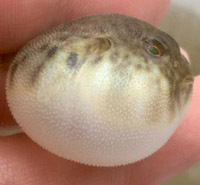 8/11 – Queens, New York City: The Great Hudson River Fish Count took us to Little Bay Park at Fort Totten. Across five hauls of our seine, we caught nine fish species, including Atlantic silverside, striped bass, white perch, winter flounder, striped killifish, northern kingfish, spot, striped sea robin, and northern puffer (40 mm), as well as blue crabs. On our first haul we counted 368 Atlantic silverside (Menidia menidia). Given their sheer numbers and the fact that they tend to be a less-resilient fish in a tank, we released all subsequent silverside and extrapolated (estimated) their numbers. Surprisingly, we saw no shrimp today. The water in the bay was 74 degrees F and the salinity was 27.0 ppt. 8/11 – Queens, New York City: The Great Hudson River Fish Count took us to Little Bay Park at Fort Totten. Across five hauls of our seine, we caught nine fish species, including Atlantic silverside, striped bass, white perch, winter flounder, striped killifish, northern kingfish, spot, striped sea robin, and northern puffer (40 mm), as well as blue crabs. On our first haul we counted 368 Atlantic silverside (Menidia menidia). Given their sheer numbers and the fact that they tend to be a less-resilient fish in a tank, we released all subsequent silverside and extrapolated (estimated) their numbers. Surprisingly, we saw no shrimp today. The water in the bay was 74 degrees F and the salinity was 27.0 ppt.
Afterwards, Joshua Lee, one of my volunteers and an avid angler, wanted to try fishing with lures. We went to a nearby spot where he caught and released his biggest striped bass (20-inches). We also saw a small school of banded rudderfish (Seriola zonata), circling the pilings in front of us. The school had 4-5 fish, each about seven-inches-long. (Photo of northern puffer courtesy of Peter Park)
- Peter Park, Andrew Wu, Andrew Tan, Joshua Lee
[The northern puffer (Sphoeroides maculatus), often called the blowfish, is a terete-shaped temperate marine stray. They have the ability, when agitated, to inflate themselves with air or water into the shape of a ball. They grow to 8-10 inches-long and their body is covered in small prickles. Northern puffers use their strong, beak-like mouths to crush the shells of small mollusks and crustaceans. Tom Lake]
8/12 – Poestenkill, HRM 151.5: The Poestenkill, a Hudson River tributary in south Troy, was running high and hard due to heavy rains. Even though our team of volunteers from DEC, Scenic Hudson, and The Sanctuary for Independent Media (NATURE Lab), arrived at low tide, many of the areas we had hoped to sample with our electro-shocker were inaccessible. We found a spot upstream underneath the second railroad bridge in the same location where a trial fyke net was placed during the 2018 glass eel season. There we found American eels (110-213 mm), tessellated darters, and three young-of-year brown bullheads. Habitat farther upstream was not sampled due to the high water.
- Aidan Mabey
8/13 – Orange County, HRM 63: In the time between first light and dawn, the world appeared in monochrome shades of gray. A cool northwest breeze felt very nice, as it pushed ripples up on the beach. We hauled our seine hoping for something new but had to settle for what had become the menu-of-the month: young-of-year striped bass (30-56 mm), American shad (68-75), alewives (48-56 mm), and blueback herring (44-58 mm). With all of the young-of-year fishes, there has been ample evidence this summer that the “fish factory” we call the Hudson River was working just fine.
- Tom Lake, A. Danforth
[This beach at Hathaway’s Glen is the terminus of a small, cold-water brook, a tributary of the Hudson, that spills down the fall line into a short run to the river. The water exiting Hathaway’s Glen Brook today was 68 degrees F Not more than 150 feet away, the river temperature was 81 degrees. Tom Lake]
8/13 – Croton-on-Hudson, HRM 33.5: While waiting for my Metro North commuter train to Manhattan at the Croton Train Station this morning, I saw four osprey flying around the cell phone tower nest. Based on the several unsuccessful landings on light towers in the Croton-Harmon railroad yard, and their demonstrated lack of aerial skills, it appeared that two of these osprey were newly fledged from the nest.
- Hugh McLean
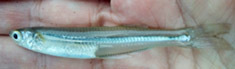 8/14 – Yonkers, HRM 18: Twenty-seven students, ages 5-18, from the Westhab community group arrived to go seining with us at the Sarah Lawrence College Center for the Urban River at Beczak. This was one of our free trips for local Yonkers organizations and community groups. The students were excited to get to seine in the Hudson River since it was a new experience for most of them, and they were definitely excited by our catch. Our seine captured American eels, blue crabs, eleven young-of-year striped bass and, the students’ favorite, 93 spectacular Atlantic silverside. (Photo of Atlantic silverside courtesy of Tom Lake) 8/14 – Yonkers, HRM 18: Twenty-seven students, ages 5-18, from the Westhab community group arrived to go seining with us at the Sarah Lawrence College Center for the Urban River at Beczak. This was one of our free trips for local Yonkers organizations and community groups. The students were excited to get to seine in the Hudson River since it was a new experience for most of them, and they were definitely excited by our catch. Our seine captured American eels, blue crabs, eleven young-of-year striped bass and, the students’ favorite, 93 spectacular Atlantic silverside. (Photo of Atlantic silverside courtesy of Tom Lake)
- Gabrielle Carmine, Jason Muller, Sam Collins-Zaluda, Maya Kharem
8/14 – Manhattan, HRM 1: We checked our research sampling gear today in Hudson River Park at The River Project's sampling station on the lighthouse tender Lilac at Pier 25. Our killifish traps had collected 14 young-of-year oyster toadfish (20-35 mm). We also found some juvenile spider crabs. This was notable since we had not been seeing nearly as many in our traps this season as in other years.
- Sage Stoney, Kirsten Rodek
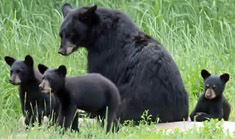 8/15 – Ulster County, HRM 92: We were headed to the Ashokan Reservoir to take a walk on the dividing weir between the upper and lower basins. I saw a black bear cub scurry up a tree. We stopped, and the little ones, two at first, shinnied down the tree and ran away. Then I saw the sow in the tree, and above her was a third cub. She and the cub started down and got to the ground. The cub ran toward its siblings. The sow gave me a glance and then followed the cubs, looking over her shoulder at me about every twenty feet. We gave them plenty of space and she did not run. (Photo of black bears courtesy Jeremy Baracca) 8/15 – Ulster County, HRM 92: We were headed to the Ashokan Reservoir to take a walk on the dividing weir between the upper and lower basins. I saw a black bear cub scurry up a tree. We stopped, and the little ones, two at first, shinnied down the tree and ran away. Then I saw the sow in the tree, and above her was a third cub. She and the cub started down and got to the ground. The cub ran toward its siblings. The sow gave me a glance and then followed the cubs, looking over her shoulder at me about every twenty feet. We gave them plenty of space and she did not run. (Photo of black bears courtesy Jeremy Baracca)
- Vivian Wadlin
[If you encounter a black bear (Ursus americanus) in the wild, do not panic. Bears are more likely to be afraid of you than you are of them. Know that you have the privilege of seeing a magnificent wild creature close-up, but don’t lose sight of the fact that black bears are powerful animals that may defend themselves if they feel threatened or if cubs are present. Give them space. Never approach, surround, or attempt to touch a bear. Always leave a clear escape route for the bear. If you feel threatened by a bear, back away slowly, but do not run. If the bear keeps coming back or will not leave, make loud noises, yell or clap. NYSDEC]
8/16 – Catskill, HRM 113: I saw my first flight of common nighthawks this evening. A group of eight of these flying aces was overhead for half an hour. They are spectacular fliers. After seven years of noting their passing in migration, they seem to be arriving earlier. This was the earliest, one day ahead of last year. In recent years, I have spotted them on August 29 in 2012, and August.31 in 2013.
- Barry Wolven
[The common nighthawk (Chordeiles minor) is a medium-sized crepuscular or nocturnal bird in the nightjar family, whose presence and identity are best revealed by its vocalization. Their southward migration intensifies in late August. - Rich Guthrie]
8/16 – Beacon, HRM 61: The air temperature on the beach was 90 degrees F, but the heat index had it feeling near 100. In an effort to cool off, we donned our snorkel gear even though the river was not as clear as it had been several days ago. As we hovered in the shallows, the fish we saw were not as distinct this time; we could make them out only as young-of-year fishes. Once thoroughly wet and halfway cooled, we hauled our seine and found all three young-of-year herrings although not in big numbers: American shad (78-83 mm), blueback herring (36-57 mm), and alewives (56-57 mm). As it has been most of the summer season, striped bass (48-62 mm) dominated the catch. The water temperature was 85 degrees F, but after three-inches of rain in the past five days, there was no measurable salinity.
- Tom Lake, T.R. Jackson, B.J. Jackson
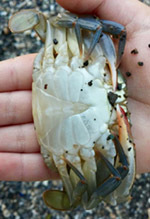 8/16 – Yonkers, HRM 18: Fifteen students from Poly Prep Country Day School joined us in a natural history program at the Sarah Lawrence College Center for the Urban River at Beczak. The students started the day volunteering for some shore clean-up. However, they had heard about seining and asked if they could try it. As educators, we could not resist. At high tide we hauled our seine in the Beczak Marsh and our catch included Atlantic silverside (117), young-of-year striped bass, and five blue crabs. One of the blue crabs was missing all five legs on its left side; we assumed that resulted from a battle with a predator or another blue crab. With luck, the next moult would begin to replace the legs. (Photo of female blue crab courtesy of Tom Lake) 8/16 – Yonkers, HRM 18: Fifteen students from Poly Prep Country Day School joined us in a natural history program at the Sarah Lawrence College Center for the Urban River at Beczak. The students started the day volunteering for some shore clean-up. However, they had heard about seining and asked if they could try it. As educators, we could not resist. At high tide we hauled our seine in the Beczak Marsh and our catch included Atlantic silverside (117), young-of-year striped bass, and five blue crabs. One of the blue crabs was missing all five legs on its left side; we assumed that resulted from a battle with a predator or another blue crab. With luck, the next moult would begin to replace the legs. (Photo of female blue crab courtesy of Tom Lake)
- Gabrielle Carmine, Jason Muller, Sam Collins-Zaluda, Maya Kharem, George Scott
[Blue crabs (Callinectes sapidus) are very aggressive and have the ability to release an appendage (being a decapod, one of their ten “legs”) at will. This is called autotomy, an adaptation for surviving battles with other crabs as well as an attack by a fish or a wading bird. They can regenerate the lost appendage, although this takes considerable time and may never fully recover to its original size. Tom Lake]
8/16 – Manhattan, HRM 1: This was another day for oyster toadfish as we checked our research sampling gear in Hudson River Park at The River Project's sampling station on the lighthouse tender Lilac at Pier 25. We found nine in our killifish traps, all young-of-year (23-35 mm). It was also a day for blue crabs. Of the five we caught, two were females. We generally catch males in our traps early in the summer, and begin to see females later in the summer and fall.
- Claire O'Loughlin, D'Leslie Jarvis, Sage Stoney
[Tolan Kister supplied an update on the giant oyster brought to The River Project on July 29. It was originally reported that the 8.89-inch-long oyster that was found under Pier 40 weighed 1.46 pounds. Upon a re-weighing, Toland discovered that it weighed 1.92 pounds. Tom Lake]
Free Trees for Streamside Planting
The Hudson River Estuary Program’s Trees for Tribs program offers free native trees and shrubs for planting along the tributary streams in the Hudson River Estuary watershed. Our staff can help you with a planting plan and work with your volunteers. Since 2007, Trees for Tribs has provided more than 40,000 native trees and shrubs for planting along 20 miles of stream with the help of more than 9,000 local volunteers. We are now accepting applications for planting projects.
For more information about the program or to download an application, please visit the DEC website at: www.dec.ny.gov/lands/43668.html. If you have questions about a potential planting site, please contact Beth Roessler at (845) 256-2253 or HudsonEstuaryTFT@dec.ny.gov.
Hudson River Miles
The Hudson is measured north from Hudson River Mile 0 at the Battery at the southern tip of Manhattan. The George Washington Bridge is at HRM 12, the Tappan Zee 28, Bear Mountain 47, Beacon-Newburgh 62, Mid-Hudson 75, Kingston-Rhinecliff 95, Rip Van Winkle 114, and the Federal Dam at Troy, the head of tidewater, at 153. The tidal section of the Hudson constitutes a bit less than half the total distance – 315 miles – from Lake Tear of the Clouds to the Battery. Entries from points east and west in the watershed reference the corresponding river mile on the mainstem.
To Contribute Your Observations or to Subscribe
The Hudson River Almanac is compiled and edited by Tom Lake and emailed weekly by DEC's Hudson River Estuary Program. Share your observations by e-mailing them to trlake7@aol.com.
To subscribe to the Almanac (or to unsubscribe), use the links on DEC's Hudson River Almanac or DEC Delivers web pages.
Discover New York State Conservationist - the award-winning, advertisement-free magazine focusing on New York State's great outdoors and natural resources. Conservationist features stunning photography, informative articles and around-the-state coverage. Visit the Conservationist webpage for more information.
Useful Links
National Oceanic and Atmospheric Administration online tide and tidal current predictions are invaluable when planning Hudson River field trips.
For real-time information on Hudson River tides, weather and water conditions from sixteen monitoring stations, visit the Hudson River Environmental Conditions Observing System website.
DEC's Smartphone app for iPhone and Android is now available at: New York Fishing, Hunting & Wildlife App.
NY Open for Hunting and Fishing Initiative
Under Governor Cuomo's Adventure NY initiative, DEC is making strategic investments to expand access to healthy, active outdoor recreation, connect more New Yorkers and visitors to nature and the outdoors, protect natural resources, and boost local economies. This initiative will support the completion of more than 75 projects over the next three years, ranging from improvements to youth camps and environmental education centers to new boat launches, duck blinds, and hiking trails. Read more about the Adventure NY initiative. For more information on planning an outdoor adventure in New York State, visit DEC's website at http://www.dec.ny.gov/outdoor.
Information about the Hudson River Estuary Program is available on DEC's website at http://www.dec.ny.gov/lands/4920.html.
Copies of past issues of the Hudson River Almanac, Volumes II-VIII, are available for purchase from the publisher, Purple Mountain Press, (800) 325-2665, or email purple@catskill.net
|


 Hudson River Almanac


