
Hudson River Almanac 8/4/18 - 8/10/18
The New York State Department of Environmental Conservation sent this bulletin on 08/17/2018 02:00 PM EDT |
| DEC Delivers - Information to keep you connected and informed from the NYS Department of Environmental Conservation |
| Share or view as a web page || Update preferences or unsubscribe |
|
Compiled by Tom Lake, Hudson River Estuary Program Consulting Naturalist
Unusually warm river water was a common theme this week with some temperatures in the high 80’s Fahrenheit (F). Another memorable time of very warm river water occurred on August 13, 2016, at the Fifth Annual Great Hudson River Fish Count at Kowawese (river mile 59). With a 97-degree F air temperature and high humidity factored in, it felt like 110 degrees (heat index) – it was debilitating. The water in the swash, or littoral zone, off the beach was 91 degrees F, hot to the touch, and there were no fish or blue crabs. Highlight of the Week
[This was within a known summer range for timber rattlesnakes (Crotalus horridus). Dating the snake from a photograph was tricky. The rattle looks to be eight segments. A new segment is added each time a snake sheds, which is about 1.5 times per year (so three segments every two years). It is difficult to gauge the age of this snake, but I would guess at least six years, and possibly older. Many populations of timber rattlesnake have been depleted or extirpated due to human persecution, collection, and habitat loss, which is why they are listed as a New York State Threatened Species. Because of this, occurrences such as this one are intentionally left vague other than to note its general presence in an area. Currently, the timber rattlesnake’s range in the watershed extends north into Essex County - Jesse Jaycox] Natural History Entries[In last week’s Hudson River Almanac (7/29), we erroneously said that Indian pipe is a “ghostlike fungi.” Several readers reminded us that Indian pipe (Monotropa uniflora), is not a fungi (mushroom). Rather, it is a saprophytic vascular flowering plant in the Heath family related to heather, blueberries, cranberries, and azaleas. Indian pipe lacks chlorophyll, so it sustains itself as a parasite often living off the mycelium of Russula fungi. Because of its pallid appearance, one common name for it is Ghost plant. Tom Lake] 8/4 – Mystery Point, HRM 47: There is a small stony island, not more than a hundred-foot-square, about 35 feet offshore that emerges twice a day from the river at low tide, not unlike Brigadoon. On a recent evening, I watched an adult bald eagle feeding on a fish at the south end of the tiny island. On the north end was a great blue heron apparently waiting for the eagle to have its fill and perhaps leave some fish behind. Eventually, the eagle left leaving some partially-eaten fish, but the heron did not move. Herons, knowing eagles, likely figured it would soon be coming back.
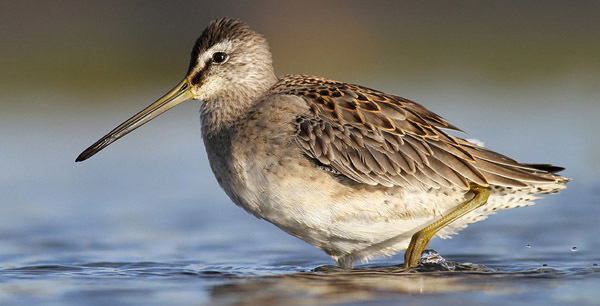
["Snapper,” a young-of-year fish, is one of several colloquial names given to bluefish (Pomatomus saltatrix) of incremental ages and sizes. One-year-olds, or yearlings, are known as cocktail or tailor blues. Some names refer to the strength of their jaws. Once they reach the 10-12-pound range, anglers speak of choppers, or slammers. Names like alligator and gorilla are reserved for the very largest and meanest of bluefish, weighing as much as twenty pounds or more. Tom Lake] [Note: one inch = 25.4 millimeters (mm)] 8/6 – Kowawese, HRM 59: Today was a warmup for our August 11 Great Hudson River Fish Count. Conditions were stifling. The river was beyond tepid at 87 degrees F and the air was 91 F, giving us a heat index of 100 degrees F. Young-of-year river herring and striped bass (48-53 mm) once again filled the net, but the highlight for us were the banded killifish (72-74 mm), all males in dazzling breeding colors. With iridescent blue, lavender and silver highlights, they earn their colloquial name of “blue-banded mudminnow,” a name coined by riverman Everett Nack. 8/6 – Manhattan, HRM 1: The highlight from our overnight set of research gear in Hudson River Park at The River Project's sampling station on the lighthouse tender Lilac at Pier 25 was a huge American eel. Anyone who has handled a strong and slippery eel can understand that it was nearly impossible for us to accurately measure the fish. Our best guess, using the inner circumference of our collection bucket, was that the eel was at least a meter long. Eels of that size are probably females, “silver eels,” heading back to sea to spawn. Our catch of eleven oyster toadfish (20-290 mm) paled in comparison. [“Silver eel” describes the sexually mature life stage of eels that have undergone physical changes preparatory to spawning. They have morphed from the green-and-yellow coloration of their yellow eel phase, to a more dark-and-light shading. Their eyes become enlarged and their alimentary canals atrophy. These changes enable the eels to adapt to traveling in the deep, dark waters of the North Atlantic to spawning locations that are still a mystery. Tom Lake] 8/7 – Mohawk River, HRM 157: We found a long-billed dowitcher (Limnodromus scolopaceus) this afternoon sitting on the rocks at the Cohoes Flats. After viewing photos, other expert birders confirmed the identification. David Harrison’s find was the first Albany County record for this species. Their breeding habitat is the wet tundra of the far north, and they migrate to the southern U.S. and into Central America to winter. 8/7 – Stockport Creek, HRM 121.5: The “Magnificent Seven,” students from LaSalle School in Albany, took part in a canoe trip today at Stockport Creek and on the Hudson River. All of the necessary gear was provided by DEC’s Hudson River Estuarine Research Reserve. The fish netting and identification at Middle Ground Flats was the highlight of the trip. It was both fun and memorable for the students. James LaFave, school counselor and trip leader, expressed his appreciation: “Thank you for such a wonderful day! I was very impressed by the way you taught during the experience, even going over to pick up a plastic water bottle that was in the river, was a first-class example of environmental conscientiousness for our students. Experiences like these are both a physical and spiritual breath of fresh air! God bless you in this valuable outreach program!” We then carried our gear to the other side of the cove open to the main stem of the river. The water was dotted with submerged vegetation such as wild celery and spiny naiad. The river was ten degrees cooler, and in one haul we caught more than 100 fish among ten species, including young-of-year alewives, blueback herring, striped bass, redbreast and pumpkinseed sunfish, largemouth bass, goldfish, spottail shiners, banded killifish, and tessellated darters. The biodiversity, biomass, vegetation, and water temperature of our second site stood in sharp contrast to that of the sheltered cove socked in by water chestnut.
8/7 – Beacon, HRM 61: This was a difficult day, even after getting wet. The river was 88 degrees F, the air temperature was 94 F, and the heat index made it feel like it was 100 degrees. With no recent rain, no wind, and a neap tide, the water had settled out from being its usual opaque to translucent. We put on our snorkels. We watched the quiet goings-on in four-feet of water – visibility was 18-20-inches. We saw dozens of young-of-year fishes swirling up close to our face masks before disappearing into the darkness and then coming back again. It was not unlike watching an aquarium that had no corners. They looked like young-of-year striped bass, but later when we hauled our seine, we discovered there were even more American shad (63-76 mm), blueback herring (43-62 mm), as well as striped bass (44-45 mm). [The heat index, also known as the apparent temperature, is what the temperature feels like to the human body when relative humidity is combined with the air temperature. National Weather Service] 8/7 – Yonkers, HRM 18: We hosted seven students this morning at the Sarah Lawrence College Center for the Urban River at Beczak from the Rockland Children's Psychiatric Center as part of our free community programming. Our popular seining effort produced American eels, Atlantic silverside, mummichogs, blue crabs, moon jellyfish, shore shrimp, and nine wonderful young-of-year striped bass. 8/7 – Yonkers, HRM 18: Our afternoon program at Beczak was for the San Andres Educational Summer Camp Program as part of our free community seining. Twenty-five students, ages 6-11, learned about the food web in the Hudson River. Seining is a very good tool to illustrate these relationships, and at low tide we caught a small school of Atlantic silverside (28), white perch, mummichogs, young-of-year striped bass, and shore shrimp. 8/7 – Manhattan, HRM 1: When we went to check our research gear in Hudson River Park at The River Project's sampling station on the lighthouse tender Lilac at Pier 25, we found a gorgeous tautog (180 mm) in our crab pot. That one fish dwarfed the seven young-of-year tautog we found in our killifish trap (20-23 mm). 8/8 – Yonkers, HRM 18: Today I worked with our Sarah Lawrence College Center for the Urban River at Beczak interns, Shreeda Segan, Vanessa Vazquez, Tyneisha Crenshaw, and Will Christiano, to help them gain seining experience when the tide is very low or when they must handle blue crabs. Each intern went seining on the deep end of the net and no one got stuck in the mud (their biggest fear). Everyone also learned about the best way to handle blue crabs – often a very tricky maneuver! We caught Atlantic silverside, mummichogs, shore shrimp, moon jellyfish, young-of-year striped bass and, of course, two feisty blue crabs.
8/9 – Yonkers, HRM 18: This morning we held a Reach for the Stars program for 35 special needs students, ages 7-11, at the Sarah Lawrence College Center for the Urban River at Beczak. These were some of the most excited students we had ever taught; they were applauding at every catch and were incredibly eager to seine. Our net caught Atlantic silverside, mummichogs, white perch, young-of-year striped bass, shore shrimp, blue crabs, comb jellies, and 573 moon jellyfish. It was such a rewarding experience to work with these students. 8/9 – Yonkers, HRM 18: In the afternoon at Beczak, eight students, ages 6-11, from the San Andres Educational Summer Camp Program joined us to go seining. Some San Andres students were here two days ago during a thunderstorm. This time our net caught mummichogs, young-of-year striped bass, shore shrimp, and forty moon jellyfish. 8/9 – Yonkers, HRM 18: Matt Hare and his Cornell University Oyster Research staff measured the Hudson River surface water temperature today at the Science Barge for Groundwork Hudson Valley. The water was 85 degrees F – maybe a record for here? 8/9 – Manhattan, HRM 3-1: American eels dominated the catch over the last three days, from Pier 46 in the West Village to Pier 63 in Chelsea, for our Hudson River Park Big City Catch-and-Release public fishing program. While most were 7-8 inches-long, one was 24-inches, a possible “silver eel,” heading back to the sea to spawn. The fish were caught on cut squid or clams.
8/10 – Greene County, HRM 112: So far, this season, I have left the hayfields behind my home in West Kill uncut to encourage wildlife. After weeks of daily downpours, we had a sunny day, so we cut the lawn up to the mill race that divides the back yard from the fields. Normally, the mill race is dry at this time of year and becomes a wildlife highway that can be observed from my window. But this summer, it was full of swiftly-moving water. When I looked out the window early this morning, two hen wild turkeys and a couple of poults were hanging out on the lawn near the edge of the brush on the mill race bank. Then a few more poults popped out. Then another adult hen. Then more poults. Then another hen. Then more poults. Eventually, there were four adult hens and a dozen poults. The poults were pecking each other and generally playing, while the adult birds kept a supervisory eye on them, intermittently pecking at the insects and grass clippings on the lawn. [During the month of August, DEC encourages residents to report their observations of wild turkeys. Go to: http://www.dec.ny.gov/animals/48732.html to download survey forms or submit your observations online.] 8/10 – Piermont, HRM 25: The tide was high during my walk on Piermont Pier this morning. I came upon a red fox along Ferry Road, as it slipped into the Phragmites bordering the south side. I wondered if this was the same one I saw in early July. That was a rather small-looking fox – perhaps this season’s kit – as it calmly walked past me in the scorching heat of that day. This one looked noticeably larger. There is a small wooded area between the Phragmites and Sparkill Creek where I imagine it lives. 8/10 – Yonkers, HRM 18: Thirty-five students from the YWCA summer camp, ages 8-11, visited the Sarah Lawrence College Center for the Urban River at Beczak today. They were a little apprehensive about the Hudson River -- the river can be imposing, even intimidating for first-timers. However, by the end of our seining, they were all excited about what they learned, right in their community. The camp counselors learned just as much as the students which is a nice reward from teaching. Altogether, we caught young-of-year striped bass, mummichogs, shore shrimp, blue crab, and 69 moon jellyfish. 8/10 – Manhattan, HRM 13.5: The great egret that had been at Inwood Hill Park all summer was fishing at the inlet of Spuyten Duyvil Creek and was joined today by an immature great blue heron. Small-flowered evening primrose was blooming and bouncing bet and chicory still had some flowers. At the visitors’ center, closed since Hurricane Sandy (2012), the maize in the untended “three sisters” garden was eight-feet high. Heart-leaved umbrella-wort (Mirabilis nyctaginea), absent since mowing a few years ago, had reappeared and was flowering, A few brilliant scarlet bee-balm flowers were there as well. In the tiny strip of salt marsh, smooth cordgrass (Spartina alterniflora) and big cordgrass (S. cynosuroides), were flowering, as was chairmaker’s rush (Scirpus americanus). On the path up through the Clove, clearweed had filled out to cover the ground and spicebush now had green berries. Virginia knotweed was everywhere, its tiny white flowers being almost the only color. Up on the ridge, several big blow-downs bore witness to recent thunderstorms. In a sunny spot, a big patch of purple-node Joe-Pye weed was gorgeous, mixed in with abundant pokeweed, also in flower. Farther on, I came upon several rough-leaved sunflowers (Helianthus strumosus). In the Overlook meadow, a monarch was visiting a bright Canada goldenrod above a patch of Queen Anne’s lace. 8/10 – Manhattan, HRM 1: We found more tautog today in our collection gear in Hudson River Park at The River Project's sampling station on the lighthouse tender Lilac at Pier 25. However, they were fewer (3) and smaller (20-30 mm) than recent days. The highlight was a northern pipefish (135 mm). Free Trees for Streamside Planting Hudson River Miles DEC's Smartphone app for iPhone and Android is now available at: New York Fishing, Hunting & Wildlife App. NY Open for Hunting and Fishing InitiativeUnder Governor Cuomo's Adventure NY initiative, DEC is making strategic investments to expand access to healthy, active outdoor recreation, connect more New Yorkers and visitors to nature and the outdoors, protect natural resources, and boost local economies. This initiative will support the completion of more than 75 projects over the next three years, ranging from improvements to youth camps and environmental education centers to new boat launches, duck blinds, and hiking trails. Read more about the Adventure NY initiative. For more information on planning an outdoor adventure in New York State, visit DEC's website at http://www.dec.ny.gov/outdoor.Information about the Hudson River Estuary Program is available on DEC's website at http://www.dec.ny.gov/lands/4920.html. Copies of past issues of the Hudson River Almanac, Volumes II-VIII, are available for purchase from the publisher, Purple Mountain Press, (800) 325-2665, or email purple@catskill.net
|
 Hudson River Almanac
 8/8 – Cornwall-on-Hudson, HR 57: We came upon a timber rattlesnake lounging in the sun near our home. The snake was about five feet long and thicker than my fist. It did not seem concerned with our presence, but we still kept a healthy distance. After a while, it meandered on up the hill through the dry grass and dead leaves, and I did not follow. (Photo of timber rattlesnake courtesy of Jonathan Duell)
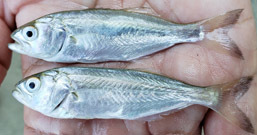 8/5 – Manhattan, HRM 3-1: It was a day for “snapper” bluefish at our Hudson River Park Big City Catch-and-Release public fishing program. We caught two at Pier 25 in Tribeca and two more at Pier 84 in Midtown. All were about 125 millimeters (mm). A break in the bluefish catch was made by a juvenile oyster toadfish (125 mm). All fish were caught on cut squid or clams. (Photo of bluefish courtesy of Chris Lake)
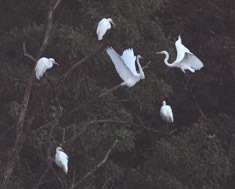 8/7 – New Hamburg, HRM 67.5: The wading-bird migration was underway! We visited the tidewater Wappinger Creek this evening where it joins the Hudson River hoping to get a decent sunset but missed it. We saw a large white bird land in a tree and noticed that there were many more, all great egrets. The light was fading fast so our eyesight was not perfect, but we counted eleven at once and 7-8 more were scattered about on water chestnut mats and stickups. It was just amazing. (Photo of great egrets courtesy of John Devitt)
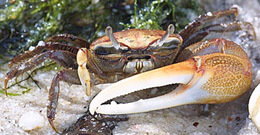 8/8 – Yonkers, HRM 18: When I joined the staff of the Sarah Lawrence College Center for the Urban River at Beczak last fall, Jay Muller told me that there were fiddler crabs in the Beczak Marsh. I had noticed their burrows and some moults, but I had never seen any crabs until today. An hour before low tide, on the beach side of the marsh’s tide pool, about four feet from the water’s edge, we counted 20-30 red-jointed fiddler crabs (Uca minax). It was really amazing! Red-jointed fiddler crabs have been found as far upriver in the estuary as Constitution Marsh Sanctuary at river mile 53. (Photo of red-jointed fiddler crab courtesy of Chris Lukhaup)
 8/9 – Manhattan, HRM 1: Tautog were featured today in our collection gear in Hudson River Park at The River Project's sampling station on the lighthouse tender Lilac at Pier 25. The eleven tautog, a juvenile and ten young-of-year, ranged in size from 25-220 mm. (Photo of tautog courtesy of Jackie Wu)
|
The New York State Department of Environmental Conservation respects your right to privacy and welcomes your feedback | Update preferences or unsubscribe | Learn more about DEC Delivers. |
|
Connect with DEC:    
|
|
| Are you registered to vote? Register to vote or update your information online today or search your voter registration status.. | |
| Andrew M. Cuomo, Governor * Basil Seggos, Commissioner | |