Air Mail: News About NY Air Quality - May
The New York State Department of Environmental Conservation sent this bulletin on 05/21/2018 12:08 PM EDT |
| DEC Delivers - Information to keep you connected and informed from the NYS Department of Environmental Conservation |
| Share or view as a web page || Update preferences or unsubscribe |
 |
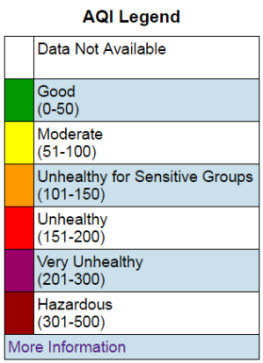
This Week's Topics:• Ozone Season Ozone Season Has ArrivedThe first ozone day in 2018 was a doozy as the entire state went under an air pollution health advisory on May 2. Calm winds, hot weather in the 80s, and plenty of sun were the triggers for the advisory. Unusual, you think? Not really. We’ve seen plenty of days in mid-spring where the forecasters send out a health advisory, typically for downstate New York. In very recent years, however, there have been enough warm April days that DEC began the ozone forecasting season a month earlier (April). Ironically, in the first year of the new ozone season opener (2018), there were no alerts in April thanks to the very cool early spring we’ve seen this year. Nonetheless, ozone levels in some areas were well into the “moderate” range – not enough to trigger an alert, but possibly enough to affect people most sensitive to the pollutant. The Air Quality Index (AQI) provides the guidelines for DEC to issue air pollution health advisories. It’s a color-coded scale used to inform the public about air quality conditions around the state. It tells you how clean or polluted your air is, and what associated health effects might be a concern for you. Our meteorology staff study atmospheric conditions and issue a daily forecast reflecting the expected degree of ground-level ozone or fine particle pollution, whichever is forecast to be higher that day.
The AQI: How it Works• An AQI value of 100 generally corresponds to the national air quality standard for the pollutant, which is the level EPA has set to protect public health. The change from May to April 1 for the ozone forecasting season opening is due to a few factors, not the least being more days of unseasonably warm weather. Additional influences are: the ozone standard has been lowered in response to increased awareness of the harmful effects of ozone; and, in the absence of tree leaves in early spring, ozone levels can rise especially quickly since leaves help to destroy ozone. Ozone is not a pollutant to take lightly. Young children, elderly people, and those with existing respiratory challenges, such as asthma, can be dramatically affected by it. People in these sensitive groups should consider limiting strenuous outdoor physical activity when ozone levels are the highest (generally afternoon to early evening). When outdoor levels of ozone are elevated, going indoors will usually reduce your exposure. Keeping an eye on the AQI is a good way to know what air quality to expect when leaving the house in the morning during those hot summer days to come. NYS Air Monitoring Network
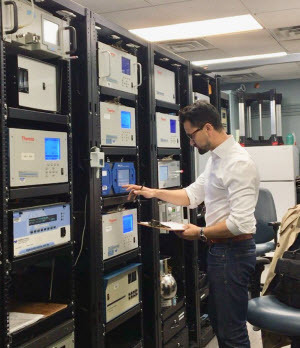
The Division of Air Resources collects air quality data from 64 monitoring sites around the state to assist DEC in planning pollution control strategies, keeping abreast of possible airborne health threats, and providing the public with air quality in their area on a daily basis. Santosh Mahat, shown here, is one of the field engineers responsible for collecting data and maintaining the equipment at the Queens College Air Monitoring Station in Queens, NY, an EPA NCore site tasked with measuring numerous contaminants.This monitoring station collects air quality data on ozone, nitrogen oxides, carbon monoxide, particulate matter, sulfur dioxide, volatile organic compounds and carbonyls.To see all 64 monitoring sites and their current air quality data, visit DEC’s air monitoring interactive map. Photo caption: DEC engineer Santosh Mahat performing a weekly check of the ground-level ozone analyzer at the Queens College air monitoring station, Queens, NY. DEC Accepting Comments on Proposed Regulations to Limit CO2Governor Andrew M. Cuomo announced that at his direction, DEC released proposed regulations to require all power plants in New York to meet new emissions limits for carbon dioxide (CO2), a potent greenhouse gas that contributes to climate change. The regulations, a first in the nation approach to regulating carbon emissions, will achieve the Governor's goal to end the use of coal in New York State power plants by 2020. DEC has scheduled three public hearings to provide additional opportunities to comment on the regulations and will accept public comments through July 29, 2018. Open Comment Period• Proposed 2018 Monitoring Network Plan available for public review until June 1, 2018. Stay Informed about Your Air QualityNew York's ozone season runs from April through September. DEC publishes ground-level ozone forecasts during ozone season and particulate matter pollution forecasts year-round using a scale called the Air Quality Index (AQI). DEC sends out an air quality alert when there is a high AQI value, which indicates polluted air. Individuals with pre-existing respiratory or cardiovascular conditions and people who exercise outdoors should take caution during an air quality alert. Find out if an Air Quality Alert is in effect by calling the toll-free Ozone Hotline: 1-800-535-1345. • check the daily ozone and particulate matter pollution forecast. We would like to know what you think. Please send your Air Mail! questions or comments to us at DAR.web@dec.ny.gov. |
|
The New York State Department of Environmental Conservation respects your right to privacy and welcomes your feedback | Update preferences or unsubscribe | Learn more about DEC Delivers. |
|
Connect with DEC:    
|
|
| Are you registered to vote? Register to vote or update your information online today or search your voter registration status.. | |
| Andrew M. Cuomo, Governor * Basil Seggos, Commissioner | |