
Hudson River Almanac 3/24/18 - 3/30/18
The New York State Department of Environmental Conservation sent this bulletin on 04/06/2018 02:00 PM EDT |
| DEC Delivers - Information to keep you connected and informed from the NYS Department of Environmental Conservation |
| Share or view as a web page || Update preferences or unsubscribe |
|
|
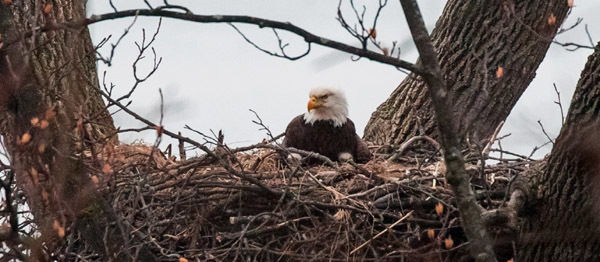
OVERVIEW HIGHLIGHT OF THE WEEK 3/29 – Town of Poughkeepsie: In late afternoon, we were finally able to get a good, non-intrusive, line-of-sight to bald eagle nest NY62. For the last five days, we had been watching the adults feed a nestling tiny bits of fish. To our surprise, a second little, gray, fuzzy head popped up today. There was no way of knowing when the second nestling hatched. Photos show them to have similar-sized fuzzy heads, which make us think the second one was there not long after the first, and was just hiding in the deep-sided nest. NATURAL HISTORY ENTRIES
3/24 – Albany County, HRM 134: Signs of spring were still hard to come by this morning, but there were a few glimmers of hope. Swamp maples were budding out and weeping willows were “yellowing” up. At the Bear Swamp Preserve heron rookery near Westerlo, we found three great blue herons standing on nests. 3/24 – Town of Poughkeepsie: This was incubation Day 32 at bald eagle nest NY372. I watched this afternoon, waiting to see if a fish came in to the nest or if the adults got excited like last year when we figured there had been a hatch. But nothing happened. They were still doing their turn-overs but so far no hatch.
3/25 – Waterford, HRM 159: The Mohawk River was surprisingly low. We were seining just west of the top of the Waterford Flight, a series of five locks that lift vessels westward, 170 feet above the Hudson River, to the beginning of the Erie Canal and the Mohawk River. A cold north wind chilled us after a three-mile fetch down the Mohawk and the going was arduous. Our 55-foot seine collected hundreds of water chestnut seeds that took us an hour to clear, but we also caught two fish, a gorgeous spotfin shiner and a sluggish 17- inch common carp. The river, at 52 degrees Fahrenheit (F), was far warmer than we expected. [The spotfin shiner (Cyprinella spiloptera) is a non-native minnow, being native to the Mississippi River watershed. It is likely they made their way to the Mohawk River and the Hudson, at least in part, through the New York State Canal system. Tom Lake] 3/25 – Montgomery County, HRM 157: There was a single greater white-fronted goose along the Mohawk River in Fultonville today. Also present among the hundreds of gulls were seven Iceland gulls and three lesser black-backed gulls. 3/25 – Colonie, HRM 153: Early this morning, a snowy owl was perched on top of the main parking garage at the Albany International Airport. By early afternoon, there were two snowy owls on top of garage. 3/25 – Cortlandt Manor, HRM 38.5: Woodsman-naturalist Craig Stevens, working near a small pond, found that conversation was well neigh impossible today. The clacking of the wood frogs and the shilling of the spring peepers was deafening. 3/25 – Croton Point, HRM 35-34: Tonight’s Saw Mill River Audubon's woodcock walk, led by Charlie Roberto, heard and saw at least five American woodcock in their display flights. The first “peent” was around 7:20 PM. Another highlight was a big movement of tree swallows at dusk (estimated to be 1,000 birds) coming into Croton Bay and likely headed for a night roost in the nearby stands of Phragmites in Croton Marsh. 3/26 – Ulster County, HRM 85: I stopped by Sturgeon Pool Reservoir late this afternoon to check on bald eagle nest NY92. There did not seem to be any incubating going on. The male and female were side-by-side on a branch just above the nest. Fifty yards to the south of the nest, was an immature eagle perched on a branch, preening. Did the immature miss a fishing or hunting opportunity or had it been chased away by the nesting pair? There were no vocalizations from any of the eagles as I watched nor any movement from the perches. 3/26 – Town of Poughkeepsie: Bald eagle nest NY62 was backlit by a sapphire blue sky in mid-afternoon. The male of the pair was in the nest, stepping around to give the new, three-day-old nestling, room. Before long, the female flew into the nest and the male flew off. She immediately began feeding the nestling from a gizzard shad that had been delivered earlier. 3/26 – Haverstraw Bay, HRM 36-34: The DEC Region 3 Hudson River Fisheries Unit caught some river herring (alewives) in our sturgeon research nets today. They were right on time, in from the sea to spawn. [In spring times past, when the shallows of the Tappan Zee and Haverstraw Bay were crisscrossed with stake and anchor gill nets to catch river herring and shad, we would begin to catch both alewives (Alosa pseudoharengus) and American shad (A. sapidissima) in late March. Tom Lake] 3/26 – Croton-on-Hudson, HRM 34.5: It was a welcome sight this morning, as the osprey had returned to their nest atop the “cell tower” in the Croton-Harmon Metro North Station parking lot. Their timely return matched the last three years within two days (March 27-28). Two dozen fish crows were doing as they pleased, mobbing the osprey sitting in the nest.
3/27 – Town of Poughkeepsie: Today was incubation Day 35 at bald eagle nest NY372. The adults’ behavior suggested that there was a third party in the nest. They waved a channel catfish around but did not seem to be reducing any of it to nestling-bite-size. Something seemed amiss. 3/27 – Town of Poughkeepsie: We found a good, but not intrusive, vantage from which to observe bald eagle nest NY62. The female of the pair seemed to be feeding the five-day-old nestling every time we looked. It was so amazing to watch the adults, so big with such large beaks, gently feeding their tiny little chick. [Note: one inch = 25.4 millimeters (mm)] [The central mudminnow (Umbra limi) is a nonnative fish in the Hudson River watershed being native to the Saint Lawrence-Great Lakes, Hudson Bay, and Mississippi River watersheds. They have expanded their range eastward into the Hudson watershed probably through the canal systems. They are also a rather uncommon catch. J.R. Greeley, in his A Biological Survey of the Lower Hudson Watershed (1937) could not find them in the lower Hudson. This was the first central mudminnow we had found in 25 years of work on the Quassaick. They can be mistaken for killifish as both are small, terete, and similarly-colored fishes, so their presence may be a bit more common than we think. Tom Lake] 3/28 – Battenkill, HRM 193: We spotted an adult male merlin at the top of a tree next to the Salem High School. The female may not have returned yet. Last year we had a very vocal nesting pair of merlin. In the same spot, in a couple of pine trees, was a noisy night roost of 30 clumsy turkey vultures. Last year's high count for the roost was 60 birds. 3/28 – Colonie, HRM 153: In midday, a snowy owl was perched on the top level of the parking garage at the Albany International Airport. This owl was a more lightly-barred individual than the ones I spotted here three days ago. 3/28 – Town of Saugerties, HRM 102: This morning I thought I heard the song of an eastern phoebe. Not surprising, it was a northern mockingbird doing a perfect imitation. Remarkably, later on I spotted an honest eastern phoebe. This fly-catcher, my first-of-season, was catching flies from a perch adjacent to an outbuilding that has been a perennially preferred nesting site.
[Harbor seals are one of four seal species found in the estuary. They include, in addition to the harbor seal, hooded seals, gray seals, and harp seals. While seals at a distance all look superficially the same, harbor seals are by far the most common. While seals can be found in the river at any time of the year, spring seems to be their peak, as they arrive to feed on the schools of shad and river herring that are migrating in from the sea to spawn. Tom Lake] 3/28 – Oscawana Point, HRM 38.5: This point of land serves as the downriver boundary for the confluence of Furnace Brook and the Hudson River. In most seasons, you will find at least one bald eagle perched in the hardwoods on the south-facing side. Today we found three “fish hawks” there – two immature bald eagles and our first-of-season osprey. 3/28 – Yonkers, HRM 18: The River Project staff from Manhattan’s Pier 40 visited the Sarah Lawrence Center for the Urban River at Beczak for a tour and some seining (our sampling sites are16 miles apart). We set out in midday and made seven exciting hauls. Included in our catch were moon jellyfish (Aurelia aurita), sand shrimp, a mummichog, and a three-spined stickleback. We were pretty sure that this was the first of this latter species caught at Beczak. The river was 43 degrees F and the salinity was eight parts-per-thousand (ppt). [The River Project had caught a three-spine stickleback (50 mm) in Manhattan at Pier 25 on March 29. The staff brought this stickleback (80 mm) back to Manhattan to add to their Pier 40 aquarium. On this day at Pier 40 in Manhattan, 16 miles toward the sea, the water temperature was 42 degrees F and the salinity was 11.0 ppt. Nina Hitchings] 3/29 – West Sand Lake, HRM 145: We witnessed the amphibian equivalent of a big migration push. The warm air temperatures and rain encouraged frogs and salamanders out of hibernation and into vernal pools. Across seven hours between 8:00 p.m. and 4:00 AM, we counted 35 spotted salamanders crossing the road from the hillside leaf litter into shallow water. These big boldly-colored fellows are a species of special concern and are probably declining due to habitat loss, so encountering that many in a one-mile stretch of road was encouraging! Four-toed salamanders were also numerous. They have the ability, when threatened, to shed their tails and leave a waving wormlike tidbit to temp a predator.
[More amphibians: Spring peepers – I have heard them in any warm spell, every month of the year – while wood frogs participate in one giant orgy over a few days, then shut up for the rest of the season. They sound more like a distant gaggle of ducks than frogs. When you're done looking at the sky for spring migrants during the day, look down on rainy nights and give amphibians a hand across the road. For more information, check out The Amphibian Migrations & Road Crossings Project, a joint project of NYSDEC and Cornell University at: http://www.dec.ny.gov/lands/51925.html Naomi Lloyd] 3/29 – Norrie Point, HRM 85: I listened to a full chorus of spring peepers in the background while red-winged blackbirds calling commanded the foreground. 3/30 – Mid-Hudson Valley: Two new bald eagle nests were given a DEC territory designation today, one in the city of Newburgh (NY488), and the other directly across the river at the mouth of Fishkill Creek (NY486). Eagles in both nests appeared to be incubating. 3/30 – New Paltz, HRM 78: I thought I heard an out-of-the-ordinary call this morning among the waves of migrating Canada Geese. This evening, there were no fewer than 30 snow geese in The Flats across from the Wallkill River. To the west, in the same field, a coyote dined on something dark-colored and about the size of a woodchuck. 3/30 – Yonkers, HRM 18: The total number of glass eels counted at the Sarah Lawrence Center for the Urban River at Beczak at the end of this week was compared to the corresponding week over the last five years. Our total to-date, in 2018, was by far the highest number. However, these are raw numbers, lacking context other than being the same week of the season. Year-to-year presence of glass eels can be affected by water temperature, weather, moon phase, and factors that are poorly understood. WINTER-SPRING 2018 NATURAL HISTORY PROGRAMS Friday, April 20 - 7:00 p.m. Free Trees for Streamside Planting For more information about the program or to download an application, please visit the DEC website at: www.dec.ny.gov/lands/43668.html . If you have questions about a potential planting site, please contact Beth Roessler at (845) 256-2253 or HudsonEstuaryTFT@dec.ny.gov. - Here’s how it works: Fill out a logbook provided by us whenever you fish on the Hudson River (by boat or shore). Record general location, time, gear used, what you caught (or if you didn’t catch anything) and return the logbook when you are done fishing. You’ll receive an annual newsletter summarizing the information in addition to the latest news regarding regulations and the river. - Whether you catch-and-release or take home a keeper, you can be part of the Cooperative Angler Program. Join today by contacting: Jessica Best 845-256-3009 jessica.best@dec.ny.gov HUDSON RIVER MILES The Hudson is measured north from Hudson River Mile 0 at the Battery at the southern tip of Manhattan. The George Washington Bridge is at HRM 12, the Tappan Zee 28, Bear Mountain 47, Beacon-Newburgh 62, Mid-Hudson 75, Kingston-Rhinecliff 95, Rip Van Winkle 114, and the Federal Dam at Troy, the head of tidewater, at 153. The tidal section of the Hudson constitutes a bit less than half the total distance – 315 miles – from Lake Tear of the Clouds to the Battery. Entries from points east and west in the watershed reference the corresponding river mile on the mainstem. TO CONTRIBUTE YOUR OBSERVATIONS OR TO SUBSCRIBE The Hudson River Almanac is compiled and edited by Tom Lake and emailed weekly by DEC's Hudson River Estuary Program. Share your observations by e-mailing them to trlake7@aol.com. To subscribe to the Almanac (or to unsubscribe), use the links on DEC's Hudson River Almanac or DEC Delivers web pages. Discover New York State Conservationist - the award-winning, advertisement-free magazine focusing on New York State's great outdoors and natural resources. Conservationist features stunning photography, informative articles and around-the-state coverage. Visit the Conservationist webpage for more information. USEFUL LINKS National Oceanic and Atmospheric Administration online tide and tidal current predictions are invaluable when planning Hudson River field trips. For real-time information on Hudson River tides, weather and water conditions from sixteen monitoring stations, visit the Hudson River Environmental Conditions Observing System website. Information about the Hudson River Estuary Program is available on DEC's website at http://www.dec.ny.gov/lands/4920.html. Smartphone app available for New York outdoor enthusiasts! Copies of past issues of the Hudson River Almanac, Volumes II-VIII, are available for purchase from the publisher, Purple Mountain Press, (800) 325-2665, or email purple@catskill.net |
 Hudson River Almanac
 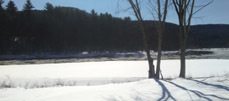 3/24 – Stony Creek, HRM 225: Half of the surface ice on the Hudson River was gone now, but there was still a lot of snow to melt. (Photo of Stony Creek, HRM 225 courtesy of Pete Lochman)
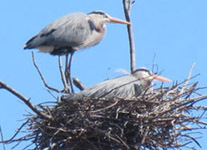 3/24 – Bedford, HRM 35: The great blue heron rookery had more arrivals today. At least eight nests had a single heron and the ninth had a pair of herons. The single herons were very likely males guarding the nests they had selected and were awaiting their mates. (Photo of great blue herons on their nest courtesty of Jim Steck)
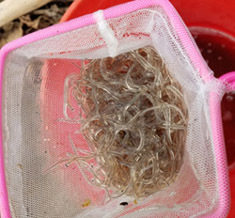 3/27 – Hudson River Estuary Eel Project Update: As our stream temperatures reached 40 degrees F, we began to see eel numbers pick up in the tributaries. We are now up to ten sites with reported catches to date including: Richmond Creek, Staten Island (50), Blind Brook, Rye (81), Sarah Lawrence Center for the Urban River at Beczak, Yonkers (503), Furnace Brook, Cortlandt (1,790), Minisceongo Creek, West Haverstraw (3,719), Quassaick Creek, Newburgh (2,000), Fall Kill, Poughkeepsie (50), Black Creek, Esopus (500), Enderkill, Staatsburg (5), and Saw Kill, Tivoli (20). (Photo of glass eels courtesy of Tom Lake)
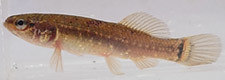 3/27 – Quassaick Creek, HRM 60: With local schools on spring recess, we were on our own checking our eel fyke. We could have used some help! After two hours, we had counted 3,417 glass eels, one elver, and a delightful little central mudminnow measuring 50 millimeters (mm). The creek was 44 degrees F. (Photo of central mudminnow courtesy of Tom Lake)
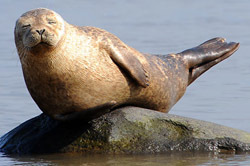 3/28 – Haverstraw Bay, HRM 39-34: A small dark-colored seal came within 100 feet of the DEC Region 3 Hudson River Fisheries Unit’s research boat today. Our crew had been out six days ago in the same area and spotted a similar seal and this may have been the same one. Our best guess is that it was a harbor seal (Phoca vitulina). (Photo of harbor seal courtesy of Tom Lake)
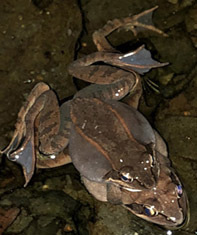 3/29 – Town of Saugerties, HRM 102: Conditions were ideal tonight with mild air temperatures, wet ground, and misting rain for an amphibian migration. Three hours of effort after dark, checking area roadways, resulted in assisting most of the 129 amphibians we encountered crossing roads, on their way to breeding sites. Roughly half were spotted salamanders (60) with a nice showing of four-toed salamanders (19) and relatively few live wood frogs (7). It was apparent that many wood frogs had already entered their breeding pools from the loud chorus of quacking males in adjacent wetlands. Dozens of pairs of eyes reflected back from our head lights (over 100 in one large pool), and several pairs were seen mating along pool edges. As is typical during these mass migration events, there were also numerous road casualties (61), with all of the road-killed wood frogs appearing to be females (based on the presence of egg masses). (Photo of wood frogs mating courtesy of Alan Beebe)
|
The New York State Department of Environmental Conservation respects your right to privacy and welcomes your feedback. | Update preferences or unsubscribe. | Learn more about DEC Delivers. |
|
Connect with DEC:   
|
 |
| NOW AVAILABLE: Receive DEC's Twitter feed via email. | |
| Andrew M. Cuomo, Governor * Basil Seggos, Commissioner | |