
Hudson River Almanac 3/10/18 - 3/16/18
The New York State Department of Environmental Conservation sent this bulletin on 03/23/2018 02:00 PM EDT |
| DEC Delivers - Information to keep you connected and informed from the NYS Department of Environmental Conservation |
| Share or view as a web page || Update preferences or unsubscribe |
|
|
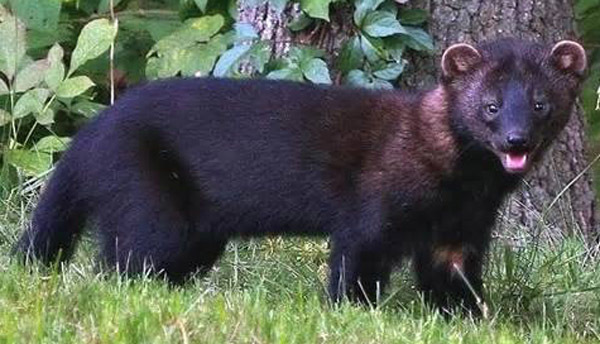
OVERVIEW This was the last full week of winter and spring was being very cryptic in its appearance. While ice had left most of the watershed, the forests and fields still held considerable snow. Two large weasels added color to this week’s entries and banded birds reminded us how much the Hudson Valley is connected to faraway places. HIGHLIGHT OF THE WEEK 3/12 – Fort Miller, HRM 192: I went for a drive along the Hudson River in Fort Miller. There were hundreds of Canada geese on the river and within a half-hour, hundreds more dropped in. It was an amazing sight and sound -- several thousand Canada geese with a few snow geese mixed on. I spotted two Canada geese that had orange collars with white letters and numbers (Y5K5 and X9C1). I reported the sighting to the U.S. Fish and Wildlife Bird Banding Laboratory. They replied letting me know that orange and blue collars are widely used in an extensive effort to track the populations and movements of Canada geese in the Mississippi Flyway. Orange collars are used in the Canadian portion and blue collars are used in the U.S. portion of the Mississippi Flyway. [Jean Rodrigue from D’Estimauville, Quebec, provided the banding data on the two Canada geese. They were hatched in 2015, or earlier, near Varennes, Quebec, Canada, northeast of Montreal. They were banded on April 30, 2016, and nearly two years later ended up 200 miles south at Fort Miller. If you come upon a banded goose and can discern its band number, you can inquire as to its origin by going to: https://www.fws.gov/birds/surveys-and-data/bird-banding/reporting-banded-birds.php. Jacquie Tinker] NATURAL HISTORY ENTRIES 3/10 – Newcomb, HRM 302: Four drake common mergansers showed up today on the Hudson River. They are always the first of the waterfowl to arrive back in late winter to early spring. 3/10 – Poestenkill, HRM 151.5: While driving toward Poestenkill this afternoon, I stopped to watch a large accipiter fly overhead. I watched it for more than a minute before it went out of sight. Based on its flight style, I think it was a northern goshawk. I was only a few miles from Grafton-Cherry Plain and the Rensselaer Plateau where they have been seen, albeit infrequently. 3/10 – Columbia County, HRM 118: The river was at low tide this afternoon off Stockport Station Road in Hudson. One adult bald eagle was on the nearby nest and a second adult came down to join seven immature eagles on sandbars exposed by the low water. Nine bald eagles was a nice count for the afternoon. 3/10 – New Paltz, HRM78: I was traveling on North Ohioville Road in midday when I saw a long black shape running quickly across the road, west to east. It was a fisher. It was about four-feet-long with half its length taken up by its bushy tail. It was the first time I had seen one live. [Fishers (Martes pennant) are one of our largest weasels (our river otters are similar-sized), reaching over forty-inches in length. They are seen periodically in the Catskills and Adirondacks and are not rare in the Mid-Hudson Valley. While the name of this fur bearer suggests an aquatic habitat and diet, they actually prefer dense forests and porcupines. One of the colloquial names for fisher is “fisher-cat.” The fisher is native to New York State and a member of the Mustelidae family (mustela, Latin for weasel), along with other New York State mammals such as the river otter, mink, American marten, and various smaller weasels. For more on fishers, see http://www.dec.ny.gov/animals/9355.html. Ellen Rathbone] 3/10 – Town of Poughkeepsie: The female was incubating in bald eagle nest NY62 as the male flew all over the fields below with his catch, a big goldfish, soaring with the wind, waiting for her to call for a turnover. And when she called, he delivered promptly. She took the fish and he took over incubating. 3/11 – Stony Creek, HRM 225: Half of the surface ice on the Hudson River was gone but there was still a lot of snow to melt.
3/11 – Castleton-on-Hudson, HRM 137: We looked across the Hudson from the Castleton waterfront to Selkirk just south of Henry Hudson Park in search of the short-eared owls John Kent had reported. At just about dusk, five owls lifted from the tree line and hunted over the farm fields along the river. 3/11 – Ulster County, HRM 85: Four immature bald eagles were at Sturgeon Pool on the Wallkill fighting over a fish. Nearby, bald eagle nest NY92 was definitely active; an adult had been sitting it for the last few days. My best guess to when they began incubating is March 7. If that is accurate, we may see a hatch April 2-5. 3/11 – Town of Poughkeepsie: This was incubation day 21 as we watched the adult pair in bald eagle nest NY62 make their turnovers throughout the day. We loved watching the non-incubating adults as they circled up and soared overhead. There is nothing more beautiful than an eagle and a deep blue sky! 3/11– Hook Mountain, HRM 31: There was still a lot of snow remaining from a storm four days ago, as much as eleven inches near the top of the mountain. Among the migrant raptors was an adult red-shouldered hawk. Non-migrating raptors included bald eagles (2), red-tailed hawk (5), turkey vultures (3), and black vultures (2). Non-raptor observations included common ravens (3) and a brown creeper, a pleasant surprise found half-way down the mountain. [The Hook Mountain Hawkwatch began in 1971 as an all-volunteer endeavor, by an independent group of raptor enthusiasts. The Hawkwatch is located on the Long Path north of Nyack and we welcome new participants and visitors. Groups should contact us at merlin@pipeline.com for introductory materials and possible volunteer scheduling. Trudy Battaly] 3/11 – Croton Point, HRM 35-34: I found a “dark morph” rough-legged hawk perched in a tree on the southeast side of the landfill. A northern harrier and two bald eagles flew above. I counted more than 20 tree swallows, my first of the year, near the Metro-North train station.
3/13 – New Paltz, HRM 78: This morning revealed a white winter wonderland, white on everything: ground, roofs, the tiniest twig, even an almost white sky. It was winter to look at but going outside to put out the bird feeders, I could have closed my eyes and thought it was spring. There was birdsong everywhere from song sparrows, house finches, robins, red-winged blackbirds, mourning doves, titmice, and black-capped chickadees all singing in the snow. As we watched the feeders, a flock of common grackles, red-winged blackbirds, brown-headed cowbirds, and European starlings fell from above like big black snowflakes, onto the birdseed. 3/13 – Hudson River Estuary: The glass eels are in the Hudson! At the beginning of the season we ask volunteers to check the nets every other day until glass eels are caught. Once these nets catch eels, we will install nets at additional sites. Total eels caught to date: Richmond Creek, Staten Island (12), Beczak, Yonkers (124), Furnace Brook, Cortlandt (110), and Minisceongo Creek, West Haverstraw (33). [Our Hudson River Estuary Program glass eel education project began in 2008. We initially sampled the Fall Kill and Indian Kill (Dutchess County), and Furnace Brook (Westchester County). We currently sample Hudson River estuary tributaries from Hannacroix (river mile 132) downriver to Staten Island, approximately 150 miles. The program involves about 750 volunteers as well as 2,000 teachers and students. Over eleven years, we have collected, analyzed and released more than 550,000 glass eels. [Interested volunteers can contact Chris Bowser at chris.bowser@dec.ny.gov, or check out this website for more info: http://www.dec.ny.gov/lands/49580.html.Chris Bowser] 3/14 – Town of Wappinger: Many of us have been monitoring a new bald eagle nest (NY459B) overlooking Wappinger Creek. This is an unusually deep-sided nest for a first-year pair. We spent some time today watching but saw no indication that anyone was home in the nest. And then, as we were packing up, the very crown of a white head lifted slightly into view. We have no idea when this pair began incubating so we will have to take close notice when the first food deliveries occur, indicating a new mouth to feed. 3/14 – Manhattan, HRM 1: With limited expectations, we went to check our research sampling gear in Hudson River Park at The River Project's sampling station on the lighthouse tender Lilac at Pier 25. We found a white perch (170 millimeters) in one of our traps. [White perch (Morone americana) are one of the most adaptable fishes in the estuary. They can thrive in conditions ranging from full saltwater to entirely freshwater. Some Hudson Valley lakes, ponds and reservoirs have transplanted white perch populations. Tom Lake]
3/15 – Battenkill River, HRM 188: While driving along the Battenkill yesterday, I spotted a white goose mixed in with the Canada geese close to the Greenwich Town Beach. The goose was smaller than the surrounding Canada geese but I did not have the chance to stop and check it out. I stopped by today and found it. It had a smaller, more rounded head, smaller body size, a shorter neck than a snow goose, and a vertical line at the base of the bill suggesting a Ross's goose. I ultimately decided to list it as a snow goose but it would be worth a second set of eyes. Many other waterfowl species were present, including two smaller cackling geese. 3/15 – Norrie Point, HRM 85: There was a strange tide today at Norrie Point. The slack water of the down tide (the ebb current, moving downriver towards the sea) had passed a couple of hours earlier but instead of the river filling back up, the Indian Kill tributary remained nearly empty and the muddy bottom of the Environmental Education Center’s big cove was merely wet. While tidal variance for this date (difference between high and low tides) was moderately high (4.8 feet), we were still two days from the new moon and a possible “moon tide.” We could not recall any strong northwest winds that might account for it either. It was a mystery. A pair of adult bald eagles were perched in a riverside sycamore peering intently down at the shallows. This was prime hunting time. [Tide is a vertical measurement of water in the estuary while current is the horizontal measurement of tidewater movement. Around the new and full moons, tides tend to be extra high and extra low. These are called moon or spring tides. Around the first and third quarter moon, tides are of average height, and are called neap tides. Tidal variance is the vertical measurement on any particular tide from slack low to slack high tide. Tom Lake] 3/15 – Denning’s Point, HRM 60: There was a new bald eagle nest in a tulip tree in the vicinity of Denning’s Point. It appeared to be a new pair of adults and they seemed serious about nesting and perhaps breeding. It will bear watching in the days ahead. 3/15 – Manhattan, HRM 1: We checked our research sampling gear in Hudson River Park at The River Project's sampling station on the lighthouse tender Lilac at Pier 25 and found a mix of sand shrimp (Crangon septemspinosa) and shore “grass” shrimp (Palaemonetes sp.) in our killifish traps. 3/16 – Town of Knox, HRM 145: We live in the extreme northwest corner of Albany County at an elevation of 1,140 feet above sea level. Over the last 18 days we have accumulated more than 32-inches of very heavy, wet snow that turned to ice and made snow blowing our 900-foot driveway very difficult. We feed the birds and, in addition to the local species like blue jay, several species of woodpeckers, cardinals, juncos, and chickadees, we have had flocks of red-winged blackbirds, robins, mourning doves, and wild turkeys. The feed is also welcomed by many red squirrels that live in our stone wall and gray squirrels that live in the woods.
WINTER-SPRING 2018 NATURAL HISTORY PROGRAMS Friday, April 20 - 7:00 p.m. Free Trees for Streamside Planting For more information about the program or to download an application, please visit the DEC website at: www.dec.ny.gov/lands/43668.html . If you have questions about a potential planting site, please contact Beth Roessler at (845) 256-2253 or HudsonEstuaryTFT@dec.ny.gov. - Here’s how it works: Fill out a logbook provided by us whenever you fish on the Hudson River (by boat or shore). Record general location, time, gear used, what you caught (or if you didn’t catch anything) and return the logbook when you are done fishing. You’ll receive an annual newsletter summarizing the information in addition to the latest news regarding regulations and the river. - Whether you catch-and-release or take home a keeper, you can be part of the Cooperative Angler Program. Join today by contacting: Jessica Best 845-256-3009 jessica.best@dec.ny.gov HUDSON RIVER MILES The Hudson is measured north from Hudson River Mile 0 at the Battery at the southern tip of Manhattan. The George Washington Bridge is at HRM 12, the Tappan Zee 28, Bear Mountain 47, Beacon-Newburgh 62, Mid-Hudson 75, Kingston-Rhinecliff 95, Rip Van Winkle 114, and the Federal Dam at Troy, the head of tidewater, at 153. The tidal section of the Hudson constitutes a bit less than half the total distance – 315 miles – from Lake Tear of the Clouds to the Battery. Entries from points east and west in the watershed reference the corresponding river mile on the mainstem. TO CONTRIBUTE YOUR OBSERVATIONS OR TO SUBSCRIBE The Hudson River Almanac is compiled and edited by Tom Lake and emailed weekly by DEC's Hudson River Estuary Program. Share your observations by e-mailing them to trlake7@aol.com. To subscribe to the Almanac (or to unsubscribe), use the links on DEC's Hudson River Almanac or DEC Delivers web pages. Discover New York State Conservationist - the award-winning, advertisement-free magazine focusing on New York State's great outdoors and natural resources. Conservationist features stunning photography, informative articles and around-the-state coverage. Visit the Conservationist webpage for more information. USEFUL LINKS National Oceanic and Atmospheric Administration online tide and tidal current predictions are invaluable when planning Hudson River field trips. For real-time information on Hudson River tides, weather and water conditions from sixteen monitoring stations, visit the Hudson River Environmental Conditions Observing System website. Information about the Hudson River Estuary Program is available on DEC's website at http://www.dec.ny.gov/lands/4920.html. Smartphone app available for New York outdoor enthusiasts! Copies of past issues of the Hudson River Almanac, Volumes II-VIII, are available for purchase from the publisher, Purple Mountain Press, (800) 325-2665, or email purple@catskill.net |
 Hudson River Almanac
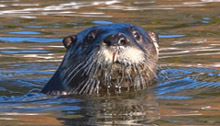 3/10 – Ulster County, HRM 85: I had a visitor at Sturgeon Pool on the Wallkill River this morning. I thought it might be a big carp when it surfaced to show its back not far in front of me. Then it dove and came back up again. My next thought was beaver but quickly I could see that it was a river otter. (Photo of river otter courtesy of Jim Yates)
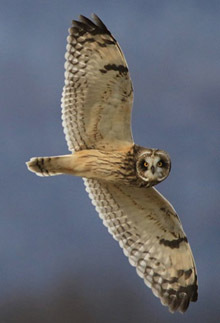 3/11 – Town of Bethlehem, HRM 141: This morning at sunrise I was surprised to see two short-eared owls circling over the river at Henry Hudson Park in Selkirk. They circled a few times, then went out of sight. Soon after, as I was looking south from the park toward the area where the owls had disappeared into the trees, an immature bald eagle emerged and suddenly, at least five short-eared owls flushed and began circling over the river. The eagle showed some interest, but didn't go after any of them. The owls circled until the eagle moved on, and then returned to the area along the west side of the river just south of the Vlomankill. (Photo of short-eared owl courtesy of Justin Schmidt)
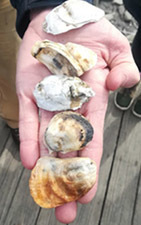 3/12 – Yonkers, HRM 18: During a tour of the lower Hudson Valley, we made a stop at the Sarah Lawrence Center for the Urban River at Beczak. Elisa Caref gave us our first glance at this season's glass eel migration, straight from their fyke net. Other treasures in the net included a juvenile mummichog (Fundulus heteroclitus) and small mud crabs. Several oyster shells gave evidence to this important mollusk surviving, at least in small numbers, on the Yonkers waterfront. The salinity was a very low 2.0 parts-per-thousand (ppt). (Photo of oysters courtesy of Ashawna Abbott)
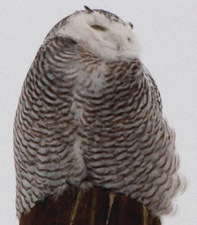 3/15 – Fort Edward, HRM202: The Fort Edward Grasslands was still hosting at least one snowy owl. This one looked like an immature female. (Photo of snowy owl courtesy of Louis Suarato)
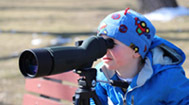 3/16 – Town of Bethlehem, HRM 141: We spent awhile, during the week, checking out the bald eagle nest across the river from Hudson Henry Hudson Park in the Town of Bethlehem. We were rewarded with a good view of one of the pair sitting on the nest, incubating, and occasionally turning the eggs. Our four-year-old grandson, Ben, was fascinated. (Photo of eagle watching courtesy of Liz Strickler)
|
The New York State Department of Environmental Conservation respects your right to privacy and welcomes your feedback. | Update preferences or unsubscribe. | Learn more about DEC Delivers. |
|
Connect with DEC:   
|
 |
| NOW AVAILABLE: Receive DEC's Twitter feed via email. | |
| Andrew M. Cuomo, Governor * Basil Seggos, Commissioner | |