
Hudson River Almanac 3/3/18 - 3/9/18
The New York State Department of Environmental Conservation sent this bulletin on 03/16/2018 02:10 PM EDT |
| DEC Delivers - Information to keep you connected and informed from the NYS Department of Environmental Conservation |
| Share or view as a web page || Update preferences or unsubscribe |
|
|
OVERVIEW The series of late-winter snowstorms continued and, although it was about the right time, there was little evidence that wintering bald eagles were leaving for northern breeding areas. We had a tale of an apparent “chicken hawk” that conjured up remembrances of the Foghorn Leghorn and Charlie the Chicken Hawk cartoon. Fishes made a welcome return to the Almanac this week. HIGHLIGHT OF THE WEEK
[The Eurasian wigeon breeds in the northernmost areas of Europe and Asia and is the Old World counterpart of North America's American wigeon. It is strongly migratory and can be found as an uncommon to rare winter visitor in the United States along the mid-Atlantic Coast. James Clements] [The Almanac chronicles natural history occurrences in the Hudson River watershed’s 13,390 square miles that includes drainage of varying degrees from four states. The common thread for the watershed is its eventual reaching the Atlantic via the Hudson River. However, there are rare instances when we will report on a natural history occurrence that lies just outside our watershed, if its rarity seems warranted. This Eurasian wigeon was discovered “just over the hill” in the adjacent Delaware River watershed. Tom Lake] NATURAL HISTORY ENTRIES 3/3 – Minerva, HRM 284: The most recent of the nor'easters last week brought five inches of snow to Minerva. Yesterday’s snowstorm brought seven more. I need to get back out there with my x-country skis! As for spring, not much showing here yet, although I heard rumors of a chilly fat robin near the post office four days ago. No sign of red-winged blackbirds, yet. My maple sap buckets were now frozen but nevertheless this has been a record-setting syrup season for me. I've boiled down 20 gallons of sap and have made 40 ounces of extremely sweet maple syrup. 3/3 – Fort Miller to Stillwater, HRM 193-173: We covered some spots along the Hudson River this afternoon. The water was very high apparently dispersing many of the recently-reported waterfowl. Common goldeneye were scattered in small groups throughout the area and there was a flock of 30 ring-necked ducks and a few common mergansers at Fort Miller. At the north leg of Wright's loop we spotted a pair of American wigeon, a pair of green-winged teal, and 15 northern pintail. 3/3 – Greene County, HRM 124: I stopped by the Coxsackie Creek Grasslands Preserve today for a brief look and found 14 hooded mergansers and two “Greene”-winged teal at Serta Pond. Also present were red-winged blackbirds, song sparrows, American robins, and two pairs of Canada geese staking out their turf. 3/3 –Ulster Park, HRM 87: I live three miles from the Hudson River at an elevation of 350 feet above sea level and received 18-inches of snow from yesterday’s storm. However, when I went down to Esopus Meadows along the river this morning, just three miles east, I found only six-inches of snow.
[Turnovers: Bald eagle eggs, if properly incubated, will hatch on average, in 32-35 days. Using NY62 as an example, across sixteen years, their eggs have hatched on average in 33 days. This number can vary depending on individual pairs and other environmental factors unique to each situation. While the adults share the incubation, the degree to which each will participate varies among pairs, even day-to-day. At NY62, our best guess over the years has been that the female takes the overnight shift (12 hours). Then the other 12 hours are split evenly between the adults resulting in an 18:6 ratio. Tom Lake] 3/3 – Croton-on-Hudson, HRM 35: Despite the lack of ice, the presence of both wintering and local bald eagles continued on the Hudson River in Haverstraw Bay. Today I spotted an adult perched on the seawall at the Half Moon Bay Marina eating a gizzard shad it had caught from the river. While eating, the eagle had to defend its meal against gulls, crows, and an immature bald eagle. 3/4 – Saratoga County, HRM 177: The light was terrible for photos and observation at Wright’s Loop, but it was great to see my duck friends doing their poking around and preening. I had been waiting for Wright's Loop North to thaw and now, in mid-morning, I counted 20 species including American wigeon (8), mallard (75), American Black Duck (45), and a gadwall. A huge number of Canada geese flew over that I estimated at 1,800 birds.
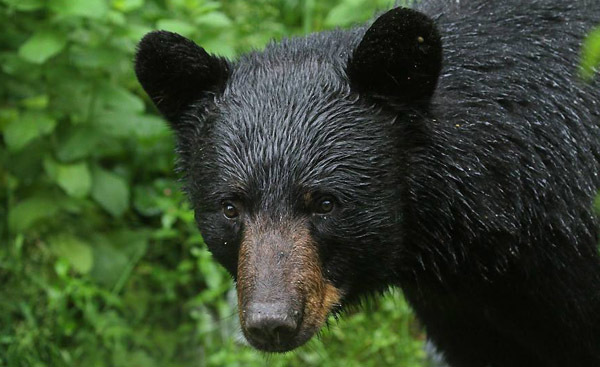
As for an upriver record, Eric Kiviat also tagged and released a diamondback terrapin captured in a 100-foot seine by Texas Instruments (October 1978) in Doodletown Bight, about a mile south of the Bear Mountain Bridge. Terrapins found farther upriver may have been pioneering during a drought year or mistakenly identified map turtles. Thanks to Erik Kiviat of Hudsonia for the finer details of terrapins past. (Photo of diamondback terrapin by Margie Turrin) [The diamondback terrapin (Malaclemys terrapin) is a turtle of salt to brackish water coastal marshes from Cape Cod to Chesapeake Bay. Their common name comes from the diamond-shaped rings on its carapace. There is a remnant population in the estuary at Piermont Marsh (river mile 25) and they have been reported as far upriver as Bear Mountain (river mile 45.5). There are populations in Jamaica and Raritan bays that may recruit or exchange terrapins. The Piermont population has been threatened in recent times due to habitat loss. Tom Lake] [If you come upon a diamondback terrapin anywhere in the Hudson River estuary, please report the details (where and when) and other particulars to Hofstra University’s Russell Burke, biorlb@hofstra.edu. Tom Lake] 3/5 – Town of Poughkeepsie: According to our less-than-scientific calculations, it was incubation Day 13 at bald eagle nest NY372 (on eggs February 21). The female, that has been euphemistically dubbed “Jill,” seems to be incubating most of the daylight hours while the male (“Jack”) is off to the river. When a turn-over occurs, she generally takes an hour or so off. This morning, the female’s off time was cut short as an immature bald eagle landed in the nest tree. Like Mighty Mouse, she came out of nowhere and escorted that youngster away. 3/6 – Saratoga County, HRM 177: The light was perfect at Wright’s Loop in late afternoon for catching the colors on ducks. The flooded field next to the Hudson River had given the ducks an opportunity to feed and I was pleased that many of them were fairly close to the road and did not take off as they often do when I show up. I marveled as I watched the ducks doing what ducks do: feeding, preening, chasing other ducks, sleeping, and swimming. I was thankful for being given the chance to see so many beautiful ducks, particularly the wigeons, seven of them, my personal favorite. Also among the 20 species I counted were green-winged teal (18) and northern pintail (100), now at the height of their migration. There were thousands of Canada geese along the river north and south of Wright’s Loop. 3/6 – Columbia County, HRM 113: A black bear had been taking our bird feeder off our window sill this winter. Tonight we heard the bear and shined a flashlight through the window. There, less than three feet away in the lantern light, was a yearling bear with but a single pane of glass between us. I have been that close to bears in the zoo where I worked, but not in nature. [For more information on Bears and Bird Feeders, and what you can do to prevent human-bear conflicts, please visit DEC’s website: http://www.dec.ny.gov/animals/94709.html ] 3/6 – Columbia County, HRM 102: When we went out last evening to close up the chickens for the night, the night before the big storm, we noticed that they were all still outside, huddling together in a pile like they used to do as chicks. When we entered the chicken house we saw a large light-breasted bird quietly perched in the high roost. Only its large feet were visible and its wing span was much wider than a chicken’s. It was an immature red-tailed hawk. We were perplexed. Our chicken predators have never entered the chicken house: they usually strike from the air. We opened a larger door to encourage the raptor to escape but it flew to a lower roost and did not leave. It appeared weak and or injured and we successfully picked it up by it legs and placed it in a large cardboard box. We made arrangements to bring the starving hawk to a local wildlife rehabilitator. She put the bird in a covered cage, gave it some tasty morsels of roadkill from her frozen stash, and told us that many predators starve this time of year. We woke up to 14 inches of snow this morning and the wildlife rehabilitator contacted us today to say that she was keeping the bird until spring so it can build up its strength. 3/6 – Town of Poughkeepsie: If our calculations are accurate, this was incubation day 18 at bald eagle nest NY62 (estimated hatch date is March 22 to March 25). A good number of our nest watchers were there (The Soul of NY62) to witness a midday turnover as Dad settled in and Mom took off for a break.
3/7 – East Fishkill, HRM 66: A large flock of red-winged blackbirds, at least 50, descended on my feeders this morning. Most of them had the red shoulder stripe but some had a stripe that looked blue or even white to me. The way the light strikes them can sometimes alter how we see their colors. The birds went on to empty my feeders in 15 minutes. 3/7 – Hammond’s Point, HRM 60: Bald eagle nest NY313 was looking serious again this year. The pair has produced five nestlings across their first four years. Today I spotted an adult at the nest and the second adult perched in a nearby tree. 3/8 – North Creek, HRM 257: I composed this e-mail in a snowstorm that continued to favor Mount Gore and the ski slopes. Spring? No robins yet! A friend of mine used to say, citing folklore, that she would rather see the devil than robins in March because robins were a precursor to heavy snowstorms. And yet, here we have had several snowstorms without robins.
[Tautog (Tautoga onitis) are a rather common bottom-dwelling fish of New York Harbor. Their colloquial name, blackfish, refers to the adults as they attain a deep, coal black color. Among their favorite foods are shellfish that they find in abundance in near-shore rocky areas. In the spirit of “you are what you eat,” blackfish, perhaps owing to their shellfish diet, are one of the most sought after food fishes in the New York Bight. Tom Lake]
3/9 – Green Island, HRM 153: The late afternoon ebb tide had bottomed out and the shallows were coming into focus. There were a few scattered groups of mallards and black ducks dabbing along the shoreline. I watched three common mergansers (two drakes and a hen) glide in for a landing below me, where I stood on the hillside. At the last instant they veered off and headed away across the river toward Troy. Had my presence troubled them? Then I heard a soft chortle and looked up overhead. An adult bald eagle had slipped in behind me into the top of an ash. It was the eagle’s presence that gave the mergansers pause. 3/9 – East Fishkill, HRM 66: I woke up this morning to find a wild turkey all curled up and sleeping in one of our trees. We were afraid it was dead. But then the turkey moved a bit when we went out to feed our outdoor critters. At one point, another wild turkey flew to the tree and sat next to it. By day’s end both turkeys had left. We were so relieved to know that it was able to fly and felt well enough to join the flock. 3/9 – Hammond’s Point, HRM 60: This will be year five at bald eagle nest NY313 at Hammond’s Point and, thanks to Bill Way, we know the nest is active again this year. Less than a half-mile away is another bald eagle nest, a new one that appears to be active as well. This one does not yet have a designation and steps are being discussed on how best to protect the eagles from human intrusion. Bald eagles will abandon a nest even when they have nestlings rather than risk dying. In their reaction to what they perceive as a threat, they have an instinctive “understanding” that they can have nestlings next year, but if they die, the lineage ends. WINTER-SPRING 2018 NATURAL HISTORY PROGRAMS Friday, April 20 - 7:00 p.m. Free Trees for Streamside Planting For more information about the program or to download an application, please visit the DEC website at: www.dec.ny.gov/lands/43668.html . If you have questions about a potential planting site, please contact Beth Roessler at (845) 256-2253 or HudsonEstuaryTFT@dec.ny.gov. - Here’s how it works: Fill out a logbook provided by us whenever you fish on the Hudson River (by boat or shore). Record general location, time, gear used, what you caught (or if you didn’t catch anything) and return the logbook when you are done fishing. You’ll receive an annual newsletter summarizing the information in addition to the latest news regarding regulations and the river. - Whether you catch-and-release or take home a keeper, you can be part of the Cooperative Angler Program. Join today by contacting: Jessica Best 845-256-3009 jessica.best@dec.ny.gov HUDSON RIVER MILES The Hudson is measured north from Hudson River Mile 0 at the Battery at the southern tip of Manhattan. The George Washington Bridge is at HRM 12, the Tappan Zee 28, Bear Mountain 47, Beacon-Newburgh 62, Mid-Hudson 75, Kingston-Rhinecliff 95, Rip Van Winkle 114, and the Federal Dam at Troy, the head of tidewater, at 153. The tidal section of the Hudson constitutes a bit less than half the total distance – 315 miles – from Lake Tear of the Clouds to the Battery. Entries from points east and west in the watershed reference the corresponding river mile on the mainstem. TO CONTRIBUTE YOUR OBSERVATIONS OR TO SUBSCRIBE The Hudson River Almanac is compiled and edited by Tom Lake and emailed weekly by DEC's Hudson River Estuary Program. Share your observations by e-mailing them to trlake7@aol.com. To subscribe to the Almanac (or to unsubscribe), use the links on DEC's Hudson River Almanac or DEC Delivers web pages. Discover New York State Conservationist - the award-winning, advertisement-free magazine focusing on New York State's great outdoors and natural resources. Conservationist features stunning photography, informative articles and around-the-state coverage. Visit the Conservationist webpage for more information. USEFUL LINKS National Oceanic and Atmospheric Administration online tide and tidal current predictions are invaluable when planning Hudson River field trips. For real-time information on Hudson River tides, weather and water conditions from sixteen monitoring stations, visit the Hudson River Environmental Conditions Observing System website. Information about the Hudson River Estuary Program is available on DEC's website at http://www.dec.ny.gov/lands/4920.html. Smartphone app available for New York outdoor enthusiasts! Copies of past issues of the Hudson River Almanac, Volumes II-VIII, are available for purchase from the publisher, Purple Mountain Press, (800) 325-2665, or email purple@catskill.net |
 Hudson River Almanac
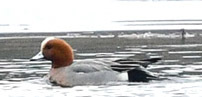 3/8 – Sullivan County: While birding at DEC’s Bashakill Wildlife Management Area, a 3,107-acre wetland, I came upon a beautiful drake Eurasian wigeon (Mareca penelope). The wigeon had a Cinnamon, reddish-brown head, buff crown, gray sides, and was discovered feeding in a marsh in company with several American wigeons, ring-necked ducks, gadwall, and Canada geese. This was only the third record of this species in Sullivan County. (Photo of Eurasian wigeon courtesy of Scott Baldinger)
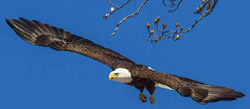 3/3 – Town of Poughkeepsie: This was incubation Day 14 at bald eagle nest NY62. I think the nest watchers feel more pressure than the eagles. There is always worry that high winds, freezing rain, hail, or heavy snow will bring the process to a crashing halt. The male (Dad) brought a gray squirrel back to the nest tree, fed a while, before completing a turn-over with the female (Mama), who then finished the meal. (Photo of bald eagle courtesy of Bob Rightmyer)
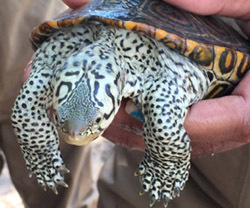 3/4 – Peekskill, HRM 43.5: We recently received an old report of an upriver capture (and subsequent release) of a diamondback terrapin in the Hudson River (July, 2016). The terrapin appeared to be a large female and was captured in a blue crab trap just inside the railroad tracks in Annsville Creek Bay. We wondered if this was an upriver record for the species. Erik Kiviat found a moribund terrapin in Sprout Creek (c. 1983) and theorized that it had been dumped (its color pattern suggested a Gulf Coast terrapin).
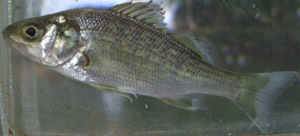 3/6 – Manhattan, HRM 1: We went to check our research sampling gear in Hudson River Park at The River Project's sampling station on the lighthouse tender Lilac at Pier 25 and were treated to a 220 millimeter-long (mm) white perch in one of our fish traps. White perch (Morone americana) are one of the signature fishes of the Hudson River not only because they are so common but they are one of the likeliest fishes to be caught on rod and reel by recreational anglers. (Photo of white perch courtesy of NJDEP)
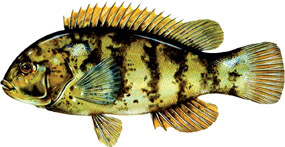 3/8 – Manhattan, HRM 1: As we were checking our research sampling gear in Hudson River Park at The River Project's sampling station on the lighthouse tender Lilac at Pier 25, we were about to give up hope for a fish when our final trap housed an adorable 77.5 mm tautog, or blackfish. (Photo of Tautog courtesy of CT.Gov)
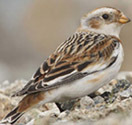 3/9 – Hadley, HRM 208: What a treat it was to find a flock of as many as two dozen snow buntings today in the fields at the Stewart's dam by the Sacandaga River. It was the first time I had seen them here and they were unmistakable! (Photo of snow bunting courtesy of Audubon.org)
|
The New York State Department of Environmental Conservation respects your right to privacy and welcomes your feedback. | Update preferences or unsubscribe. | Learn more about DEC Delivers. |
|
Connect with DEC:   
|
 |
| NOW AVAILABLE: Receive DEC's Twitter feed via email. | |
| Andrew M. Cuomo, Governor * Basil Seggos, Commissioner | |