
Hudson River Almanac 2/17/18 - 2/23/18
The New York State Department of Environmental Conservation sent this bulletin on 03/02/2018 02:00 PM EST |
| DEC Delivers - Information to keep you connected and informed from the NYS Department of Environmental Conservation |
| Share or view as a web page || Update preferences or unsubscribe |
|
|
OVERVIEW This was a winter week masquerading as springtime. There were record high air temperatures, early returns of various blackbirds, American woodcock, and Canada geese. Some of our bald eagles were already on eggs. HIGHLIGHT OF THE WEEK [An evaporator or a large pan is used to boil and concentrate maple sap with the water content escaping as water vapor. While the values can vary, it generally it takes about 48 gallons of maple sap to make one gallon of maple syrup. Pete Seeger was devoted to making maple syrup. Every late winter we would visit Pete as he boiled the sap at his forested hillside sugar bush in Beacon. Tom Lake] NATURAL HISTORY ENTRIES 2/17 – Hudson, HRM 118: I was at the City of Hudson boat launch watching bald eagles perched in cottonwood trees and riding ice floes north on the incoming tide. A tugboat pushing an oil barge came by. As they passed, the noise was loud as they crashed into the ice. I noticed a herring gull in the parking lot next to me pecking at a live foot-long fish (I was unable to identify the species). I wondered how a gull could find a fish in these icy river conditions. Then I realized that when the tug and barge crashed into the ice, it created a churning that toppled the floes end-over-end, probably exposing fish that were swimming underneath. As the fish floundered on the surface, it must have made easy picking for the gull. 2/17 – Norrie Point, HRM 85: The river splendidly displayed its "flows both ways" phenomenon in mid-morning today, but this time both ways at once. Near shore, the start of the flood tide dutifully carried pieces of drift ice upstream. But in the middle of the river, in the deeper-water, the ice was still rushing toward the sea. 2/17 – Ulster County, HRM 84: We watched four drake goldeneyes in Rondout Creek this morning flirting with two hens, frequently diving. This was the first time we’d seen this species of waterfowl in our neighborhood in Rosendale. 2/17 – Ossining, HRM 33: I came upon a fairly large, but dead fish washed up on the beach today. After some deliberation, I identified it as a gizzard shad. I wondered how it came to be there. [Gizzard shad, a nonnative herring, made its way into the estuary decades ago via the Intracoastal Waterway from Delaware Bay or points south. They are a winter favorite of bald eagles due to their vulnerability to the rigors of a northern winter, frequently succumbing to a phenomenon known as “winter kill.” Studies have shown (Jester and Jensen 1972) “high mortality rates at water temperatures below 2.2 degrees Celsius (C), or 35.96 Fahrenheit (F).” Tom Lake] 2/18 – New Baltimore, HRM 131.5: We walked the Armstrong Farm at the Scenic Hudson and New Baltimore Conservancy Preserve in New Baltimore today. At an overlook, we could see two adult bald eagles standing alongside two nests on Hotaling Island at Schodack Island State Park (NY52, NY87). As we walked down to the shoreline, we saw four immature bald eagles as well. It was truly a spectacular day as we were treated to seeing six eagles at once.
2/18 – Hyde Park, HRM 82: After last night's “clipper” snowstorm (four inches), this afternoon's warm and sunny blue skies were a delightful respite. I counted eight black vultures in downtown Hyde Park, six on a roof and two others in a nearby tree. A couple of them dropped down into a parking lot to investigate foraging opportunities. Black vultures are becoming more common in the Hudson Valley as their range spreads north. A ninth vulture, a turkey vulture, circled overhead. 2/18 – Ulster County, HRM 76: There were two male red-winged blackbirds at my feeder today. I've been a birder for 35 years and this was the earliest date I have ever seen red-wings here. Two days ago, cardinals were singing their spring-time songs. - Jeremy Baracca 2/18 – Croton Point, HRM 35-34: Taking advantage of mild weather on the day after we had eight-inches of snow, we spent the mid-afternoon hours exploring the Point. On the crest of the landfill we spotted a winter holdover: a lone horned lark flying around, calling, and then feeding on the snowy path in front of us. In the absence of ice on the river, a single adult bald eagle perched on a piece of wood sticking out of Croton Bay near the railroad bridge. The eagle was buzzed by gulls and then buzzed them in turn when it lifted off. In late afternoon we spotted a huge flock of vultures, at least 50, mostly turkey vultures, but with some black vultures mixed in. They circled and then headed off to their night roost. – Joe Wallace, Sharon AvRutick
[NY62 probably gets the most consistent scrutiny of any Hudson Valley bald eagle nest. As a result, we generally extrapolate to suggest that what is occurring at NY62 is likewise occurring at most of the other three dozen active nests along the river. If the timing is right, and they are truly on eggs, we may have a hatch in 32-35 days (March 22 to March 25). Across the last four years at NY62, egg laying has occurred, on average, on March 25. Tom Lake] 2/19 – Manhattan, HRM 2.5: I had been watching a pair of bufflehead ducks (drake and hen) in the river for a week from the west side of Manhattan between piers 39 and 66. Today I found them diving and feeding off Pier 62. - A. Salcius 2/20 – Town of Saugerties, HRM 102: I was a bit surprised three weeks ago to see a dandelion in bloom. Today I noticed two more dandelions with open flowers and several bees investigating the cracked corn under my bird feeders. Eastern chipmunks have been active on-and-off since mid-January, including two that were seen foraging in leaf litter today. - Steve Chorvas 2/20 – Ulster County, HRM 88: I came upon a white-tailed deer carcass in a snowy field today on Hurley Mountain Road. Close by its side was a gorgeous adult bald eagle having its share of the spoils. 2/20 – Town of Poughkeepsie, HRM 75: The air temperature reached 67 degrees F today, establishing a new record high for the date.
Today we added seining with a 25-foot-long net as a sampling component to the students’ monthly research protocol. Two passes in the shallows produced many treasures including algae, colonial hydroids, two species of jellyfish (sea wasp and a hydromedusae), several species of shrimp, a small paddle worm, a tiny green nudibranch (eelgrass slug), a hermit crab, a small mole crab, and several species of “swimming crabs”, related to our Hudson River blue crab (Callinectes sp.). A crowd favorite was a one-inch-long decorator crab (Macrocoeloma trispinosum) that had carefully camouflaged itself with bits of shell, pebbles, and algae. And then there were the beautiful fish! We caught deep green gulf pipefish (Syngnathus scovelli), colorful white grunts (Haemulon plumierii) with wonderful blue and pale yellow striping, a few tiny permit, a jack, (Trachinotus falcatus), that looked like silver coins in the seine, juvenile parrotfish (Scaridae), and several species of anchovies. The students were especially excited by the bandtail puffers (Sphoeroides spengleri) that, when agitated, puff up into the shape of a golf ball. It was comforting to relate to these fish since our Hudson River estuary also has species of pipefish, grunts, anchovies, jacks, and puffers. Everything we caught was examined and then returned to the water. The students were openly proud of the biodiversity of their mangrove estuary and excited to come back next month for more investigations. (Photo of seining in Puerto Rico courtesy of Augusto Menezes) [The JBNERR was inaugurated in 1981 as part of the National Estuarine Research Reserve System. Established in 1972, this network of 29 estuarine sanctuaries protects more than 1.3 million acres of coastal and estuarine habitat for long-term research, water-quality monitoring, education, and coastal stewardship. The National Oceanic and Atmospheric Administration (NOAA) provides funding, guidance and technical assistance. Each reserve is managed by a state agency or university with input from local partners. JBNERR is a sister site to our four HRNERR locations, established in 1982 (www.hrnerr.org). Both sites have iconic endangered animals, (manatees in Bahia de Jobos, sturgeon in the Hudson River estuary), crucial aquatic habitat (Bahia de Jobos mangroves, Hudson River tidal marshes) as well as a commitment to educating students with hands-on science programs. Chris Bowser] 2/21 – Albany, HRM 145: The air temperature reached 73 degrees F today, establishing a new record high for the date. 2/21 – Columbia County, HRM 104: As we were conducting presence/absence sampling for New England cottontail (Sylvilagus transitionalis) in the Boston Corners area of Taconic State Park, we flushed seven woodcock (Scolopax rusticola). This was an early date for the return of these small wading birds from wintering areas in the southeast and along the Gulf coast. 2/21 – Clermont, HRM 103: On the morning of a day of record warm air temperatures, I saw five “V” flocks of Canada geese, about a quarter-mile inland, heading north. I was stunned by how many flocks I spotted in such a short time. 2/21 – Columbia County, HRM 102: On a warm spring-like day in Craryville, we had a picnic lunch by our six-inch-deep vernal pool. There had been two-inches of ice on the pond yesterday, now melted. Several Canada geese were honking overhead and flying north. In early evening we heard spring peepers. We usually hear our first peepers around Saint Patrick’s Day, so this was very early. What a day it was! 2/21 – Town of Ulster, HRM 93: At 2:00 a.m. today, in the dark of night, I heard at least two first-of-season spring peepers calling from a wooded swamp. This was the first of them I had heard in this wetland since last October. They were not there yesterday [and they were not there the next day, either]. Good quality habitat abuts this wetland, so the frogs probably do not stray far afield after breeding in the pools. 2/21 – Galeville, HRM 74: I went to the Shawangunks Grasslands National Wildlife Refuge in late morning. Just after I arrived, a large flock of 80 or more snow geese flew up out of Blue Chip Farms and across the grasslands. This was the first time I had seen a large flock in winter. They circled around and headed west. Just after midday a short-eared owl came up after being dive-bombed by two northern harriers. Altogether, three male harriers were up making swooping passes at each other. 2/21 Town of Poughkeepsie: There were strong indications that the mated pair from bald eagle nest NY372 had begun incubating. Thus we began another 32-35 day countdown. 2/21 – Town of Poughkeepsie, HRM 75: The air temperature reached 76 degrees F today, establishing a new record high for the date. 2/21 – Town of Wappinger, HRM 67: There were sights and sounds of a spring day in February: Tufted titmice were calling, a cardinal was singing its spring song, and a flock of red - winged blackbirds came through. We heard them before we saw them. A half-dozen turkey vultures were scattered across the sky, teetering on their silver-lined wings, and several skeins of Canada geese passed over heading north. 2/21 – Beacon, HRM 61: The lure was irresistible. On an early morning low tide, on a day when the air temperature would rise into the mid-70s, we were drawn to the beach. In contrast to the air, and with a water temperature of 36.3 degrees F, the river was shrouded in a heavy fog. The warm air felt like April and red-winged blackbirds were calling from all quarters. We dragged our seine over the remnant shelf ice to reach the water and made several hauls. Did we catch a fish? I’d love to say we did, but the truth always produces the purest data: we caught nothing, matching our expectations. 2/21 – Manhattan, HRM 5: The air temperature reached 78 degrees F today, establishing a new record high for the date. 2/22 – Selkirk, HRM 135: Light overnight snow covered everything and this morning red-winged blackbirds were storming the feeders! I could not count them; every time I tried, they’d all fly away, only to return and I’d start all over again. One of these days I'll get the count.
2/22 – Town of Wappinger, HRM 67: We watched hundreds of blackbirds careening along the edge of the forest, leapfrogging by the score, tree-to-tree. There were red-winged blackbirds, common grackles, brown-headed cowbirds and a significant number of starlings mixed in. Thinking back to late winters past, I associated this rush of returning blackbirds to mid-March.
[Onion grass (Romulea rosea) is a strange invasive plant. In several years of seeing it, I’ve never noticed flowers. It grows from little bulbs that look like cocktail onions; they bud underground, extending individual clumps (I dig them up in the Brooklyn Botanic Native-flora Garden, so I see this). Yet it has spread over a large area, so it must reproduce by seed as well. Thomas Shoesmith] 2/23 – Manhattan, HRM 1: We checked our collection gear in Hudson River Park at The River Project's sampling station on the lighthouse tender Lilac at Pier 25. It was tempting to say that we only caught grass shrimp (Palaemonetes sp.) and isopods this week, but we know the essential role these aquatic creatures play in the ecology of the inter-pier area of Manhattan’s west side. 2/23 – Hudson River: Striped Bass Cooperative Angler Program - Do you fish for striped bass in the Hudson River? You can share your fishing trip information and help biologists understand and manage our striped bass fishery. - Here’s how it works: Fill out a logbook provided by us whenever you fish on the Hudson River (by boat or shore). Record general location, time, gear used, what you caught (or if you didn’t catch anything) and return the logbook when you are done fishing. You’ll receive an annual newsletter summarizing the information in addition to the latest news regarding regulations and the river. - Whether you catch-and-release or take home a keeper, you can be part of the Cooperative Angler Program. Join today by contacting: Jessica Best 845-256-3009 jessica.best@dec.ny.gov WINTER-SPRING 2018 NATURAL HISTORY PROGRAMS Free Trees for Streamside Planting For more information about the program or to download an application, please visit the DEC website at: www.dec.ny.gov/lands/43668.html . If you have questions about a potential planting site, please contact Beth Roessler at (845) 256-2253 or HudsonEstuaryTFT@dec.ny.gov. Saturday, March 3 - 5:00 - 8:00 p.m. Wednesday, March 14 - 5:00 - 8:00 p.m. HUDSON RIVER MILES The Hudson is measured north from Hudson River Mile 0 at the Battery at the southern tip of Manhattan. The George Washington Bridge is at HRM 12, the Tappan Zee 28, Bear Mountain 47, Beacon-Newburgh 62, Mid-Hudson 75, Kingston-Rhinecliff 95, Rip Van Winkle 114, and the Federal Dam at Troy, the head of tidewater, at 153. The tidal section of the Hudson constitutes a bit less than half the total distance – 315 miles – from Lake Tear of the Clouds to the Battery. Entries from points east and west in the watershed reference the corresponding river mile on the mainstem. TO CONTRIBUTE YOUR OBSERVATIONS OR TO SUBSCRIBE The Hudson River Almanac is compiled and edited by Tom Lake and emailed weekly by DEC's Hudson River Estuary Program. Share your observations by e-mailing them to trlake7@aol.com. To subscribe to the Almanac (or to unsubscribe), use the links on DEC's Hudson River Almanac or DEC Delivers web pages. Discover New York State Conservationist - the award-winning, advertisement-free magazine focusing on New York State's great outdoors and natural resources. Conservationist features stunning photography, informative articles and around-the-state coverage. Visit the Conservationist webpage for more information. USEFUL LINKS National Oceanic and Atmospheric Administration online tide and tidal current predictions are invaluable when planning Hudson River field trips. For real-time information on Hudson River tides, weather and water conditions from sixteen monitoring stations, visit the Hudson River Environmental Conditions Observing System website. Information about the Hudson River Estuary Program is available on DEC's website at http://www.dec.ny.gov/lands/4920.html. Smartphone app available for New York outdoor enthusiasts! Copies of past issues of the Hudson River Almanac, Volumes II-VIII, are available for purchase from the publisher, Purple Mountain Press, (800) 325-2665, or email purple@catskill.net |
 Hudson River Almanac
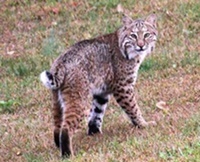 2/18 – Pine Plains, HRM 96: Driving into town at midday, I had the chance to see, of all things, a bobcat loping off a hill and galloping across the road in front of my car into the adjoining snowy cornfield. The big cat ran, paws splayed in front as though just playing in the snow, toward a wooded stream. It was dark, striped and muscular with its distinctive tail. This was my first bobcat.(Photo of bobcat courtesy of Deb Tracy-Kral)
 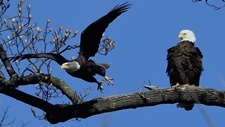 2/19 – Town of Poughkeepsie: Our daily diligence seems to have paid off. It appeared to us that the adult pair at bald eagle nest NY62 had settled on eggs. The best indication has been the presence of one or the other adult all the time – the nest never left uncovered for more than a few minutes or even seconds. (Photo of bald eagles courtesy of Dave Tryon)
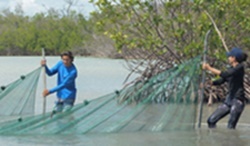 2/20 – Puerto Rico: As Education Coordinator for the Hudson River National Estuarine Research Reserve (HRNERR), I was eager to explore a different type of estuary at the Jobos Bay National Estuarine Research Reserve (JBNERR) in southern Puerto Rico. Along with 22 high school students from the Cento Residencial de Opportunidades Educativas de Villalba, we investigated the Camino del Indio site on Jobos Bay, an area of mangroves, sandy beaches, and sea grass beds that the students have been studying since December 2017. We began investigating our study area and discovered that the water temperature was 27.0 C (81 degrees F), salinity was 35.0 parts-per-thousand (ppt), and had a pH of 7.0 (neutral, neither basic nor acidic). We sampled during the ebb tide (tidal range was a foot or 300 millimeter). Students then did a beach profile to determine possible beach erosion.
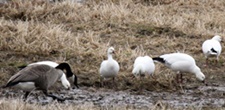 2/22 – Red Hook, HRM 96.5: I counted five snow geese in a small cornfield mixed in with 50 Canada geese. The cornfield abuts an orchard, empty fields, and nearby hayfields. They seemed to be congregating around a very small area of water, a vernal wetland that had developed. (Snow geese courtesy of Elisa Shaw)
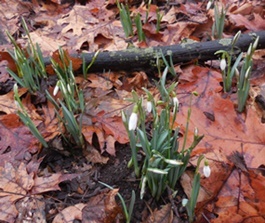 2/23 – Manhattan, HRM 13.5: I visited Inwood Hill Park in midday; fog over the river made the Palisades invisible. In the woods there were hints of spring. Little clumps of “onion grass” were everywhere, the fresh leaves thin and tangled. Near the top of the path up through the Clove, snowdrops (Galanthus nivalis) were up, the flowers beginning to open. Tiny leaves of celandine were up as well and so were shoots of day-lilies, promising a wonderful display this summer. (Photo of snowdrops courtesy of Thomas Shoesmith)
|
The New York State Department of Environmental Conservation respects your right to privacy and welcomes your feedback. | Update preferences or unsubscribe. | Learn more about DEC Delivers. |
|
Connect with DEC:   
|
 |
| NOW AVAILABLE: Receive DEC's Twitter feed via email. | |
| Andrew M. Cuomo, Governor * Basil Seggos, Commissioner | |