
Hudson River Almanac 2/10/18 - 2/16/18
The New York State Department of Environmental Conservation sent this bulletin on 02/23/2018 02:00 PM EST |
| DEC Delivers - Information to keep you connected and informed from the NYS Department of Environmental Conservation |
| Share or view as a web page || Update preferences or unsubscribe |
|
|
A fish mystery that had lingered for 86 years was solved this week and we had a rare visit from a Midwest songbird. In a week that included Valentine’s Day, our bald eagles continued to ready themselves and their nests for the upcoming breeding season.
[Harris’s Sparrow (Zonotrichia querula) breeds along the edges of boreal forests and tundra in north-central Canada and winters in the Great Plains, from Iowa to Texas, rarely venturing east of the Mississippi. According to e-bird, fewer than a dozen Harris’s sparrows have been reported in New York over the last ten years. Sightings for the Hudson River watershed include: one each from Saratoga County (2016) and Loudonville (2015), a cluster of winter sightings around Goshen (2013-14), and one reported in Newcomb (2012). This bird was way off course. Larry Alden, John Paarlberg]
2/10 – Hudson River Watershed: Our list of fishes for the Hudson River watershed (227 species) largely contains fishes for which we have museum specimens or other incontrovertible evidence that they were found here. There are a few exceptions, such as the 19th century record of a dusky shark (Carcharhinus obscurus) for which we have only newspaper accounts. Another record, until now considered dubious, was the barndoor skate, a large saltwater fish (up to six-feet-long). While the type site for this fish was from the East River (Samuel Mitchill,1818), the single record for the Hudson River began with a newspaper story from August 4,1932, when Jack Johnson reportedly caught a barndoor skate on rod and reel in the river at North Albany (river mile 150). For this saltwater species to be found in freshwater made the thinly documented record doubtful. Clues to the specimen’s fate comes from J.R. Greeley who notes in his A Biological Survey of the Lower Hudson Watershed (1936), “An adult male of this large species is preserved in the collection of the New York State museum. It was contributed by a local fisherman who said he caught it on rod and reel in the Hudson River at North Albany.” However, the specimen could not be located. It appeared lost.
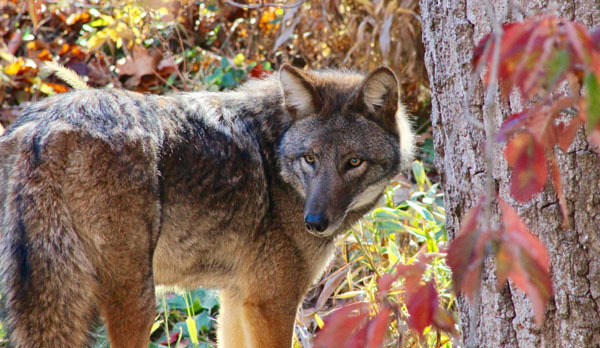
2/10 – Town of LaGrange, HRM 69: Last night after dark, we spotted a very large coyote on Bushwick Street in LaGrange. I moved here in 2015 from California and I am very familiar with coyotes. They were seemingly everywhere in the San Francisco Bay Area. The coyote we saw last night was far larger than any of the coyotes we used to see in California. [This was likely an eastern coyote (Canis latrans var.), a variety of coyote that grows to a larger size and often has darker fur than is generally associated with the species. Researchers studying the genes of coyotes in the Northeast have found evidence that these larger coyotes are in fact, coyote-wolf hybrids (Canis latrans x C. lupus), carrying both wolf and coyote DNA. The findings may explain why some coyotes in the East are generally larger than their Western counterparts – that is, more wolf-like in size – and why they are so much more varied in coat color, as might be expected from a creature with a more diverse genome. As a result, we coyote fans like to refer to them as “woyotes.” Tom Lake] 2/11 – Hudson River Watershed: Winter is one of the best seasons to observe wildlife, especially birds. Keeping in mind that winter is a stressful time for birds, for tips on how to observe them and other wildlife in a legal, safe manner that does not harm or harass them, visit DEC’s website (www.dec.ny.gov/outdoor/112582.html). For a DEC press release, click on http://www.dec.ny.gov/press/112637.html. 2/12 – Town of Colonie, HRM 157: I counted four Iceland gulls this morning among a cluster of about 300 gulls on the Mohawk River at the Crescent Bridge. A little farther down the river on the Cohoes-Crescent Road, I found a glaucous gull among another cluster of gulls.
2/12 – Croton Bay, HRM 34-33: From the Metro North 11:00 a.m. local commuter train to Manhattan, I counted 31 bald eagles on Croton Bay, 25 on broken ice floes and six perched in a tree. I estimated that two-thirds of them were immatures. 2/12 – Westchester County, HRM 30: On our second-Monday Saw Mill River Audubon bird walk this morning, we saw an interesting movement of 19 black vultures at Rockefeller State Park Preserve. Twelve were drifting together north and the others were perched around the park’s Swan Lake. There have been good numbers of black vultures with the turkey vultures in a night roost five miles upriver near Croton-on-Hudson but not as many recorded here in the last couple of months. We watched as six snow geese flew over heading northwest, and the song sparrows and cardinals were singing their spring songs. 2/13 – Saratoga County, HRM 200: I counted 29 bird species this morning as I made the Northumberland farmland ramble, zigzagging back and forth. There were mixed horned larks and snow buntings in many locations. I also counted 34 common goldeneye with much courting going on. Where there were only drakes, they seemed to practice their moves on each other. 2/13 – Hoosic River, HRM 172: I spotted two greater white-fronted geese within a flock of Canada geese along the Hoosic River in Schaghticoke. Bald eagles kept flying past them, but they never moved away.
2/14 – Hudson Valley: Eagle courtship is usually, but not exclusively, performed by breeding pairs in the days and weeks before the spring nesting season. We have tried to use simple words to describe this behavior with little success. We have described their aerial performance of grace and symmetry as “sky dancing.” On a long-ago Valentine’s Day at Verplanck, we watched a courtship display over the river in a snow squall. Through a small break in the clouds came a shaft of sunlight and we watched that pair perform as though they were dancing on a sunbeam. On a Valentine's Day dawn at New Hamburg a few years ago, my wife and I watched a pair of eagles shadow each other high over the ice with loop-de-loops and wing-touches. At the apex of a long arc in the sky they locked talons – one turned on its back in the air, the other mirrored it from above – and they went into a free-fall for more than a hundred feet before releasing and flaring out over the ice. At the climax of each acrobatic move they fell away in synchronized flight – flap-flap-glide – both wheeling and banking away in perfect form. It was like an exquisite ballet performance. At times, they flew so close to each other that they cast only one shadow, drifting across the limestone face of Cedarcliff. Their effortless yet powerful wing beats moved them through the air as a single bird, communicating more through instinct than any utterance. 2/14 – Town of Poughkeepsie: The adult pair at bald eagle nest NY62 were vocalizing more than usual on Valentine’s Day morning. The female (Mom) repeatedly called for the male (DAD) and he responded by bringing in a fish and nesting material. Then we gave a collective “a-h-h-h” as they mated – quite appropriate for the day. [Some readers might wince with our designating breeding male and female bald eagles as “Mom” and “Dad,” and describing their behavior in terms of human behavior. These are wild animals and while such roles seem to mimic our own, we recognize that they see the process in ways we cannot imagine. Still, it offers a comfortable frame of reference. - Tom Lake]
2/15 – Hyde Park, HRM 82: As I watched the various birds at the bird feeders this morning as well as some gray squirrels on the ground, a chipmunk showed up to feed on the bird seed. That seemed early for a chipmunk. Forget the groundhog seeing his shadow, I'm convinced my chipmunk was a more reliable indicator that spring is close. Yesterday I was treated to a mink on my property near the Fallkill Creek. It scurried into a pile of saplings I had taken down in the summer. 2/16 – Mohawk River, HRM 157: There were hundreds of blackbirds in the flooded fields on Niska Isle this morning. They included at least 400 red-winged blackbirds, six common grackles, and two calling rusty blackbirds. Hungry robins were eating the sumac bobs along the bike path. I also listened to a starling do a spot-on imitation of an eastern meadowlark’s “spring-is-here” song. [Niska Isle is a peninsula along the Mohawk River in the town of Niskayuna. Niska Isle was a highly defensible hillock for native peoples, located at the junction of the Lisha Kill and Mohawk River and may have been the site of an Indian village (probably Haudenosaunee). A trail led from the Indian village to the Norman’s Kill and Helderberg Escarpment, the location of well-known quarries and hunting grounds. Tom Lake] 2/16 – Dutchess County, HRM 77: As I was driving on Salt Point Turnpike I caught sight of a very white bird in a corn field. I slowed down – this season we're all on the lookout for snowy owls. It was a single snow goose in a flock of at least 30 Canada geese no more than 30 feet off the road. At this point on the road there are corn fields on one side and a cow farm on the other. Often a single snow goose means a left-behind bird due to injury or illness. However, this one appeared to be fit enough, poking around in the cornfield. 2/16 – Manhattan, HRM 1: Under cloudy skies and in relatively warm air, we checked our collection gear in Hudson River Park at The River Project's sampling station on the lighthouse tender Lilac at Pier 25. Checking our fish traps, we were greeted by an assemblage of crustaceans: amphipods, isopods, grass shrimp (Palaemonetes sp.), mud crabs, and a few adorable juvenile spider crabs!
Saturday, February 24 - 1:00 p.m. Saturday, March 3 - 5:00 - 8:00 p.m. Wednesday, March 14 - 5:00 - 8:00 p.m. HUDSON RIVER MILES The Hudson is measured north from Hudson River Mile 0 at the Battery at the southern tip of Manhattan. The George Washington Bridge is at HRM 12, the Tappan Zee 28, Bear Mountain 47, Beacon-Newburgh 62, Mid-Hudson 75, Kingston-Rhinecliff 95, Rip Van Winkle 114, and the Federal Dam at Troy, the head of tidewater, at 153. The tidal section of the Hudson constitutes a bit less than half the total distance – 315 miles – from Lake Tear of the Clouds to the Battery. Entries from points east and west in the watershed reference the corresponding river mile on the mainstem. TO CONTRIBUTE YOUR OBSERVATIONS OR TO SUBSCRIBE The Hudson River Almanac is compiled and edited by Tom Lake and emailed weekly by DEC's Hudson River Estuary Program. Share your observations by e-mailing them to trlake7@aol.com. To subscribe to the Almanac (or to unsubscribe), use the links on DEC's Hudson River Almanac or DEC Delivers web pages. Discover New York State Conservationist - the award-winning, advertisement-free magazine focusing on New York State's great outdoors and natural resources. Conservationist features stunning photography, informative articles and around-the-state coverage. Visit the Conservationist webpage for more information. USEFUL LINKS National Oceanic and Atmospheric Administration online tide and tidal current predictions are invaluable when planning Hudson River field trips. For real-time information on Hudson River tides, weather and water conditions from twelve monitoring stations, visit the Hudson River Environmental Conditions Observing System website. Information about the Hudson River Estuary Program is available on DEC's website at http://www.dec.ny.gov/lands/4920.html. Smartphone app available for New York outdoor enthusiasts! Copies of past issues of the Hudson River Almanac, Volumes II-VIII, are available for purchase from the publisher, Purple Mountain Press, (800) 325-2665, or email purple@catskill.net |
 Hudson River Almanac
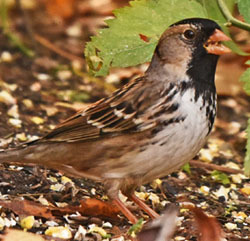 2/16 – Albany County, HRM 143: While walking along Meadowdale Road (Guilderland) this morning, surveying for the Great Backyard Bird Count, we happened upon a Harris’s Sparrow. We knew what it was immediately despite having seen only one previously in Saratoga County in May 1998. This one was in non-breeding plumage with a small black bib and black on the crown up to the peak. The large, pink bill really stood out. It was a truly handsome bird! There were a few American tree sparrows and white-throated sparrows about, but the Harris’s did not seem to be directly associating with them. (Photo of Harris Sparrow courtesy of Scott Stoner)
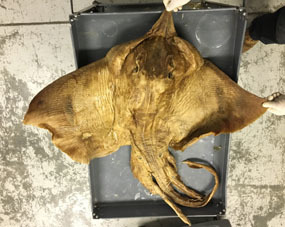 The mystery was solved today. Bob Schmidt, Bryan Weatherwax, and Jeremy J. Wright opened a stainless-steel tank and were surprised to discover that a large skate was squeezed inside. When they accessed the computer records, they discovered that this specimen was the barndoor skate that Jack Johnson caught in 1932. The barndoor skate specimen was a male, measuring 55-inches total length. Schmidt, Weatherwax, and Wright view this specimen as evidence that a barndoor skate was collected in the freshwater tidal portion of the Hudson River in vicinity of North Albany. (Photo of barndoor skate courtesy of Jeremy Wright)
 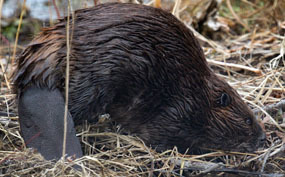 2/12 – Dutchess County, HRM 96: We checked on the beavers at Thompson Pond today. It seemed that we were not the only ones with “cabin fever.” The Thompson Pond beaver family seems to always have an opening in the ice no matter how frozen the rest of the pond is and they remain active during the winter. They were active today working on their lodge, feeding, and entertaining us especially with the slapping of their tails! (Photo of beaver courtesy of Deb Tracy-Kral)
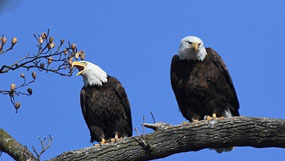 2/13 – Town of Poughkeepsie: Nest NY62 continued to be the best bald eagle show in town. The two adults were very active in mid-afternoon still refurbishing their nest, an activity that has been ongoing since early December. They gave us a real treat by perching side-by-side on a branch a few feet above their nest as they enjoyed the warm afternoon sun. (Photo of bald eagles at NY62 courtesy of Dave Tryon)
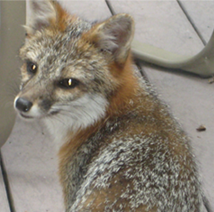 2/14 – East Fishkill, HRM 66: We had a visit tonight from a beautiful gray fox. We had not seen one here in a year and it was a break from all the red foxes we have had in our yard this winter (we are hoping the red foxes will have kits). The gray fox was checking out the food I had put out for the birds, as do the opossums and raccoons. The fox had no tail and I hate to think what had happened to it. Other than its lack of a tail, the fox looked very healthy. All the foxes look so beautiful against the white snow. (Photo of gray fox courtesy of Diane Anderson)
|
The New York State Department of Environmental Conservation respects your right to privacy and welcomes your feedback. | Update preferences or unsubscribe. | Learn more about DEC Delivers. |
|
Connect with DEC:   
|
 |
| NOW AVAILABLE: Receive DEC's Twitter feed via email. | |
| Andrew M. Cuomo, Governor * Basil Seggos, Commissioner | |