Hunting and Trapping News: Big Game Update
The New York State Department of Environmental Conservation sent this bulletin on 09/05/2017 02:07 PM EDT |
| DEC Delivers - Information to keep you connected and informed from the NYS Department of Environmental Conservation |
| Share or view as a web page || Update preferences or unsubscribe |
Big Game Update: Early Bear Seasons, Deer Health, and Deer Hunting |
Early Bear Hunting Seasons Begin in September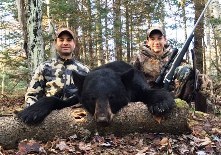 The early bear season runs from September 9 to September 24 in portions of southeastern NY, including Wildlife Management Units (WMUs) 3A, 3C, 3H, 3J, 3K, 3M, 3P, 3R, 4P, and 4R. The early bear season runs from September 9 to September 24 in portions of southeastern NY, including Wildlife Management Units (WMUs) 3A, 3C, 3H, 3J, 3K, 3M, 3P, 3R, 4P, and 4R.
In northern New York, the early bear season runs from September 16 to October 13 in WMUs 5A, 5C, 5F, 5G, 5H, 5J, 6C, 6F, 6H, and 6J. With abundant apples, late ripening corn, and good hard mast crops across the state, bears will tend to cluster around these concentrated food sources. Early season bear hunters will do well to focus on areas where bears are feeding heavily. Hunters should skin and cool harvested bears as soon as possible to protect the quality of the meat and may consider skinning and quartering the bear in the field and packing out the meat in game bags. See Black bear Hunting in New York for season dates and regulations. DEC’s booklet Hunting the Black Bear in New York (PDF, 800 KB) includes tips on bear hunting and proper care of harvested bears. Help DEC Monitor Deer HealthTo date, Epizootic Hemorrhagic Disease (EHD) has not been reported in New York deer this year but has recently been detected in seven eastern states: PA, OH, VA, KY, TN, WV, and NC. EHD was previously confirmed in New York in 2007 and 2011. EHD is transmitted from animal to animal by bites of infected midges. Outbreaks tend to occur in late summer and early fall before the onset of frost and may affect only a few animals or result in localized pockets of high deer mortality. Fever and edema are common, and deer with EHD often have swollen heads, necks, tongues, or eyelids. Deer die quickly--within 8 to 36 hours. Fever causes deer to seek out water, so that dead deer may be found near or in water. EHD does not infect humans. Please report any observations of sick deer or groups of dead deer to your local DEC regional wildlife office. Deer Are Getting Ready for Fall – Are You?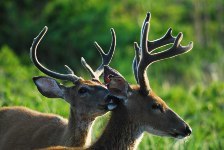 The shortening day length triggers hormonal responses in antlered bucks that cease antler growth and begin the antler hardening process. Cooler temperatures also mean that deer need to fatten up and grow their winter coat to maintain body temperature. Now is a good time to inventory food resources to determine what will be available for food in the upcoming months. Fall food plots and standing agricultural crops provide high quality forage, making them attractive places for deer to feed. However, GPS studies have shown that deer may avoid these areas during daylight hours with as few as 2 to 3 hunts, so give yourself some options as you set your stands and plan your hunting spots. If mast crops are abundant in your hunting area, seeing deer may be more difficult, as deer may not need to travel very far to find food. The shortening day length triggers hormonal responses in antlered bucks that cease antler growth and begin the antler hardening process. Cooler temperatures also mean that deer need to fatten up and grow their winter coat to maintain body temperature. Now is a good time to inventory food resources to determine what will be available for food in the upcoming months. Fall food plots and standing agricultural crops provide high quality forage, making them attractive places for deer to feed. However, GPS studies have shown that deer may avoid these areas during daylight hours with as few as 2 to 3 hunts, so give yourself some options as you set your stands and plan your hunting spots. If mast crops are abundant in your hunting area, seeing deer may be more difficult, as deer may not need to travel very far to find food.
Here are some wild foods to look for while scouting:
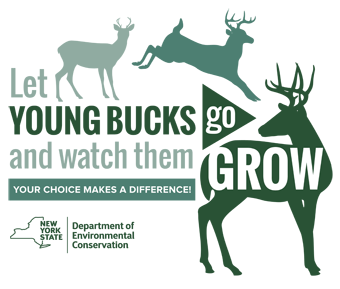
As you observe deer in coming weeks and anticipate your fall hunts, remember that the decisions you make this year will affect your harvest options in the future. When you and your hunting companions choose to Let Young Bucks Go, you’ll have greater opportunity to see and take older, larger bucks. For NY bucks to get bigger bodies and larger antlers, they simply need to get older. Your choice makes a difference!
|
|
The New York State Department of Environmental Conservation respects your right to privacy and welcomes your feedback. | Update preferences or unsubscribe. | Learn more about DEC Delivers. |
|
Connect with DEC:   
|
 |
| NOW AVAILABLE: Receive DEC's Twitter feed via email. | |
| Andrew M. Cuomo, Governor * Basil Seggos, Commissioner | |