
Hudson River Almanac 8/12/17 - 8/18/17
The New York State Department of Environmental Conservation sent this bulletin on 08/25/2017 03:57 PM EDT |
| DEC Delivers - Information to keep you connected and informed from the NYS Department of Environmental Conservation |
| Share or view as a web page || Update preferences or unsubscribe |
|
|
This week featured sightings of two rather rare creatures - a sandpiper and a lizard. The late-summer flight of the nighthawks seems to have begun and the shorebird migration picked up its pace as well. HIGHLIGHT OF THE WEEK
[The northern fence lizard (Sceloporus undulatus) is listed as a threatened species in New York State and is only known from a few sites in the lower Hudson Valley. By comparison, five-lined skinks are much more widespread. This sighting represents a new location and is a very important record. The new location will be passed along to the New York Natural Heritage Program whose mission is to facilitate conservation of New York's biodiversity by providing comprehensive information and scientific expertise on rare species and natural ecosystems to resource managers and other conservation partners. Jesse Jaycox.] NATURAL HISTORY NOTES 8/12 – Cohoes, HRM 157: There were more shorebirds early this morning at the Cohoes Flats than I ever recall seeing there. Lesser yellowlegs, semipalmated plovers, and least sandpipers had double digit counts. Also mixed in were semipalmated sandpipers, pectoral sandpipers, solitary sandpipers, greater yellowlegs, and killdeer. They were all viewable right from the shore at Falls View Park. 8/12 – Yonkers, HRM 18: Our Nyack College Fishing Club Research Squad began our day this morning at the Center for the Urban River at Beczak. In our ongoing study of catch-per-unit-of-effort, we made a dozen seine hauls and caught six species of fish and four species of invertebrates. Among the fish were Atlantic silverside, northern pipefish, and young-of-the-year [YOY]) bluefish, striped bass, and Atlantic menhaden. Among the invertebrates were blue crabs, shore shrimp, sand shrimp, and comb jellies. The river was 76 degrees Fahrenheit and the salinity was 12.0 parts-per-thousand [ppt]. [Atlantic needlefish (Strongylura marina) are a saltwater species that has been able to adapt to inshore waters to the point where, defying their literature, they have spawned in freshwater. A while ago, a larval or post-larval Atlantic needlefish was caught by Steve Stanne in freshwater at Kingston (river mile 92). That fish was of a size that suggested it was only a week or two old. A good indication as to how dynamic their presence is in the estuary, in his Biological Survey of the Lower Hudson Watershed (1937), J.R. Greeley calls the Atlantic needlefish “rare,” and notes that they “spawn in saltwater.” Needlefish are often found on the surface where they do line-of-sight predation with their long, tooth-studded jaws. They have a ventrally-adjusted lateral line that allows them to be directly on top and still maintain use of this sensory organ. Tom Lake.] 8/13 – Germantown, HRM 108: Monarch butterflies were definitely on the move. I saw my first a couple of weeks ago and now I am getting them regularly on the Columbia/Dutchess County border.
8/13 – Constitution Marsh, HRM 52: It was a perfect day for a canoe trip in the marsh with a guide from the Audubon Center. The tide was nearly high in late afternoon when we put in on Indian Brook. Across two hours on the water we saw a great egret and a great blue heron fishing and an osprey perched on a deadfall overlooking the water. We were delighted by the many plants that were in bloom: Along the brook we saw yellow cutleaf coneflowers, monkey flowers, and water hemlock. Among the narrow-leaved cattails, the dominant flora in the marsh, were many big rose mallows and wild rice (Zizania aquatica) in its various stages of flowering. Mild water-pepper was blooming as well, and lots of pickerel-weed, but arrow-arum was finished. We saw a lot of spatterdock but did not get close enough to see if they had any flowers. The real treat was the truly weird flowers of common broad-leaved arrowhead (Sagittaria latifolia). Its green spheres are not fruit, they are the carpels (seed-bearing structures, the innermost whorl of a flower); the stamens are in the part that looks like a flower. 8/13 – Piermont, HRM 25: On a morning walk at Piermont Pier just after low tide, I spotted seven diamondback terrapins basking on the rocks of the breakwater. They varied in size and at least three were relatively large; I was able to see the pale “beak” on the larger ones. Female terrapins can get to be more than seven inches carapace length. Also notable were two common terns, an adult and a begging juvenile. [The diamondback terrapin (Malaclemys terrapin) is a turtle of salt to brackish water coastal marshes from Cape Cod to Chesapeake Bay. Their common name comes from the diamond-shaped rings on its carapace. There is a remnant population in the estuary at Piermont Marsh (river mile 25) and they have been reported as far upriver as Verplanck (river mile 40). There are population in Jamaica and Raritan bays that may recruit or exchange individual terrapins. The Piermont population has been threatened in recent times due to habitat loss. Tom Lake.] 8/14 – Green Island, HRM 153.4: It is always nice to see a new face in the net, one that we rarely see in the Hudson River below Albany County. We hoped for river herring as another step in discovering what the young-of-the-year were up to, but caught none. The only fishes that found their way into our net on every haul were spotfin shiners (86-92 millimeters) and spottail shiners. The river was a delightful 76 degrees F. [The spotfin shiner (Cyprinella spiloptera) is a non-native minnow. They are very common in the Mohawk River. Being native to the Mississippi River watershed, it is likely they made their way to the Hudson from the Great Lakes, at least in part, via the Erie and Barge Canals. Tom Lake.] 8/14 – Palisades, HRM 23: This morning I watched two juvenile five-lined skinks climb up the sunny east side of my office building at the Lamont-Doherty Earth Observatory. They were barely three inches long with bright blue tails. Earlier in the morning my colleague had to liberate one from another colleague's office. [Five-lined skinks (Plestiodon fasciatus) are small lizards, less than nine inches long, and are not rare in the lower Hudson Valley. The bright blue tail of the immature five-lined skink may serve as a survival strategy: Predators grabbing the skink by its colorful tail will find that it breaks off; the skink escapes and eventually regenerates another. Tom Lake.] 8/14 – Manhattan, HRM 1: We checked our collection gear in Hudson River Park during an early afternoon high tide at The River Project's sampling station on the lighthouse tender Lilac at Pier 25. Our crab pots had three tautog 185-210 millimeters [mm] long, a black sea bass (180 mm), and three female blue crabs, two of which were gravid (with eggs). As we hauled up the killifish trap, we grabbed a lined sea horse (85 mm) that was clinging to the side. Inside the trap were YOY skilletfish (10 mm) and oyster toadfish (20 mm).
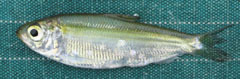
[The stilt sandpiper (Calidris himantopus) is an Arctic breeder that winters in South America. We see them only in migration and, in this instance, the late summer shorebird migration. Tom Lake,] 8/15 – Stockport Creek, HRM 121.5: 8/15 – Croton-on-Hudson, HRM 34: On the road to Teatown Lake, I came upon three crows harassing an adult red-tailed hawk and her two fledglings. The adult hawk chased the crows, cutting through the canopy of trees with knife blade precision until out of sight. The fledglings perched stock-still in tree branches, crying out forlornly for five minutes, then flew tree-to-tree in the direction of where the adult hawk had given chase. I cannot recall seeing red-tailed hawks chasing off crows; I assumed the fledglings raised the stakes. 8/16 – Cohoes, HRM 157: The stilt sandpiper, two short-billed dowitchers, a pectoral sandpiper, a possible Wilson's phalarope, and many yellowlegs and “peeps” were still present this morning at Falls View Park. Cohoes. [“Peeps” is a collective noun describing five small and closely related sandpipers whose identities can be difficult to determine, requiring careful study of subtly different field marks and behaviors. The term is sometimes more loosely applied to include other small shorebirds. Tom Lake.] 8/16 – Beacon, HRM 61: Our desire to know “what was out there” was never stronger as we waded into the warm river (80 degrees F) with our 85-foot seine. We made only a single, long haul, but as the net neared the beach we knew that we would not be able to slide it up on the sand. The bag was bulging with YOY fishes, easily hundreds, some so small they were squeezing out, escaping through the quarter-inch mesh. To limit mortality (river herring are extremely fragile), we held the seine in six inches of water, checked them over to see if they were all known species and that number 228 was not lurking in the folds, selected a represented sample of 40 fish, and then spilled the bag open to let them all escape. The small percentage that did not make it would be lunch for the blue crabs. There were striped bass (47-55 mm) and river herring, the latter a mix of alewives (48-49 mm) and lots of blueback herring (35-49 mm). If what we think we know is true, in four years we should have a bumper crop of spawning adult blueback herring in the Hudson River. [Photos of YOY alewife (L - big eye, deep body) and YOY blueback herring (R - smaller eye, slender body) courtesy of Steve Stanne.]
8/16 –Manhattan, HRM 2: During a midday flood tide we checking our collection gear at The River Project’s Pier 40 research site. A crab pot yielded an adult oyster toadfish as well as two female blue crabs. We've caught more "sooks" (female blue crabs) than usual in the past few weeks, presumably due to mating season. Our killifish traps contained five YOY oyster toadfish. [Blue crabs have several colloquial names known mainly to crabbers: Adult males are called “Jimmys,” mature females are called “Sooks,” and immature females are known as “Sallys.” Tom Lake.] 8/16 – Manhattan, HRM 1: We checked our collection gear during a late morning low tide in Hudson River Park at The River Project's sampling station on the lighthouse tender Lilac at Pier 25. The catch was impressive: Our four crab pots had two tautog (235, 250 mm), a gravid female blue crab, and a large male blue crab (135 mm). The killifish traps held many YOY fishes including three skilletfish (10-15 mm), oyster toadfish (20 mm), and three gobies (10-15 mm). The gobies were still too small for us to accurately distinguish them as seaboard or naked gobies. 8/17 – Catskill, HRM 114: I saw my first common nighthawk flyover of the season at dusk with a dozen birds putting on a show for a half-hour. Flying at the same time were at least three dozen chimney swifts. [The common nighthawk (Chordeiles minor) is a medium-sized crepuscular or nocturnal bird within the nightjar family, whose presence and identity are best revealed by its vocalization. Their southward migration intensifies in late August. Rich Guthrie.] 8/17 – Manhattan, HRM 2: During a late-afternoon flood tide, we checked our sampling gear at The River Project's research site at Pier 40. A crab pot held a female blue crab and an adult oyster toadfish. Our killifish traps had seven YOY gobies (still too small to positively identify as to species) and five small oyster toadfish. 8/17 – Manhattan, HRM 1: We checked our collection gear during a mid-day low tide in Hudson River Park at The River Project's sampling station on the lighthouse tender Lilac. Our killifish traps had captured a YOY striped bass (80 mm) and another tiny goby (10 mm). In a crab pot we found an adult tautog (320 mm). 8/18 – Albany County, HRM 136: I was kayaking this afternoon a mile north of Henry Hudson Park when I spotted an adult bald eagle dipping down into the water for a fish. As it flew off, the eagle moved the fish from one foot to the other. Later, I came upon three bald eagles, an adult and two immatures. The adult was standing in the water and the two immatures (probably its offspring) were on the beach working on an earlier catch. 8/18 – Beacon, HRM 61: We were back on the beach looking for YOY blueback herring. We hauled our seine over and over with not a single blueback to show for it; the large school of young-of-the-year from two days ago had moved on. We did catch YOY striped bass (61-72 mm) as well as American shad (65-82 mm). The river was 79 degrees F and the salinity was about 2.0 ppt. [This has been a very unusual and confusing year for blueback herring. Small bluebacks (38-39 millimeters) were caught in the East River in early June; larger ones (51-66 mm) were caught in mid-June at Croton Point – a reversal of what you might expect given their spawning reach far up the Hudson River. Were any of these from the Mohawk River? Or were they from other tributaries (e.g., Rondout Creek) closer to Croton Point or the East River? Or were blueback herring spawning in places that we were not aware of? Tom Lake.] 8/18 – Denning’s Point, HRM 60.5: Acres of water chestnut covered the cove on the north (upriver) side of Denning’s Point. The huge and incredibly thick green mat was providing a hunting stage for wading birds. With 10x50 binoculars, we counted 18 great egrets, four great blue herons, and two green herons stalking the shallows for the multitude of small fish swimming underneath. [By the next morning, the entire contingent of wading birds was gone.] [Deborah Tracy-Kral and Rich Guthrie describe these congregations of late-summer wading birds as post-breeding wanderings. Carena Pooth counted 25 great egrets here two days ago. Tom Lake.] SUMMER 2017 NATURAL HISTORY PROGRAMS Saturday, September 16: 2:00 PM HUDSON RIVER MILES The Hudson is measured north from Hudson River Mile 0 at the Battery at the southern tip of Manhattan. The George Washington Bridge is at HRM 12, the Tappan Zee 28, Bear Mountain 47, Beacon-Newburgh 62, Mid-Hudson 75, Kingston-Rhinecliff 95, Rip Van Winkle 114, and the Federal Dam at Troy, the head of tidewater, at 153. The tidal section of the Hudson constitutes a bit less than half the total distance – 315 miles – from Lake Tear of the Clouds to the Battery. Entries from points east and west in the watershed reference the corresponding river mile on the mainstem. TO CONTRIBUTE YOUR OBSERVATIONS OR TO SUBSCRIBE The Hudson River Almanac is compiled and edited by Tom Lake and emailed weekly by DEC's Hudson River Estuary Program. Share your observations by e-mailing them to trlake7@aol.com. To subscribe to the Almanac (or to unsubscribe), use the links on DEC's Hudson River Almanac or DEC Delivers web pages. Discover New York State Conservationist - the award-winning, advertisement-free magazine focusing on New York State's great outdoors and natural resources. Conservationist features stunning photography, informative articles and around-the-state coverage. Visit the Conservationist webpage for more information. USEFUL LINKS National Oceanic and Atmospheric Administration online tide and tidal current predictions are invaluable when planning Hudson River field trips. For real-time information on Hudson River tides, weather and water conditions from twelve monitoring stations, visit the Hudson River Environmental Conditions Observing System website. Information about the Hudson River Estuary Program is available on DEC's website at http://www.dec.ny.gov/lands/4920.html . Smartphone app available for New York outdoor enthusiasts! Copies of past issues of the Hudson River Almanac, Volumes II-VIII, are available for purchase from the publisher, Purple Mountain Press, (800) 325-2665, or email purple@catskill.net |
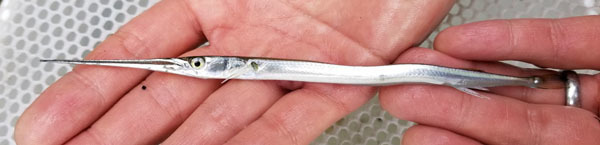
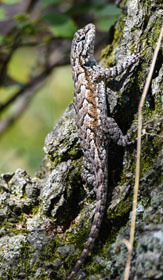 8/13 – Westchester County, HRM 46: While hiking in the Hudson Highlands at midday, I came upon a northern fence lizard perfectly camouflaged on a rock face. [Photo of northern fence lizard courtesy of Steve Rappaport.]
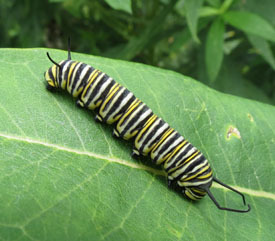 8/13 – Putnam County, HRM 54: I was hiking in Fahnestock State Park with some friends when we spotted a monarch butterfly. In past years they were so common that we barely found them noteworthy to mention. We started checking the common milkweed (Asclepias syriaca), one of the host plants for monarch butterflies, and did find a monarch caterpillar, about two inches long. It would soon be going into its chrysalis stage later to emerge as a butterfly. [Photo of monarch butterfly caterpillar courtesy of Jim Steck.]
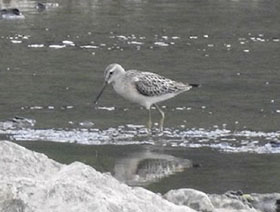 8/15 – Cohoes, HRM 157: I spotted two each of short-billed dowitcher and pectoral sandpiper at the Falls View Park overlooking the Cohoes Flats. However, one of the short-billed dowitchers was acting more like a stilt sandpiper. [It was, in fact, a stilt sandpiper; the last record of a stilt sandpiper in Albany County was in 2013, at Cohoes Flats, by Ramona Bearor. [Photo of stilt sandpiper courtesy of Zach Schwartz-Weinstein.]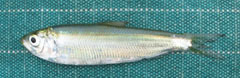
|
The New York State Department of Environmental Conservation respects your right to privacy and welcomes your feedback. | Update preferences or unsubscribe. | Learn more about DEC Delivers. |
|
Connect with DEC:   
|
 |
| NOW AVAILABLE: Receive DEC's Twitter feed via email. | |
| Andrew M. Cuomo, Governor * Basil Seggos, Commissioner | |