
Hudson River Almanac 8/5/17 - 8/11/17
The New York State Department of Environmental Conservation sent this bulletin on 08/18/2017 06:41 PM EDT |
| DEC Delivers - Information to keep you connected and informed from the NYS Department of Environmental Conservation |
| Share or view as a web page || Update preferences or unsubscribe |
|
|
This week featured the Hudson River Estuary Program’s sixth annual Great Hudson River Fish Count. Events such as these provide a great venue for education as well as creating an enthusiastic constituency for protecting the dynamic Hudson-Mohawk River watershed. HIGHLIGHT OF THE WEEK
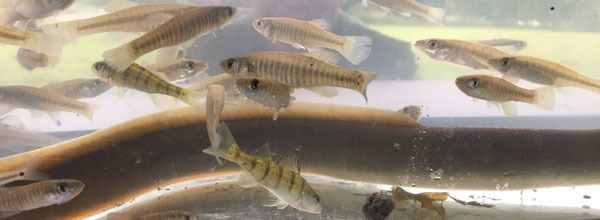
[Many populations of timber rattlesnake (Crotalus horridus) have been depleted or extirpated due to human persecution, collection, and habitat loss, which is why they are listed as a New York State Threatened Species. Because of this, entries such as this one are intentionally left vague other than to note its general presence in an area. Currently, the timber rattlesnake ranges as far north as Essex County. Jesse Jaycox.] NATURAL HISTORY NOTES 8/5 – Saratoga County, HRM 158: DEC Regions 4 and 5 Fisheries staff sampled the Hudson River fish community for the Sixth Annual Great Hudson River Fish Count. We sampled at the confluence of the Hudson and Mohawk rivers at Peebles Island, where the NYS Office of Parks, Recreation, and Historic Preservation offers great shoreline access, and from Waterford upriver to the Champlain Canal Lock C-1. [The bowfin (Amia calva) is an ancient and rugged predator species in the taxonomic realm of sharks and sturgeon. Its order (Amiiformes) arose in the Triassic Period (250 million years ago); its family (Amiidae) is known from the Cretaceous (100 million years ago). The bowfin lineage has endured many global cataclysms and carries an adaptation from those times through an ability to breathe atmospheric oxygen using the swim bladder to survive in waters with very low dissolved oxygen. The bowfin is a native species and occurs throughout the lowlands of the eastern United States. Scott Wells notes that bowfin are now well established in the upper Hudson River, having possibly migrated down the Hudson-Champlain Canal from Lake Champlain, and have extended their range downriver to at least Greene County. Tom Lake.] 8/5 – Schodack Island State Park, HRM 135: People nearly outnumbered fish at today’s Great Hudson River Fish Count. Of the 56 fish captured in our seine at low tide, 31 of them were young-of-the-year [YOY] herring. It was just two days shy the full moon, known as the Sturgeon Moon, but alas, there were no sturgeon in our net.
8/5 – Kingston, HRM 92: We made three seine hauls at Kingston Point Beach today as our contribution to the Great Hudson River Fish Count. As expected, young-of-the-year fishes dominated including American shad, mixed river herring, striped bass, and a small hogchoker (50 mm). We also caught two blue crabs; one was a female (100 mm), a very uncommon find this far from brackish water. 8/5 – Kowawese, HRM 59: We drew a nice crowd to the beach for the Great Hudson River Fish Count. As was the case elsewhere, young-of-the-year fishes dominated the catch, which included American shad (62-70 mm), alewives (57-59 mm), striped bass (42-45 mm), and also blueback herring (34-47 mm). The conversation fish was a hybrid sunfish – bluegill x pumpkinseed – carrying field marks of both species, the former introduced, the latter a native species. The river was 80 degrees F. 8/5 – Little Stony Point, HRM 55: A warm westerly breeze was blowing off Storm King, pushing rollers up on the beach and dousing the seine haulers. The comfortable water (79 degrees F) rewarded us for leaving our chest waders at home. In three hauls of our net, with the assistance of young and not-so-young, we collected 99 fish for the Great Hudson River Fish Count. There was a preponderance of young-of-the-year fishes including American shad (58-68 mm), alewives (60-64 mm), and striped bass (45-77 mm). 8/5 – Sleepy Hollow, HRM 28: Forty river enthusiasts came to enjoy an afternoon on the Hudson at Kingsland Point Park and to help Teatown Lake Reservation and Strawtown Art Studio sample the river for the Great Hudson River Fish Count. In 22 hauls of our seine, we caught seven species including YOY striped bass, white perch, banded killifish, Atlantic silversides, northern pipefish, a largemouth bass, an American eel, and two blue crabs, one of which was beginning to moult. Perhaps most special moment of all was when a bald eagle flew low over us as we fished. The water temperature was 80 degrees F, with salinity at 3.0 parts-per-thousand [ppt]. 8/5 – Piermont, HRM 25: For the Great Hudson River Fish Count we sampled three different locations, starting at our usual spot, “Duck Pond.” This stop produced a nice mix of fish and other aquatic life including YOY striped bass, mummichogs (killifish), and Atlantic silversides. Of the 15 blue crabs we caught, three were females – one was a softshell and the two others moulted while in our bucket. Added to the catch were comb jellies, shore shrimp, and a moon jellyfish. On the south side of the pier we caught more striped bass as well as a pair of “doublers” [mating] blue crabs. From a third location, anglers showed us their rod and reel catch of white perch, channel catfish, and small bluefish. The river was 79 degrees F and the salinity was 5.0 ppt. 8/5 – Brooklyn, New York City: Visitors who came out to Brooklyn Bridge Park for the Park Conservancy’s Great Hudson River Fish Count had many fish to count! Over the course of 17 seine hauls, we caught tautog/blackfish, winter flounder, and northern pipefish, as well as YOY blueback herring, alewife, striped bass, cunner, and northern kingfish. Non-fish included blue crabs, shore shrimp, sand shrimp, and a plethora of moon jellyfish and comb jellies. 8/6 – Manhattan, HRM 25: Our Director of Education, along with 38 visitors, led our contribution to the Hudson River Fish Count in Hudson River Park at The River Project's sampling station on the lighthouse tender Lilac at Pier 25. We were rewarded with quite a catch: one large and one medium-size tautog/blackfish (very blue-black in color), two oyster toadfish, and one each butterfish, skilletfish, and feather blenny. [Feather blenny (Hypsoblennius hentz), a tropical marine stray, is a small, scaleless fish with fleshy cirri (“feathers”) on their head. Their lower jaw has a row of small, close-set teeth like those of a comb, thus their family name, combtooth blennies (Blenniidae). Blennies are benthic dwellers where they often burrow in the soft bottom or find refuge in old mollusk shells. C. Lavett Smith (1997)]
[Even though muskrats (Ondatra zibethicus) are known chiefly as herbivores (plant eaters), they will eat small fish and shellfish. Along the upper Hudson estuary, they have a colloquial name of “mushrats.” Tom Lake.] 8/7 – Manhattan, HRM 1: Braving heavy rain on a dreary day, we checked our collection gear in Hudson River Park at The River Project's sampling station on the lighthouse tender Lilac at Pier 25. While no fish were found, there was a large assortment of invertebrates including shore shrimp, mud dog whelk snails, sea squirts, oyster drills, baby mud crabs, and amphipods. 8/8 – Hudson River Watershed: Lake sturgeon (Acipenser fulvescens) have been present in adjacent watersheds – Great Lakes, Lake Champlain – for millennia, but as far as we know, not in the Hudson. Since the 1990s, the Oneida Lake Fish Hatchery has stocked lake sturgeon in Oneida Lake, about 13 miles west of Rome, NY, to the point where they are now naturally reproducing. More recently, some immature sturgeon have found their way out of Oneida Lake, probably through the Barge Canal, and have been caught by anglers in the Mohawk River. As a result, they have become species 227 on our watershed fish list. [Note: If you would like an electronic copy (e-mailed as an attachment) of the Hudson River Watershed Fish Fauna Checklist, please request via e-mail.] 8/8 – Manhattan, HRM 1: We went back again today to check our collection gear in Hudson River Park at The River Project's sampling station on the lighthouse tender Lilac at Pier 25. After yesterday’s no-fish result we hoped for something more and found it in two large male blue crabs. One was 110 mm carapace width while the other was a massive 170 mm. We also spotted dozens of baby mud crabs, each only a few millimeters in size. 8/9 – Green Island, HRM 153.4: We were at the federal dam, the head of tide, one of those special places on the estuary where migratory fishes have a choice: swim into the federal lock at Troy to get above, or be satisfied that they made it 165 miles from the sea. We hauled a short seine and caught a short list of fish: tessellated darters, smallmouth bass, and YOY blueback herring (45-55 mm). The river was 75 degrees F. [It was almost certain that the blueback herring we caught were the progeny of adult bluebacks that had chosen the federal lock in May, got above the dam, turned west at Waterford, and then ascended a series of five locks (Waterford Flight) that lifted them 170 feet above the Hudson River to the beginning of the Erie Canal and the Mohawk River. From there, they traveled west perhaps as far as Rome to spawn. In four years, these young-of-the-year will return to the Hudson River as adults and be faced with that same choice. Tom Lake.] 8/9 – West Point, HRM 51-52: We seined three locations (30-foot seine) at West Point today: The South Dock, Gee's Point, and the Crow's Nest delta. Our catches are summarized below: 8/9 – Croton River, HRM 34: I was kayaking near the mouth of the Croton River this evening and found many “fishermen,” both human and avian. Among them were great blue herons, green herons, a black-crowned night heron, and belted kingfishers. Out in the shallows of Croton Bay, four bald eagles, three immatures and one adult, frolicked on a sandbar and an adjacent snag. 8/9 – Piermont, HRM 25: The river was calm this morning heading toward high tide. Three osprey were fishing and several great blue herons were perched on the rocks, pilings, and in trees near the mouth of Sparkill Creek. I counted four Forster's terns, active, vocalizing, and feeding two begging juveniles. Four semipalmated plovers were the only shorebirds in sight, and a lone diamondback terrapin was sunning on the breakwater rocks. 8/9 – Manhattan, HRM 13.5: Along the shore of Spuyten Duyvil Creek plant life was abundant. Bouncing bet and horse nettle (Solanum carolinense) were both still flowering and a patch of white sweet-clover was wonderfully fragrant. Some plants that I’ve seen here, but not in a year or two, were back including flowering common evening-primrose, some big, gorgeous rose mallow flowers, and a few of black nightshade. Saltmarsh grass (Spartina alterniflora) was in full bloom (as that term applies to grasses). 8/9 – Manhattan, HRM 2: A professional development group of teachers, sponsored by the American Museum of Natural History, assisted us in checking our collection gear at The River Project’s Pier 40 research site in Hudson River Park. They met hundreds of sea squirts, amphipods, many shore shrimp, mud dog whelk snails, and one medium sized adult male blue crab. 8/9 – Manhattan, HRM 1: Our interns went out to check our research sampling gear in Hudson River Park at The River Project's sampling station on the lighthouse tender Lilac at Pier 25. They caught one blue crab in a crab pot (125 mm carapace width) but the prize catch was a baby skilletfish (15 mm). [Skilletfish (Gobiesox strumosus) are a small benthos-loving fish somewhat related to gobies and blennies. They find oyster reefs ideal habitat for both forage and safety. Their name comes from a dorsally-flattened body with a large, roundish head that altogether looks like a skillet. Tom Lake.] 8/10 – Cohoes, HRM 157: Our Thursday Birders group visited the Cohoes Flats this morning. The water levels were fluctuating but we still saw lots of open rock [shale bedrock] along the stretch downstream of the Cohoes Falls. We counted at least ten lesser yellowlegs that flew and landed within feet of us. At a distance, we saw semipalmated plovers, least sandpipers, numerous killdeer, and three osprey that peeped overhead. [The Cohoes Falls flow over graywacke (a hard sandstone) and shale, and range from 75-90 feet high. They were carved during the post-glacial draining of glacial Lake Iroquois. Tom Lake.] 8/10 – Manhattan, HRM 1: We checked our research sampling gear at high tide this morning in Hudson River Park at The River Project's sampling station on the lighthouse tender Lilac at Pier 25. The highlight of our catch - two blackfish/tautog (200, 250 mm) in a crab pot. [Tautog (Tautoga onitis) are a rather common, bottom-dwelling fish of New York Harbor. Their colloquial name, “blackfish,” refers to the adults as they attain a deep, coal black color. Among their favorite foods are shellfish that they find in abundance in near-shore rocky areas. In the spirit of “you are what you eat,” blackfish, perhaps owing to their shellfish diet, are one of the most sought after food fishes in the New York Bight. Tom Lake.]
8/11 – Manhattan, HRM 1: Interns and our new Wet-Lab assistant checked our collection gear in Hudson River Park at The River Project's sampling station on the lighthouse tender Lilac at Pier 25. Fish presence has been dwindling recently and today we found none at all. However, we did find a single comb jelly and noted a proliferation of sponges (uncertain as to species) around and in the traps. Last year at this time, we found a huge clump of bright orange red beard sponge (Microciona prolifera) on our traps. TREES FOR TRIBS OFFERS FREE TREES & SHRUBS FOR STREAMSIDE PLANTING Do you own or manage land along a stream? You can apply for free native plants to help reduce erosion and improve habitat along your stream! The Hudson Estuary Trees for Tribs Program offers free native trees and shrubs for planting along the tributary streams in the Hudson River Estuary watershed. Our staff can help you with a planting plan and work with your volunteers. SUMMER 2017 NATURAL HISTORY PROGRAMS Saturday, September 16: 2:00 PM HUDSON RIVER MILES The Hudson is measured north from Hudson River Mile 0 at the Battery at the southern tip of Manhattan. The George Washington Bridge is at HRM 12, the Tappan Zee 28, Bear Mountain 47, Beacon-Newburgh 62, Mid-Hudson 75, Kingston-Rhinecliff 95, Rip Van Winkle 114, and the Federal Dam at Troy, the head of tidewater, at 153. The tidal section of the Hudson constitutes a bit less than half the total distance – 315 miles – from Lake Tear of the Clouds to the Battery. Entries from points east and west in the watershed reference the corresponding river mile on the mainstem. TO CONTRIBUTE YOUR OBSERVATIONS OR TO SUBSCRIBE The Hudson River Almanac is compiled and edited by Tom Lake and emailed weekly by DEC's Hudson River Estuary Program. Share your observations by e-mailing them to trlake7@aol.com. To subscribe to the Almanac (or to unsubscribe), use the links on DEC's Hudson River Almanac or DEC Delivers web pages. Discover New York State Conservationist - the award-winning, advertisement-free magazine focusing on New York State's great outdoors and natural resources. Conservationist features stunning photography, informative articles and around-the-state coverage. Visit the Conservationist webpage for more information. USEFUL LINKS National Oceanic and Atmospheric Administration online tide and tidal current predictions are invaluable when planning Hudson River field trips. For real-time information on Hudson River tides, weather and water conditions from twelve monitoring stations, visit the Hudson River Environmental Conditions Observing System website. Information about the Hudson River Estuary Program is available on DEC's website at http://www.dec.ny.gov/lands/4920.html . Smartphone app available for New York outdoor enthusiasts! Copies of past issues of the Hudson River Almanac, Volumes II-VIII, are available for purchase from the publisher, Purple Mountain Press, (800) 325-2665, or email purple@catskill.net |
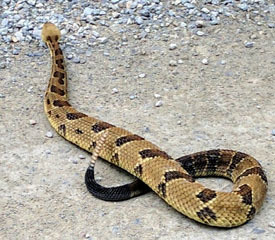 8/6 – Putnam County: Some of our neighbors keep a predatory eye out for them, but I had begun to disbelieve their claims that there were timber rattlesnakes in our immediate neighborhood. Today, finally, I came across a timber rattlesnake in mid-afternoon, stretched out full-length, sunning itself in the middle of the road. Sensing my presence, the snake made a slow and dignified exit. [Photo of timber rattlesnake courtesy of Will Vogel.]
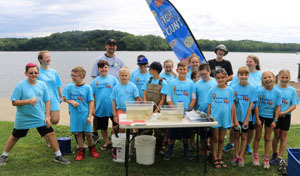 8/5 – Coxsackie, HRM 124: With three hauls of our seine, the Aqua Club students captured six species of fish at the Coxsackie Riverfront Park for the Great Hudson River Fish Count. Among the fishes were YOY herring, striped bass, and spotfin shiners, a canal immigrant from the Mohawk River. In the back of the bag we found a single male blue crab (50 mm carapace width). [Photo of Aqua Club members courtesy of Chris Bowser.]
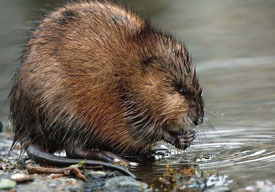 8/7 – Yonkers, HRM 18: A juvenile muskrat has decided that the Science Barge’s aluminum rescue platform makes a good dining place. Each evening it dives into the river and returns with something to eat. One of our students climbed down to look for evidence and discovered that the muskrat was eating ribbed mussels. [Photo of muskrat courtesy of Justin Schmidt.]
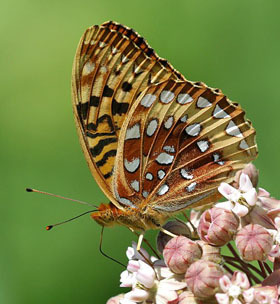 8/11 – Town of Wappinger, HRM 67: The numbers and species of butterflies on our butterfly bushes seemed to peak today with a dozen tiger swallowtails, a black swallowtail, eight monarchs, seven great spangled fritillaries, several red-spotted purples, cabbage white butterflies, and many skippers. [Photo of great spangled fritillary courtesy of Deborah Tracy-Kral.]
|
The New York State Department of Environmental Conservation respects your right to privacy and welcomes your feedback. | Update preferences or unsubscribe. | Learn more about DEC Delivers. |
|
Connect with DEC:   
|
 |
| NOW AVAILABLE: Receive DEC's Twitter feed via email. | |
| Andrew M. Cuomo, Governor * Basil Seggos, Commissioner | |