
Hudson River Almanac 4/29/17 - 5/5/17
The New York State Department of Environmental Conservation sent this bulletin on 05/12/2017 03:50 PM EDT |
| DEC Delivers - Information to keep you connected and informed from the NYS Department of Environmental Conservation |
| Share or view as a web page || Update preferences or unsubscribe |
|
|
|
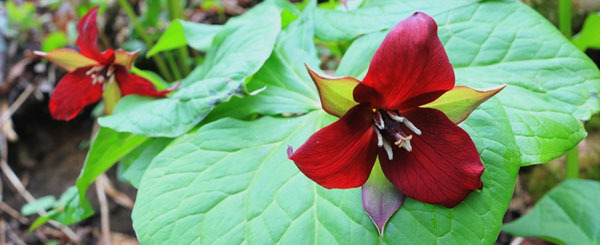
This was a special week that included a rarely seen wading bird, a songbird with a genetic oddity, snapping turtles on the move, and many stories of the next generation from birds to fish. A HIGHLIGHT OF THE WEEK 5/2 – Stillwater, HRM 17: An adult bald eagle had put up most of the birds on a muddy field at the north end of Wrights Loop off Route 4. Most returned after 15 minutes. We counted six species of shorebirds including killdeer, least sandpiper, spotted sandpiper, solitary sandpiper, greater yellowlegs, and lesser yellowlegs. We also spotted a pale buffy-colored sandpiper in among and slightly smaller than the lesser yellowlegs. We carefully studied the bird for more than an hour and concluded that it was a ruff (Calidris pugnax). [The ruff is a medium-sized wading bird that breeds in wetlands across northern Eurasia. They are a rare migrant along the Pacific and Atlantic coasts of North America. Based on plumage, we decided this ruff was an immature female, or a “reeve,” an archaic reference that goes back to old English names that define males and females. With the global standardization of English common names for birds, reeve is not used these days, unless perhaps in affectionate recollections. The New York State Ornithological Association/New York State Avian Records Committee cites 12 records for New York State through 2015. There are five from the lower Hudson Valley, all from Queens, New York City (2006, 2012). Rich Guthrie.] NATURAL HISTORY NOTES 4/29 – Albany, HRM 145: I walked the rail trail from South Pearl Street to Delaware Plaza and then back to Rockefeller Road. Notables: 3,000,000 yellow-rumped warblers (by careful count), blue-winged warbler, yellow warbler, Louisiana waterthrush, common yellowthroat, ovenbird, wood thrush, rose-breasted grosbeak, least flycatcher, great crested flycatcher, and a very scary wild turkey perched in a tree. 4/29 – Rhinebeck, HRM 90: Early this morning I noticed ripples in the pond beyond my deck. Two snapping turtles, each with a foot-long carapace, were mating. The spectacle continued for nearly an hour with lots of snapping, flailing, and rolling each other over revealing the thick orange hide surrounding their feet and tails. Occasionally they sat still in the water, giving the appearance of two large rounded rocks, but each time-out soon ended with more “attacks” on each other. Snapper is a good name for them. [According to an article about snapping turtles in the April 2017 issue of the New York State Conservationist, this behavior is more likely a territorial tussle. Snappers generally mate on the bottom of a waterbody. Steve Stanne.] 4/29 – Hyde Park, HRM 82: I had a very large snapping turtle show up in my yard today. It found a sunny spot and hung out there for a couple of hours before meandering off toward Fall Kill Creek. While this is the season for the females to go searching for suitable places to lay their eggs, this was earliest that I have seen them. [The same turtle, or another, showed up the next day as well.] 4/29 – Town of Wappinger, HRM 67: We had our first male ruby-throated hummingbird show up two days ago. Today, as kind of a surprise, a female showed up at the feeders. 4/29 – Kowawese, HRM 59: It was two days after the new moon and there was a huge ebb tide exposing bottom where we usually haul our net (6.0 feet tidal variance from high to low). Our catch verified what we expected - resident fishes spawning - including five “spent” female yellow perch (ones that had already spawned) and more than 100 spottail shiners, many of which were chubby-with-eggs females. The river was 54 degrees Fahrenheit and the salinity was barely measurable at about 1.0 parts-per-thousand (ppt). As we came off the beach, an orange-and-black male Baltimore oriole tracked the hillside in a splash of brilliant color. [Naturalist Aldo Leopold once described the oriole’s flash as “like a burst of fire.” Tom Lake.] 4/30 – Hudson Falls, HRM 205: I hiked the Five Combines Trail today and noticed a dramatic increase from a week ago in the diversity of spring migrant species: Yellow warblers were abundant as were yellow-rumped warblers and I got my first black-throated blue warbler of the season. Highlights included a warbling vireo, two spotted sandpipers, and three not-so-solitary solitary sandpipers working the muddy areas. 4/30 – Black Creek, HRM 85: It was an overcast morning, an hour before low tide at Black Creek, when we emptied our eel fyke (381 glass eels); the creek was a chilly 44 degrees F. Inside the forest we found a few spring ephemerals: red trillium, toothwort, and Dutchman's breeches. Fiddle heads, pitcher plants, and bloodroots were leafing as red efts (immature eastern red-spotted newts, Notophthalmus viridescens) crossed the trail. [See banner photo of red trillium, courtesy of Chris Bowser.] 5/1 – Coxsackie, HRM 124: My fried Janet and I paddled our kayaks off the Coxsackie boat launch heading downriver. It was a charmed paddle: the river was calm, the air temperature warm, the water cool, Janet remarking that her kayak was acting like an air conditioner. I was paddling with an old friend on a perfect spring day enjoying my favorite sport. All of that was miracle enough but then just five minutes into our paddle a bald eagle showed up perched on a low branch, accompanied by its mate a few trees over. On our way back I spotted a familiar sight from my years of kayaking in the Adirondacks—a silhouette hunkered low on the water. It was a common loon in full breeding plumage. I was ecstatic, and grateful.
[Gynandromorphism describes an organism that displays both male and female characteristics. The term gynandromorph is from Greek “gyne” = female and “andros” = male. While it is rare, it is not unknown. On August 19, 1998, William Cook came upon a dead gynandromorphous black-throated blue warbler in Guilderland, Albany County, which Rich Guthrie subsequently donated to the bird collection at Columbia-Greene Community College. Tom Lake] 5/1 – Manhattan, HRM 2: During an early-afternoon high tide, we sampled water quality parameters at The River Project’s Pier 40 research site in Hudson River Park. Today’s results: 70 centimeters [cm] turbidity, 7.0 ppt salinity, 14.0 degrees C/58 degrees F water temperature, and dissolved oxygen of 7.0 parts-per-million [ppm]. 5/2 – Hathaway’s Glen, HRM 63: The beach at Hathaway’s Glen is the terminus of a small, cold water brook that spills down the fall line into a short run to the river. In summer, the water exiting Hathaway’s Glen is considerably cooler than the river. Today, however, the river was a chilly 57 degrees F. while the water exiting Hathaway’s Glen was warmer at 59F. We were searching for banded killifish for a school program but managed only one. Still, the resident fishes, tessellated darters, spottail shiners, and white perch filled our net. 5/2 – Manhattan, HRM 1: We checked our collection gear in mid-afternoon at The River Project’s sampling station on the lighthouse tender Lilac at Pier 25 in Hudson River Park. We caught no fish, although a seahorse fell off the rope attached to a killifish trap. Even with no fish we still found many isopods, mud crabs, amphipods, and shore shrimp.
5/3 – Hyde Park, HRM 82: In response to the lilacs’ early bloom, I hung out the hummingbird feeders last week. Today my first ruby-throated hummingbird arrived. I was also treated to my first sighting of an indigo bunting as he joined with the goldfinches and house finches at the sunflower feeder – a colorful feast for the eyes. 5/3 – Brockway, HRM 62: We did a little bushwhacking this afternoon, just enough to get a decent view of the Brockway bald eagle nest NY377. One adult was in the nest (standing upright); the other adult (we guessed the male) was on a snag on the north end of the point about 250 feet from the nest. He was eating what looked like a small buck shad, maybe an adult menhaden, but probably a gizzard shad - seemed too large for river herring. While we could not see a nestling, this behavior suggested there was a nestling. There was a strong wind aloft, a northerly, and we watched several turkey vultures pirouetting overhead, tacking in the breeze like a Hudson River sloop. In the time we watched, we saw not a single wing beat from them. 5/3 – Bedford, HRM 35: Things were quiet today at the great blue heron rookery. The single nestling in the great horned owl nest was there alone. Both adults were gone, very likely hunting. The owlet was now nearly half the size of its parents and was very hungry.
[After viewing Kaare’s photograph, I concluded that the blue band had alpha-numeric S72. This was a female, fledged in 2007 from bald eagle nest NY106 in Allegheny County, about 280 miles west of Stuyvesant, in Columbia County. Pete Nye.] 5/4 – Ulster County, HRM 85: I reconfirmed this morning that bald eagle nest NY92, on the Wallkill River at Sturgeon Pool, had one nestling as I watched a large fish being delivered. I would guess, based on its size, that the nestling is about five weeks old. Two common loons flew over the pool but did not land. 5/4 – Norrie Point, HRM 85: Marist College biology students helped us sample the bay at Norrie Point Environmental Center today. We caught a nice collection of fishes in our seine including banded killifish, pumpkinseed sunfish, spottail shiners, golden shiners, tessellated darters, and a weatherfish (Misgurnus anguillicaudatus). This invasive species' scientific name hints at the fact that it looks “eel-like” at first glance, but the distinct fins and stiff barbels give it away as a loach. 5/4 – Hunter’s Brook, HRM 67.5: Two days of strong north winds produced a blowout tide in Hunter’s Brook– the afternoon ebb tide just kept going. As a result, our fyke net was barely in the water. A series of chilly nights had cooled the tributary to 57 degrees F (two degrees lower from last week). Pat Hancock and his 9th grade John Jay students joined us to see what we had caught overnight. In the wake of our high numbers at Hunter's Brook this spring, today's 179 seemed very average. We noted a few alewives and white suckers, on their spawning missions, moving about in the brook 5/4 – Manhattan, HRM 2: During an early-afternoon low tide, we sampled water quality parameters at The River Project’s Pier 40 research site. We wanted to compare today’s values with those collected earlier this week at Pier 40. Today’s results: 75 cm turbidity (42 on 5/3), 6.0 ppt (8.0 on 5/3), 14.0 degrees Celsius/58 degrees F water temperature (13.0 degrees C on 5/3), and dissolved oxygen of 5.8 ppm (6.6 on 5/3). 5/5 – Newcomb, HRM 302: Some spring wildflowers were in bloom: trout lily, sessile-leaved bellwort, red trillium, toothwort, and Viola spp. were in abundance. Witch-hobble (Viburnum lantanoides) and shadbush (Amelanchier spp.) were also in bloom. Newly arrived migrant songbirds, seen and heard in the woods, included yellow-rumped, black-throated green, and magnolia warblers, as well as American redstart and a bonus red-breasted grosbeak. Unfortunately, the black flies were also starting to send out their scouts. [It is quite likely these were the adults from a newly discovered bald eagle nest less than a mile away. It was unclear if the eagles they had laid eggs or hatched nestlings. Tom Lake.] SPRING 2017 NATURAL HISTORY PROGRAMS Saturday, June 3 Monday, June 5: 7:00 PM HUDSON RIVER MILES The Hudson is measured north from Hudson River Mile 0 at the Battery at the southern tip of Manhattan. The George Washington Bridge is at HRM 12, the Tappan Zee 28, Bear Mountain 47, Beacon-Newburgh 62, Mid-Hudson 75, Kingston-Rhinecliff 95, Rip Van Winkle 114, and the Federal Dam at Troy, the head of tidewater, at 153. The tidal section of the Hudson constitutes a bit less than half the total distance – 315 miles – from Lake Tear of the Clouds to the Battery. Entries from points east and west in the watershed reference the corresponding river mile on the mainstem. TO CONTRIBUTE YOUR OBSERVATIONS OR TO SUBSCRIBE Smartphone app available for New York outdoor enthusiasts! Copies of past issues of the Hudson River Almanac, Volumes II-VIII, are available for purchase from the publisher, Purple Mountain Press, (800) 325-2665, or email purple@catskill.net
|
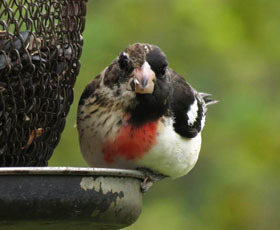 5/1 – Town of Poughkeepsie, HRM 70: When a rose-breasted grosbeak landed on our feeder today, its left side was facing me and I thought it was simply a yearling male that still had a few chest-streaks and a bit of brown mottling on its back and sides. But then it turned and I did a double-take–it seemed to be half-female. Could a moult ever proceed so asymmetrically, or was I really looking at a rare genetic anomaly, a gynandromorphous bird? I got a glimpse of the underwing color on its right side, and it was gold. Gold should never be on the same bird as a red chest. There was some black mottling in the streaky brown of the “female” side, though, so was not a strictly bilateral gynandromorph. That means the proper term is “mosaic gynandromorph” rose-breasted grosbeak. [Photo of gynandromorphous rose-breasted grosbeak courtesy of Diane DesAutels.]
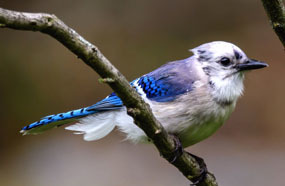 5/3 – Ulster Park, HRM 87: A new visitor stopped by today that looked like a “bearded old man.” It was a leucistic blue jay! This looks like a banner year for rose-breasted grosbeaks. We have more of them—at least four males and two females—than ever before. [Photo of leucistic blue jay courtesy of Jim Yates.]
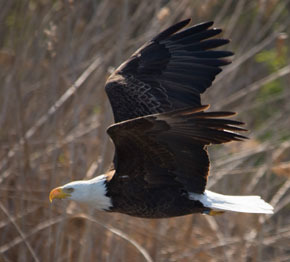 5/4 – Stuyvesant, HRM 127: I got a nice photo today of an adult bald eagle in flight. When I looked at the image, I noticed that the bird had a blue band on its left leg, likely a New York State DEC band. [Photo of bald eagle courtesy of Kaare Christian.]
|
The New York State Department of Environmental Conservation respects your right to privacy and welcomes your feedback. | Update preferences or unsubscribe. | Learn more about DEC Delivers. |
|
Connect with DEC:   
|
 |
| NOW AVAILABLE: Receive DEC's Twitter feed via email. | |
| Andrew M. Cuomo, Governor * Basil Seggos, Commissioner | |