
Hudson River Almanac 4/23/17 - 4/28/17
The New York State Department of Environmental Conservation sent this bulletin on 05/05/2017 02:00 PM EDT |
| DEC Delivers - Information to keep you connected and informed from the NYS Department of Environmental Conservation |
| Share or view as a web page || Update preferences or unsubscribe |
|
|
|
This was a week of nestlings, from owls to eagles, great blue herons to Canada geese, cardinals and other songbirds. It was a week that reminded us how the river is connected to the uplands as fish sustained hungry hatchlings. A HIGHLIGHT OF THE WEEK 4/26 – Bedford, HRM 35: The big news at the Bedford great blue heron rookery was the great horned owl. There had been a hatch! The owlet is large enough to make me think that it hatched a while ago but noticeable just now. Great horned owls begin nesting before the herons, so it is likely that the owls claimed the nest before the herons arrived. The herons continue to incubate their eggs, with the exception of two nests where an adult was tending to young. NATURAL HISTORY NOTES 4/23 – Esopus Meadows, HRM 87: Our April 15 story about the low tide-stranded male white sucker at Esopus Meadows left readers hanging! Several readers asked: Did Chris Bowser’s nephew Will Mason save the sucker, or leave it to its fate (“nature’s will”)? We asked Chris Bowser and his reply: “Will carried it to deeper water, where it swam away swift and strong.” 4/23 – Greene County: On my visit to bald eagle nest NY203 two weeks ago it did not appear that the adults were incubating. Today removed all doubts; from hundreds of yards out, I could see the white head of an adult in the nest, carefully watching me with eyes just above the rim. After ten minutes the eagle stopped watching me and the head vanished below the rim. Its mate was 200 yards down the shoreline on a high bare branch at the water’s edge. 4/23 – Ulster Park, HRM 87: We just saw our first ruby-throated hummingbird; it arrived on the same day as last year’s first hummingbird. I have had the hummingbird feeders out for a week now. It is hard to tell if this one was just passing through or a resident. 4/23 – Ulster County, HRM 85: We have a hatch for sure in bald eagle nest NY92 at Sturgeon Pool on the Wallkill River. I saw my first food delivery today (brown bullhead) and later I think I saw one little head. 4/23 – Wappinger Creek, HRM 67.5: Just outside the mouth of Hunter’s Brook we found a new great blue heron nest where the adults were incubating eggs. An osprey briefly landed on the rim of the nest and then flew off. Osprey can be nest opportunists; sometimes it seems they would rather “borrow” a heron nest than build their own. 4/24 – Battenkill River, HRM 188: A couple of weeks ago a pair of great blue herons started to use the last intact nest in the Town of Greenwich rookery, but they were replaced by a pair of very serious osprey. The Battenkill Conservancy bought the property to protect the rookery but the herons are not using it now.
[The king rail is the largest and rarest of the secretive, marsh-dwelling rail species found in New York. King rails utilize a variety of wetlands including brackish coastal marshes, tidal and non-tidal freshwater cattail marshes, prairie swamps, shrub swamps, and rice fields. Their range extends from southern Ontario to the Gulf Coast of Mexico, east to the low-lying areas of the Mid-Atlantic States, and west to the Mississippi. In New York, scattered breeding records have occurred in the southern Hudson River Valley and within large wetlands associated with the Great Lakes. Information from NYSDEC King Rail Fact Sheet.]
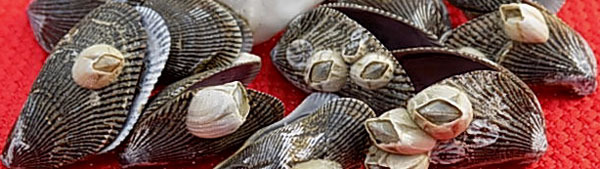
4/24 – Croton-on-Hudson, HRM 34: What was this bouncing across a field at the edge of the Croton River? A dozen yellow tennis balls? Better by far, the first Canada goose goslings of the year no more than two days out of the shell. Golden, fluffy, little-baby cuddly and beneath a shadbush in full bloom. Spring. 4/24 – Manhattan, HRM 1: In late afternoon we checked our collection gear at The River Project’s sampling station on the lighthouse tender Lilac at Pier 25 in Hudson River Park. The mud crab (Panopeidae) numbers were definitely rising! We caught 19 tiny mud crabs today after weeks of seeing far fewer. We also caught three mud dog whelk snails, a very tiny hard clam (smaller than a grain of jasmine rice), 17 isopods, and three amphipods. We also had a record number (135) of shore shrimp as well as the most ever in one killifish trap (34). [Last week we discussed the three native species of shrimp in the lower estuary as well as an invasive, the Oriental shrimp. Another, much less common native shrimp in the Hudson River, is the brown shrimp (Penaeus aztecus). Tom Lake.] 4/25 – Columbia County, HRM 124: I took down my feeders in the Town of Austerlitz more than a week ago which was a good thing. Tonight a black bear knocked down a feeder pole and turned over a large yard urn that had some seed spread on top. It's that time again. 4/25 – Croton Point, HRM 34.5: We revisited last month’s die-off of hooked mussels at Croton Point. Looking though another few hundred mussels, we found that many of them were covered with bay barnacles (Amphibalanus improvises) a further testament to the salinity in Haverstraw Bay last summer. [See banner photo of bay barnacles attached to hooked mussels, courtesy of Tom Lake.] [A barnacle is ...“nothing more than a little shrimp-like animal standing on its head in a limestone house and kicking food into its mouth.” Louis Agassiz, American naturalist.] 4/25 – Manhattan, HRM 2: Students from Manhattan’s PS 102 helped us check our collection gear at The River Project’s Pier 40 research site. The catch was meager, but we did catch our first white perch (Morone americana) of the season. 4/26 – Stillwater, HRM 171.5: The osprey were back in their nest on concrete pilings in a diverted backwater off the river. I heard a black-and-white warbler and saw a gorgeous male yellow-rumped warbler. After seeing the later in its drab brown plumage all winter, it was startling to see a male in full breeding plumage. 4/26 – Town of Saugerties, HRM 102: I have been seeing several myrtle warblers (yellow-rumped) at the stream crossing on Dutchtown Road where red-winged blackbirds have been displaying and mate-calling. The stream has no name but it is fed by a few headwater streams that pass through wetlands and eventually into the Hudson. Our cardinals have had their first brood already. 4/26 – Westchester County, HRM 30: I was looking for birds on the river but instead spotted a river otter along the shoreline between Scarborough and Phillipse Manor. The otter was gliding downriver. 4/26 – Manhattan, HRM 1: In late afternoon we checked our collection gear at The River Project’s sampling station on the lighthouse tender Lilac at Pier 25 and we found fish! One of our crab pots finally caught a lined sea horse 60 millimeters [mm] long that was hanging onto the edge of the wire pot with its prehensile tail. The killifish traps caught 100 shore shrimp, five isopods, 14 mud crabs, a surf clam, two isopods, and four mud dog whelk snails. 4/27 – Salem, HRM 193: I discovered a pair of merlins nesting in a Norway spruce near Salem Central School not far from a turkey vulture night roost that was accommodating 74 vultures. [According to The Second Atlas of Breeding Birds in New York State [2000-2005], the extent of the merlin’s nesting range in the state was “surprisingly large” given that the first atlas survey [1980-1985] found no instances of breeding. In addition to numerous confirmed nestings in the Adirondacks, this little falcon has been found breeding in urban areas outside the mountains. The Atlas article concludes that “the merlin does appear well on its way to being a common urban nester in the rest of New York.” Steve Stanne.] 4/27 – Greene County, HRM 134: We have two nestlings in bald eagle nest (NY87) viewable across the river from Upper Schodack Island. We have been monitoring the nest since February. One fuzzy head poked up today as an adult was feeding, and then a second head bobbed up. I'm glad we saw them today; in another week the hardwood tree in front of the nest will be leafed out and may block the view until they're climbing out of the nest. 4/27 – Town of Poughkeepsie: Another delivery this morning (white sucker) to bald eagle nest NY372. With the failure of NY62 as well as a couple other bald eagle nests in the Hudson Valley this spring, NY372 has been a welcome success. So far it looks like just one very hungry nestling. 4/27 – Hunter’s Brook, HRM 67.5: Pat Hancock and his John Jay students joined us to check our glass eel fyke net. The impressive numbers continued as we counted 256 glass eels. In the clear water we were able to see the flashes of alewives heading upstream and the occasional and more deliberate ascent of white suckers. The tributary water had warmed to 59 degrees Fahrenheit. 4/27 – Scarborough, HRM 32: While awaiting the 6:52 a.m. Metro North at Scarborough station, I spotted a river otter swimming out of Kemeys Cove. The otter emerged out in the river and then headed south in the fog-shrouded Hudson. [River otters (Lontra canadensis), a native fur-bearer in the weasel family, are well known from Westchester County but are more often seen on upland waters. This may have been the same otter Larry Trachtenberg saw the day before. Tom Lake] 4/28 – Town of Saugerties, HRM 102: First-of-season birds today, along a utility cut, included three prairie warblers singing on breeding territory, an indigo bunting, and a very colorful and very vocal adult male orchard oriole singing from a roadside shrub. There was also a good showing of recently emerged butterflies including clouded sulphur, eastern pine elfin, eastern tailed blues (a dozen or more), and a Juvenal's duskywing. Spring azures and cabbage whites were flying in good numbers and there were at least three falcate orangetips coursing the ground including my first female of the year. Most remarkably, I counted at least eight fresh gray hairstreaks. 4/28 – Town of Poughkeepsie: The nestling in bald eagle nest NY372 was getting fed regularly. Across the two hours I watched today there were two feedings of white suckers. The closest source would probably be the Fall Kill where white suckers are ascending that tributary to spawn. 4/28 – Town of Wappinger, HRM 67: Our first ruby-throated hummingbird of the season, a bright red-throated male, stopped by today. 4/28 – Beacon, HRM 61: There must have been a lot of small golden shiners at work off Long Dock today as I was constantly having my bait stolen. One positive aspect to the presence of these minnows is that channel catfish feed on them, and that will help the catfish increase their size. I managed to catch and release two channel catfish today; each was just under three pounds. 4/28 – Bedford, HRM 35: Two days ago, there were two nests at the great blue heron rookery with an adult standing on the edge, usually indicating a hatch has occurred. Today there were at least seven herons standing on the edge of their nest. It will be awhile before any nestlings have grown enough to become visible. The great horned owls that shares the rookery appears to have one nestling. It was warm today and the owl and owlet were panting to cool off. The herons do not seem to be concerned by the presence of the owls.
[Blackfish is a colloquial common name for tautog (Tautoga onitis) a rather common, bottom-dwelling fish of New York Harbor. Their colloquial name, blackfish, refers to the adults as they attain a deep, coal black color, but juveniles like this one are often greenish. Among their favorite foods are shellfish that they find in abundance in near-shore rocky areas. In the spirit of “you are what you eat,” blackfish, perhaps owing to their shellfish diet, are one of the most sought after food fishes. Tom Lake.] SPRING 2017 NATURAL HISTORY PROGRAMS Monday, June 5: 7:00 PM HUDSON RIVER MILES The Hudson is measured north from Hudson River Mile 0 at the Battery at the southern tip of Manhattan. The George Washington Bridge is at HRM 12, the Tappan Zee 28, Bear Mountain 47, Beacon-Newburgh 62, Mid-Hudson 75, Kingston-Rhinecliff 95, Rip Van Winkle 114, and the Federal Dam at Troy, the head of tidewater, at 153. The tidal section of the Hudson constitutes a bit less than half the total distance – 315 miles – from Lake Tear of the Clouds to the Battery. Entries from points east and west in the watershed reference the corresponding river mile on the mainstem. TO CONTRIBUTE YOUR OBSERVATIONS OR TO SUBSCRIBE Smartphone app available for New York outdoor enthusiasts! Copies of past issues of the Hudson River Almanac, Volumes II-VIII, are available for purchase from the publisher, Purple Mountain Press, (800) 325-2665, or email purple@catskill.net |
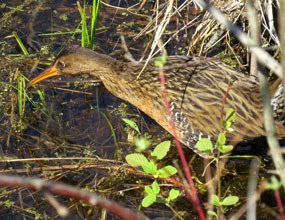 4/24 – Town of Saugerties, HRM 102: I came upon a king rail at The Vly on West Camp Road this afternoon (confirmed by vocalization). If you go looking for this bird, please do not audio tape it. The last king rail we had did NOT fare well. [Photo of king rail courtesy of Peter Schoenberger.]
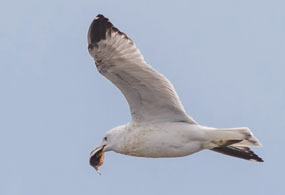 4/24 – Sleightsburgh Spit, HRM 91.5: A ring-billed gull swooped down and picked up a fish that was swimming in shallows adjacent to the mud flats right in front of me. As it flew off I could see that it was a palm-size hogchoker. This was the third gull-carrying hogchoker we’ve seen this spring. [Photo of ring-billed gull with hogchoker courtesy of Jim Yates.]
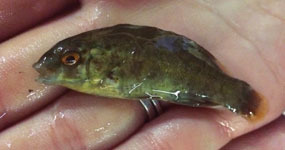 4/28 – Manhattan, HRM 1: In late morning we checked our collection gear at The River Project’s sampling station on the lighthouse tender Lilac at Pier 25. More fish! A crab pot caught an adult white perch (230 mm). Our killifish traps caught a lined sea horse (120 mm) and a blackfish (65 mm). [Photo of juvenile blackfish (tautog) courtesy of Jacqueline Wu.]
|
The New York State Department of Environmental Conservation respects your right to privacy and welcomes your feedback. | Update preferences or unsubscribe. | Learn more about DEC Delivers. |
|
Connect with DEC:   
|
 |
| NOW AVAILABLE: Receive DEC's Twitter feed via email. | |
| Andrew M. Cuomo, Governor * Basil Seggos, Commissioner | |