|
OVERVIEW
Wildlife usually comes to us, but this week a banded bald eagle that spent the winter in Dutchess County returned to its home 200 miles away. We spent a lot of time this week investigating a massive mussel die-off in the river, only to reach no conclusion. But we did learn a lot about mussels along the way.
A HIGHLIGHT OF THE WEEK
4/2 – Waltham, MA: I am happy to report that bald eagle (banded MK) was back home safely today at Mount Feake Cemetery, returning to the nest area where he was fledged after spending the winter in Dutchess County, New York. MK, an immature eagle, was banded on May 25, 2016. MK’s parents, now into another season, were there as well, and while there was lots of “eagle chatter” between the adults, they did not try to chase MK away.
- Darlene Ellis, and Tom Ellis
[See Town of Poughkeepsie: 2/1/17. This immature bald eagle with a burnt-orange band number 0709-02117 MK was spotted several times this winter along the tidewater Wappinger Creek and the Hudson River. Mount Feake Cemetery, in Middlesex County, is near the Charles River 13 miles west of Boston. Tom Lake.]
NATURAL HISTORY NOTES
4/1 – Tivoli Bays, HRM 100: While hiking around Tivoli Bays, we happened upon an adult bald eagle sitting high up in a tree overlooking the bay. We watched it for a short time and when we got home and looked at our photographs, we noted that it had a blue band on its left leg, a New York State banded bird.
- Jamie Collins, Leena Collins
[This could be a bald eagle (V72) banded and fledged from nest NY62 in the Town of Wappinger in 2003. A previous sighting of V72 suggested that she had nested in Tivoli Bays and fledged young of her own. Tom Lake]
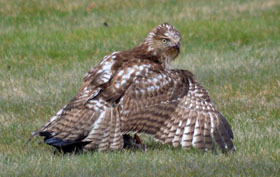 4/1 – Westchester County, HRM 40: I watched an amazing struggle in Goldens Bridge today as an immature red-tailed hawk caught and killed a crow and then ate it. Meanwhile, the crow’s allies lined the nearby trees, squawking their displeasure, but offering no assistance. [Photo of immature red-tailed hawk on common crow courtesy of Rick Stafford.] 4/1 – Westchester County, HRM 40: I watched an amazing struggle in Goldens Bridge today as an immature red-tailed hawk caught and killed a crow and then ate it. Meanwhile, the crow’s allies lined the nearby trees, squawking their displeasure, but offering no assistance. [Photo of immature red-tailed hawk on common crow courtesy of Rick Stafford.]
- Rick Stafford
4/1 – Piermont, HRM 25: I saw my first osprey of the year over Piermont Marsh. A sharp-shinned hawk passed over as well and a pair of wood ducks were heading upriver. Most notable, however, was a steady stream of robins, set against the clouds, heading north from the Palisades.
- Linda Pistolesi
4/2 – Kerhonkson, HRM 76: We were enjoying the screaming from the three red-shouldered hawks circling above while a barred owl was hooting down in the swamp. Just a few minutes later we heard the whistle of wood ducks as a pair came rocketing over the tree tops, cupped and ready to drop in our pond. The wood ducks circled and landed in a big hickory tree a couple hundred feet away. The ducks stayed and watched for a while until a large northern harrier came gliding in, causing the wood ducks to take off, dive into the pond, and tuck into the cattails.
- Jeremy Baracca, Justin Baracca
4/2 – Beacon, HRM 61: This was my first day out this year fishing for carp at Long Dock Park and it was memorable. My first carp of the season, caught and released, weighed eight pounds, eleven ounces. There was also a nice channel catfish – four pounds, four ounces – also released. The spring striped bass anglers were showing up as well.
- Bill Greene
4/3 – Ulster County, HRM 85: Bald eagle nest NY92 at Sturgeon Pool had a new location. The adults abandoned the old nest this year and moved a few hundred yards away where they refurbished an existing nest in a white pine for this breeding season. The new nest looks to be a bit larger than the old one. I assumed they were on eggs near the beginning of March, so if the eggs are viable they should be hatching very soon.
- Jim Yates
4/3 – Denning’s Point, HRM 60: I took my first walk of the season around Denning’s Point and found an unwelcome but not unexpected sight: an ash tree (12 inches in diameter) near the south point had the unmistakable signs of emerald ash borer – exfoliating exterior bark and numerous D-shaped exit holes where the beetles emerged. The insects probably emerged last year and set out to find more ash trees. While there are few ash trees on Denning’s Point, they are quite common on the slopes in Dutchess Junction to the southeast. I won’t be surprised if they are found there this season or next.
- Steve Seymour
[The emerald ash borer is a jewel beetle native to northeastern Asia that feeds on North American ash species (Fraxinus sp.) including green, white, black and blue ash. In its native range, it is typically found at low densities and does not cause significant damage. Outside its native range, it is an invasive species and is highly destructive. The beetle was first discovered in the U.S. in 2002 in southeastern Michigan. For more information, visit DEC’s emerald ash borer web page. NYSDEC]
4/3 – Staatsburg, HRM 86: Bald eagle nest NY143 collapsed late in 2016, after which the pair built a new nest nearby. Breeding activity was been sporadic so far this season but there is evidence that both adults are around the nest so incubation is still possible.
- Dave Lindemann
4/3 – Schultzville, HRM 88: Bald eagle nest NY261 reportedly began incubating on February 15 and has continued non-stop making today Day 48, well beyond the 32-35 day average incubation period. Possibilities are two: the eggs are not viable, or incubation started much later than February 14.
- Dave Lindemann
4/3 – West Park, HRM 83: Bald eagle nest NY142, which usually is on eggs by mid-March, had yet to show incubation, and instead continued with nest-tending. It is getting late in the breeding season for them.
- Dave Lindemann
4/3 – Manhattan, HRM 1: We checked our collection gear in late afternoon at The River Project’s sampling station on the lighthouse tender Lilac at Pier 25 in Hudson River Park. The traps yielded 37 shore shrimp, four amphipods, a mud crab, an Asian shore crab, an isopod, and a hermit crab. Based on a cursory glance, we thought the hermit crab might be a new species for The River Project.
- Jacob Tuszynski, Ileana Aguilar, Jackie Wu
4/4 – New Paltz, HRM 78: Walking along the Wallkill Valley Rail Trail, I watched a crow swoop in very close to a perched immature Cooper’s hawk, giving it a hard time as crows will do. The Cooper’s sprang off its perch and in a flash was on the crow’s tail and back, easily following every twist and turn the now squawking crow made before breaking off as another crow flew in, attracted by the commotion. When the Cooper’s landed on a branch a short distance away, the crows did not choose to continue the chase.
- Steve Stanne
4/4 – Croton-on-Hudson, HTM 34.5: There has been at least one osprey in the cell tower nest at the Metro North train station parking lot each day for the last week. Both adults were around and they took turns tending the nest. It was difficult to tell if they were incubating or just getting ready.
- Hugh L. McLean, Charlie Roberto
[This will be this osprey pair’s fifth season at the cell tower nest. Across their first four years, they have fledged nine young. Tom Lake.]
4/5 – Fort Edward, HRM 202: The osprey pair returned to their Fort Edward nest today.
- Louis Suarato, Hudson-Mohawk Bird Club
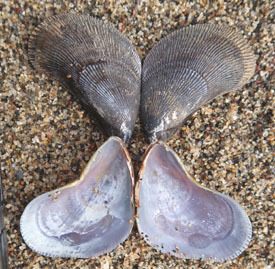 4/5 – Croton Point, HRM 35-34: At low tide on March 13, John Phillips came upon an unexpected find: live oysters. The oysters were nestled among a great many hooked mussels (Ischadium recurvum), a bivalve often found in brackish water. 4/5 – Croton Point, HRM 35-34: At low tide on March 13, John Phillips came upon an unexpected find: live oysters. The oysters were nestled among a great many hooked mussels (Ischadium recurvum), a bivalve often found in brackish water.
Not long thereafter, large tiderows - thousands of dead hooked mussels - were exposed at low tide. The question was asked: What caused the die-off? John Waldman suggested that the mussels were established in the warm and salty waters of last summer and may have succumb to a winter of much lower salinity. Several blow-out tides may also have contributed, exposing the mussels to the freezing night air (at low as six degrees Fahrenheit).
Ray Grizzle (Jackson Estuarine Laboratory, New Hampshire) added that winter die-offs of bivalves are not unusual. He did a size-frequency of 565 measured valves and concluded that they were all of a single major year class with a mean size of 26.7 millimeters. Jim Lodge and Katie McFarland reported that hooked mussels have been found with wild reef oyster populations in the Tappan Zee and the upriver recruitment of oysters and mussels may have been concurrent in 2016.
The answer to the question? There likely were a myriad of natural causes that all contributed to the die-off of the hooked mussels.[Photo of hooked mussels courtesy of John Phillips.]
- Tom Lake
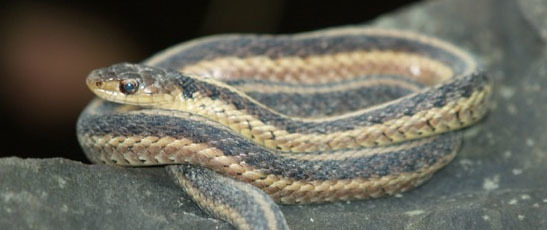
4/5 – New Paltz, HRM 78: I stopped by our pond today and noticed a small eastern garter snake curled up on one of the flat rocks by the pond edge. By the look of the dry mud on its scales it had just made its way out of its hibernation site. [See banner photo of garter snake courtesy of Bob Ottens.]
- Bob Ottens
4/5 – New Paltz, HRM 78: In late afternoon, there were six snow geese grazing with many gulls in a field just west of the Wallkill River. One goose had a gray neck and body, a color variety or morph called a “blue goose.”
- Lynn Bowdery
4/5 – Brockway, HRM 62: We were making a run down along the river, checking several bald eagle nests. Brockway, NY377, was our final stop. There had been some activity near the nest over the last month but nothing definitive. We peered through our spotting scope from a few hundred yards away at what appeared to be an empty nest. We were set to leave when a Metro North commuter train roared past. One last look at the nest and we saw a white head pop up and a pair of yellow eyes fix on us. Someone was on eggs.
- Malcolm Grant, Tom Lake
4/5 – Beacon, HRM 61: It was another very good day of spring fishing at Long Dock Park. I caught and released three impressive carp that weighed from eight pounds, eight ounces to thirteen pounds, fourteen ounces. Three channel catfish, three to four pounds each, were also released. A dozen anglers passed me on their way to Denning’s Point, toting a very large net and some serious tackle, no doubt after some serious striped bass.
- Bill Greene
4/5 – Westchester County, HRM 34: It had been a while since I had seen wood ducks and today was a bonanza of them. On my way to Croton Point I stopped to look at a bufflehead in a small lake and found a pair of wood ducks there as well. The lighting was perfect – the males are just about the most beautiful aquatic bird. Later, I made my way down to the water-filled clay pits at Croton Point where I found another two pairs of wood ducks that promptly flew up into the trees as I approached.
- Scott Horecky
4/5 – Bedford, HRM 35: This is the sixth year that the great blue herons have been using the Bedford Rookery. They were in the early stages of egg laying and incubation and at this point, things were looking good. Some nests appeared to be unoccupied, but were deep enough that a heron might not be seen. There were also some shallow and occupied nests that in past years were unoccupied. This may be due to a shortage of nests due to an increase in the heron population. On this visit, there were seven nests with a heron settled down and 13 that had one or both herons standing.
- Jim Steck
[My notes from 2015 showed that about 30 herons fledged here. Since they reach sexual maturity in 22 months, the survivors might be ready to breed, perhaps even at this rookery. Jim Steck.]
4/5 – Manhattan, HRM 1: We checked our collection gear in mid-afternoon at The River Project’s sampling station on the lighthouse tender Lilac at Pier 25. Again, no fish, but we did catch 39 shore shrimp, two sand shrimp, and one amphipod.
- Ileana Aguilar, Jacqueline Wu
4/6 – Stony Creek, HRM 225: After three inches of rain in four days, and accompanying snow melt, the Hudson flooded its banks at Stony Creek. Two Canada geese and three common loons in breeding plumage found calm and quiet in a flooded backwater.
- Pete Loch
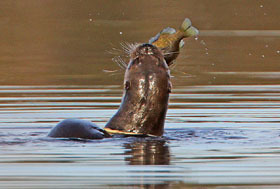 4/6 – Stanfordville, HRM 84: A river otter was busily fishing in a pond near here today. In the few minutes I watched, it caught four fish, including a large bluegill sunfish. [Photo of river otter with bluegill courtesy of Deborah Tracy-Kral.] 4/6 – Stanfordville, HRM 84: A river otter was busily fishing in a pond near here today. In the few minutes I watched, it caught four fish, including a large bluegill sunfish. [Photo of river otter with bluegill courtesy of Deborah Tracy-Kral.]
- Deborah Tracy-Kral
[The river otter (Lontra canadensis) is native to New York State and a member of the Mustelidae family (mustela, Latin for weasel) along with other mammals such as the mink, fisher, pine marten, and various other smaller weasels. For more on river otters, visit DEC river otter web page. Tom Lake]
4/6 – Town of Poughkeepsie: I watched bald eagle nest NY372 for four hours today, during which time there were two changeovers as the adults kept to serious incubating. Depending on when we calculate they began on eggs, this could be Day 35. However, I am beginning to think we confused their settling down in the nest with actually being on eggs.
- John Badura
4/6 – Manhattan, HRM 2: During a mid-afternoon high tide, we sampled water quality parameters at The River Project’s Pier 40 research site. We wanted to compare today’s values with those collected on March 30 at Pier 40. Today’s results: 70 centimeters turbidity (55 cm on 3/30), 3.0 parts-per-thousand salinity (10.0 ppt on 3/30), 6.0 degrees Celsius/42 degrees Fahrenheit water temperature (6.0 degrees C. on 3/30), and dissolved oxygen of 12.6 parts-per-million (6.2 ppm on 3/30).
- Jacqueline Wu
4/7 – Minerva, HRM 284: There had been a lot of rain over the past few days (1.5"), and more was promised for today. We still had ice on ponds and 12-18" of snow in the woods but it was loosening up. I’ve been hearing and seeing flocks of red-winged blackbirds as they pass through along with a few robins. The tufted titmice were singing their spring song this morning. My five buckets hanging on sugar maples were still producing sap and I have had a record volume of syrup. I may end up with close to a half-gallon this spring!
- Mike Corey
4/7 – Valatie, HRM 129: There may be fifty shades of gray, but the Kinderhook Creek at the Patchaquack Preserve had even more shades of green. After the rains, I noted the “Army” green color of the Valatie Kill at its confluence with the Kinderhook Creek which was more like an olive-drab green.
- Fran Martino
4/7 – Ulster County, HRM 82: I've been watching bald eagle nest NY394 this spring across the river from Rogers Point. There has often been at least one adult there. This morning I saw the pair exchange places in the nest, suggesting that incubation is going well so far.
- Dale Becker
4/7 – Town of Poughkeepsie: If the count was correct, and it seems it was not, today should have been Day 36 at bald eagle nest NY372. Yet, we saw no hatch. The adults were busy both incubating and bringing fish to the nest tree. In midday a channel catfish was delivered and then an hour later a river herring, an alewife, the first we’ve seen in the talons of an eagle this spring.
- Sheila Bogart, Dana Layton, Bob Rightmyer
FUNDING AVAILABLE FOR HUDSON RIVER FISH ADVISORY OUTREACH INITIATIVE
Fish are an important part of a healthy diet, containing high quality protein, essential nutrients, healthy fish oils, and low saturated fat. However, fish in some New York waterbodies contain chemicals at levels that may be harmful to health. To help people make healthier choices about which to eat, the New York State Department of Health (NYSDOH) issues advice about eating fish you catch. One of the water bodies for which NYSDOH has fish advisories is the Hudson River.
The Hudson River Fish Advisory Outreach Project has set a goal that all Hudson fish and crab consumers know about, understand, and follow the NYSDOH fish advisories. To this end, Health Research, Inc. and NYSDOH announce the availability of a total of $90,000 per year to develop partnerships with local groups. Applications for funding must serve populations that fish or are likely to eat fish from the Hudson River in Albany, Bronx, Columbia, Dutchess, Greene, New York, Orange, Putnam, Rensselaer, Rockland, Saratoga, Ulster, Washington, and/or Westchester Counties. Priority audiences are women under 50 (childbearing years), families with children under 15, minority, low-income, low-literacy and limited-English-proficiency individuals. Maximum awards are $15,000. Government entities and community-based not-for-profit organizations are eligible to apply. Applications are due May 10, 2017, with narratives limited to six pages. For details, visit the project’s Request for Applications website.
HUDSON RIVER MILES
The Hudson is measured north from Hudson River Mile 0 at the Battery at the southern tip of Manhattan. The George Washington Bridge is at HRM 12, the Tappan Zee 28, Bear Mountain 47, Beacon-Newburgh 62, Mid-Hudson 75, Kingston-Rhinecliff 95, Rip Van Winkle 114, and the Federal Dam at Troy, the head of tidewater, at 153. The tidal section of the Hudson constitutes a bit less than half the total distance – 315 miles – from Lake Tear of the Clouds to the Battery. Entries from points east and west in the watershed reference the corresponding river mile on the mainstem.
TO CONTRIBUTE YOUR OBSERVATIONS OR TO SUBSCRIBE
The Hudson River Almanac is compiled and edited by Tom Lake and emailed weekly by DEC's Hudson River Estuary Program. Share your observations by e-mailing them to trlake7@aol.com.
To subscribe to the Almanac (or to unsubscribe), use the links on DEC's Hudson River Almanac or DEC Delivers web pages.
Discover New York State Conservationist - the award-winning, advertisement-free magazine focusing on New York State's great outdoors and natural resources. Conservationist features stunning photography, informative articles and around-the-state coverage. Visit the Conservationist webpage for more information.
USEFUL LINKS
National Oceanic and Atmospheric Administration online tide and tidal current predictions are invaluable when planning Hudson River field trips.
For real-time information on Hudson River tides, weather and water conditions from twelve monitoring stations, visit the Hudson River Environmental Conditions Observing System website.
Information about the Hudson River Estuary Program is available on DEC's website at http://www.dec.ny.gov/lands/4920.html .
Smartphone app available for New York outdoor enthusiasts!
DEC, in partnership with ParksByNature Network®, is proud to announce the launch of the New York Fishing, Hunting & Wildlife App for iPhone and Android. This FREE, cutting-edge mobile app gives both novice and seasoned outdoorsmen and women essential information in the palm of their hands. Powered by Pocket Ranger® technology, this official app for DEC will provide up-to-date information on fishing, hunting and wildlife watching and serve as an interactive outdoor app using today's leading mobile devices. Using the app's advanced GPS features, users will be able identify and locate New York's many hunting, fishing and wildlife watching sites. They will also gain immediate access to species profiles, rules and regulations, and important permits and licensing details.
NY Open for Hunting and Fishing Initiative
Governor Cuomo's NY Open for Fishing and Hunting Initiative is an effort to improve recreational opportunities for sportsmen and women and to boost tourism activities throughout the state. This initiative includes streamlining fishing and hunting licenses, reducing license fees, improving access for fishing and increasing hunting opportunities in New York State.
In support of this initiative, this year's budget includes $6 million in NY Works funding to support creating 50 new land and water access projects to connect hunters, anglers, bird watchers and others who enjoy the outdoors to more than 380,000 acres of existing state and easement lands that have gone largely untapped until now. These 50 new access projects include building new boat launches, installing new hunting blinds and building new trails and parking areas. In addition, the 2014-15 budget includes $4 million to repair the state's fish hatcheries; and renews and allows expanded use of crossbows for hunting in New York State.
This year's budget also reduces short-term fishing licenses fees; increases the number of authorized statewide free fishing days to eight from two; authorizes DEC to offer 10 days of promotional prices for hunting, fishing and trapping licenses; and authorizes free Adventure Plates for new lifetime license holders, discounted Adventure Plates for existing lifetime license holders and regular fee Adventure Plates for annual license holders.
Copies of past issues of the Hudson River Almanac, Volumes II-VIII, are available for purchase from the publisher, Purple Mountain Press, (800) 325-2665, or email purple@catskill.net
|