
Hudson River Almanac 3/11/17 - 3/17/17
The New York State Department of Environmental Conservation sent this bulletin on 03/24/2017 02:26 PM EDT |
| DEC Delivers - Information to keep you connected and informed from the NYS Department of Environmental Conservation |
| Share or view as a web page || Update preferences or unsubscribe |
|
|
|
Every so often an event or a sighting reminds us of earlier times in the estuary. This week the discovery of a modest number of oysters at river mile 35-34, had us thinking of long ago when there was almost a continuous oyster reef for 50 miles from Haverstraw Bay to the Narrows. In the uplands, despite a mid-week blizzard, several bald eagles nests were incubating. A HIGHLIGHT OF THE WEEK
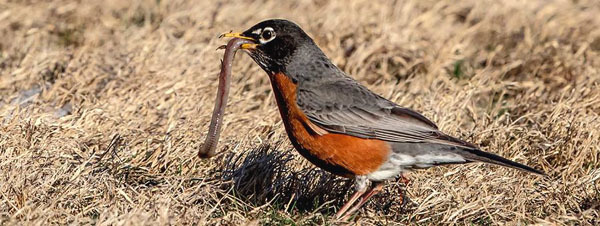
[Croton Point is well known for its ancient oyster shells (Crassostrea virginica), many that date to 4,000 years ago when the salinity regime in the estuary was optimal for their growth. The empty shells that have eroded out of middens are the residue of Native American harvesting at a time when the water quality was near pristine. Tom Lake.] [With warm, dry summers and autumns, as well as relatively high salinities, the Tappan Zee remnant wild reefs oyster population, ten miles downriver, has been doing very well. We monitor recruitment as far north as Irvington (river mile 25) and each year in the early fall we observe a pulse in newly settled spat (larvae) upriver. The Croton Point oysters could very well be an extension of that recruitment. Katie McFarland, Cornell University.] NATURAL HISTORY NOTES 3/11 – Stanfordville, HRM 84: The fox sparrow “migration bus” made a stop here today. Now there were four scraping away, foraging, near the shrubs, along with over 100 mixed blackbirds: grackles, brown-headed cowbirds, red-winged blackbirds, and a few starlings. 3/11 – Brockway, HRM 62: It was a brutally cold morning (18 degrees Fahrenheit) at bald eagle nest NY377. The wind chill made it feel below zero. As we arrived, two adults were flying away from the river and disappeared over the hill. The nest was still a robust image in the tall cottonwood, but no one was home. If this pair is to incubate eggs, they might wait for a break in the weather. 3/12 – Ulster County, HRM 85: With frigid overnights, the edges of the Wallkill’s Sturgeon Pool had begun to ice up again. I was checking on bald eagle nest NY92, looking for any activity that might suggest the nest would be active this season. There were loads of ring-necked ducks as well as hooded and common mergansers on the pool. One of the adult eagles was perched near the nest before flying into the woods. A few minutes later a wild turkey came out of the woods with the eagle right on its tail! The eagle broke off the pursuit and returned to its perch. 3/12 – Town of Poughkeepsie: We put in a six-hour shift today watching bald eagle nest NY62. There were two “turnovers,” so we still had hopes this was truly incubating (this would be Day 7). It was nice to see the eagles doing “proper” exchanges; early on they seemed to be tentative. And, super exciting was to see the robins out hunting for worms—there must have been 30 of them! [See banner photo of robin with earthworm courtesy of Debbie Quick.] 3/12 – Fort Montgomery, HRM 46.5: I was walking in woods near the river just north of Mine Dock Park today with my dog when we kicked up a lone woodcock. It appeared to be breaking apart a big piece of fungus, looking for bugs. I thought this might be a little early for them.
3/13 – Rensselaer County, HRM 172: I spotted a cackling goose along with a snow goose amid a huge flock of Canada geese across the Hudson River from Stillwater. Drove over the river into Saratoga County for better look and spotted seven wood ducks. [The newly recognized cackling goose (Branta hutchinsii) is a smaller version of the Canada goose. Formerly considered the smallest subspecies of one variable species, recent work on genetic differences found the four smallest forms to be very different. These four races are now recognized as a full species: the cackling goose. It breeds farther northward and westward than does the Canada goose. Cornell Lab of Ornithology.] 3/13 – Town of Poughkeepsie: We watched today as one of the adults was incubating in bald eagle nest NY62. The first change-over—Dad replaced Mom?—occurred in mid-afternoon. We were still struggling to decide which one of them is the male and which one is the female. As in all nests where the birds are unbanded, it comes down to behavior, and as we learned with N42, behavior can be misleading. At day’s end, we think Mom settled in for the overnight shift. [As had been stated many times, NY62 is just one of several dozen bald eagle nests along the river. We frequently cite NY62 as typical of most nests because this nest gets thorough daily monitoring. However, what occur at NY62 is also occurring at most other nests. Tom Lake.] 3/13 – Croton Point, HRM 35: The ebb tide was halfway out mid-afternoon when I saw a harbor seal basking in the sun on top of a rock at Enoch’s Neck on the north side of Croton Point. The seal was light-colored and rather small. The seal was lying in their typical “reclining banana” posture that observers often mistake for a seal in distress. I kept my distance but it must have felt uneasy at seeing me because it slipped into the water and dove off. [Over the last twenty-three years, we have had four species of seals recorded in the Hudson River watershed: gray, harbor, hooded, and harp seals. The overwhelming majority of sightings have been harbor seals, with Almanac records of them as far upriver as Troy (river mile 153). Harbor seals are spotted most often in winter on ice floes or in spring when the spawning runs of herring and shad surge in from the sea. Tom Lake] 3/14 – Hudson Valley: By most measures, it was a blizzard—a day of relentless snow driven by strong and sustained north winds, the windchill near zero. It was a strong nor’easter that created blizzard conditions in the Hudson Valley. Snowfall totals ranged from 22 inches in the Town of Wappinger (Dutchess County), to 24 inches in Otisville (Orange County), to 33 inches at West Shokan (Ulster County). Some areas elsewhere in the watershed received three feet of snow. 3/14 – East Hoosick, HRM 172: It was the day after the blizzard and while no new species showed up at our feeders, we were delighted to count 19 northern cardinals (nine male, ten female).They looked splendid against the snow. 3/14 – Milan HRM 90: A small weasel come onto my porch, right to the door, during the height of the blizzard. The weasel was all white except for a black tip of its tail and a black stripe down its back. [Determining the species of this weasel (Mustelids) was a challenge. The least weasel is nearly unknown from the Hudson River Valley, so our best guess is that it was either a short-tailed (Mustela erminea) or a long-tailed weasel, with a lean toward the former. The fur of all three species (often referred to as ermine) becomes white in winter as an adaptation for survival in a season of snow. - Tom Lake] 3/14 – Clintondale, HRM 75: While watching the blizzard through the window, I was very surprised to see two female evening grosbeaks land in the nearby tree. I grabbed my binoculars and saw that there were five in the tree, all female. They stayed for some time, feeding on maple seeds that were still clinging to the tree. The grosbeaks eventually flew off but I could hear them, or others, calling from nearby evergreens. 3/14 – Millbrook, HRM 82: The blizzard was wild and woolly! A large flock of grackles, red-winged blackbirds, brown-headed cowbirds, and some starlings attacked the feeders. Four rusty blackbirds, 75-100 American goldfinches, and a modest number of juncos (one was nailed by a Cooper’s hawk) were also coming to the feeders. Remarkably, a wood duck flew past the house at eye level, obviously disoriented in the blizzard conditions. 3/14 – Manhattan, HRM 2: During a mid-afternoon low tide, we sampled water quality parameters at The River Project’s Pier 40 research site in Hudson River Park. We wanted to compare today’s values with those collected March 2 at Pier 25. Today’s results: 70 centimeters turbidity (170 on 3/2), 14.0 parts-per-thousand salinity (4.0 on 3/2), 4.0 degrees Celsius/40 degrees F water temperature (6.0 degrees C on 3/2), and dissolved oxygen of 7.0 parts-per-million (7.2 ppm on 3/2). 3/15 – Minerva, HRM 284: Yesterday’s blizzard rewarded local students with a day off school! Snowfall totals were about 24 inches of light, fluffy white stuff. My “sugar bush” (sugar maple sap into syrup) was going well a couple of weeks ago (we made a modest amount). Then a freeze came, followed by some warmth, then a serious freeze for the last week. As a result our sap flow has been wildly inconsistent. 3/15 – Stillwater, HRM 171.5: I did a brief survey of the river in late afternoon and counted 23 bird species. Among them were Canada geese (260), a yellow-bellied sapsucker, a northern flicker, and two green-winged teal napping on the ice shelf. 3/15 – Scarborough, HRM 32: The blizzard brought many birds to our feeders yesterday and they ate like it was their last meal. Today, during a lull in their frenzy, a red fox came by to snuffle up all the seed that was the spilled in the snow.
3/16 – Eastern Dutchess County, HRM 84: In early afternoon, I came upon a huge assemblage of birds. I estimated that the flock contained more than 400 horned larks and at least one snow bunting. 3/16 – Manhattan, HRM 1: It was windy in mid-afternoon as we stomped through the deep snow to check our collection gear at the River Project’s sampling station on the lighthouse tender Lilac at Hudson River Park’s Pier 25. The pots and traps were nearly empty. Our very modest catch included shore shrimp (4), amphipods (2), and an isopod. Out most exciting find was some lovely green algae growing on our ropes and ties. 3/17 – North Bennington, Vermont, HRM 172: Perhaps it was the Luck o' the Irish that had us spot a pair of hooded mergansers floating down Lake Paran Creek. That white patch on the crest of the drake really got our attention. Paran Creek flows into the Wallomsac and then into the Hoosick River where it meets the Hudson River in Washington County. Although we live in Vermont, we are still in the Hudson River watershed. 3/17 – Fort Edward, HRM 202: There were plenty of short-eared owls at the Fort Edward Grasslands today along with at least one red-tailed hawk, a rough-legged hawk, and a northern harrier. The blizzard seemed to have spread the owls out a little more as I saw them in several locations. 3/17 – Wappinger Creek, HRM 67.5: With bitter cold nights, ice had reformed on the lower one-mile reach of the tidal Wappinger. Here and there were open leads where the tide and current had worked on the thin ice. There is a recurring mystery with eagles and waterfowl: At times ducks and geese will explode in pandemonium with the slightest hint of an eagle in the area; at other times waterfowl seem relaxed with an eagle in close proximity. Today was one of the latter. We counted two dozen Canada geese closely huddled on the ice and in the water, while not more than 100 feet way two eagles, one adult and one immature, shared a small patch of ice (the immature had an orange band on its leg; a wintering bird from Massachusetts). When we left, none of the participants showed any inclination to do anything more than just loaf in the midst of steadily falling snow flurries. 3/17 – Town of Poughkeepsie: Throughout the day we witnessed several change-overs by the adults incubating in bald eagle nest NY62. Several times one of the adults brought branches to the nest and fit them in, often around the other adult already in the nest. In the wake of the loss of the original male (N42), we are still in the learning stages of figuring out the male and female. Along the way, we also spotted a pair of peregrine falcons. 3/17 – Croton Point, HRM 34.5: As I walked over the snowy Croton Point landfill I saw three snow buntings on the path ahead. As I walked along they took off and returned to the path behind me. Three red-tailed hawks were floating on thermals overhead, their undersides bright and white against the clear blue sky. 3/17 – Manhattan, HRM 2: During an early afternoon ebb tide, we sampled water quality parameters at The River Project’s Pier 40 research site. We wanted to compare today’s values with those collected on March 14 at Pier 40. Today’s results: 60 centimeters turbidity (70 cm on 3/2), 6.0 parts-per-thousand salinity (14.0 on 3/2), 3.0 degrees C/38 degrees F water temperature (6.0 degrees C. on 3/2), and dissolved oxygen of 8.0 parts-per-million (7.0 ppm on 3/2). The icy runoff from the blizzard had dropped the water temperature five degrees Fahrenheit. 3/17 – Manhattan, HRM 2: In mid-afternoon we went to check our collection gear at The River Project’s Pier 40 research site. We were getting close to our field trip season so we set up our Pier 40 traps again. Unfortunately, the eight killifish traps and two crab pots were completely and utterly empty. SPRING 2017 NATURAL HISTORY PROGRAMS Saturday, April 1: 10:00 AM HUDSON RIVER MILES The Hudson is measured north from Hudson River Mile 0 at the Battery at the southern tip of Manhattan. The George Washington Bridge is at HRM 12, the Tappan Zee 28, Bear Mountain 47, Beacon-Newburgh 62, Mid-Hudson 75, Kingston-Rhinecliff 95, Rip Van Winkle 114, and the Federal Dam at Troy, the head of tidewater, at 153. The tidal section of the Hudson constitutes a bit less than half the total distance – 315 miles – from Lake Tear of the Clouds to the Battery. Entries from points east and west in the watershed reference the corresponding river mile on the mainstem. TO CONTRIBUTE YOUR OBSERVATIONS OR TO SUBSCRIBE Smartphone app available for New York outdoor enthusiasts! Copies of past issues of the Hudson River Almanac, Volumes II-VIII, are available for purchase from the publisher, Purple Mountain Press, (800) 325-2665, or email purple@catskill.net |
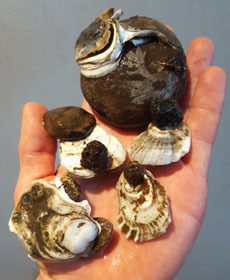 3/13 – Croton Point: I was walking around the Point at low tide this evening and came upon live oysters, one after another, not thousands, but maybe a few per square meter along that depth line. [Due to the vulnerability of these shellfish to illegal harvest in uncertified waters, the exact location is not stated.] [Photo of oysters courtesy of Gareth Hougham.]
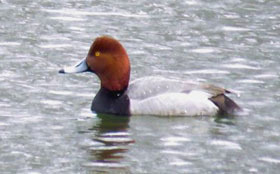 3/13 – Saratoga County, HRM 182: A lot of waterfowl had moved into Saratoga Lake in the last three days. With deep cold and strong winds, large swathes of the lake were frozen over again. A large raft of waterfowl was spread out in open water in the middle of the lake. I totaled 18 bird species in my survey of three locations this afternoon: Manning Cove, Riley Cove and Silver Beach. Among them were common mergansers (120), hooded mergansers (95), mixed scaup (72) with one redhead duck, and a white-winger scoter. [Photo of redhead courtesy of Carena Pooth.]
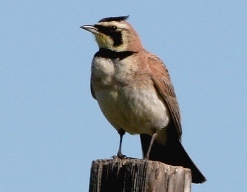 3/16 – Washington County, HRM 205: Everywhere we drove today produced snow buntings and horned Larks. The largest and most impressive flock was in Kingsbury near a working farm. We conservatively estimated 1,000 snow buntings, 200 horned larks, and a few Lapland longspurs feeding in a field with freshly-spread manure. [Photo of horned lark by Dave Herr, courtesy U.S. Fish and Wildlife Service.]
|
The New York State Department of Environmental Conservation respects your right to privacy and welcomes your feedback. | Update preferences or unsubscribe. | Learn more about DEC Delivers. |
|
Connect with DEC:   
|
 |
| NOW AVAILABLE: Receive DEC's Twitter feed via email. | |
| Andrew M. Cuomo, Governor * Basil Seggos, Commissioner | |