
Hudson River Almanac 9/23/16 - 9/30/16
The New York State Department of Environmental Conservation sent this bulletin on 10/07/2016 05:29 PM EDT |
| DEC Delivers - Information to keep you connected and informed from the NYS Department of Environmental Conservation |
| Share or view as a web page || Update preferences or unsubscribe |
|
|
|
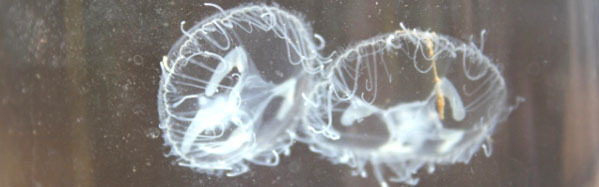
Our first week of autumn saw the last of our ruby-throated hummingbirds until next spring. Hawk migration was off to a sputtering start, though falcons seemed on schedule. The first cold touches of winter hit the High Peaks of the Adirondacks, while dry weather allowed the salt front to creep up the Hudson to Poughkeepsie. HIGHLIGHT OF THE WEEK 9/26 – Newcomb, HRM 302: We had our first hard frost of the season this morning. There were scattered pockets of frost yesterday morning but today it was necessary to scrape the windshields and mourn the garden flowers. We are also at season’s end for our local common loons. Of the six lakes that we monitor for loons, only one pair was successful in rearing chicks this summer. The other lakes had nesting attempts but they failed due to lowering water levels and egg predators. The adult loons were now leaving the Adirondack lakes, migrating to the Atlantic coast to spend the winter. NATURAL HISTORY NOTES 9/23 – Columbia County, HRM 118: Yesterday I spotted a banded Canada goose (1038-71914) mixed with about 20 other Canada geese at the Hudson-Cedar Park Cemetery Pond. Most of them appeared to be this year's young with only a few adults. The banded bird, an adult, was the largest and was walking on the lawn along the edge of the pond. I reported the band number to the NYSDEC. [This Canada goose, a male with band number 1038-71914, was banded at nearby Hudson as a young-of-the-year (too young to fly) in 2009 by Joshua C. Stiller. NYSDEC, U.S. Geological Survey Band Report.] 9/23 – Claverack, HRM 118: I saw my first V-formation of Canada geese for the season, flying way up high over Claverack, migrating south. 9/23 – Ulster County, HRM 85: I got to watch another kettle forming today, this time at Sturgeon Pool on the Wallkill River. I went there to see if any winter ducks had arrived when I saw a few broad-winged hawks circling over. Within another minute there were seven. They slowly drifted over the pool and were joined by a few more from different directions. Before they drifted away, there were 25 of them. [“Kettle” is a birding term that describes an aggregation of birds, usually raptors or vultures, often circling overhead in warm, rising thermals. The circular upward movement of the group appears like a cauldron of birds being “stirred” by the wind, thus a kettle. While kettles can occur almost any time of the year, they are particularly common during fall migration. Tom Lake.] 9/23 – Ulster County, RM 76: I was fishing in Tillson Lake today and came upon thousands of freshwater jellyfish (Craspedacusta sowerbyi) dancing just under the surface of the very calm water. They were concentrated at the south end of the lake over a sandy bottom with minimal aquatic vegetation. I scouted around the entire lake for other “pockets” of jellyfish but no others were to be found. [See banner photo of freshwater jellyfish courtesy of Chris Bowser.] [The freshwater jellyfish is best identified as a small, bell-shaped jellyfish known as a hydromedusa. This jellyfish is native to the Yangtze River valley in China where it is called the “peach blossom fish.” It was probably transported from its native region to North America with ornamental aquatic plants, especially water hyacinth. Tom Lake.] 9/23 – Bedford, HRM 35: It was a very slow day for migrants at the Chestnut Ridge Hawkwatch, bizarrely so for the time of year. Nine sharp-shinned hawks were high count among 22 raptors. Among the non-raptor observations were 60 cedar waxwings, ten monarchs, and five ruby-throated hummingbirds.
[Sandy Hook, New Jersey, borders on the Lower Bay of New York Harbor and is either the beginning or the end of the Hudson River watershed, depending upon your perspective. Migrants, from fish to songbirds to raptors to butterflies, closely follow the coastline in autumn and springtime, making Sandy Hook an important waystation in and out of the watershed. Tom Lake.] 9/24 – Newcomb, HRM 302: This was our annual visit to various lakes in Newcomb for my SUNY-ESF Fisheries Science Practicum class. Our day-one target was Arbutus Lake where my students and I have been sampling since 1999 and where, with good records on my part since 2003, we were seeing some strong changes. Arbutus Lake used to be loaded with brown bullhead. In the 1960s, the lake was treated with rotenone (a piscicide, used to control unwanted species of fish) in an effort to make conditions more suitable for brook trout, but the bullheads persisted. In 2003-2005, I had students set two overnight trap nets that we would pick the next day. There would be thousands of brown bullheads and just about nothing else. This year, with the same sampling strategy, we caught one small brown bullhead and one brook trout. Piecing together my records and those of one of my colleagues, Arbutus Lake may have been losing brown bullhead since 2007 without our really noticing it. 9/24 – Town of Bethlehem, HRM 141: We put in at the DEC launch at Henry Hudson Park in Bethlehem and were immediately treated to an adult bald eagle perched in a tree on the opposite shore. As we cruised down the river behind Houghtaling Island, we came upon so many adult and immature eagles that we lost count. Twice we saw an adult harass an immature that had caught a fish, causing the bird to drop it. The adults then swooped down to collect the booty. As we proceeded back upstream under the New York Thruway Bridge, we saw two peregrine falcons zooming through the sky in pursuit of a hairy woodpecker. The woodpecker was forced to the water under the bridge in a desperate and futile attempt to escape. One of the falcons caught its prey and we watched as the raptor carried it off not more than 50 feet from our stern. 9/24 – Peekskill, HRM 43: It was a good day for carp fishing at Peekskill’s Riverside Park. I caught and released two carp, 15 pounds 2 ounces and 14 pounds 1 ounce. I also lost a couple of others that I imagine were carp. There are a lot of rocks strewn about in the shallows and sometimes a larger fish will pull your line over a rock and cut the line. The fish survive because the sinker drops off once the line is severed, and the hook rusts away. 9/24 – Bedford, HRM 35: We had perfect conditions for migration–cold front, northeasterly wind–at the Chestnut Ridge Hawkwatch today, but a surprisingly low number of birds moved through. High count was 35 broad-winged hawks. A family of ravens mobbed a few broad-winged hawks first thing in the morning, making their migration difficult. Among the non-raptor observations were 60 cedar waxwings and one monarch. 9/24 – Croton Point, HRM 35-34: It was a breezy, clear sky, perfect morning on Croton Point– some alone time after a week of work. Autumn was here as I spotted the first flock of American pipits (20 birds) on the landfill. There were no fewer than eight American kestrels there as well. 9/24 – Manhattan, HRM 2: Chris Anderson, A former staff member of The River Project, came back today to dive in the river at Pier 26 as a part of the Hudson River Park’s SUBMERGE festival. While diving, he hand-caught a large lined seahorse (130 mm). [SUBMERGE is a free New York City marine science festival produced by the Hudson River Park Trust to promote better understanding our coastal waters. Jacqueline Wu.] 9/25 – Newcomb, HRM 302: Today, our SUNY-ESF Fisheries Science Practicum class set nets in Deer and Wolf lakes. Wolf Lake has a reputation as a “heritage lake,” with an undisturbed watershed and no non-native fishes. As a result, we were very surprised when our 500 micron plankton net captured non-native freshwater jellyfish. They were blooming like crazy in the lake. We quickly figured out what they were and that they were now fairly widespread and reported from a lake nearby. Needless to say, Wolf Lake has lost its reputation as a pristine lake. We also wonder if this critter is the reason why the lake has been very green for the last two years (trophic effects?) and why the fish numbers were way down as well (zero catch in the trap net). These are cases of strong changes happening without good monitoring in place – aquatic biology has largely been ignored. We are trying to figure out how to jump start some much needed monitoring. Our students were very intrigued with the possibility that they were witnessing climate change in action. 9/25 – Saratoga County, HRM 177.5: A dozen birders showed up at the Saratoga Historic Park and Battlefield for our annual birding trip. In colorful fields of goldenrod, aster, and thistle, we found song and field sparrows, common yellowthroat, and numerous American goldfinches, with juveniles making begging calls. We saw large flocks of Canada geese and three wood ducks flying overhead. Groups of blue jays (40) were also on the move. By the time we crossed the Park Loop Road we had already seen or heard five woodpecker species: downy, pileated, red-bellied, northern flicker, and yellow-bellied sapsucker. A hairy woodpecker spotted climbing up a birch tree made it a full “woodpecker six-pack.” All together, we counted 40 species. 9/25 – Poughkeepsie, HRM 75: It is that time of year when we get to appreciate the wildlife right where we live. It pleases me so when I see our red fox, puffed up and healthy, trot over the green on the golf course behind our house. The wild turkeys were roosting in the trees and we enjoy their awkward flight up into the branches each twilight. 9/25 – Bedford, HRM 35: It was another day with great conditions and potential at the Chestnut Ridge Hawkwatch but broad-winged hawks (34) were just not passing through in big numbers (at least not here). We did however see our first (early) golden eagle of the season. Among the non-raptor observations were 30 cedar waxwings, two monarchs, and one ruby-throated hummingbird. 9/25 – Hastings-on-Hudson, HRM 21.5: As part of the Billion Oyster Project Hastings High School has an oyster station at the Science Barge in Yonkers as well as one in Hastings-on-Hudson. Today we found a small (45 mm) oyster toadfish (Opsanus tau) as a stowaway in the Hastings cage.
9/26 – Upper Bay, New York Harbor: There have been (unsubstantiated) angler reports of little tunny (Euthynnus alletteratus) inside the Narrows of the Upper Bay of New York Harbor. While “false albacore” are not on our watershed fish list, it would not be surprising if they made an occasional visit. In Chesapeake Bay they are known to occasionally venture inland into brackish water. [The little tunny is the most common tuna in the Atlantic Ocean. It is found in warm temperate and tropical waters of the western Atlantic ranging from Brazil to the New England. Occurring in large schools and weighing up to 36 pounds, it is one of the smaller members of the tuna family. Tom Lake.] 9/27 – North River, HRM 263: Our apple trees were filled with ripe fruit and the white-tailed deer were enjoying them. Also enjoying our yard was a single wild turkey, a tom, as well as a gray fox and a pine marten. The beavers were busy creating more dams in the creek across the road. I always enjoy seeing them but lately I've only heard an occasional slap on the water to know they are still there. 9/27 – Germantown, HRM 108: I was about to take down my main hummingbird feeder since I've had no hummers here for a week. I reached up and looked out over my garden to see a hummingbird moth going from zinnia to zinnia. I walked closer and watched it, unperturbed, sampling but returning to one big red bloom. I'm not sure if that's coincidental or not. Several years ago I had a hummingbird moth on red monarda flowers. I did leave up one small hummingbird feeder on a basket of red geraniums. 9/27 – Rhinebeck, HRM 90: I happened to be looking out the window this afternoon when a single female ruby-throated hummingbird made a quick stop at the feeder. I've put out a fresh supply of nectar in case there might be other hummers heading south. 9/27 – Bedford, HRM 35: This was an aberrant day for raptor migration at the Chestnut Ridge Hawkwatch. Single digit migrants (4) in late September? Among the non-raptor observations were two monarch butterflies. 9/28 – Kowawese, HRM 59: For the first time in what seemed like all summer, the river was warmer (72 degrees F) than the air (66 degrees F). Heavy clouds and a strong east wind blowing in our faces suggested a significant change in the weather. The rollers on the beach kept twisting the seamlines of our seine, making our hauls doubly tough. Through it all – seining is not always simple – we managed to beach our twisted net, dumping half the catch in the swash in the process. In spite of all that, our haul was impressive, consisting of entirely of young-of-the-year fishes: alewife (64-66 mm), American shad (91-95 mm), bluefish (114-117 mm), Atlantic menhaden (74-118), and striped bass (67-75 mm). The salinity was holding steady at 3.5 ppt. 9/28 – Bedford, HRM 35: It was a blustery day of steady winds to 17 miles-per-hour from the north and east at the Chestnut Ridge Hawkwatch. Birds struggled in the wind, even though it was blowing from auspicious directions for migration. High count among 17 raptors were eleven sharp-shinned hawks. Among the non-raptor observations were two monarch butterflies. 9/28 – Manhattan, HRM 1: It was extremely windy when we checked our collection gear at The River Project’s sampling station on the lighthouse tender Lilac at Pier 25 in Hudson River Park. The crab pots held three small tautog (blackfish), measuring 32-34 mm. A bit of a surprise was a 190 mm scup (porgy). We had two more skilletfish (15-20 mm) in the killifish traps, two oyster toadfish (45-110 mm), three (quarter-sized) spider crabs, and lots of comb jellies. 9/29 – Saugerties, HRM 102: I was very surprised this late in the season to see a female ruby-throated hummingbird perched in a very old white cedar that graces our stone patio. I had left a hummingbird feeder up next to the tree. 9/29 – Bedford, HRM 35: The windiness made it difficult again today for migrants at the Chestnut Ridge Hawkwatch, although a few more pushed through than yesterday. Local red-tailed hawks seemed to enjoy the gales, and a red-tail/red-shouldered hawk “fighting pair” was observed throughout the day. Among the non-raptor observations were 20 cedar waxwings. 9/29 – Manhattan, HRM 2: While going through our horseshoe crab tank inside our River Project Wet Lab at Pier 40, we found a skilletfish (40 mm), an Atlantic silverside, and a juvenile winter flounder. All three fish were unexpected “bonus” fish that had snuck in from the river via our flow-through system.
9/30 – Rhinebeck, HRM 90: I just received the weekly Hudson River Almanac and read the entry on the American chestnut. I’ve been watching a similar clump of American chestnut “trees” close to my home, accessible from a town road. 9/30 – Poughkeepsie, HRM 77: The Hudson River Environmental Conditions Observing System [HRECOS] sensors at Marist College have recorded increasing salinity since the middle of September. In shallow water near shore, salinity reached .36 practical salinity units [psu] - basically equivalent to parts-per-thousand - this morning as the flood current ended. During the ebb that followed, salinity dropped to .19 psu. The U.S. Geological Survey locates the salt front – the leading edge of dilute seawater entering the Hudson – where chloride concentration reaches 100 milligrams per liter [mg/L]. Converting the readings to milligrams per liter of chloride, the salinity this morning was about 200 mg/L at its highest, 105 mg/L at its lowest. Lack of widespread, substantial rain has reduced runoff from the Hudson’s watershed, allowing seawater to reach Poughkeepsie.
9/30 – Bedford, HRM 35: The wind, brisk and moderately strong from the northeast, made flight difficult for all birds today at the Chestnut Ridge Hawkwatch. Visibility was quite low due to low-hanging clouds and fog on the horizon. Our count included only two sharp-shinned hawks. FALL 2016 NATURAL HISTORY PROGRAMS Wednesday, November 8: 7:00 PM HUDSON RIVER MILES The Hudson is measured north from Hudson River Mile 0 at the Battery at the southern tip of Manhattan. The George Washington Bridge is at HRM 12, the Tappan Zee 28, Bear Mountain 47, Beacon-Newburgh 62, Mid-Hudson 75, Kingston-Rhinecliff 95, Rip Van Winkle 114, and the Federal Dam at Troy, the head of tidewater, at 153. The tidal section of the Hudson constitutes a bit less than half the total distance – 315 miles – from Lake Tear of the Clouds to the Battery. Entries from points east and west in the watershed reference the corresponding river mile on the mainstem. TO CONTRIBUTE YOUR OBSERVATIONS OR TO SUBSCRIBE Smartphone app available for New York outdoor enthusiasts! Copies of past issues of the Hudson River Almanac, Volumes II-VIII, are available for purchase from the publisher, Purple Mountain Press, (800) 325-2665, or email purple@catskill.net |
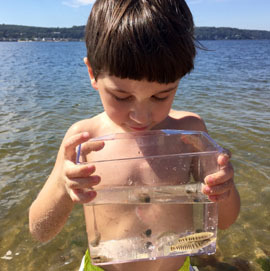 9/23 – Sandy Hook, NJ: Although Sandy Hook Bay is open to the sea, the water was diluted enough from upland freshwater to lower the salinity to 30 parts-per-thousand [ppt]. (Seawater at this latitude averages 32-35 ppt.) The bay was warm (76 degrees Fahrenheit) and so inviting that we could have seined all day. The near-shore shallows were teeming with fish and we soon discovered that most of them were Atlantic silverside 70-125 millimeters [mm] long. Beach walkers were dazzled by their silver stripes in the bright sunshine. Swimming through beds of bright green sea lettuce (Uva lactuca) were schools of striped killifish (55-75 mm). The vertical orientation of their stripes gave them away as males. The only unexpected fish was a 43 mm Florida pompano (Trachinotus carolinus). This member of the jack family of fishes is an uncommon late-summer tropical stray. [Photo of boy holding aquarium containing striped killifish courtesy of Tom Lake.]
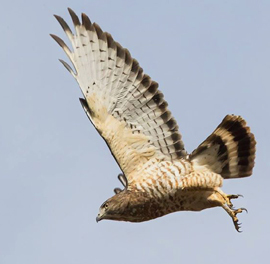 9/26 – Bedford, HRM 35: We had a short and exciting burst of broad-winged hawks (237) in the early morning at the Chestnut Ridge Hawkwatch that stopped abruptly in late morning. A solid sharp-shinned hawk flight (66) was mostly confined to the morning as well. Our ten bald eagles, however, were scattered throughout the day. Among the non-raptor observations were 104 Canada geese and four monarchs. [Photo of broad-winged hawk courtesy of Bob Rightmyer.]
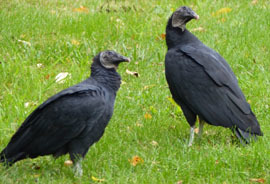 9/30 – Columbia County, HRM 126: I spotted four magnificent black vultures on the road near the sign for Borden’s Pond Preserve. They were feeding on (sharing) a gray squirrel carcass. [Photo of black vultures courtesy of Nancy Castaldo.]
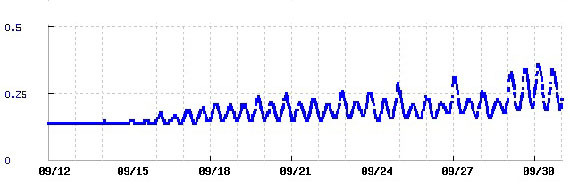 [This HRECOS graph shows salinity rising and falling as flood and ebb currents flow past near-surface sensors at Marist College, and also an increase in salinity here from about 9/15/16 through 9/30/16. Steve Stanne.]
|
The New York State Department of Environmental Conservation respects your right to privacy and welcomes your feedback. | Update preferences or unsubscribe. | Learn more about DEC Delivers. |
|
Connect with DEC:   
|
 |
| NOW AVAILABLE: Receive DEC's Twitter feed via email. | |
| Andrew M. Cuomo, Governor * Basil Seggos, Commissioner | |