|
OVERVIEW
September in the Hudson Valley means waves of migrating broad-winged hawks, sharp-shinned hawks, and the last of our ruby–throated hummingbirds. Note that waterfowl hunting season opens October 1 in the Southeastern Zone (Mohawk River and lower Hudson Valley).
HIGHLIGHT OF THE WEEK
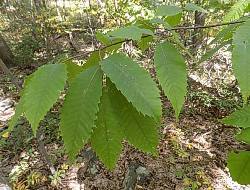 9/16 – South Mount Beacon, HRM 60: At 1635 feet, the highest point in the valley between the Catskills and the sea, I rediscovered a small stand of American chestnut trees (Castanea dentata) nestled within a forest of red oaks. When I first came upon these small trees eight years ago, the largest had a circumference of eight inches. The largest I found today were 11 inches, or 3.5 inches diameter-breast-height (DBH). [Photo of American chestnut leaves courtesy of Tom Lake.] 9/16 – South Mount Beacon, HRM 60: At 1635 feet, the highest point in the valley between the Catskills and the sea, I rediscovered a small stand of American chestnut trees (Castanea dentata) nestled within a forest of red oaks. When I first came upon these small trees eight years ago, the largest had a circumference of eight inches. The largest I found today were 11 inches, or 3.5 inches diameter-breast-height (DBH). [Photo of American chestnut leaves courtesy of Tom Lake.]
-Tom Lake
[At the time of European contact, more than a quarter of the hardwood trees east of the Mississippi River were American chestnut. In 1876, blight-resistant Japanese chestnut trees carrying the pathogenic bark fungus (Cryphonectria parasitica) were imported to New York City. But it was not until 28 years later (1904) that the first effects of the chestnut “blight” were discovered in New York State. In the first half of the 20th century, it is estimated that as many as four billion American chestnut trees died.
Despite its decimation, the American chestnut has not gone extinct. The species has survived by sending up stump sprouts that can grow for many years but inevitably succumb to the blight and die. The chestnut trees I found today were actually sturdy sprouts from blighted trees whose remaining stumps were below the forest floor, out of the reach of the bark fungus.
– Tom Lake]
[The most recent USDA Forest Service survey for New York State indicated that there are many of these sprout clumps in New York State and that they represent a rich gene pool for a restoration effort that is currently underway. - William Powell, SUNY ESF]
NATURAL HISTORY NOTES
9/16 – Selkirk, HRM 135: Just for the record, I noted my last ruby-throated hummingbird of the season today, a large female. She stopped for a long drink and headed south. It is time to bring in the feeders for a thorough cleaning until next spring.
- Roberta Jeracka
[Female ruby-throated hummingbirds are the last to arrive in the spring and the last to leave in the fall. - Tom Lake]
 9/16 – Greene County, HRM 105: I was camped on an overlook above Plattekill Clove. The sky was perfectly clear to the east over Saugerties and the Hudson Valley when moonrise came at 7:11 p.m. It was not only a full moon but a spectacular “Harvest Moon,” the full moon nearest the Autumnal Equinox that will occur on September 22. [Photo of full moon courtesy of Deborah Tracy-Kral.] 9/16 – Greene County, HRM 105: I was camped on an overlook above Plattekill Clove. The sky was perfectly clear to the east over Saugerties and the Hudson Valley when moonrise came at 7:11 p.m. It was not only a full moon but a spectacular “Harvest Moon,” the full moon nearest the Autumnal Equinox that will occur on September 22. [Photo of full moon courtesy of Deborah Tracy-Kral.]
- Milo Tsukroff
9/16 – Esopus Meadows, HRM 87: I spotted a pair of broad-winged hawks this morning flying above the tree line. Soon more joined in, coming up out of the trees below and from all directions. I counted 36 in the first formation and then another group with 23 birds. A short while later a third squadron came over the river from the north that had 20 hawks. Eventually all three seemed to join and slowly circle off to the southwest over land. An immature bald eagle flew with them for a short while.
- Jim Yates
9/16 – Orange County, HRM 44: We have always had wild turkeys visit our feeders in the winter and spring, but now the young birds had grown up and this week two females lead their flock of eight back to the same feeders. We were able to watch them peck and scratch away undisturbed for at least a half hour as they rummaged for the seeds kicked out by smaller songbirds. The squirrels, doves and others birds move away until the flock decides to move on. Every now and then, one of the adults will take off in a short, low level flight with flapping wings blowing leaves in their wake. Somehow they seem to have avoided the fox who also shares the nearby forest with them.
- John M. Zahradnik
9/16 – Bedford, HRM 35: It was a good day for migrating osprey (14), sharp-shinned hawks (18), and broad-winged hawks (11) at the Chestnut Ridge Hawkwatch. Among the non-raptor observations were 55 cedar waxwings, eight ruby-throated hummingbirds, and 16 monarch butterflies.
- Anna Butler, Allen Kurtz, Brendan Popp, Ed Williams
9/16 – Manhattan, HRM 2: We had a “smack” of ctenophores (comb jellies) moving past our floating dock in midday at The River Project’s sampling site on Pier 40. However, the water got choppier throughout the day and they were no longer visible by late afternoon.
- Jacqueline Wu
[A large group of jellyfish is often referred to as a “smack.” However, since ctenophores (comb jellies) are not true jellyfish, we more often tend to use the term “swarm” for this phenomenon. Comb jellies swim by using groups of cilia that look like the teeth of a comb, thus “comb jellies.” The most common comb jelly in the estuary is Leidy’s comb jelly (Mnemiopsis leidyi). - Tom Lake]
9/17 – Essex County, HRM 287: We went hiking the beautiful Moxham Ridge Trail today north of Moxham Pond. I was hiking with 13 others as part of a Town of Minerva Youth Commission sponsored event. We had students from seven years of age up to adults. We took our time, searching the trees for birds, ground for critters, and under logs for all sorts of stuff. In particular, one 10-year-old girl with no fear of things you find under downed branches and tree trunks, was very interested in finding salamanders. On the trip to the end of the trail we found only one small red eft, but on the trip back we found numerous millipedes, another small eft, and a red-backed salamander that was particularly cool and slimy. Our young naturalist really enjoyed the red-backed and by the time we got to the trail head, she had become an expert in lifting up likely tree parts looking for moving things, and then carefully replacing them. We also found some spectacular fungi, including a stunning orange slime mold and equally stunning coral fungus.
- Mile Corey
9/17 – Albany County, HRM 144: The combined Hudson/Mohawk Bird Club and Helderberg Hawk Watch team field trip had surprisingly good results today considering unfavorable south winds. It was the best day of the season for migrating broad-winged hawks with 322 counted between 9:00 a.m. and 3:30 p.m. A pair of peregrine falcons have nested on a cliff face along the Helderberg Escarpment this year; we watched them zoom back and forth several times. A big surprise was a single common nighthawk that passed right over the site just after midday.
- Tom Williams, Gary Goodness, Don Gresens
9/17 – Bedford, HRM 35: A local red-shouldered hawk, a red-tailed hawk, and a broad-winged hawk antagonized each other across the sky throughout much of the day at the Chestnut Ridge Hawkwatch. We were still anticipating the big broad-wing hawk movement, but it didn't happen today. Among the non-raptor observations were 60 cedar waxwings, five ruby-throated hummingbirds, seven monarchs, and ten double-crested cormorants.
- Anna Butler, Allen Kurtz, Brendan Popp, Tait Johansson
9/18 – Albany County: Four of us endured a rainy beginning to the Fall Migrants field trip at the Albany Pine Bush Preserve–Karner Barrens East this morning. We were rewarded with a surprising amount of raptor activity once the precipitation subsided. The complexion of the day changed once the group reached the open, edge habitat toward the landfill. Suddenly raptors appeared from all directions. A northern harrier was first, flushing from the ground carrying a prey item, a Cooper's hawk flew into a snag, and shortly thereafter a second Cooper’s appeared. Up on the landfill, along the fence line, we counted at least four American kestrels zooming around and occasionally perching on various stick-ups. Finally, a sharp-shinned hawk flew by several times to get in on the action.
After a quiet mile of trail heading inbound to the Discovery Center, things erupted again, this time with falcons and blue jays. At least three American kestrels, a peregrine falcon, and a merlin were all interacting with hordes of blue jays, sometimes as the aggressor, other times in retreat. It was a dizzying display that lasted for a good five minutes before all the combatants moved off to the southeast.
- Tom Williams
[The Albany Pine Bush, one of the largest of the 20 inland Pine Barrens in the world, was formed thousands of years ago following the Late Pleistocene drainage of Glacial Lake Albany. Pine Bush Preserve (a state nature preserve) covers 3,100 acres and holds a remarkable 45 “Species of Greatest Conservation Need,” including 16 birds, 17 insects, and 12 reptile and amphibian species. It also supports 20 at-risk plant and animal species listed as rare or endangered by the state or federal government. The Pine Bush is home to the Karner blue butterfly, an endangered species first identified by Vladimir Nabokov in 1944 using a type specimen from the Pine Bush. - Albany Pine Bush Preserve Commission]
9/18 – Esopus Meadows, HRM 87: Ducks were starting to show up. We had two green-winged teal, three blue-winged teal, and a northern shoveler hanging out with the mallards. I counted eleven pied-billed. Last year my high count was 18. At least a half-dozen green herons were still here, but the great egrets were thinning out. I counted fewer than a dozen today. The ducks that had been ignoring eagle flyovers were now taking flight when they got close.
- Jim Yates
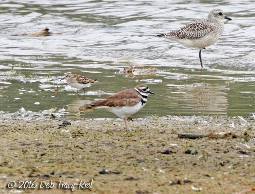 9/18 – Dutchess County, HRM 85: Jane Rossman first alerted us to the presence of an immature black-bellied plover at Round Pond in Amenia. These shorebirds are tundra breeders that will spend their winter along the coast. We were able to view the plover in late morning until the bald eagles arrived and strafed the ducks and shorebirds. The plover was in with killdeer, a lesser yellowlegs, and a least sandpiper. [Photo of black-bellied plover courtesy of Deborah Tracy-Kral.] 9/18 – Dutchess County, HRM 85: Jane Rossman first alerted us to the presence of an immature black-bellied plover at Round Pond in Amenia. These shorebirds are tundra breeders that will spend their winter along the coast. We were able to view the plover in late morning until the bald eagles arrived and strafed the ducks and shorebirds. The plover was in with killdeer, a lesser yellowlegs, and a least sandpiper. [Photo of black-bellied plover courtesy of Deborah Tracy-Kral.]
- Debra Tracy-Kral, Carena Pooth
9/18 – Kowawese, HRM 59: John Waldman’s enthusiastic Ecology students from Queens College were on the beach and eager to help haul our seine. The salinity read 3.5 ppt, the highest of the summer, so we had expectations. Our catch featured young-of-the-year (YOY) fishes including alewives (82-96 millimeters), heading to the sea, striped bass (67-100 mm), heading to saltier water down river, and the late summer predator-prey tandem of bluefish (115 mm) and Atlantic menhaden (96 mm). A dozen or more penny-sized blue crab scurried across the net onto the sand to make good their escape. The river was a warm 76 degrees Fahrenheit (F).
- John Waldman, Tom Lake
9/18 – Bedford, HRM 35: We had a very small mix of migrants at the Chestnut Ridge Hawkwatch today, led by osprey (3), merlin (3). American kestrel (2), and northern harrier (2). Among the non-raptor observations were 34 cedar waxwings, a ruby-throated hummingbird, and a monarch.
- Tait Johansson, Brendan Popp
9/19 – Town of Wappinger, HRM 67: Today was the last day I found ruby-throated hummingbirds at my feeders. One adult female took a long drink and then was on her way. Last year the final hummingbird left on September 26; the year before it was the 29th, and the year before that, September 25.
- Tom Lake
9/19 – Croton River, HRM 34: When I arrived here this morning it was still dark with light rain. I could make out white forms on the low tide mud flats of Inbuckie; I counted nine great egrets and two snowy egrets. A few minutes more and a little more light and the hulking forms of six great blue herons materialized out of the gloom. I looked outside in Croton Bay to see if I could add to my count but the big sand bar was vacant, and for good reason. In the dim light, an immature bald eagle loomed large. As I was leaving, two immature black-crowned night herons arrived to take up position in the cottonwoods overlooking the marsh.
- Christopher Letts
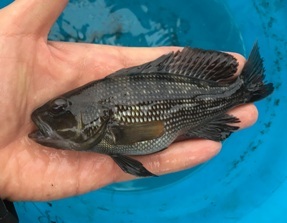 9/19 – Brooklyn, New York City: The Brooklyn Bridge Park Conservancy educators hosted the Macaulay Honors College BioBlitz along the East River. As many as 500 students participated. One component of the BioBlitz focused on aquatic life, in particular fishes. At the end of the day, we totaled our 24-hour catch of fishes numbering 15 species. In taxonomic order they were: American eel, Atlantic menhaden, bay anchovy, oyster toadfish, Atlantic silverside, northern sea robin, striped bass, black sea bass, scup (porgy), silver perch, northern kingfish, tautog (blackfish), cunner (bergall), naked goby, and seaboard goby. The silver perch (49 mm) and the seaboard goby (26 mm) were new species to the Brooklyn Bridge Conservancy’s fish list. The salinity was 26.0 parts-per-thousand (ppt), and the water temperature was 74 degrees F. [Photo of black sea bass courtesy of Peter Park.] 9/19 – Brooklyn, New York City: The Brooklyn Bridge Park Conservancy educators hosted the Macaulay Honors College BioBlitz along the East River. As many as 500 students participated. One component of the BioBlitz focused on aquatic life, in particular fishes. At the end of the day, we totaled our 24-hour catch of fishes numbering 15 species. In taxonomic order they were: American eel, Atlantic menhaden, bay anchovy, oyster toadfish, Atlantic silverside, northern sea robin, striped bass, black sea bass, scup (porgy), silver perch, northern kingfish, tautog (blackfish), cunner (bergall), naked goby, and seaboard goby. The silver perch (49 mm) and the seaboard goby (26 mm) were new species to the Brooklyn Bridge Conservancy’s fish list. The salinity was 26.0 parts-per-thousand (ppt), and the water temperature was 74 degrees F. [Photo of black sea bass courtesy of Peter Park.]
- Eliza Phillips, Isa Del Bello, Peter Park, Shad Hopson, Tom Lake
[A “bio blitz” is a 24-hour biological inventory whose goal is to find as many organisms as possible. Our "fish-focus" was the East River between the Brooklyn Bridge and the Manhattan Bridge. Conservancy. - Peter Park]
9/20 – Bedford, HRM 35: We had a decent push of broad-winged hawks today (61) at the Chestnut Ridge Hawkwatch. Beyond that we had ten osprey. Among the non-raptor observations were two monarchs and two ruby-throated hummingbirds.
- Anna Butler, Allen Kurtz
9/20 – Manhattan, HRM 2: When we checked our collection gear at The River Project’s sampling station on Pier 40, surprisingly we found no fish at all. But there were many, many shore shrimp (Palaemonetes sp.). We had not seen any shrimp in weeks.
- Elisa Caref, Melissa Rex
9/21 – Bedford, HRM 35: The anticipated big push of broad-winged hawks (197) finally arrived today at the Chestnut Ridge Hawkwatch along with 26 sharp-shinned hawks. Among the non-raptor observations were 94 cedar waxwings, two monarchs, and two ruby-throated hummingbirds.
- Anna Butler, Allen Kurtz, Brendan Popp, Charles Bobelis, Jack Kozuchowski, Tait Johansson, Tony Loomis
9/21 - Verplanck, HRM 40.5: Summer was coming to an end and I had only enjoyed a single feast of blue crab. It was time to give Frank at Verplanck a call. I got there just as he finished pulling his pots from the river; he had filled a gunny sack with blue crabs. Later, when I dumped them into my kitchen sink, they filled it to the brim. There were so many that I had to steam them in three batches (many were 8.5-inches carapace width; none were smaller than seven.). I picked out the meat until my hands hurt but the reward was more than two pounds of blue crab to be frozen until some cold winter night.
- Christopher Letts, Nancy Letts
9/21 – Manhattan, HRM 1: When we checked our killifish traps and crab pots at The River Project’s sampling station on the lighthouse tender Lilac at Pier 25, we found a variety of sea life. The traps were covered with sea squirts but they were now the size of “Cheerios.” Inside, among many comb jellies, were two oyster toadfish (10-40 mm), a lined seahorse (70 mm), a northern pipefish (135 mm), and a small spider crab. The pipefish was a male carrying eggs. We found three scup, or porgies (170-180 mm), and four male blue crabs (140-190 mm carapace width) in our crab pots.
- Jacqueline Wu
[The northern pipefish (Syngnathus fuscus) is a close relative of the lined sea horse. Male sea horses and pipefish are notable for their brood pouch in which they carry fertilized eggs deposited by the females. In one of the rare instances in the animal kingdom, it is the males that give live birth. - Tom Lake]
9/22 – Croton Point, HRM 35: We welcomed in autumn with 22 second-graders from Coman Hill Elementary. After an absence of submerged aquatic vegetation (SAV) in recent years due to the effects of tropical storms, the inshore shallows were rejuvenated with thick beds of Eurasian water milfoil and wild celery. While our catch seemed to us as disappointing, in the eyes of seven-year-olds, the Atlantic silversides, northern pipefish, and hogchoker (118 mm) were magical. In the hour we seined, we counted six monarch butterflies fluttering past. The river was a warm 76 degrees F, and the salinity was a very brackish 10.0 ppt.
- Christopher Letts, Tom Lake
[“Mother’s Lap” is a colloquial name for a small, sheltered cove on the north end of Croton Point. When commercial fishing was in its heyday in the mid-twentieth century, fishermen knew they could find refuge from wind and tide in this little bay as their nets worked offshore. In that regard, it reminded them of the calm and solace of sitting in mother’s lap. - Tom Lake]
9/22 – Bedford, HRM 35: The big push of broad-winged hawks (119) continued today at the Chestnut Ridge Hawkwatch along with 24 sharp-shinned hawks. Among the non-raptor observations were 75 cedar waxwings, a common nighthawk, seven monarchs, and two ruby-throated hummingbirds.
- Anna Butler, Brendan Popp, Margaret Loomis, Tony Loomis
9/22 – Inwood Hill Park, HRM 13.5: While it was a warm day (86 degrees F), there was a hint of fall in the air. Common dayflower and Pennsylvania smartweed were having an exuberant second flowering. At the Nature Center, the squash plants still had blossoms but the tassels on the maize were done. Berries of horse nettle were brown and dry but a bouncing bet still had flowers. Along the inlet of Spuyten Duyvil Creek, a monarch, the first I had seen this season, was visiting the flowers of seaside goldenrod and a pearl crescent was on the flowers of yam-leaved clematis. In the Clove, the last flowers of jewelweed were giving way to the asters. In the woods up on the ridge asters were much more numerous and white snakeroot flowers were opening. Canada goldenrod had gone to seed, bluestem goldenrod had only buds, and the staghorn sumac was starting to show a little color.
- Thomas Shoesmith
FALL 2016 NATURAL HISTORY PROGRAMS
Sunday, October 2: 10:00 a.m. - 12:30 p.m.
Piermont Marsh Ecology Adventure
NYSDEC Hudson River National Estuarine Research Reserve
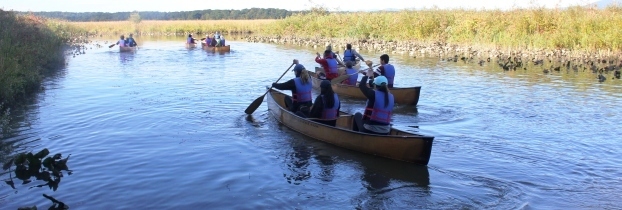
- Working with Paradise Boats and in partnership with the Lamont Doherty Earth Observatory, we will explore Piermont Marsh by canoe and clean up several access points along the shore.
Pre-registration required. Contact Jim Herrington (james.herrington@dec.ny.gov) or call (845) 889-4745 x109.
Sunday, October 2: 2:00 - 4:00 p.m.
Piermont Pier Ecology Adventure
NYSDEC Hudson River National Estuarine Research Reserve
- Free family fishing program. This will include seining with nets and rod and reel angling with all equipment provided by I Fish NY. No registration needed.
Sunday, October 2: 1:00 PM
Mohicans and their Ancestors: Nurtured by the River for 8,000 years. Join Tom Lake, NYSDEC Hudson River Estuary Program consulting naturalist as we discuss Clinton Point, a multi-component site at the confluence of the Casper Kill and the Hudson River in Dutchess County.Bring stone tools, artifacts, and projectile points for identification. Croton Point Park Nature Center, Croton-on-Hudson [Westchester County]. Donations accepted for the Lower Hudson Chapter NYS Archaeological Association. For more information, e-mail bebuske@aol.com.
HUDSON RIVER MILES
The Hudson is measured north from Hudson River Mile 0 at the Battery at the southern tip of Manhattan. The George Washington Bridge is at HRM 12, the Tappan Zee 28, Bear Mountain 47, Beacon-Newburgh 62, Mid-Hudson 75, Kingston-Rhinecliff 95, Rip Van Winkle 114, and the Federal Dam at Troy, the head of tidewater, at 153. The tidal section of the Hudson constitutes a bit less than half the total distance – 315 miles – from Lake Tear of the Clouds to the Battery. Entries from points east and west in the watershed reference the corresponding river mile on the mainstem.
TO CONTRIBUTE YOUR OBSERVATIONS OR TO SUBSCRIBE
The Hudson River Almanac is compiled and edited by Tom Lake and emailed weekly by DEC's Hudson River Estuary Program. Share your observations by e-mailing them to trlake7@aol.com.
To subscribe to the Almanac (or to unsubscribe), go to DEC's Email Lists page, enter your email address, and click on "Submit." Fill in and submit the requested information on the “New Subscriber” page. This will take you to “Quick Subscriptions”. Scroll down; under the heading "Natural Areas and Wildlife" is the section "Lakes and Rivers" with a listing for the Hudson River Almanac. Click on the check box to subscribe. While there, you may wish to subscribe to RiverNet, which covers projects, events and actions related to the Hudson and its watershed, or to other DEC newsletters and information feeds.
The current year's issues are available at http://www.dec.ny.gov/lands/25611.html . To view older issues, visit the New York State Library's Hudson River Almanac Archive. If it asks you to login, click on "Guest." You may then need to reopen this page and click on the Almanac Archive link again to access the Almanac collection in the library's files.
Discover New York State Conservationist - the award-winning, advertisement-free magazine focusing on New York State's great outdoors and natural resources. Conservationist features stunning photography, informative articles and around-the-state coverage. Visit the Conservationist webpage for more information.
USEFUL LINKS
National Oceanic and Atmospheric Administration online tide and tidal current predictions are invaluable when planning Hudson River field trips.
For real-time information on Hudson River tides, weather and water conditions from twelve monitoring stations, visit the Hudson River Environmental Conditions Observing System website.
Information about the Hudson River Estuary Program is available on DEC's website at http://www.dec.ny.gov/lands/4920.html .
Smartphone app available for New York outdoor enthusiasts!
DEC, in partnership with ParksByNature Network®, is proud to announce the launch of the New York Fishing, Hunting & Wildlife App for iPhone and Android. This FREE, cutting-edge mobile app gives both novice and seasoned outdoorsmen and women essential information in the palm of their hands. Powered by Pocket Ranger® technology, this official app for DEC will provide up-to-date information on fishing, hunting and wildlife watching and serve as an interactive outdoor app using today's leading mobile devices. Using the app's advanced GPS features, users will be able identify and locate New York's many hunting, fishing and wildlife watching sites. They will also gain immediate access to species profiles, rules and regulations, and important permits and licensing details.
NY Open for Hunting and Fishing Initiative
Governor Cuomo's NY Open for Fishing and Hunting Initiative is an effort to improve recreational opportunities for sportsmen and women and to boost tourism activities throughout the state. This initiative includes streamlining fishing and hunting licenses, reducing license fees, improving access for fishing and increasing hunting opportunities in New York State.
In support of this initiative, this year's budget includes $6 million in NY Works funding to support creating 50 new land and water access projects to connect hunters, anglers, bird watchers and others who enjoy the outdoors to more than 380,000 acres of existing state and easement lands that have gone largely untapped until now. These 50 new access projects include building new boat launches, installing new hunting blinds and building new trails and parking areas. In addition, the 2014-15 budget includes $4 million to repair the state's fish hatcheries; and renews and allows expanded use of crossbows for hunting in New York State.
This year's budget also reduces short-term fishing licenses fees; increases the number of authorized statewide free fishing days to eight from two; authorizes DEC to offer 10 days of promotional prices for hunting, fishing and trapping licenses; and authorizes free Adventure Plates for new lifetime license holders, discounted Adventure Plates for existing lifetime license holders and regular fee Adventure Plates for annual license holders.
Copies of past issues of the Hudson River Almanac, Volumes II-VIII, are available for purchase from the publisher, Purple Mountain Press, (800) 325-2665, or email purple@catskill.net
|