|
OVERVIEW
Although it was still late summer, the autumn migration of raptors had begun in earnest led by broad-winged hawks. The unseen migration, many thousands of young-of-the-year (YOY) fishes headed to the sea, were a highlight in seining programs.
HIGHLIGHT OF THE WEEK
9/10 – Kowawese, HRM 59: Twenty of us gathered on the beach for our contribution to the 17th Annual Hudson River Valley Ramble. Everyone got wet in the warm shallows that were 81 degrees Fahrenheit (F). The salinity, having risen a bit to just over 2.0 parts-per-thousand (ppt) increased our expectation for some brackish-water fishes. As we slid our seine up on the sand, we found YOY striped bass (59-87 millimeters) and alewives (70-88 mm) in abundance. Among them was the unexpected: a hundred or more baby bay anchovies (41-52 mm).
- Tom Lake, Ken Preblich, Nathan Reyor
[Bay anchovies, near relatives to the herrings, are small translucent fishes with a uniquely-hinged lower jaw that serves them well in preying on zooplankton. Bill Dovel, in his 1972 survey of fishes of the lower river for Boyce Thompson Institute, called the bay anchovy the “dominant fish species in the Hudson estuary.” In the 44 years since, populations and niches have fluctuated and anchovies may no longer have that status. Tom Lake]
NATURAL HISTORY ENTRIES
9/9 – Coxsackie, HRM 124: While kayaking late this afternoon along the east Hudson River shoreline near Coxsackie, I watched an adult bald eagle interact with an immature and then with a second immature. One of the young birds went for a fish, missed, and then flew to a nearby snag. Perched not far above the eagle was a much smaller bird, a merlin. It was a good size comparison–the eagle dwarfed the merlin. Later I watched as two merlins interacted before moving off to the south. Across the entire river channel there were many small fish jumping all around; one even landed in my kayak. They were river herring. To end my trip, a single monarch passed by heading down river.
- Brenda Inskeep
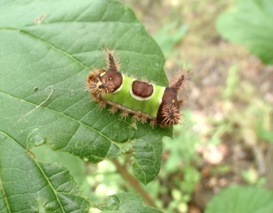 9/9 – Rhinebeck, HRM 94: We were cleaning up some brush today when I heard my son, Ben, shout. It sounded like he’d been stung by a hornet. I could see barbs impaled in his fingers from a saddleback caterpillar (Acharia stimulea), a species of slug moth. I carefully extracted barb after barb from his fingers and as each venomous barb was pulled, he told me the pain levels decreased. Gardeners beware: This caterpillar was hardly an inch long but it certainly packed a punch. [Photo of saddleback caterpillar courtesy of Lyle Buss.] 9/9 – Rhinebeck, HRM 94: We were cleaning up some brush today when I heard my son, Ben, shout. It sounded like he’d been stung by a hornet. I could see barbs impaled in his fingers from a saddleback caterpillar (Acharia stimulea), a species of slug moth. I carefully extracted barb after barb from his fingers and as each venomous barb was pulled, he told me the pain levels decreased. Gardeners beware: This caterpillar was hardly an inch long but it certainly packed a punch. [Photo of saddleback caterpillar courtesy of Lyle Buss.]
- Ted Fink, Ben Fink
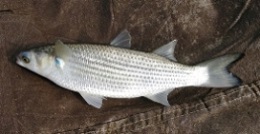 9/9 – Hyde Park to Clinton Point, HRM 80-69: The DEC Hudson River Fisheries Unit continued their annual juvenile striped bass beach seine sampling from just south of Hyde Park to Clinton Point. The only surprise catch was three striped mullet (9-10 inches) netted in totally freshwater at the mouth of the Casper Kill. Striped mullet are a salt and brackish water fish that are not uncommon in the lower reach of the estuary. There were also many YOY blueback herring, a few alewives, but only a couple American shad. [Photo of Striped mullet courtesy of Steve Stanne] 9/9 – Hyde Park to Clinton Point, HRM 80-69: The DEC Hudson River Fisheries Unit continued their annual juvenile striped bass beach seine sampling from just south of Hyde Park to Clinton Point. The only surprise catch was three striped mullet (9-10 inches) netted in totally freshwater at the mouth of the Casper Kill. Striped mullet are a salt and brackish water fish that are not uncommon in the lower reach of the estuary. There were also many YOY blueback herring, a few alewives, but only a couple American shad. [Photo of Striped mullet courtesy of Steve Stanne]
- Steve Stanne
[“Reach is a nautical term, designating a stretch of water visible between bends in a river or channel. Functionally, a reach is the stretch of river that a sailboat (like a sloop) could travel without having to tack. The sixteen mile-long Hudson River Long Reach runs from the river bend at Crum Elbow south to Wappinger Creek. John Mylod]
9/9 – New Paltz, HRM 78: My wife, Shelly, discovered a unique caterpillar in our backyard today. I had never seen this species in the 60-plus years of exploring outdoors. The green saddle, the chartreuse “eyes,” and the tufts of spikes were distinctive. It was a saddleback caterpillar. This caterpillar is not a significant agricultural pest but is a significant health hazard. Its spines are hollow and contain a venom that will break off causing pain, a skin rash, hemorrhaging, and blistering.
- Bob Ottens
9/9 – Bedford, HRM 35: We counted two migrating sharp-shinned hawks and one red-tailed hawk today at the Chestnut Ridge Hawkwatch. In midday, we spotted two juvenile red-tailed hawks doing battle just south of the platform. In late afternoon, a sharp-shinned hawk headed north had us wondering: Was it local, or hunting? Non-raptor observations included a nighthawk and various ravens.
- Anna Butler
9/9 – Manhattan, HRM 2: When we checked our collection gear at The River Project’s sampling station on the lighthouse tender Lilac at Pier 25 we found a lined sea horse and a naked goby (30 mm) in our killifish trap, and a large “quite portly” blackfish (tautog) in a crab pot.
- Jacqueline Wu
9/10 – Waterford, HRM 159: We traveled up the river from Yonkers for the 18th annual Tugboat Round Up in Waterford. Once there, we had the opportunity to ride aboard Solar Sal through the Federal Lock from Waterford to Troy. Captain David Borton’s Solar Sal, powered by 16 solar panels and 200 pounds of batteries, is a 39 foot-long vessel and the first solar-powered canal boat in New York State. It is named in tribute to the iconic mule in an old canal song. Just upriver from the Federal Dam at Troy, we spotted two adult bald eagles, one in flight and one perched in a tree. These may have been the adults from a nearby nest.
- Leah Ann Caro
[The annual Tugboat Round Up in Waterford attracts working tugs and hobby tugs from across the state including Lake Champlain, the Saint Lawrence Seaway, the Mohawk River-Erie Canal, the Hudson River, and New York Harbor. Being the crossroads of the Erie Canal, Champlain Canal, and Hudson River makes Waterford the ideal location for this event. - Leah Caro]
9/10 – Rhinebeck, HRM 90: A short time after sunrise this morning, I saw a low-flying V of 16 snow geese fly over. Fifteen of them were completely silent, but the leader honked constantly.
- Phyllis Marsteller
9/10 – Bedford, HRM 35: We counted 23 migrating raptors today at the Chestnut Ridge Hawkwatch including ten osprey, nine sharp-shinned hawks, two eagles, a red-shouldered hawk, and a merlin. Among the non-raptor observations were 200 cedar waxwings, 15 ruby-throated hummingbirds, 27 chimney swifts, a common nighthawk, an American redstart, a black-throated blue warbler, and a Tennessee warbler.
- Tait Johansson, Brendan Popp
9/11 – Saratoga County, HRM 159: I was able to count a total of 46 great egrets wading in the west pond at the Vischer Ferry Preserve visible from the Whipple Bridge. They all dispersed within an hour. I also had a wave of songbirds near the bridge. The highlight for me was two bay-breasted warblers.
- John Hershey (HMBirds)
9/11 – Esopus Meadows, HEM 87: It is interesting how fortunes can changes during migration. The last two evenings I had raptors galore: merlin, peregrine falcon, ospreys, red-tailed and Cooper’s hawks, bald eagles, even a northern harrier made a close pass, all hunting and perching close to me over a couple of hours. Tonight at low tide, I spotted only a single bald eagle flying across the river at a distance.
- Jim Yates
9/11 – Bedford, HRM 35: We counted eight migrating raptors today at the Chestnut Ridge Hawkwatch including another merlin and a northern harrier. Among the non-raptor observations were 80 cedar waxwings,
- Anna Butler, Brendan Popp
9/12 – Constitution Island, HRM 52: There is a tree on the south side of Constitution Island–an oak, I think–that is always good for a raptor or two; eagles in winter, osprey in summer. Today it was an osprey perched over the water in the falling tide waiting for the shallows to become shallow and enhance hunting prospects. A second osprey was doing pirouettes over World’s End searching for a target.
- Tom Lake
[World’s End is the deepest point in the Hudson River at about 200 feet. This narrow slot of river between West Point and Constitution Island was gouged out by a glacier 20,000 years ago and is well known for its treacherous tidal currents. Its name is derived from its legendary and long ago effects on sailing ships, where boats and hands often met their “world’s end.” - Tom Lake]
9/12 – Bedford, HRM 35: This was the first notable day for migrating broad-winged hawks (17) at the Chestnut Ridge Hawkwatch. Among the non-raptor observations were 30 cedar waxwings, four ruby-throated hummingbirds, and three monarchs.
- Anna Butler, Allen Kurtz
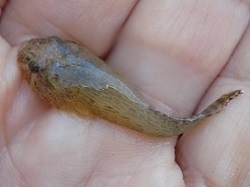 9/12 – Manhattan, HRM 2: Three days ago, Melissa Rex, educator for The River Project, found a skilletfish (41 mm) stuck on the underside of an oyster shell inside an oyster cage she had hung off the lighthouse tender Lilac at Pier 25. This occurrence was uncommon but not rare. It would, however, become the first skilletfish in the Collection of Fishes at the New York State Museum. [Photo of skilletfish courtesy of Tom Lake.] 9/12 – Manhattan, HRM 2: Three days ago, Melissa Rex, educator for The River Project, found a skilletfish (41 mm) stuck on the underside of an oyster shell inside an oyster cage she had hung off the lighthouse tender Lilac at Pier 25. This occurrence was uncommon but not rare. It would, however, become the first skilletfish in the Collection of Fishes at the New York State Museum. [Photo of skilletfish courtesy of Tom Lake.]
- Jacqueline Wu, Andrea Calderon
[Skilletfish (Gobiesox strumosus), are a small bottom-dwelling ocean fish that are found from New Jersey south to Brazil. This places the Hudson River on the northern fringe of their range. Its family, the Clingfishes (Gobiesocidae) derive their common name from their habit of “clinging” to substrate with a sucking disk not unlike our naked goby. They are found around rocks, pilings, and oyster reefs (they spawn in discarded oyster shells). In the past when oysters flourished in the river, it is likely that skilletfish were more common. Skilletfish were added to the Hudson River watershed fish fauna list in April 2011, from a 52 mm fish caught by The River Project at Pier 40. Tom Lake]
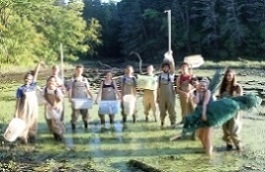 9/13 – Tivoli South Bay, HRM 98.5: A group of Bard College students and I seined and kick-netted the mouth of the Saw Kill in the fading light of a gorgeous sunset. Our catch included spottail shiners, banded killifish, a YOY rock bass, and a small brassy-colored goldfish. We also found a dead American eel in the riffle rocks with several puncture wounds suggesting a heron’s beak or raptor’s talons. [Photo of students courtesy of Chris Bowser.] 9/13 – Tivoli South Bay, HRM 98.5: A group of Bard College students and I seined and kick-netted the mouth of the Saw Kill in the fading light of a gorgeous sunset. Our catch included spottail shiners, banded killifish, a YOY rock bass, and a small brassy-colored goldfish. We also found a dead American eel in the riffle rocks with several puncture wounds suggesting a heron’s beak or raptor’s talons. [Photo of students courtesy of Chris Bowser.]
- Chris Bowser
9/13 – Bedford, HRM 35: Broad-winged and sharp-shinned hawks shared the spotlight today at the Chestnut Ridge Hawkwatch with nine each. We also counted two American kestrels. Among the non-raptor observations were eight monarch butterflies.
- Anna Butler, Allen Kurtz
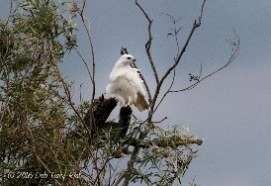 9/14 – Clinton Corners, HRM 82: A leucistic, near-white, red-tailed hawk that we have dubbed “Lucy,” looked very dramatic perched against the dark stormy sky today. I have been photographing her in the Stanfordville-Clinton Corners area for the past four years and it always makes my heart sing to see her. [Photo of red-tailed hawk courtesy of Deborah Tracy-Kral.] 9/14 – Clinton Corners, HRM 82: A leucistic, near-white, red-tailed hawk that we have dubbed “Lucy,” looked very dramatic perched against the dark stormy sky today. I have been photographing her in the Stanfordville-Clinton Corners area for the past four years and it always makes my heart sing to see her. [Photo of red-tailed hawk courtesy of Deborah Tracy-Kral.]
- Deborah Tracy-Kral
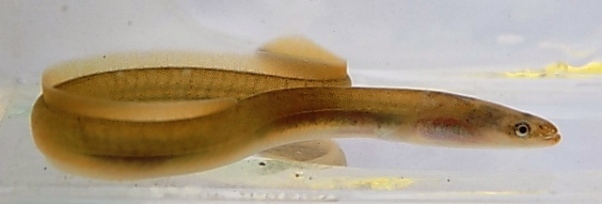
9/14 – Beacon, HRM 61: The blue-crabbers on Long Dock were having success–collectively a crab-a-minute. Bait did not seem to matter. They were using everything from chicken necks to sunfish to mystery concoctions that were not to be disclosed. It was a steamy day on the beach (89 F) and we enjoyed the marginally cooler water (80 F) more than the seining. The highlight of our catch however was a half-dozen small American eels (50 mm) that were arguably this spring’s “glass eel class” now with mature eel coloration. The salinity had crept up to 3.0 ppt.
- Tom Lake, B.J. Jackson
9/14 – Bedford, HRM 35: Our first large kettle of broad-winged hawks (36) went over the Chestnut Ridge Hawkwatch today just ahead of a storm. Among the non-raptor observations were five monarch butterflies and three ruby-throated hummingbirds.
- Anna Butler, Brendan Popp
9/14 – Manhattan, HRM 1: When we checked our crab pots at The River Project’s sampling station on the lighthouse tender Lilac at Pier 25, we found a large (for us) tautog (270 mm). But the real story was in our killifish traps. There we discovered two lined sea horses, two naked gobies (15-20 mm), a butterfish (25 mm), and two spider crabs the size of a fifty-cent coin.
- Jacqueline Wu
9/15 – Albany, HRM 145: Shortly before noon today, I spotted a black-bellied plover on the mud flats a few hundred feet north of the launching ramp at Corning Preserve. It was in basic plumage, distinguished from golden-plover by the lack of a dark tail and wingtips. It was still there two hours later but the tide was coming in fast [less than two hour to high tide] reducing its area to forage.
- John Kent, Naomi Lloyd (HMBirds)
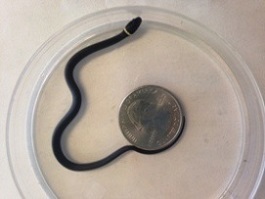 9/15 – Norrie Point, HRM 85: To my surprise, I found a juvenile northern ringneck snake (Diadophis punctatus) on the floor of the wet classroom at the Norrie Point Environment Education Center. I released it outside, well away from the building and ongoing construction. [Photo of ringneck snake courtesy of Chris Bowser.] 9/15 – Norrie Point, HRM 85: To my surprise, I found a juvenile northern ringneck snake (Diadophis punctatus) on the floor of the wet classroom at the Norrie Point Environment Education Center. I released it outside, well away from the building and ongoing construction. [Photo of ringneck snake courtesy of Chris Bowser.]
- Chris Bowser
9/15 – Verplanck, HRM 40.5: I usually hear, but don't see bald eagles much during the summer on my morning walks. This morning I got to see an adult bird lit by the rising sun. The eagle was actively hunting in mid-river and I watched as it broke off a dive on menhaden that were being harassed from below by bluefish or striped bass. I could see the spray as the fish broke the water trying to escape. Closer to shore, right off Old Steamboat Dock, I watched a school of Atlantic silversides being chased by smaller bluefish.
- Ed McKay
9/15 – Bedford, HRM 35: We had our first serious push of broad-winged hawks (129) in midmorning at the Chestnut Ridge Hawkwatch. Among the non-raptor observations were 85 cedar waxwings and five ruby-throated hummingbirds.
- Anna Butler, Allen Kurtz, Brendan Popp, Charlie Plimpton, Ed Williams, Jack Kozuchowski, Tait Johansson, Tony Loomis
FALL 2016 NATURAL HISTORY PROGRAMS
Tuesday, September 27: 7:00 PM
The Changing Ecology of the Hudson River Flyway. Join Tom Lake, DEC Hudson River Estuary Program consulting naturalist as he discusses the stresses facing waterfowl, wading birds, and raptors as climate, weather, and invasives alter the ecology of the Hudson River Flyway. Orange County Community College, Orange Hall Gallery, 24 Grandview Avenue, Middletown, NY. For more information, call Dorothy Szefc: 845-341-4891.
Sunday, October 2: 10:00 a.m. - 12:30 p.m.
Piermont Marsh Ecology Adventure
Working with Paradise Boats and in partnership with the Lamont Doherty Earth Observatory, we will explore Piermont Marsh by canoe and clean up several access points along the shore. Sponsored by the NYSDEC Hudson River National Estuarine Research Reserve.Pre-registration required. Contact Jim Herrington (james.herrington@dec.ny.gov) or call (845) 889-4745 x109.
Sunday, October 2: 2:00 - 4:00 p.m.
Piermont Pier Ecology Adventure
Free family fishing program. This will include seining with nets and rod and reel angling with all equipment provided by I Fish NY. No registration needed. Sponsored by the NYSDEC Hudson River National Estuarine Research Reserve
Sunday, October 2: 1:00 PM
Mohicans and their Ancestors: Nurtured by the River for 8,000 years. Join Tom Lake, NYSDEC Hudson River Estuary Program consulting naturalist as we discuss Clinton Point, a multi-component site at the confluence of the Casper Kill and the Hudson River in Dutchess County.Bring stone tools, artifacts, and projectile points for identification. Croton Point Park Nature Center, Croton-on-Hudson [Westchester County]. Donations accepted for the Lower Hudson Chapter NYS Archaeological Association. For more information, e-mail bebuske@aol.com.
HUDSON RIVER MILES
The Hudson is measured north from Hudson River Mile 0 at the Battery at the southern tip of Manhattan. The George Washington Bridge is at HRM 12, the Tappan Zee 28, Bear Mountain 47, Beacon-Newburgh 62, Mid-Hudson 75, Kingston-Rhinecliff 95, Rip Van Winkle 114, and the Federal Dam at Troy, the head of tidewater, at 153. The tidal section of the Hudson constitutes a bit less than half the total distance – 315 miles – from Lake Tear of the Clouds to the Battery. Entries from points east and west in the watershed reference the corresponding river mile on the mainstem.
TO CONTRIBUTE YOUR OBSERVATIONS OR TO SUBSCRIBE
The Hudson River Almanac is compiled and edited by Tom Lake and emailed weekly by DEC's Hudson River Estuary Program. Share your observations by e-mailing them to trlake7@aol.com.
To subscribe to the Almanac (or to unsubscribe), go to DEC's Email Lists page, enter your email address, and click on "Submit." Fill in and submit the requested information on the “New Subscriber” page. This will take you to “Quick Subscriptions”. Scroll down; under the heading "Natural Areas and Wildlife" is the section "Lakes and Rivers" with a listing for the Hudson River Almanac. Click on the check box to subscribe. While there, you may wish to subscribe to RiverNet, which covers projects, events and actions related to the Hudson and its watershed, or to other DEC newsletters and information feeds.
The current year's issues are available at http://www.dec.ny.gov/lands/25611.html . To view older issues, visit the New York State Library's Hudson River Almanac Archive. If it asks you to login, click on "Guest." You may then need to reopen this page and click on the Almanac Archive link again to access the Almanac collection in the library's files.
Discover New York State Conservationist - the award-winning, advertisement-free magazine focusing on New York State's great outdoors and natural resources. Conservationist features stunning photography, informative articles and around-the-state coverage. Visit the Conservationist webpage for more information.
USEFUL LINKS
National Oceanic and Atmospheric Administration online tide and tidal current predictions are invaluable when planning Hudson River field trips.
For real-time information on Hudson River tides, weather and water conditions from twelve monitoring stations, visit the Hudson River Environmental Conditions Observing System website.
Information about the Hudson River Estuary Program is available on DEC's website at http://www.dec.ny.gov/lands/4920.html .
Smartphone app available for New York outdoor enthusiasts!
DEC, in partnership with ParksByNature Network®, is proud to announce the launch of the New York Fishing, Hunting & Wildlife App for iPhone and Android. This FREE, cutting-edge mobile app gives both novice and seasoned outdoorsmen and women essential information in the palm of their hands. Powered by Pocket Ranger® technology, this official app for DEC will provide up-to-date information on fishing, hunting and wildlife watching and serve as an interactive outdoor app using today's leading mobile devices. Using the app's advanced GPS features, users will be able identify and locate New York's many hunting, fishing and wildlife watching sites. They will also gain immediate access to species profiles, rules and regulations, and important permits and licensing details.
NY Open for Hunting and Fishing Initiative
Governor Cuomo's NY Open for Fishing and Hunting Initiative is an effort to improve recreational opportunities for sportsmen and women and to boost tourism activities throughout the state. This initiative includes streamlining fishing and hunting licenses, reducing license fees, improving access for fishing and increasing hunting opportunities in New York State.
In support of this initiative, this year's budget includes $6 million in NY Works funding to support creating 50 new land and water access projects to connect hunters, anglers, bird watchers and others who enjoy the outdoors to more than 380,000 acres of existing state and easement lands that have gone largely untapped until now. These 50 new access projects include building new boat launches, installing new hunting blinds and building new trails and parking areas. In addition, the 2014-15 budget includes $4 million to repair the state's fish hatcheries; and renews and allows expanded use of crossbows for hunting in New York State.
This year's budget also reduces short-term fishing licenses fees; increases the number of authorized statewide free fishing days to eight from two; authorizes DEC to offer 10 days of promotional prices for hunting, fishing and trapping licenses; and authorizes free Adventure Plates for new lifetime license holders, discounted Adventure Plates for existing lifetime license holders and regular fee Adventure Plates for annual license holders.
Copies of past issues of the Hudson River Almanac, Volumes II-VIII, are available for purchase from the publisher, Purple Mountain Press, (800) 325-2665, or email purple@catskill.net
|