
Hudson River Almanac 9/1/16 - 9/8/16
The New York State Department of Environmental Conservation sent this bulletin on 09/16/2016 03:00 PM EDT |
| DEC Delivers - Information to keep you connected and informed from the NYS Department of Environmental Conservation |
| Share or view as a web page || Update preferences or unsubscribe |
|
|
|
OVERVIEW This week did not lack for excitement, with black bears, rattlesnakes, dueling raptors, a visit from a rare marine stray, and “piracy” on the river. HIGHLIGHT OF THE WEEK 9/4 – Rockland County: After hiking a trail in Harriman State Park we decided to take a rest. As we were about to sit down, we noticed a large yellow and umber snake loosely coiled, basking in the sun at the end of the log just below where we were about to sit. It was an absolutely gorgeous three-foot-long yellow-phase timber rattlesnake and we were all slightly unnerved that we hadn’t noticed it until it was almost too late. [The timber rattlesnake (Crotalus horridus) is a threatened species in New York State. As a result, entries such as this one are intentionally left vague other than to note its general presence in a large area. Not disclosing exact locations of easily threatened flora and fauna such as eagle nests, orchids, and rattlesnake dens, becomes necessary following examples of human intrusion. Tom Lake.] NATURAL HISTORY NOTES 9/1 – Hudson River Valley: Weather and climate records have been recorded and kept by the National Weather Service since the mid-19th century. Weather is a description of short-term conditions; climate outlines long-term trends. Globally, July was the warmest single month ever recorded (climate). August in the mid-Hudson Valley had 28 of 31 days over 80 degrees Fahrenheit, including six over 90; the other three days were 79 degrees F (weather). 9/1 – Verplanck, HRM 40.5: Walking in the drizzle this morning I witnessed an interesting interaction between two fish-eating birds. Looking out at the channel marker off Steamboat Dock, I saw an osprey feeding on a fish. A great blue heron that had been perched on a piling took flight and flew out to the channel marker. Using his greater size, the heron tried to displace the osprey. The osprey kept its catch and repeatedly tried to reclaim the channel marker but to no avail. The heron stood its ground until the osprey flew off.
[The cobia (Rachycentron canadum) is a rare marine stray in the Hudson, being far more common in southern coastal waters. Early records from the estuary include a 31-inch cobia from New York Bay in 1815, another cobia, now in the NYS Museum Collection, from New York Bay in 1872, and a 95 millimeter (mm) cobia collected in a minnow seine in Croton Bay in 1890. At that time they were known colloquially as “crab eater,” reflecting their predilection for blue crabs. Bob Schmidt.] 9/2 – Staatsburg, HRM 86: While kayaking in the river near Mills-Norrie State Park, we spotted an osprey swoop down and execute a flawless fish snatch. As it regained altitude an adult bald eagle chased the osprey, causing it to lose the fish. The eagle then dueled with another eagle that had its sights on the dropped fish, engaging in talon-posturing and the fish was forgotten. [Piracy! One of the best shows on the river is watching eagles harass osprey. While eagles are among the best hunters of fish, they frequently allow osprey to do the heavy lifting, then swoop down and steal the fish hawk’s catch. Tom Lake] 9/2 – Bedford, HRM 35: We counted two migrating broad-winged hawks today at the Chestnut Ridge Hawkwatch. Another highlight was an osprey perched on the microwave tower being dislodged by a red-tailed hawk. Non-raptor observations included four common ravens. 9/2 – Manhattan, HRM 1: When we checked our crab pots at The River Project’s sampling station on the lighthouse tender Lilac at Pier 25 in Hudson River Park we found that two of them were empty but covered with tiny tapioca ball-sized sea squirts. The third pot had two adult blue crabs on top and two more inside. The two inside were “doublers,” but they released as we pulled out the pot. The final pot had a good-sized seahorse hanging on the outside but it fell back into the water before we could measure it. [Mating blue crabs are called “doublers.” This occurs when a male cradles a female, part of a protracted mating process. Once the female selects a mate, she submits to being cradled in his walking legs. The two remain coupled until she makes her final moult at which time the male deposits packets of sperm in the female. He then resumes carrying her, sometimes for a couple days, until her shell hardens and she can defend herself. This late in the season, the female will not begin the production of young. Instead, in the company of thousands of other females she will ride the tides until she finds deep salty water with a soft bottom. There she will remain buried in the mud until warm water returns in the spring. Christopher Letts.] 9/3 – Stockport Flats, 122: I spotted a Virginia rail, several bald eagles (both adults and immatures), and ospreys as I paddled in the marsh this morning. We were goose hunting. We didn't see many geese, only those that we kicked up going in at 4:30 AM. Apparently they roost on the river and head out to the fields around dawn. All in all it was a very successful day even though we never had any geese come to our decoy spread. But the day turned out to be an outstanding opportunity to work my dog. We both agreed that any day spent on the river is great day. [Canada goose season in the Hudson Valley runs from September 1-25, November 5-17, and December 3 to January 8, 2017. NYSDEC.] 9/3 – Dutchess County, HRM 100: While driving north toward Germantown in mid-afternoon, we had to stop quickly to watch a bobcat run across the road in front of the car. He looked healthy and in a bit of a rush to reach the woods on the other side.
9/3 – Kowawese, HRM 61: Species diversity (number of species) and species richness (number of individuals of each species) continued to be disappointing here. We were expecting baby river herring in our seine but had to settle for a net full of baby striped bass (70-74 mm). The river was warm at 78 degrees F and the salinity had inched up to 2.0 ppt. 9/3 – Bedford, HRM 35: We counted three broad-winged hawks and an American kestrel at the Chestnut Ridge Hawkwatch. Non-raptor observations were limited to a flock of 25-30 cedar waxwings headed south. 9/4 – Minerva, HRM 287-284: Six of us walked the Roosevelt Truck Trail hoping for some boreal birds. Soon after we started, we heard a black-backed woodpecker calling and then saw a male black-backed working dead spruce trees. There were many of what we felt were golden-crowned kinglets working the tops of the spruces. The woods were quiet in genera,l with some mixed flocks of chickadees, red-breasted nuthatch, tufted titmice, red-eyed vireos, and two black-throated green warblers. Near the boreal/hemlock forest transition, we spotted a trio of gray jays working the woods. Our total species count was eighteen. 9/4 – Town of Fishkill, HRM 61: On Lambs Hill, at 1,300 feet on the Fishkill Ridge Trail (part of Hudson Highlands State Park), I found many oaks, eastern white pines, and two ornamental plums all succumbing to the hot and dry weather. After gypsy moths defoliated them this summer, they could not recover. They leafed out again but then dried up, turned brown, and fell off. I'm curious to see if they leaf out next spring. This has been a tough summer. 9/4 – Bedford, HRM 35: Migrating raptors counted at the Chestnut Ridge Hawkwatch today included sharp-shinned hawks (3), broad-winged hawks (2), osprey (2), and a merlin. Non-raptor observations included a common raven and an American redstart. 9/5 – Hyde Park, HRM 80: The locust leaf miner (Odontota dorsalis) went crazy this year! At the Culinary Institute of America we had to cut down 75 dead trees that had been planted twelve years ago. The locust leaf miner is not native to our area; its native range includes the central Appalachian Mountains and the Ozark Plateau. As the common name implies, the larvae “mine” the inside of leaves of locust trees. 9/5 – Town of Poughkeepsie: Mom and Dad from bald eagle nest NY62 continued to be a presence. There was a time in the early years of their sixteen-year relationship when they would leave the area until it was time to refurbish the nest for the new season. Their single fledgling, “Peep” (hatched on Easter, fledged June 14), had left. There were congregations of immature eagles along the river and Peep was likely among them. 9/5 – Highland Mills, HRM 50: We had been watching a monarch on our sedum plant for most of the day. The butterfly changed flowers but stayed on the same plant. It appeared to be fueling up for the long trip south. 9/5 – Bedford, HRM 35: Among the nine migrating raptors we counted at the Chestnut Ridge Hawkwatch today were sharp-shinned hawks (4), bald eagles (3), a broad-winged hawk, and an osprey. 9/6 – Columbia County, HRM 119: We saw a butterfly new to us in our yard in Hillsdale – an Aphrodite fritillary (Speyeria aphrodite), unusual for this area but not unknown. The only reason we were able to identify this butterfly was that it was clearly weak and tattered and spent a lot of time just sitting. We were able to get close and see it very well with our binoculars. 9/6 – Denning’s Point, HRM 60: The oppressive heat and humidity made our mile-long hike to the tip of the Point seem like a walk through a rainforest. Once there, the stiff southwesterly wind was refreshing. We spotted an osprey cruising over the heavy chop on the water, dipping occasionally and coming up empty. On a final dive he grabbed a ten-inch fish and peeled off toward the trees. We guessed that it may have caught an Atlantic menhaden or possibly a striped mullet. The water was 78 degrees F. and the salinity was 1.5 ppt. [Ten years ago this summer, Lucy Johnson, myself, and our Vassar College field archaeology students investigated the history and prehistory of Denning’s Point. We were often able to read the landscape like a book. There was a vertical feature near the tip of the Point on an eroded bank (read horizontally) where a long narrow lens of oyster shells underlay a lens of freshwater mussels. The Indian refuse midden told a story of the river long ago and a transition from brackish to freshwater. 9/6 – Bedford, HRM 35: There were only two migrating raptors passing the Chestnut Ridge Hawkwatch today, one each sharp-shinned and broad-winged hawks. The sharp-shinned hawk made several movements to the northeast throughout the day but seemed to become discouraged by the wind and finally migrated south. 9/6 – Manhattan, HRM 2: This afternoon, in the wake of tropical storm Hermine, we checked the water quality at The River Project’s monitoring site on Pier 40. The water temperature was 77 degrees F, salinity was 21.0 ppt, turbidity (the depth at which the pattern on a Secchi disk is still visible) was 160 centimeters (cm), and the dissolved oxygen (DO) was 3.4 parts-per-million (ppm). Salinity was a bit higher and the turbidity was a bit lower than usual.
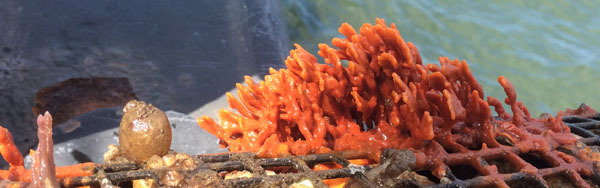
9/7 – Beacon, HRM 61: Cooler nights had the water temperature dropping a degree a day: 79, 78, and 77 degrees F. The salinity remained at 1.5 ppt where it had been for more than two weeks. Our seine hauls were ordinary - banded killifish and spottail shiners - until our final haul when we netted several dozen YOY blueback herring (65-76 mm). 9/7 – Bedford, HRM 35: Among the eight migrating raptors we counted at the Chestnut Ridge Hawkwatch today were sharp-shinned hawks (4), an American kestrel, and a broad-winged hawk. We also spotted a local osprey heading northeast, carrying a fish. 9/7 - Manhattan, HRM 1: When we checked our three oyster cages at The River Project’s sampling station on the lighthouse tender Lilac at Pier 25 we found a small male blue crab, two small oyster toadfish, a skilletfish (40 mm), and two large mud crabs. We also hauled in a huge clump of bright orange red beard sponge (Microciona prolifera) attached to the cage. Our crab pot had our first scup (porgy) of the season (175 mm), a small blackfish (tautog), and a male lined seahorse (100 mm) that was rust-colored orange instead of the usual Hudson mud color. [See banner photo of red beard sponge courtesy of Jackie Wu.] 9/8 – Beacon, HRM 61: Summer lingers – it was 90 degrees F at midday. The water (77 F) was refreshing and we were nearly ready to forego the seine to stay cool. I think it was the number of blue crab moults on the sand that got us going, curious as to what else was out there. In addition to the usual number of pebbles and cobbles we dragged in, was a half-dozen adult blue crabs, all males and all extremely feisty. Subsequent hauls captured the baby blueback herring we had been expecting (66-75 mm). The salinity lingered as well at 1.5 ppt. 9/8 – Town of Fishkill, HRM 63: I had a surprise this morning when I checked my tomato garden: a beautiful tomato hornworm (Manduca quinquemaculata). As an adult, they are called the five-spotted hawk moth. The larva or caterpillar can be very destructive to tomato plants. 9/8 – Bedford, HRM 35: A migrating red-shouldered hawk was the highlight today at the Chestnut Ridge Hawkwatch. We also counted a sharp-shinned and a broad-winged hawk. Non-raptor observations included a monarch butterfly. FALL 2016 NATURAL HISTORY PROGRAMS Tuesday, September 27: 7:00 PM Sunday, October 2: 1:00 PM HUDSON RIVER MILES The Hudson is measured north from Hudson River Mile 0 at the Battery at the southern tip of Manhattan. The George Washington Bridge is at HRM 12, the Tappan Zee 28, Bear Mountain 47, Beacon-Newburgh 62, Mid-Hudson 75, Kingston-Rhinecliff 95, Rip Van Winkle 114, and the Federal Dam at Troy, the head of tidewater, at 153. The tidal section of the Hudson constitutes a bit less than half the total distance – 315 miles – from Lake Tear of the Clouds to the Battery. Entries from points east and west in the watershed reference the corresponding river mile on the mainstem. TO CONTRIBUTE YOUR OBSERVATIONS OR TO SUBSCRIBE Smartphone app available for New York outdoor enthusiasts! Copies of past issues of the Hudson River Almanac, Volumes II-VIII, are available for purchase from the publisher, Purple Mountain Press, (800) 325-2665, or email purple@catskill.net |
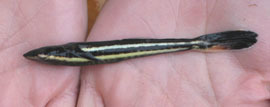 9/1 – Montrose to Hastings-on-Hudson, HRM 39-21: The big excitement for DEC’s Hudson River Fisheries Unit during their annual juvenile striped bass beach seine project was a young-of-the-year (YOY) cobia 103 millimeters [mm] long caught at Kingsland Point – one year to the day after another juvenile cobia was captured and released in the Tappan Zee. Salinity was 7.39 parts-per-thousand (ppt). Other interesting catches included adult and juvenile Atlantic needlefish at Ossining, Atlantic croaker at Grandview, and striped mullet and silver perch at Upper Nyack. We also noticed three very small, dark sandpipers swimming in the middle of the Tappan Zee just south of the Piermont Pier. We came upon them quickly and they flushed before we could get a good look, but the only sandpipers that regularly swim out on big water are the phalaropes. These could have been red-necked phalaropes. [Photo of young of the year cobia courtesy of Steve Stanne.]
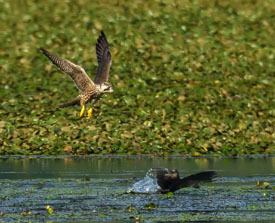 9/3 – Esopus Meadows, HRM 85: I watched as a young peregrine made a half dozen attempts on a green heron perched on the edge of the water chestnut. The heron ducked away each time and managed to get away unscathed, finally flying to the safety of the shore. [Photo of immature peregrine falcon attacking green heron courtesy of Jim Yates.]
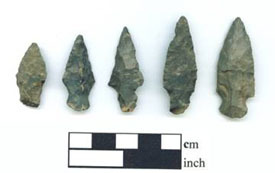 Other discoveries that enriched our understanding of the area’s prehistory included a quartz projectile point (Rossville) that had eroded out of a bank along the shore. This type of Indian dart point, named for a site on Staten Island, dated to about 2,500 years ago (bow-and arrow technology would not arrive in our area for another thousand years). Students also recovered a perfect spear point (Lamoka) from a unit in the interior. This style, named for Lamoka Lake in Schuyler County near the Finger Lakes, dated to about 4,200 years ago. It was made and used by a band of hunter-gatherers, people for whom the river was an important stop in their seasonal rounds. Tom Lake. Photo of Lamoka points courtesy of Tom Lake.]
 9/7 – Esopus Meadows, HRM 87: I was at the park at Esopus Meadows to photograph birds when a female belted kingfisher flew up from the shallows and landed on a limb. In her beak was a five-inch largemouth bass. [Photo of female belted kingfisher with largemouth bass courtesy of Dwight Reed.]
|
The New York State Department of Environmental Conservation respects your right to privacy and welcomes your feedback. | Update preferences or unsubscribe. | Learn more about DEC Delivers. |
|
Connect with DEC:   
|
 |
| NOW AVAILABLE: Receive DEC's Twitter feed via email. | |
| Andrew M. Cuomo, Governor * Basil Seggos, Commissioner | |