
Hudson River Almanac 8/25/16 - 8/31/16
The New York State Department of Environmental Conservation sent this bulletin on 09/09/2016 05:32 PM EDT |
| DEC Delivers - Information to keep you connected and informed from the NYS Department of Environmental Conservation |
| Share or view as a web page || Update preferences or unsubscribe |
|
|
|
OVERVIEW The common nighthawk migration continued this week with spectacular sightings along the Hudson River flyway. The Chestnut Ridge Hawk Watch in Bedford began its 39th season monitoring migratory raptors and other natural history occurrences. The Watch will continue through November. HIGHLIGHT OF THE WEEK
NATURAL HISTORY NOTES 8/25 – Warren County, HRM 207: Five common nighthawks flew over Queensbury this evening. There may well have been more but my view of the sky was limited. 8/25 – Mechanicville, HRM 166: Our Thursday Birders visited a few spots along the river today. Our best sighting was three immature back-crowned night herons by Mark Fitzsimmons at Lock 2 of the Hudson-Champlain Canal. We also saw ten each of least and spotted sandpipers. 8/25 – New Paltz, HRM 78: In early evening I spotted several common nighthawks flying above Taliaferro Farm. Later, heading home, I saw hundreds (if not more) nighthawks flying overhead, along Route 32N. I guessed that they were assembling for their long migration to southern South America. 8/25 – New Paltz, HRM 78: This evening, at the same time Laura Heady was having her nighthawk experience, I saw the biggest flock of common nighthawks I had ever seen. The sky over downtown New Paltz was full of them - there had to be at least 1000 if not more. It was spectacular! 8/25 – Bedford, HRM 35: We counted six broad-winged hawks and one northern harrier today at the Chestnut Ridge Hawkwatch. There were no non-raptor observations of note. 8/25 - Manhattan, HRM 1: The killifish traps at The River Project’s sampling station on the lighthouse tender Lilac at Pier 25 in Hudson River Park were covered with sea squirts. After clearing an entryway, we found inside a lined sea horse 75 millimeters [mm] long, nine oyster toadfish (20-40 mm), two naked gobies (10-30 mm), oyster drills, and an abundance of small mud crabs. A toadfish (20 mm) had also made its way into one of our crab pots. [The Atlantic oyster drill (Urosalpinx cinerea) is a small sea snail, a marine gastropod. The oyster drill preys on oysters by drilling though their shell to get at the animal inside. Tom Lake.] 8/26 – Minerva, HRM 284: My dogs and I were in the back forty and as we approached an open swampy area I flushed an immature bald eagle from a pine tree. I followed its path with my binoculars as the bird flew across the wet area to a roosting spot in the forest. It was pretty startling as well as unexpected. 8/26 – Salem, HRM 193: I counted 14 common nighthawks flying over the village in early evening. I had two last night, but this was an absolute spectacle to behold! 8/26 – Beacon, HRM 61: The river (83 degrees Fahrenheit) provided scant relief from the hot summer sun (89 F), but seining while submerged to our necks helped. It was another single species haul, something that has become common recently. Our catch was entirely young-of-the-year [YOY] blueback herring (58-74 millimeters). 8/26 – Bedford, HRM 35: It was a very hot day at the Chestnut Ridge Hawkwatch and we only counted a single migrating raptor: an osprey. A ruby-throated hummingbird visited the platform to check out the red weather flag. 8/27 – West Sand Lake, HRM 145: Our final tally was 50 common nighthawks over the fields in West Sand Lake. I counted nine in early evening soon joined by 30 more actively feeding on a huge hatch of flying ants. Within an hour they left due east over a hill before circling back, flying west, and I was able to count 50 moving past. 8/27 – Bedford, HRM 35: We counted three raptors in migration today at the Chestnut Ridge Hawkwatch, two sharp–shinned hawks and one broad-winged hawk. In midday, we had an excellent close-up look at a local broad-winged hawk as it came directly in front of and over the platform. Our only non-raptor observation was a monarch butterfly. 8/27 – New York Bight: NYSDEC and The Riverhead Foundation are interested in knowing whether you see a wayward manatee in New York waters. There was a confirmed sighting of a manatee at a beach in Hyannis, MA. Although this is rare, it does occasionally happen, and in the past animals have made their way through Long Island Sound as part of their journey. Sightings can be reported to The Riverhead Foundation’s 24-hour Hotline (631) 369-9829. [In late July 2006, a Florida manatee (Trichehus manatus latirostris) that had been making its way up the coast with sightings in Delaware, Maryland and New Jersey, entered the lower Hudson estuary. It was first spotted off the west side of Manhattan and estimated to be 10 feet long with barnacles on its dorsal surface. The manatee was later sighted upriver at Kingsland Point, river mile 28. Peter Folkens, in his Guide to the Marine Mammals of the World, explains that the Florida manatee “...inhabits the coast, estuaries, and the major rivers of Florida year round. During warmer months they may range along the Atlantic Coast as far north as Rhode Island ...” They can grow to 12 feet long and weigh 3,000 lb. Tom Lake.] 8/28 – Beacon, HRM 61: We watched a double-crested cormorant that had a double dilemma: he was wrestling with a channel catfish that he had by the tail, and he was sinking in the water, now up to his neck. The struggling catfish required a delicate maneuver to ensure that he swallowed it head first. Swallowing it tail first could result in choking as catfish can lock hardened rays on their dorsal and pectoral fins that will stick in the bird’s throat. Moreover, cormorants get out of the water occasionally in order to dry out their feathers, otherwise they sink lower and lower (their feathers lack the buoyancy oils of waterfowl). We frequently see them on buoys and pilings in a “Dracula” pose, wings outstretched, drying off. The cormorant and catfish took a final dive and that was the last we saw of them. Our seining was equally interesting as we continually filled the seine with YOY blueback herring (53-68 millimeters). The river was 81 degrees F, and the salinity was 1.5 parts-per-thousand [ppt], where it has been for two weeks. [The functions of the cormorant’s wings-outstretched pose have been much discussed. According to the Birds of North America Online, feather-drying is generally thought to be primary. Wettable feathers are interpreted as an adaptation for diving – they reduce the bird’s buoyancy – and not merely a consequence of inadequate oil glands. However, the behavior is not shown by all species of cormorants, and there is no evidence that wet wings interfere with flight. Steve Stanne.] 8/28 – Bedford, HRM 35: We counted two red-shouldered hawks and two osprey at the Chestnut Ridge Hawkwatch today. There were no non-raptor observations.
[The Science Barge in Yonkers is one of eleven sites along the Hudson River estuary where the Cornell Department of Natural Resources recently set out just shy of 50,000 oyster spat. We will monitor these sites monthly over the next year for growth and survival. The oysters were produced in a hatchery and reared to 5.0 millimeters in length. Through hatchery spawning, we used controlled fertilization to produce cohorts of high and low genetic diversity. Additionally, we have a cohort of aquaculture oysters from Fishers Island. We aim to compare growth and survival of the two genetic diversities across a wide range of naturally occurring environmental conditions. The Science Barge is a special site because we get to interact with a lot of interested and highly motivated students. Katie McFarland, Matt Hare.] 8/28 – Manhattan, HRM 3: In mid-afternoon I watched two Caspian terns (an adult and what appeared to be a juvenile) cruise north up the Hudson River from Chelsea until I lost them in the heat haze south of the George Washington Bridge. Judging by local reports, numbers of Caspian terns have been picking up in recent days, especially around the New Jersey Meadowlands. 8/29 – Bedford, HRM 35: We counted no migrant raptors today at the Chestnut Ridge, but in midday we saw a red-tailed hawk dive into the trees next to the platform and in early afternoon we counted three turkey vultures hanging out in the microwave tower. There were no non-raptor observations. 8/29 – Manhattan, HRM 1: The tide was extremely low in early afternoon at The River Project’s sampling station on the lighthouse tender Lilac [just ahead of a new moon]. As has been the case recently, the killifish traps were covered with sea squirts and a good deal of skeleton shrimp amphipods (Caprella spp.). Once we got inside, we found four naked gobies (10-35 mm), four tiny spider crabs (5-10 mm), and nine oyster toadfish (25-90 mm). The highlight of the crab pot catch was a tautog or blackfish (215 mm). 8/30 – Tahawus, HRM 310: It was 1984, 32 years ago today, when my son, Chris, and I, climbed Mount Marcy (5,344 feet) to the origin of the Hudson River for the first time. It was both a grueling and invigorating trek. Today, my six-year-old grandson, Tommy, and I, started up the Calamity Brook Trail from the Upper Works in Tahawus with more reasonable expectations. The magic of the High Peaks of the Adirondacks was visible everywhere when seen through new eyes: water bars to bridges over the brook, paper birch to bunchberry, a black-backed woodpecker putting on a show, and crushing balsam fir needles in our hands for instant holiday fragrance. We came upon tracks in the sand of nocturnal woodland wildlife such as fisher (Martes pennant), what may have been mink, and possibly long-tailed weasel. The brook was 67 degrees F, five degrees cooler than a mile downstream where we begin to call it the Hudson River. We made it a bit over two miles before shorter legs had the sense to call it a hike. [In maps of the Adirondacks, the name Hudson River first appears along the stream formed by the confluence of Calamity Brook and the outlet stream from Henderson Lake. Steve Stanne.] 8/30 – Cohoes, HRM 157: I spotted a ruddy turnstone in company with five least sandpipers and five semipalmated plovers at the Cohoes Flats in midday. Tom Williams noted that the ruddy turnstone appeared to be a juvenile with a very pale throat and noticeable white edging on the wing feathers. [The ruddy turnstone breeds in the Arctic/sub-Arctic and winters along the coast where they are most commonly seen. According to ebird, the last ruddy turnstone at Cohoes Flats was reported by Larry Alden in 2008. There has been only one sighting in the area since, two birds at Vischer Ferry power plant in 2011 by Nancy Kern. Zach Schwartz-Weinstein.] 8/30 – Bedford, HRM 35: We counted only one migratory raptor today, an osprey, at the Chestnut Ridge Hawkwatch. Non-migrants included turkey vultures circling directly over the platform during the day, a dozen red-shouldered hawks and local broad-winged hawks hanging out together. Non-raptor observations were limited to ravens. 8/30 – Manhattan, HRM 40: We checked our sampling gear at The River Project’s station at Pier 40 and found tons of sea squirts on our eight killifish traps, all except for two in the middle of our set. Inside we recovered two tiny spider crabs (one a male), six naked gobies, and an oyster toadfish (25 millimeters). 8/31 – Newcomb, HRM 302: It does not take much to make a morning in the High Peaks of the Adirondack extra special. We awoke at first light on the banks of Arbutus Lake to see a dozen common mergansers (they appeared to be juveniles) making their noisy crash landings along the shore. But that was not the moment. We thought we had heard it just at dark the night before, and now we were certain of the call of a common loon from the across the lake. It was a single note, a “wail,” what John McPhee refers to as a “primordial call which loons use to maintain contact with each other.” This one may have been out there hunting, diving again and again for fish. In Europe they are called the “great northern diver,” a name perhaps more befitting this magnificent bird.
Some results of tagging: - Tag 595 - Tag 477 - Tag 592 – 8/31 – Town of Montgomery, HRM 62: The Wallkill at Riverfront Park in Montgomery was full of sounds today as I walked along the lower trail. Two great blue herons squawked raucously as they switched places along the opposite shore. A great egret stood ghost-like on a fallen branch above the water as a kingfisher flashed past with its imperious twittering. Then I heard a loud, shrill “chee, chee, chee!” for which I could not find the source. Then it came again and I saw two shore birds across the river alighting and taking off among the rocks and shallow water. Their incredibly long bright yellow legs stood out. They were greater yellowlegs, a new species for me at Riverfront. 8/31 – Bedford, HRM 35: Two migratory raptors were counted today at the Chestnut Ridge Hawkwatch, a merlin and a northern harrier. Non-raptor observations were limited to small movements of six or seven common nighthawks headed south just before the end of the day. SUMMER 2016 NATURAL HISTORY PROGRAMS Saturday, September 10: 1:00 PM Tuesday, September 27: 7:00 PM HUDSON RIVER MILES The Hudson is measured north from Hudson River Mile 0 at the Battery at the southern tip of Manhattan. The George Washington Bridge is at HRM 12, the Tappan Zee 28, Bear Mountain 47, Beacon-Newburgh 62, Mid-Hudson 75, Kingston-Rhinecliff 95, Rip Van Winkle 114, and the Federal Dam at Troy, the head of tidewater, at 153. The tidal section of the Hudson constitutes a bit less than half the total distance – 315 miles – from Lake Tear of the Clouds to the Battery. Entries from points east and west in the watershed reference the corresponding river mile on the mainstem. TO CONTRIBUTE YOUR OBSERVATIONS OR TO SUBSCRIBE Smartphone app available for New York outdoor enthusiasts! Copies of past issues of the Hudson River Almanac, Volumes II-VIII, are available for purchase from the publisher, Purple Mountain Press, (800) 325-2665, or email purple@catskill.net |
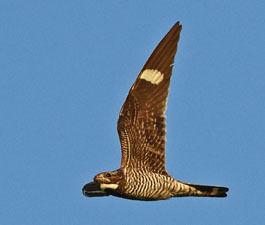 8/26 – Albany, HRM 150: We tallied 101 common nighthawks this evening at the Albany Pine Bush Preserve. They came from all directions, mostly in twos and threes, with the largest flock being ten. [Photo of common nighthawk courtesy of Scott Stoner.]
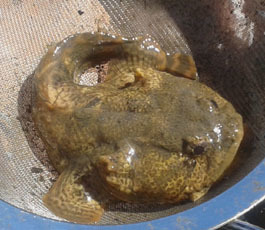 8/28 – Yonkers, HRM 18: We found another oyster toadfish today that had snuck into one of the Cornell oyster cages. [Photo of oyster toadfish courtesy of Bob Walters.]
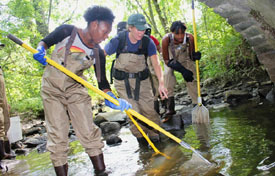 8/31 – Norrie Point, HRM 85: As part of her graduate studies, Sarah Mount tagged more than 300 eels in the Indian Kill in recent years. We have continued to track them through time with the Dutchess County Cornell Cooperative Extension’s No Child Left Inside (NCLI) program - Camille Marcotte’s Poughkeepsie High School students - with assistance from Grace Ballou and Bob Schmidt. [Photo of students electro-shocking to capture eels courtesy of Chris Bowser,]
|
The New York State Department of Environmental Conservation respects your right to privacy and welcomes your feedback. | Update preferences or unsubscribe. | Learn more about DEC Delivers. |
|
Connect with DEC:   
|
 |
| NOW AVAILABLE: Receive DEC's Twitter feed via email. | |
| Andrew M. Cuomo, Governor * Basil Seggos, Commissioner | |