
Hudson River Almanac 8/19/16 - 8/24/16
The New York State Department of Environmental Conservation sent this bulletin on 09/02/2016 03:46 PM EDT |
| DEC Delivers - Information to keep you connected and informed from the NYS Department of Environmental Conservation |
| Share or view as a web page || Update preferences or unsubscribe |
|
|
|
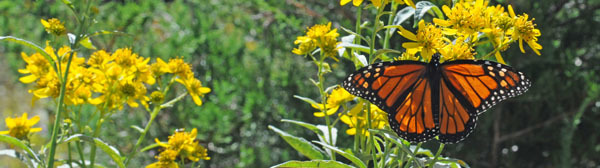
OVERVIEW Among the many late-summer and fall bird migrations, one of the most visually interesting is that of the common nighthawk. This week and next we will read of this extraordinary dusk-to-dawn exodus of these birds that, in most instances, will travel as much as 4,000 miles to South America to winter. HIGHLIGHT OF THE WEEK 8/23 – Hamilton County, HRM 242: On a chilly morning (40 degrees Fahrenheit) in a low-lying fog between first light and dawn, in a quiet backwater of the Sacandaga River, two common loons were calling, their haunting wails echoed through the stands of conifers. Although I never saw them, their ethereal calls authenticated the lingering wildness of the Adirondacks. [Loon behavior, including their four distinct calls - hoots, tremolos, wails, and yodels - is beautifully described in John McPhee’s Survival of the Bark Canoe (1982). Tom Lake.] NATURAL HISTORY NOTES 8/19 – Coxsackie, HRM 124: An adult peregrine falcon pulled up to a conspicuous perch overlooking the Hudson River at last light. The same outstretched branch of this dead tree was occupied earlier, first by an immature bald eagle and then by a rather noisy osprey. As usual for this time of year, there were hundreds of tree swallows with some barn swallows and probably other species mixed in. The river’s West Flats is an important overnight roosting place for these migrants. 8/19 – Germantown, HRM 108: The monarchs are here! Their late-summer migration was underway. I'm getting them in my garden and hope that the one that flew in front of my car an hour ago escaped the grille. 8/19 – Bedford, HRM 35: We spotted a migrating sharp-shinned hawk fleeing the rain in early afternoon at the Chestnut Ridge Hawkwatch. Earlier, a local accipiter was seen twice dive-bombing a local red-tailed hawk. Two turkey vultures landed on the microwave tower in midday. Non-raptor observations included 20 cedar waxwings and a raven that was hanging out with the turkey vultures. 8/20 – Cheviot, HRM 106: The great egrets have been coming in several nights now around 7:30. My first count was 20, second was 41, tonight 35, along with some least sandpipers. I also had an osprey move in for a couple of days to the local bald eagle perch. Now the eagle is back. 8/20 – Milan HRM 90: While sitting in my backyard watching the many birds visiting the feeders, two red-shouldered hawks flying close together and low to the ground came in from the north right toward me. One turned to the west while the other went east at close range. A few moments later the one that went east came out of a horse chestnut tree not 30 feet from me. Wings set and talons at the ready, emitting its scream, it passed only a couple feet over my head. I don't know if it was aiming at me or some other prey behind me, I was too busy ducking. 8/20 – Esopus Meadows, HM 87: From a friend’s boat anchored just below Esopus Meadows, we saw a spectacular show of seven bald eagles concurrently. At least one was an adult, but the others appeared to be new fledges or yearlings. The adult was with one of the newly fledged immatures, soaring, flipping, claws in a down and locked position, even a barrel roll [Mama teaching baby how to be an eagle]. 8/20 – Beacon, HRM 61: A strong and warm south wind (89 degrees F) aided by a rising tide, was pushing two-foot rollers up on the beach. The “swash” or littoral zone of the beach (where the river meets the sand) was a tumult of energy. As we have seen before in summer, the tumbling shallows were filled with white perch taking advantage of small invertebrates swept up in the turbid water. In the fat belly of one perch we found a crumpled up young-of-the-year [YOY] alewife. The salinity was 1.5 parts-per-thousand [ppt] and the water was 85 degrees F. 8/20 – Stony Point: HRM 40: We were on the river at low tide to monitor the wild celery beds (Vallisneria americana) among other submerged aquatic vegetation (SAV) that have been recovering from the devastating effects of hurricanes and tropical storms Irene, Lee, and Sandy (2011-2012). The sea of plants was clearly visible as their tops broke above the water where a few small fish were jumping. One fish caught our eye as it moved like a skipping stone, skimming three times across the water surface before dropping back below the surface [Atlantic menhaden]. We assumed a larger fish was looking for a meal. We were moving slowly in the shallows when we were jolted by a solid hit to the bottom of the boat and a corresponding cascade of bubbles. Had we been rammed by something from below? A striped bass, a large carp, perhaps a sturgeon? 8/20 – Bedford, HRM 35: There were a number of raptors in the air today at the Chestnut Ridge Hawkwatch, but very few appearing migratory. Among those not counted as migrants were a red-shouldered hawk diving at an immature broad-winged hawk, four other broad-winged hawks, and four adults and one immature Cooper’s hawks. Non-raptor observations included a monarch butterfly, 33 double-crested cormorants, and a Baltimore oriole. 8/21 – Stillwater, HRM 174-172: I enjoyed some amazing birding from my kayak on the Hudson River this evening. I launched in a light rain from the Stillwater Riverside Park north of the village and then paddled down to the Stillwater bridge and back. The rain seemed to have brought out the birds. I spotted a black-crowned night heron and an osprey on the way down. On the return trip, I enjoyed close-up sightings of two bald eagles, half a dozen great egrets, three great blue herons, and a flight of Canada geese. Shortly before sunset, I found myself surrounded by a swarm of tree swallows performing high-speed aerobatics over the water as they foraged. This was one of the best evenings of kayak birding that I have enjoyed on the river. 8/21 – Selkirk, HRM 135: The action was on! It was all I could do to keep the hummingbird feeders filled. All sizes have been at the feeders from morning until night. They not only chase one another back and forth but are extremely vocal as well. There are a lot of ruby-throated hummingbirds this year, more so than in previous years. I enjoy their antics but know that soon they will be moving on. 8/21 – Bedford, HRM 35: Only one migrant counted today at the Chestnut Ridge Hawkwatch, an osprey. Among the raptors not counted as migrants were a Cooper’s hawk, two adult and one immature broad-winged hawk, and an immature red-shouldered hawk. Non-raptor observations included an eastern wood pewee, a raven, and an American redstart.
8/22 – Hudson Valley: Since 2013, DEC has been keeping count of new bald eagle nests per year in Region 3 [encompassing counties from Westchester and Rockland in the south to Dutchess and Ulster in the north]. The annual increase has been very impressive: 2013 (10); 2014 (8); 2015 (8); 2016 (19). 8/22 – Bedford, HRM 35: We had three migrating raptors today at the Chestnut Ridge Hawkwatch: a bald eagle, a northern harrier, and a red-tailed hawk. Non-raptor observations included six ravens and a black vulture that landed on the microwave tower. 8/22 – Dobbs Ferry, HRM 23: I was on my way back from collecting milkweed seed pods from our garden when I spied our first monarch butterfly of the season on a butterfly bush. [The common nighthawk (Chordeiles minor) is neither a hawk (it is in the nightjar family, which also includes the whip-poor-will) nor especially active in the dead of night. It forages on the wing for insects chiefly at dawn and dusk. Nighthawks can seem quite numerous during late summer as large flocks form during migration, and they once commonly nested throughout New York State, often on flat gravel roofs in urban areas. However, the breeding population here has declined steeply in recent decades, and it is listed as a Species of Special Concern in New York. Check out DEC’s common nighthawk fact sheet for more information. Steve Stanne.] 8/23 – North Germantown, HRM 109: This prime sampling site for YOY river herring again had us baffled (see 8/10, North Germantown). It seemed as though banded killifish had dominated the spawning season here and the tiny ones we caught today by the hundreds were their offspring. Either the schools of young river herring had not yet reached here, had already passed us by, or our techniques were faulty. All had a decent chance of being true. The river temperature had fallen below 80 degrees F (78) for the first time in more than a month. 8/23 – Beacon, HRM 61: I caught and released eight channel catfish and two carp at Long Dock today. All of the fish were on the small side: I'd estimate that the catfish were in the one to two pound range; the carp about two to five. I did see a few splashes made by carp throughout the day - very encouraging. The approach of fall should see better fishing results with carp and larger channel catfish. 8/23 – Bedford, HRM 35: One migrating sharp-shinned hawk was counted today at the Chestnut Ridge Hawkwatch. There was a single non-raptor observation, a raven flying past, headed south. 8/23 – Yonkers, HRM18: When we lifted our crab pot and our Billion Oyster cage today at the Science Barge, we found an oyster toadfish in each – 152 and 159 millimeters [mm] long respectively. Oyster toadfish are prime predators of oysters, as their name suggests. [Oyster toadfish, known colloquially as “oyster crackers,” are a common bottom-dwelling fish in the lower estuary and New York Harbor. With strong, sharp teeth, they crush and feed on shellfish such as crabs, oysters, and other bivalves. Tom Lake.] 8/24 – Albany, HRM 150: This evening, Hudson-Mohawk Birds and the Albany Pine Bush Preserve combined forces. Fifteen local birders and about 20 guests of the Albany Pine Bush Drop-in Nighthawk Watch program counted 55 birds flying in all directions in both direct and feeding flight. The largest group was 37 common nighthawks flying southeast to northwest. 8/24 – Priming Hook, HRM 120.5: At the mid-afternoon low tide, I got out of the boat to collect samples of submerged aquatic vegetation (SAV) and stepped on a rock. The rock moved, parting the thick mat of wild celery. It was a map turtle (6" x 10"). It moved away slowly on top before slipping under the vegetation toward deeper water. In ten years of monitoring this location for the SAV Project, I have never seen so much wild celery (Vallisneria americana) growing here, and never a turtle. Upon closer examination of the SAV samples, I found several small zebra mussels attached to the base of each stalk and leaf. 8/24 – Germantown, HRM 108: I looked out my window this morning and was shocked to see a black bear standing in clear view underneath our bird feeders. It stood there for a minute and then sauntered off into the brush. I have two seed feeders into which I put black oil sunflower seeds. I will be taking them down shortly. I have had a couple of instances of the seed feeders being pulled down and destroyed. The first time that happened, I thought it was a raccoon, until the second time when the feeder was completely ripped apart and destroyed - not the work of a raccoon. However, until this morning, I had never seen the perpetrator of the destruction. 8/24 – Kowawese, HRM 59: Seining here has been sketchy at best recently and, as a “fisherman,” I have had ready reasons (excuses) at hand. Our first two hauls today featured pebbles, cobbles, and a dozen blue crabs. No fish. Our expectations for the third were nonexistent but, as the net neared the beach we could see where it was bulging with silver, reflecting the strong sunlight. No fewer than 300 small fish were in the seine as we slid it into the swash; a like number escaped by surging over the seamline. We recognized what they were - YOY Atlantic menhaden - a very delicate species. Keeping them wet in just a few inches of water would save many of them. Still, the blue crabs ate well. Their sizes ran from 67 to 107 mm. After stowing the net we swam out in the shallows and watched as large dark shadows swept over the sandy bottom. We counted a half dozen of them, each a school of menhaden with up to a thousand fish swimming in perfect synchrony so close together they appeared like a dark carpet undulating over the sand. The water was 84 degrees F; the salinity was 1.5 ppt. 8/24 – Bedford, HRM 35: All morning, two broad-winged wings antagonized each other across the sky at the Chestnut Ridge Hawkwatch, finally migrating in the afternoon. These were two of nine that we counted along with five osprey and a red-tailed hawk. Our only non-raptor observation was a common nighthawk.
[The feather blenny (Hypsoblennius hentz), a tropical marine stray, is a small, scaleless fish with fleshy cirri (“feathers”) on their head. Their lower jaw has a row of small, close-set teeth like those of a comb, thus their family name, combtooth blennies (Blenniidae). Blennies are benthic dwellers where they often burrow in the soft bottom or find refuge in old mollusk shells. C. Lavett Smith (1997).] SUMMER 2016 NATURAL HISTORY PROGRAMS Saturday, September 10: 1:00 PM HUDSON RIVER MILES The Hudson is measured north from Hudson River Mile 0 at the Battery at the southern tip of Manhattan. The George Washington Bridge is at HRM 12, the Tappan Zee 28, Bear Mountain 47, Beacon-Newburgh 62, Mid-Hudson 75, Kingston-Rhinecliff 95, Rip Van Winkle 114, and the Federal Dam at Troy, the head of tidewater, at 153. The tidal section of the Hudson constitutes a bit less than half the total distance – 315 miles – from Lake Tear of the Clouds to the Battery. Entries from points east and west in the watershed reference the corresponding river mile on the mainstem. TO CONTRIBUTE YOUR OBSERVATIONS OR TO SUBSCRIBE Smartphone app available for New York outdoor enthusiasts! Copies of past issues of the Hudson River Almanac, Volumes II-VIII, are available for purchase from the publisher, Purple Mountain Press, (800) 325-2665, or email purple@catskill.net |
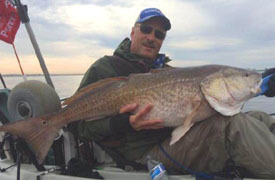 8/21 – Queens, New York City: Although we report from Jamaica Bay for the Almanac from time to time (“a sister estuary”), primarily for birds, we do not count their fish for the Hudson River watershed. There are just too many one-of-a-kinds that might never enter the Hudson. However, in the spirit of “maybe someday,” several red drum (Sciaenops ocellatus) were caught in Jamaica Bay in May (on live menhaden). Next stop, New York Harbor? There are early 20th century newspaper accounts of red drum (channel bass, redfish) taken in Newark Bay (Upper Bay New York Harbor). Red drum are one of the premier gamefish along the Atlantic and Gulf coasts. Much like the black drum, they are probably here seasonally in small numbers. It took us a long while to get black drum - a close relative - and now they are no longer even rare.
 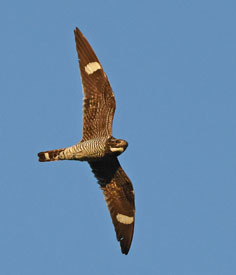 8/23 – Albany, HRM 150: Twelve watchers witnessed a great show of migrating common nighthawks this evening at the Albany Pine Bush Discovery Center. Sixty-nine birds were counted, many of which flew directly over the viewing site at low altitude, providing some good looks at plumage differences between male and female. [Photo of common nighthawk courtesy of Scott Stoner.]
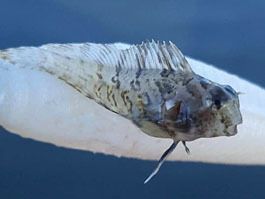 8/24 – Bronx, New York City: Kasho Ramdin was fishing in 19 feet of water off a City Island Pier for summer flounder when he landed a very small, and curious-looking fish, a feather blenny (32 mm). To call this area of the Bronx part of the Hudson River watershed is a stretch, but it is often of interest, on occasion, to include adjacent tidewater in the Almanac. We have one feather blenny record from the Hudson River, from the west side of Manhattan, captured by Cathy Drew on November 20, 1993 (Hudson River Almanac, Vol. I). In 1993, this was fish number 205 on our watershed list (we now have 225). [Photo of feather blenny courtesy of Kasho Ramdin.]
|
The New York State Department of Environmental Conservation respects your right to privacy and welcomes your feedback. | Update preferences or unsubscribe. | Learn more about DEC Delivers. |
|
Connect with DEC:   
|
 |
| NOW AVAILABLE: Receive DEC's Twitter feed via email. | |
| Andrew M. Cuomo, Governor * Basil Seggos, Commissioner | |