
Hudson River Almanac 7/21/16 - 7/28/16
The New York State Department of Environmental Conservation sent this bulletin on 08/05/2016 04:07 PM EDT |
| DEC Delivers - Information to keep you connected and informed from the NYS Department of Environmental Conservation |
| Share or view as a web page || Update preferences or unsubscribe |
|
|
|
OVERVIEW For those people working in the field in the Mid-Hudson Valley this week, the persistently hot days (eight straight at 90+ degrees Fahrenheit, averaging 94) were notable if not the highlight. However, the appearance of an alligator gar, an alien fish species, in an urban setting in Schenectady won the nod. HIGHLIGHT OF THE WEEK
[Alligator gar fall under DEC’s Aquatic Invasive Species management plan, enacted to prevent the introduction and spread of species that threaten the ecology of New York's richly abundant waters. The alligator gar was added to the Hudson River Fish Fauna List following a 2005 record of another intentionally released fish in the lower estuary. Tom Lake.] NATURAL HISTORY NOTES 7/21 – East Fishkill, HRM 66: The black bear family was back (see July 10, East Fishkill). They managed to rip down the remaining bird feeder. We went out with a horn to scare them away in hopes of saving the feeder. The horn worked very well as they ran into the woods and left the feeder on the ground. 7/21 – Kowawese, HRM 59: On a very warm day (92 degrees F) we doused our heads to stay cool. As has been common recently, even with multiple hauls, our sampling net contained only young-of-the-year [YOY] striped bass 34-52 millimeters [mm] long. We could blame the tide, the water temperature (80 degrees), the salinity (2.0 parts-per-thousand), a near full moon, or our seining technique, but none would likely answer the question. Where were all the other fish? 7/21 – Croton-on-Hudson, HRM 35: It became apparent this evening that one of the two osprey nestlings from the cell tower nest at Croton-Harmon had fledged. We spotted one of the nestlings perched on the tower below the nest, flapping its wings and taking little hops. One of the adults appeared and dropped a fish in the nest. We could see wings flapping when the other immature got its dinner. The fledgling finally flew off its perch and circled around a few times, but quickly returned to its spot on the tower. 7/21 – Bedford, HRM 35: It was quiet at the great blue heron rookery and only one nest still held two fledglings. They were facing to the west, the general direction from which the adults appear with food. Three herons flew into view and left without stopping. They appeared to be adults checking their nests and finding them empty. 7/21 – Manhattan, HRM 1: When we checked our killifish traps at The River Project’s sampling station on the lighthouse tender Lilac at Pier 25 in Hudson River Park, we found a lined seahorse (90 mm). It also seemed as though the sea squirts were dying out again and the golden star tunicates (Botryllus schlosse) were taking over. 7/22 – Greene County: I paddled over to bald eagle nest NY203 this morning in moderate winds and somewhat more than moderate waves. Two adults and a fledgling were circling over the river. One of the adult took a dive, a touch-and-go, but came up empty. The second adult actually landed in the water in its attempt, but also failed. The second fledgling was on some near-shore driftwood, and it took off as I watched, flying a hundred yards to a mid-height branch on a tree and landing with an audible “thump.” It looked awkward, but I would rate it a “pass” on the fledgling test.
7/22 – Manhattan, HRM 1: We've started catching more isopods in our collection gear at The River Project’s station on the lighthouse tender Lilac at Pier 25, as well as a load of tiny mud crabs (Rhithropanopeus harrisii, Panopeus herbstii), all no more than 3.0 mm in carapace width. 7/23 – Athens, HRM 118: It was nearing midnight and I was lightly asleep when awakened by a loud call. My first thought was my six chickens in a coop near my house. I grabbed a flashlight, and headed outside. A nearly full bright moon was casting a golden shadow on the river. As it turned out, the chickens were fine. It was a great horned owl calling close by that caused the ruckus. In the time I was outside, I also heard Canada geese and a black-crowned night heron and saw a raccoon. I guess the bright moonlight was keeping many critters awake. 7/23 – Ulster County, HRM 78: I was with a group of friends hiking at Minnewaska State Park, and snacking on plenty of wild blueberries. Making the day memorable were the two timber rattlesnakes we came upon. We saw one retreat between some rocks, followed by some movement three feet away in the low bush blueberries. Then we heard the unmistakable sound of the second one rattling. [Timber rattlesnakes (Crotalus horridus) are known throughout Minnewaska State Park and people do encounter them and sometimes even report them. Many populations in New York State have been depleted or extirpated due to human persecution, collection, and habitat loss. That is why they are listed as a New York State Threatened Species. Currently, timber rattlesnakes range as far north in the watershed as Essex County. Jesse Jaycox.] 7/23 – Beacon, HRM 61: We sat under shoreline cottonwoods that gave us some relief from the hot sun (96 degrees F) and listened to the trill and chatter of the cicadas. We ventured down to the water only when we were ready to haul our seine. The warm shallows (83 degrees) were filled with YOY striped bass (41-43 mm) as well as spottail shiners and banded killifish. The salinity remained at 2.0 parts-per-thousand [ppt]. 7/24 – Bedford, HRM 35: Another hot day (94 degrees F) and it appeared that all of the nests at the great blue heron rookery were empty. I would estimate that the 24 nests, with an average of three fledglings each (some had four) could mean nearly 80 new great blue herons. 7/24 – Manhattan, HRM 2-1: We thought the sea squirts – marble-sized, colonial tunicates (a type of marine invertebrate) that attach themselves to substrate, were dying out at our two sites on piers 40 and 25 in Hudson River Park, but we've hit a second wave of them. They're about the size of tapioca balls and are covering many of our traps again. 7/25 – Beacon, HRM 61: At dawn, a cool westerly breeze was masquerading what the day would become (96 degrees F). The river at Long Dock Park had “cooled off” overnight to 80 degrees F. The steady stream of YOY striped bass (39-48 mm) continued, an amazing daily spectacle. The one “different” catch today – a half-dozen YOY largemouth bass (51-52 mm). The salinity was 2.0 ppt. [I remember this piece of the Beacon waterfront as a small child in the early 1950s, when it was a derelict oil depot. Coupled with a burning dump just north along the river, the air was nearly unbreathable. Beginning in 1996, Scenic Hudson invested much time and expense to turn the former industrial site into the beautiful 15-acre Long Dock Park. Tom Lake.] 7/25 – Manhattan, HRM 2: In our collection gear at The River Project’s Pier 40 research site in Hudson River Park, we captured 18 YOY oyster toadfish (25 mm). 7/25 – Manhattan, HRM 1: When we checked our killifish traps at The River Project’s station on the lighthouse tender Lilac at Pier 25 today, we found one oyster toadfish (25 mm) and a hermit crab. 7/26 – Stockport Creek, HRM 121.5: On a warm (91 degrees F) day, our group of canoeists on a Hudson River Estuarine Research Reserve trip enjoyed two special treats at the mouth of Stockport Creek. We pulled ashore on the small island affectionately called “Firefly Isle” to see what we might catch in our seine. An adult bald eagle flew by holding a fairly large fish in its talons. Our seine net brought in a giant water bug (Lethocerus americanus), the largest of the true bugs, and most likely a male since it was carrying eggs on its back. The male giant water bug allows a female to lay only one to four eggs on his back at a time. Then he shakes her off. The mating process is repeated as many as 50 times until he is completely covered with eggs and it ensures that all those “kids” he’ll be carrying around for the next three weeks are truly his own offspring. 7/26 – Manhattan, HRM 1: When we checked our killifish traps at The River Project’s sampling station on the lighthouse tender Lilac at Pier 25 we found five oyster toadfish of a variety of sizes (20-95 mm). Broad size ranges of YOY fishes can reflect an extended spawning season or, in some cases, differential availably of forage. We also found a “pregnant” male northern pipefish. From our crab pot, intern Sean Ryan released a 330 mm blackfish and a spider crab. Our final catch was a gravid female blue crab. Crabbers call them “sponge crabs.” The female tucks the fertilized eggs under her tail (apron) that she wraps under her abdomen. When the eggs are near hatching, it looks like she is carrying a tennis ball. [The common spider crab (Libinia emarginata), a small (100 mm), slow-moving decapod, ranges from the Canadian Maritimes to the Gulf of Mexico. Like other “decorator crabs,” spider crabs cover their carapace with organic debris as a means of camouflage. A spider crab taken last summer at Pier 40 was nicely decorated with ghost anemones (Diadumene leucolena). Tom Lake.] 7/27 – Klyne-Esopus Kill, HRM 87: It was another hot day (92 degrees F) in a week of hot days. It was nice to find some shade along the Klyne-Esopus Kill where the water was a somewhat cool 70 degrees. Not more than 100 feet away in the bay of Esopus Meadows, the river was 81 degrees. Both black and tiger swallowtails were flitting around and finding the pools in the cooler water to their liking for a drink. 7/27 – Esopus Meadows, HRM 87: Hudson River beaches were long a great source of raw material during the Hudson Valley prehistoric Stone Age. Pebbles and cobbles glacially plucked from bedrock by an ice age glacier 20,000 years ago are not uncommon on many undisturbed low tide beaches. A dozen students from the Teaching the Hudson Valley program went on a beach walk looking for evidence of the river’s deep past. We found a purple quartzite hammerstone, a quarry stone, a hearth-stone, fire-cracked rock, all of quartzite, and small nodules of both black Helderberg and green-and-blue Coxsackie chert. All of these artifacts dated to a human presence along the river sometime in the last 12,000 years. Bringing us back to the present, we watched an osprey offshore near the Esopus Meadows Lighthouse, sporadically dive-bombing open patches in the water chestnut, dropping from the sky like a pelican or a gannet to grab a fish. [Quarry stones, usually heavy quartzite cobbles, were used to reduce larger pebbles and cobbles to smaller pieces from which knives, scraper, spear points, and even arrowheads could be fashioned. Fire-cracked rocks are artifacts of hearths, campfires, and human food-processing that usually predate the advent of pottery in the Northeast, about 2,000 years ago. They are often made of quartzite, and when fire-heated and then used to boil water, will crack, spall and fracture in a way that is diagnostic. Given the number of campfires that must have been used in the Hudson Valley across the millennia, it is easy to see why “FCR” is commonly found strewn along the flood plains and shoreline. Tom Lake.]
[The map turtle (Graptemys geographica) gets its name from the topographic map-like pattern on its carapace. This species is found primarily in bays of Lake Ontario and in large rivers, preferring stretches that are slow-moving with soft bottoms and good basking sites. With its massive head and powerful jaws, females are well designed to smash large snails, freshwater clams and crayfish. The diminutive male eats aquatic insects, small snails and crustaceans. Al Breisch, John Behler.] 7/27 – Ulster County, HRM 87: While kayak fishing on Rondout Creek just above High Falls, I saw my first monarch butterfly of the season visiting some purple loosestrife. On my journey upstream I spotted a green heron and a great blue heron wading along the river’s edge, as well as cedar waxwings, a very chatty belted kingfisher, an osprey, and an adult bald eagle that flew directly toward and then over me. My catch for the day was a Rondout Creek potpourri: a dozen redbreast sunfish, nine smallmouth bass, eight rock bass, three pumpkinseed sunfish, three bluegills, a largemouth bass, and a ten-inch-long fallfish. 7/27 – Bedford, HRM 35: My second visit to the great blue heron rookery in six days found not only empty nests but no herons flying around. The fledglings were off learning their survival skills. It was another successful year with the rookery producing 36 fledglings from 13 nests [other estimates at the rookery found 24 nests]. 7/27 – Piermont Marsh, HRM 25: It was approaching low tide when we canoed out of Sparkill Creek with a group of Lamont-Doherty Secondary School Field Research Program interns prepared to look for fiddler crabs in Piermont Marsh. With wide mud flats on both sides, we had left just enough margin in the tides to get in and out of the creek. Numerous small menhaden were floating dead on the surface as we paddled the creek, presumably from the very warm water (87 degrees F). More than a dozen great blue herons waded in the mud along the shore, leaving deep footprints. As we approached, they took to the air, skimming low over the phragmites. Several great egrets added a bit of white to our view. The crabs we caught and measured were identified as Atlantic marsh fiddler crabs (Uca pugnax). 7/27 – Manhattan, HRM 1: A group of visiting graduate students on a field trip helped us check our killifish traps at The River Project’s sampling station on the lighthouse tender Lilac at Pier 25. We only caught three fish but they all had stories to tell: a lined seahorse (90 millimeters), a northern pipefish (180 mm), and an oyster toadfish (20 mm). 7/28 – Schenectady, HRM 159: Four days ago an effort was made to capture the alligator gar in Iroquois Pond (see 7/24). In the days since, the mayor of Schenectady offered a $100 bounty to whomever catches the mysterious fish. Dozens of people have tried but none have succeeded. The original angler, Julian Canavan, was back today and almost caught the gar, but his line broke as the fish bolted away. The alligator gar has received a gargantuan amount of attention and now has its own Twitter account: @TheAlligatorGar. Today the gar tweeted, “Here’s the deal: Raise the reward to $500 or I eat one sunfish every hour, on the hour. Clock’s ticking.” DEC is asking anyone who catches the fish to bag it, put it on ice, and call them to pick it up. 7/28 – Kowawese, HRM 59: The conditions on the beach went beyond sultry to stifling, with the air temperature at 95 degrees F and the river at 85 degrees. There was little respite in getting totally submerged, but it was the only option. Snorkeling visibility was very limited so it was more of an exercise in cooling off. Once we were wet, a slight breeze helped. We hauled our seine and found that once again we had collected a large school of YOY striped bass (32-62 mm). As common as striped bass have been, YOY river herring have been nearly absent. We managed just a half-dozen alewives (65-72 mm). The salinity continued at 2.0 ppt. [Given the salinity at Newburgh Bay and the low flushing rate with lack of rain, it’s possible that young herring haven’t yet moved downriver from the main spawning areas in any numbers. Steve Stanne.] 7/28 – Manhattan, HRM 1: When we checked our killifish trap at The River Project’s sampling station on the lighthouse tender Lilac we found it fairly stuffed with YOY oyster toadfish! The five of them ranged from 25-55 mm long. Our crab pot had captured a tautog (blackfish), also a YOY (190 mm). 7/28 – Brooklyn, New York City: While seining under the East River’s Manhattan Bridge for the Brooklyn Bridge Park’s marine education program, we caught striped bass, winter flounder, Atlantic silverside, and a larval/juvenile fish that was preserved in alcohol for positive identification. It was tentatively identified as a member of the livebearer family (Poeciliidae). The water was 74 degrees F and the salinity was 28 ppt. SUMMER 2016 NATURAL HISTORY PROGRAMS Saturday, August 13: The Fifth Annual Great Hudson River Estuary Fish Count HUDSON RIVER MILES The Hudson is measured north from Hudson River Mile 0 at the Battery at the southern tip of Manhattan. The George Washington Bridge is at HRM 12, the Tappan Zee 28, Bear Mountain 47, Beacon-Newburgh 62, Mid-Hudson 75, Kingston-Rhinecliff 95, Rip Van Winkle 114, and the Federal Dam at Troy, the head of tidewater, at 153. The tidal section of the Hudson constitutes a bit less than half the total distance – 315 miles – from Lake Tear of the Clouds to the Battery. Entries from points east and west in the watershed reference the corresponding river mile on the mainstem. TO CONTRIBUTE YOUR OBSERVATIONS OR TO SUBSCRIBE Smartphone app available for New York outdoor enthusiasts! Copies of past issues of the Hudson River Almanac, Volumes II-VIII, are available for purchase from the publisher, Purple Mountain Press, (800) 325-2665, or email purple@catskill.net |
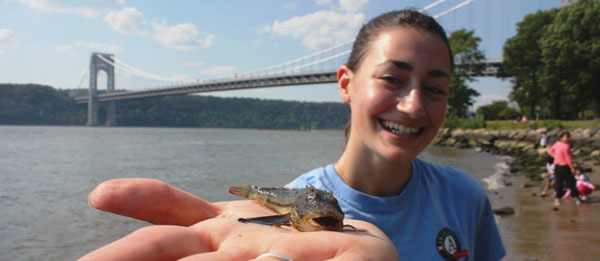
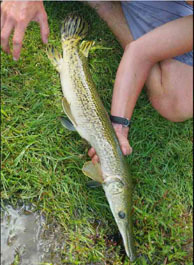 7/24 – Schenectady, HRM 159: A week ago, Julian Canavan saw an alligator gar swimming near the surface of Iroquois Pond, a seven-acre lake in downtown Schenectady’s Central Park. He ran home, grabbed his rod and heavy bait-casting reel, tied a size 6/0 treble hook onto a stout fluorocarbon leader, baited it with a chunk of “special recipe” chicken, returned and caught the fish. Julian estimated the gar to be 37 inches long and 12 pounds in weight. He released the fish back into the pond. [Photo of alligator gar courtesy of Julian Canavan.]
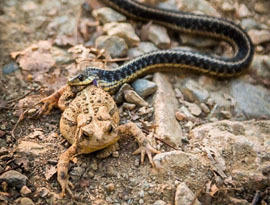 7/22 – Beacon, HRM 61: I hiked Mount Beacon on a suffocatingly hot day (98 degrees F), and came upon a fine example of nature’s struggle: A garter snake (Thamnophis sirtalis) had an American toad halfway past its jaws. [Photo of garter snake eating toad courtesy of Robert Welsted.]
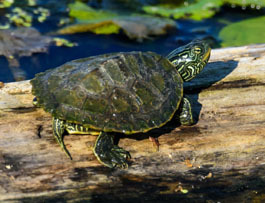 7/27 – Esopus Meadows, HRM87: I went down to Esopus Meadows in the evening to watch the osprey hunt in the clearings of the water chestnut, but none showed up. I spotted a single pied-billed grebe and found a small (four-inch carapace) map turtle on a log. [Photo of map turtle courtesy of Jim Yates.]
|
The New York State Department of Environmental Conservation respects your right to privacy and welcomes your feedback. | Update preferences or unsubscribe. | Learn more about DEC Delivers. |
|
Connect with DEC:   
|
 |
| NOW AVAILABLE: Receive DEC's Twitter feed via email. | |
| Andrew M. Cuomo, Governor * Basil Seggos, Commissioner | |