
Hudson River Almanac 7/14/16 - 7/20/16
The New York State Department of Environmental Conservation sent this bulletin on 07/29/2016 04:50 PM EDT |
| DEC Delivers - Information to keep you connected and informed from the NYS Department of Environmental Conservation |
| Share or view as a web page || Update preferences or unsubscribe |
|
|
|
OVERVIEW Hot weather and a warming estuary dominated a week which once more featured reports of small young-of-the-year fishes. Almanac readers and participants in events like our Great Hudson River Estuary Fish Count (see calendar below) often ask why so many of the fish recorded are small. In part, it is because the Hudson estuary provides critical nursery habitat for young fish, notably anadromous species like striped bass and river herring. These migratory species have evolved life cycles that bring them into the Hudson to spawn so that their offspring will find themselves in habitat favorable to their growth and survival…and in lots of Almanac observations as well. HIGHLIGHT OF THE WEEK 7/16 – Norrie Point, HRM 85: Marist College graduate students came to the Norrie Point Environmental Center to seine and, despite the ever-encroaching water chestnut, we managed to make several sweeps through open water. Tessellated darters, many of them young-of-the-year [YOY], made up the bulk of the catch. We did catch a gorgeous yearling smallmouth bass, but the highlight was a YOY goldfish 41 millimeters [mm] long. At first glance it could have been a very close relative, the carp, but a look through a microscope revealed no barbels on its jaws (carp have four barbels, two on each side; goldfish have none; hybrid carp/goldfish have one to three). This goldfish, unlike those usually seen in the aquarium trade (orange), was a burnished gold. [Photo of young-of-the-year goldfish courtesy of Tom Lake.] [C.L. Smith’s Inland Fishes of New York (1985) noted that goldfish (Carassius auratus) are native to eastern Asia and were introduced into North America sometime before 1832. J.R. Greeley, in his A Biological Survey of the Lower Hudson Watershed (1937), called goldfish “moderately common” in the Hudson River watershed and allowed that “this species in the wild, constitutes a worthless although apparently not seriously destructive addition to the fish population.” Greeley also noted that goldfish are “... sold in winter for a small price for food; but are rarely purchased twice by the same individual, they are so exceedingly boney.” Tom Lake.] NATURAL HISTORY NOTES 7/14 – Mohawk River, HRM 159: In the ongoing wading bird and shorebird migration, I counted a dozen great egrets foraging in the shallows of the Mohawk River at the base of the Ferry Road Bridge, visible from the Mohawk-Hudson bike path in Niskayuna, about 13 miles west of Cohoes. 7/14 – Kowawese, HRM 59: We were seining against the clock as a thunderstorm was brewing over Storm King Mountain two miles downriver. Stumbling over hang-downs and rocks, we hastened our hauls and beached our net. The dominant fish in the seine was striped bass (35-45 millimeters) – YOY fish that had been hatched seven weeks ago about 75 miles upriver. A beautiful smallmouth bass (145 mm) popped out of the net as well, an emigrant from nearby Moodna Creek. The river was warm at 78 degrees Fahrenheit and the salinity was measurable at 2.0 parts-per-thousand [ppt]. [According to the scientific literature, YOY striped bass of this size are about 50-60 days old. Tom Lake.] 7/14 – Dutchess County: We investigated the report of an active Hudson River osprey nest in the Hudson Highlands. When we arrived there was an adult on the nest and then a nestling began moving around – but only one, or so we thought. Then a second adult arrived, smaller than the first so likely the male of the pair. It brought food that the female began feeding to the young. By now we could tell there were two nestlings. The amount of nest material on our first visit seemed to have been augmented by the next day, but it was still one of the smaller osprey nests we’ve seen. 7/14 – Croton River, HRM 34: For a week now, at the top of the flood tide, the surface of the tidewater Croton River has been scalloped by hundreds of little rings – “penny bunker” were here. From what I could see – a silver flash, they were all three to four inches long. Their appearance is one of the hallmarks of summer. [Atlantic menhaden are a species of herring that spawn in salt-to-brackish water. Adults – also known regionally as bunker, mossbunker, or pogies – and their YOY – known colloquially as penny bunker or peanut bunker – are found by the millions in the estuary in summer, providing forage for striped bass, bluefish, osprey, harriers, eagles and seals. Tom Lake.] 7/14 – Manhattan, HRM 2: We had a surprise visitor today in our horseshoe crab tank at The River Project’s sampling station on Pier 40 in Hudson River Park. It was a naked goby. It most likely found its way in via our flow-through Hudson River water system. [Naked gobies (Gobiosoma bosc) are small estuarine fish, usually less than 75 millimeters long, and are found in shallow, sandy inshore areas of the lower Hudson. Tom Lake.] 7/15 – Yonkers, HRM 18: Earlier this spring, we were delighted to see two muskrats take up residence along the banks of the day-lighted Saw Mill River at Van der Donck Park in downtown Yonkers. Today I saw one swimming under one of the bridges. We’ve put up “Muskrat Habitat” signs to alert the public. We also have had plenty of birds including a black-crowned heron that visits regularly, as well as large Hudson River carp that come in from the river to our tidal basin. 7/15 – Bronx, New York City, HRM 13.5: I recently moved to the Spuyten Duyvil area of the Bronx. Looking out from our 17th story apartment, we’re able to look straight onto the Harlem River and also see where it joins the Hudson. A pair of peregrine falcons have been stunning us lately with their aerials, most recently flying at eye level. The other day we saw the Riverkeeper boat on the Harlem River, on its ways past the train platform to the Hudson. We waved and called to Captain John Lipscomb, cheering him on his way. 7/15 – Brooklyn, New York City: While seining at Brooklyn Bridge Park for their marine education program, we caught quite a few Atlantic menhaden and another herring that we hesitated on identifying. It was about 130 mm long and was released back into the East River. The water was 75 degrees F and the salinity was 27 ppt. [After viewing several photographs, a half-dozen expert opinions on the identity of this herring were split between blueback herring and American shad. Tom Lake.] 7/16 – Tivoli North Bay, HRM 100: Thirteen members of the Hackensack River Canoe and Kayak Club paddled out of the marsh at Tivoli North Bay just before high tide. When we got out around Magdalen Island, we got a wonderful look at an adult bald eagle as it left its perch on the north end and flew past. While it might seem like a simple pleasure, the highlight for us was hearing and getting several good looks at marsh wrens.
7/16 – Croton-on-Hudson, HRM 35: There was a flurry of activity this afternoon at the osprey nest at the Croton-Harmon train station. We spotted an adult perched on a post below the nest and saw some wing-flapping in the nest. Another adult flew in, possibly with a fish, and perched nearby. A nestling leaped up from of the nest, flapping its wings and attempting to follow the adult. We could see a second nestling moving around as well. We now know there are two nestlings and they seem close to fledging. 7/16 – Bedford, HRM 35: I visited the great blue heron rookery today and saw that the young herons were more actively moving about the branches that support their nests. There were 16 of them and, since I was sure that they were all capable of flying, they should be considered fledglings. Those I saw flying around the rookery and landing in nests were all strong flyers. The remaining fledglings very likely find it easier to wait for a parent to feed them than to hunt on their own. 7/17 – Mechanicville, HRM 166: In late afternoon I investigated the area around Lock 2 of the Hudson-Champlain Canal after hearing of the little blue heron spotted there. Among the 36 species of birds counted were many shorebirds such as killdeer, spotted sandpiper, solitary sandpiper, and least sandpiper, as well as wading birds like lesser yellowlegs, great egrets, and great blue herons. Eventually I found the little blue heron. A cedar waxwing migration was underway; I counted 150 congregating on mats of marsh plants and poking their heads into the water foraging on berry-sized objects. 7/17 – Milan HRM 90: A large black bear, estimated at 300 pounds, visited our sunflower birdseed can this morning. The racket, right at sunrise, awoke me to see the bear flat on his stomach with his head in the can, enjoying himself. 7/17 – Beacon, HRM 61: The inshore shallows of the river were percolating at 86 degrees F, the warmest I have ever encountered short of a power generating facility’s outflow. Salinity had risen to 3.0 ppt. We began seining and caught many YOY striped bass (30-37 mm) but soon began snorkeling to cool off in the 88 degree air. Under the water and closer to the action we found small schools of YOY tessellated darters and spottail shiners. Visibility was an impressive three to four feet in places. 7/18 – Greene County: As I approached bald eagle nest NY203, cautiously paddling my kayak in from the south, I came upon an adult and two fledglings on driftwood along the shore. Both fledglings were flapping and hopping around. One of the fledglings began eating a fish, held by his talons, exactly like the adults do. Although it appeared that the fledglings were not going anywhere, they were being fed. 7/18 – George’s Island, HRM 39: The embayment surrounding George’s Island to the south and west were teeming with Atlantic menhaden. While many appeared to be 7-10 inches long, there were also vast numbers of other, smaller menhaden (“peanut bunker”) breaking the water across several acres. Bluefish and striped bass are well known to drive these huge schools into shallow water where they are easier to catch. 7/18 – Manhattan, HRM 2: We checked our sampling gear at The River Project’s site on Pier 40 and found three more very tiny skilletfish (10 millimeters), as well as a blackfish and an oyster toadfish. 7/19 – Beacon, HRM 61: It was early morning on the day after a series of violent thunderstorms (an inch of rain). The air temperature had dropped 15 degrees F and there was a stiff and cool westerly breeze. The water temperature had dropped eight degrees to 78 and the salinity was down to 2.0 ppt. The baby alewives we saw three weeks ago were still missing but YOY fishes, most notably striped bass (35-38 mm), were plentiful along with spottail shiners and tessellated darters. 7/19 – Manhattan, HRM 1: When we checked our killifish traps at The River Project’s station on the lighthouse tender Lilac at Pier 25, we found an oyster toadfish (85 mm). In a crab pot we found a blue crab missing its right claw. The river was 75 degrees F and the salinity was 14.5 ppt. [Blue crabs have the ability to release an appendage (being a decapod, one of their ten “legs”) at will (autotomy), an adaptation for surviving battles with other crabs as well as an attack by a fish or a wading bird. They can regenerate the lost appendage, although this takes considerable time and it never fully recovers its original size. Tom Lake.] 7/20 – Greene County: I paddled my kayak over to monitor bald eagle nest NY203 this evening and found one of the two nestlings back on some shoreline driftwood. One of the adults was swimming a fish to shore. From descriptions of eagles doing the butterfly stroke in the Almanac, I knew what was going on. Once on shore, the adult began to eat; after a few minutes, the immature moved in to share the 18-inch-long channel catfish. [Bald eagles are quite adept at short-term water navigation to procure a meal. It is not rare to see them “sitting” on the water, talons latched onto a big fish, assessing its options. If they are near shore, they use their wings like “paddles” to drag in and beach their prey. Tom Lake.]
7/20 – Town of Wappinger, HRM 67: As we slid our seine up on the sand yesterday we noticed a slew of fish, some tiny, some not so tiny, escaping out the back of the net. Upon inspection we found a number of tears in the seine, some silver dollar-sized. We immediately thought of Henry Gourdine, the legendary riverman from Ossining. Henry would have admonished us on the spot. “You have enough holes in that net already (meshes) without abiding more!” So this evening we took more than an hour to mend our net, all the while wondering how many special fishes have escaped out the back door of poorly tended seines. [Henry Gourdine was known as the “Net Doctor.” He carried a small satchel that contained needles, twine, and the rest of his net-making and net-mending gear. Henry was from an era when rivermen knitted their own gill nets and seines from cotton and linen, and then multifilament in more recent times. They would then hang or build their nets, fastening the knitted mesh to seam lines. Today gill nets and seines arrive in the mail fully assembled, ready to use. While the craftsmanship of net-making is largely lost, the labor of net-mending is still with us out of necessity. Tom Lake.] 7/20 – Hathaway’s Glen, HRM 63: Reaching the sandbar to seine here requires wading through the often icy waters of Hathaway’s Glen Brook. That was a welcome respite today (the air was 84 degrees F). As has been the case recently, YOY striped bass (33-44 millimeters) dominated the catch on every haul. YOY alewives (49-51 mm) and banded killifish were much in the minority. [The beach at Hathaways’s Glen is the terminus of a small, cold water brook that spills down the fall line into a short run to the river. The water exiting Hathaway’s Glen today was 68 degrees. Not more than 150 feet away, the river was 82. Tom Lake.]
7/20 – Manhattan, New York City: We netted two small mullet (65 mm) while seining in the Little Hell Gate salt marsh off the Harlem River on Randall’s Island. With the Peterson Guide to Atlantic Coast Fishes in hand, we decided that they were white mullet rather than striped mullet. [Scientists believe that the white mullet (Mugil curema) is actually a species complex. Since the holotype of Mugil curema is from Brazil, the chances are that M. curema is only valid for the South Atlantic and South Caribbean. The Pacific, Gulf of Mexico, and Western North Atlantic populations are (probably) several species. My guess is that ultimately the Western North Atlantic “white” mullet will be reclassified. In our area, both white mullet and striped mullet are occasional summer and fall visitors into brackish water. Bob Schmidt.] 7/20 – Manhattan, HRM 2: The River Project’s Elisa Caref, our Education Programs Coordinator, and Melissa Rex, our educator, spotted a small school of fish close to the bulkhead at their Pier 40 sampling station. They described the fish as being about 100 mm long, dark banded top and sides with a white underbelly. They swam in a messy school, often swimming up and then going back down deeper. Elisa said they were reminiscent of the banded rudderfish from 2014. [The banded rudderfish (Seriola zonata), a member of the jack family (Carangidae), and typically an offshore ocean species, was added to the Hudson River Checklist of Fishes in August 2014. A small school of banded rudderfish (estimated 250 mm long) was clearly photographed by Chris Anderson from The River Project’s Pier 40 sampling station in Hudson River Park. Tom Lake.] 7/20 – Manhattan, HRM 1: When we checked our killifish traps at The River Project’s station on the lighthouse tender Lilac at Pier 25 we found another lined seahorse (105 mm), and a small skilletfish (15 mm). [The skilletfish (Gobiesox strumosus) is a small bottom-dwelling fish somewhat related to gobies and blennies. They find oyster reefs ideal habitat for both forage and safety. Their name comes from a dorsally-flattened body with a large, roundish head that – taken together – look like a skillet. The skilletfish was added to the Hudson River Checklist of Fishes in April of 2012, when a 52 millimeter individual was caught by The River Project from an artificial oyster reef. Tom Lake.] SUMMER 2016 NATURAL HISTORY PROGRAMS Trees and Shrubs Available for Planting Along Hudson Tributaries Saturday, August 13: The Fifth Annual Great Hudson River Estuary Fish Count HUDSON RIVER MILES The Hudson is measured north from Hudson River Mile 0 at the Battery at the southern tip of Manhattan. The George Washington Bridge is at HRM 12, the Tappan Zee 28, Bear Mountain 47, Beacon-Newburgh 62, Mid-Hudson 75, Kingston-Rhinecliff 95, Rip Van Winkle 114, and the Federal Dam at Troy, the head of tidewater, at 153. The tidal section of the Hudson constitutes a bit less than half the total distance – 315 miles – from Lake Tear of the Clouds to the Battery. Entries from points east and west in the watershed reference the corresponding river mile on the mainstem. TO CONTRIBUTE YOUR OBSERVATIONS OR TO SUBSCRIBE Smartphone app available for New York outdoor enthusiasts! Copies of past issues of the Hudson River Almanac, Volumes II-VIII, are available for purchase from the publisher, Purple Mountain Press, (800) 325-2665, or email purple@catskill.net |
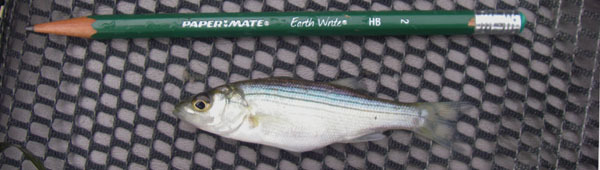
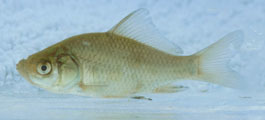 - Tom Lake, Colleen Bucci
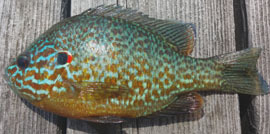 7/16 – Norrie Point, HRM 85: Staatsburg Library co-sponsored a public fishing day at the Norrie Point Environmental Center and nearly 50 people tried their luck with rod, reel, and nightcrawler. Despite the warm air (92 degrees F), warm water (79 degrees), and brilliant sunshine, all of which do not suggest good fishing, we caught 25 fish of six different species (bluegill, pumpkinseed, redbreast sunfish, yellow perch, white perch, and golden shiner.) All three sunfish species were represented by males in breeding colors. making our two temporary fish tanks look very “tropical.” [Photo of male pumpkinseed sunfish courtesy of Tom Lake.]
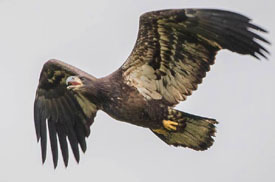 7/20 – Town of Poughkeepsie: Three of us were monitoring bald eagle nest NY62 on post-fledge Day 36 for the nestling we have called “Peep” (hatched on Easter). We often do not see Peep all day but he seems to have a schedule where he arrives back to the area of the nest tree about 7:45 each evening. After seven months of nest monitoring, every time we leave we wonder if it might be the last time we see Peep. [Photo of young eagle from NY62 courtesy of John Badura.]
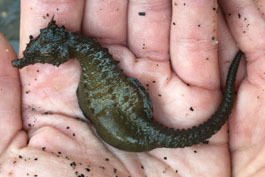 7/20 – Brooklyn, New York City: A fish that seems to be more abundant than usual this year is the lined seahorse. Besides all the reports from The River Project, and Fort Washington Park in June, today we caught a large pregnant male in the East River at Brooklyn Bridge Park. [Photo of lined seahorse courtesy of Rebecca Houser.]
|
The New York State Department of Environmental Conservation respects your right to privacy and welcomes your feedback. | Update preferences or unsubscribe. | Learn more about DEC Delivers. |
|
Connect with DEC:   
|
 |
| NOW AVAILABLE: Receive DEC's Twitter feed via email. | |
| Andrew M. Cuomo, Governor * Basil Seggos, Commissioner | |