
Hudson River Almanac 7/6/16 - 7/13/16
The New York State Department of Environmental Conservation sent this bulletin on 07/22/2016 05:40 PM EDT |
| DEC Delivers - Information to keep you connected and informed from the NYS Department of Environmental Conservation |
| Share or view as a web page || Update preferences or unsubscribe |
|
|
|
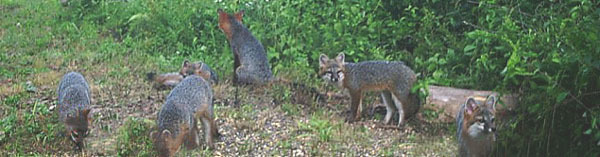
OVERVIEW Fledgling birds and young-of-the-year [YOY] fishes dominated the week as summer moved along. “Pregnant” male seahorses off Manhattan’s west side continued to delight observers. HIGHLIGHT OF THE WEEK 7/12 – Coeymans Landing to New Baltimore, 133.5-131.5: Late this afternoon there was a Caspian tern out on the jetty at Coeymans Landing, mixed in with about 15 ring-billed gulls. Later this evening, the tern was in spotted on the river at New Baltimore. [Caspian terns are a large, nearly herring gull-size birds. The species is found worldwide. The closest breeding colonies to us are along the Great Lakes, Thousand Islands, and - in recent years - Lake Champlain. They pass through the Hudson Valley on migration to and from their wintering range in the Southeast U.S. along the Gulf Coast. Tom Lake.] NATURAL HISTORY NOTES 7/6 – Hannacroix, HRM 132.5: For the past week, we have been watching a family of gray foxes come out in the late afternoon. Yesterday, the female was nursing three half-grown pups in a clearing below the house. A fourth cub and the male were off somewhere else. Those we could see chased and wrestled with each other as the mother looked on and kept watch. [banner photo of gray fox family courtesy of Barbara Heinzen.] 7/6 – Bedford, HRM 35: The air temperature was 92 degrees Fahrenheit, which made it a very hot day at the great blue heron rookery. Due to the heat and no shade, most of the nestlings had their bills open and were panting to cool off as they waited for their next food delivery. Except for preening, there was very little activity. 7/6 – Manhattan, HRM 1: We checked our sampling gear at the River Project’s station on the lighthouse tender Lilac at Pier 25 in Hudson River Park and found a pregnant male lined seahorse 90 millimeters [mm] long in our crab pot. With water temperature in the mid-70s, we were surprised to find a grubby (80 mm) in a killifish trap. Scientific literature on the grubby (Myoxocephalus aenaeus) cites a water temperature comfort range for this fish as 32-69 degrees F. 7/7 – Verplanck, HRM 40.5: We have been watching and protecting a killdeer nest at Veterans’ Memorial Park (see June 28, Verplanck). Today we found a chick dangerously running around the parking lot. Mom and Dad killdeer were both there and doing their best to steer us away but the chick, probably a lone survivor of their second brood, was headed for trouble. We scooped up the chick and returned him to the nest area and the three of them were quickly reunited.
[Sea squirts, or sea grapes (Ascidiacea) are marble-sized tunicates, colonial marine invertebrates that attach themselves to substrate. These filter-feeders have two siphons through which they take in and expel water. They collect in amazing numbers on sampling gear frequently covering pots and traps. Tom Lake. Photo of sea grape (Molgula manhattensis) by Misjel Decleer from World Registry of Marine Invertebrates.] 7/8 – Saugerties, HRM 102: There has been a family of wild turkeys passing through several times a day for a few weeks now – mama and six chicks. It has been great watching the little ones scratch the ground foraging. Recently they've been using our decks and railings for group preening sessions. The poults are now the size of chickens and, while capable of flight, rarely fly more than a few feet. Mama seems pretty mellow as wild turkey mamas go. If we open the door, she'll just leisurely start to wander off, head still erect, toward the woods with the chicks loosely following. There is also a female Cooper’s hawk nearby with three fledglings but the turkeys don't seem to care. She knows the hawks are around but doesn't seem to think her chicks are in danger 7/8 – Peekskill, HRM 43.5: Not for the first time, a pair of osprey were back on the navigation tower in Peekskill Bay. This may be their year. While they have a substantial nest, it was difficult to see if there was any breeding activity. 7/9 – Cohoes, HRM 157: I saw the ongoing shorebird and wading bird migration this morning with a few semipalmated and least sandpipers, along with a lesser yellowlegs, at Cohoes Flats. The was also a mink carrying off a spotted sandpiper in its maw, scurrying under the large retaining wall behind the Department of Public Works site. Overhead, I saw two black vultures fly by, heading east. 7/9 – Galeville, HRM 74: Zachary Smith banded the last of the young kestrels hatched at the Shawangunks Grasslands National Wildlife Refuge this season (21 in all). We have seven nest boxes on the refuge and all were occupied at one time. This was the first year that any banding was done.
7/10 – East Fishkill, HRM 66: Three black bears, two adults and one cub, have been around now for ten days (see July 1, East Fishkill) and were seemingly settled in and quite at home on our property. The cub has been walking around smelling flowers and drinking from the birdbath. He tips it towards himself with his paws so it is at a better angle to get a sip. We are not feeding them so they may not stay much longer. [With last week’s report was a sidebar suggesting that it was unusual to see a female black bear with a cub being accompanied by an adult male. Further discussion with DEC wildlife biologists has suggested another possibility – that the second large bear is a yearling, the mother’s cub from last year. Yearlings have usually been chased off by their mothers by this time of year, but there are exceptions. Steve Stanne.]
7/11 – Town of Poughkeepsie: For several days we had not seen the fledgling (“Peep”) from bald eagle nest NY62 and Mama together. This evening Peep, now 27 days in the wild, flew in from the river and landed near the nest tree. A short while later Mom flew in from the river and also landed near the nest tree. Unfortunately for Peep, she did not come bearing food. Nevertheless all indications are that the fledgling is adapting well to his freedom, including acquiring food. What we are missing is the education of the immature out on the river by the adults when we are not looking. 7/11 – Peekskill, HRM 43.5: It was only a matter of time before the carp came back. They had been absent from my fishing forays since June 27. The one carp I caught and released today was rather small at four pounds. An additional eight channel catfish, the largest of which was also four pounds, made the day. The constant northwest breeze made it an enjoyable summer fishing experience. 7/11 – Crugers, HRM 39: On our usual check of Ogilvie’s Pond this morning, we were surprised to find not one, but two great blue herons among the spatterdock. They stood on opposite ends of the pond, their long necks sticking out above the vegetation. Also swimming around the spatterdock was a hen wood duck with three adorable ducklings following her in a single file. 7/11 – Manhattan, HRM 1: When we checked our sampling gear at the River Project’s station on the lighthouse tender Lilac at Pier 25, we found two large (for us) tautog or blackfish (250, 265 mm) in our crab pot. Our killifish trap was fairly loaded with three lined seahorses (a female and two “pregnant” males), as well as a black sea bass (105 mm) and two oyster toadfish (85, 100 mm). 7/12 – Mohawk River, HRM 159: We were trying to understand what habitats are used by YOY blueback herring in the Mohawk River, part of the Hudson River watershed. Today was Day One of our initial survey as we boated down the Mohawk from Alplaus to Lock 6, a distance of about eleven miles, seining as we went at what seemed like plausible habitats. The Lock 6 boat launch had been a “tried and true” spot in the past, but not this day. All sites were loaded with small fishes, just not herring. Near day’s end we sampled along a couple of small islands not far from the Crescent Boat Club and at last we struck silver! Although most of the bluebacks were too small for our net - slipping through the mesh - we managed to capture a few dozen YOY in the 30-40 mm size range. 7/13 – Mohawk River, HRM 159: We headed upstream of Alplaus, not quite five miles to where I-890 grazes the Mohawk River. We checked out the lovely islands named for the tribes of the Iroquois-Haudenosaunee confederacy – Isle of the Cayuga, Isle of the Onondagas, Isle of the Oneidas – as well as other sites. As it was yesterday, we found many other fishes but nary a herring. As a final try, beneath a tiny waterfall near Schenectady, we found “Herring City!” These YOY blueback herring were about 275 kilometers (170 miles) from the sea, an impressive distance for their parents to have migrated through many obstacles such as salinity changes, locks and predatory fishes. [Our list of 22 fishes (ordered taxonomically) taken across two days: Blueback herring, spotfin shiner, emerald shiner, spottail shiner, rosyface shiner, rudd, creek chub, fallfish, white sucker, yellow bullhead, brown bullhead, chain pickerel, banded killifish, brook silversides, rock bass, pumpkinseed, bluegill, smallmouth bass, largemouth bass, black crappie, yellow perch, and tessellated darter. Cara Ewell Hodkin.] 7/13 – Manhattan, HRM 1: When we checked our sampling gear at the River Project’s station on the lighthouse tender Lilac at Pier 25 we discovered a male blue crab (100 mm point-to-point) that had moulted in one of the pots. Our killifish traps had four fish, a female seahorse (85 mm), a winter flounder (55 mm), an oyster toadfish 65 mm), and a black sea bass 110 mm). [Blue crabs, as crustaceans, have an exoskeleton that they must shed periodically in order to grow. A shed exoskeleton, or moult, is an exact replica of the crab except that when you open the carapace, you see that no one is home! The “new” crab is now a softshell crab, noticeably larger, waiting for its new shell to harden, a process that can take up to 24 hours depending on water temperature. Tom Lake.] SUMMER 2016 NATURAL HISTORY PROGRAMS Trees and Shrubs Available for Planting Along Hudson Tributaries Saturday, August 13: The Fifth Annual Great Hudson River Estuary Fish Count HUDSON RIVER MILES The Hudson is measured north from Hudson River Mile 0 at the Battery at the southern tip of Manhattan. The George Washington Bridge is at HRM 12, the Tappan Zee 28, Bear Mountain 47, Beacon-Newburgh 62, Mid-Hudson 75, Kingston-Rhinecliff 95, Rip Van Winkle 114, and the Federal Dam at Troy, the head of tidewater, at 153. The tidal section of the Hudson constitutes a bit less than half the total distance – 315 miles – from Lake Tear of the Clouds to the Battery. Entries from points east and west in the watershed reference the corresponding river mile on the mainstem. TO CONTRIBUTE YOUR OBSERVATIONS OR TO SUBSCRIBE Smartphone app available for New York outdoor enthusiasts! Copies of past issues of the Hudson River Almanac, Volumes II-VIII, are available for purchase from the publisher, Purple Mountain Press, (800) 325-2665, or email purple@catskill.net |
 7/7 – Manhattan, HRM 1: Checking our sampling gear at the River Project’s station on the lighthouse tender Lilac, we discovered that sea squirts were beginning to cover our killifish traps. Inside was an oyster toadfish (50 millimeters), a male northern pipefish with eggs (170 mm) and, in a recurring theme, two very pregnant male seahorses (105, 100 mm).
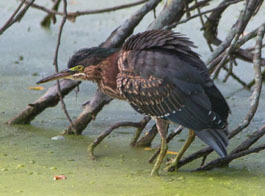 7/10 – Town of Poughkeepsie, HRM 68: We were looking to photograph eagles at Bowdoin Park and did see at least one immature at a distance. The star of the show, however, was a gorgeous green heron at the park pond. [Photo of green heron courtesy of Debbie Lephew.]
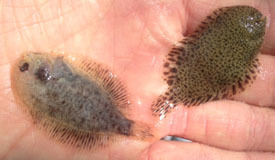 7/11 – Poughkeepsie, HRM 77: Participants in the Institute of Ecosystem Studies’ training course on water quality in the Hudson sampled the river at Quiet Cove Park. Our analysis found a dissolved oxygen (DO) concentration of 7.5-8.0 milligrams per liter at 97% saturation, and a steady pH of 7.5, a comfortable level for our fishes. Meanwhile, our beach seiners caught a banded killifish, a dozen YOY striped bass and alewives, and two silver dollar-sized hogchokers. One had strange coloration – lightly mottled all over, with dark eyes – unlike the usual camo-brown. Hogchokers occasionally have pigmentation on both sides, top and bottom. [Photo of pair of hogchokers courtesy of Chris Bowser.]
 |
The New York State Department of Environmental Conservation respects your right to privacy and welcomes your feedback. | Update preferences or unsubscribe. | Learn more about DEC Delivers. |
|
Connect with DEC:   
|
 |
| NOW AVAILABLE: Receive DEC's Twitter feed via email. | |
| Andrew M. Cuomo, Governor * Basil Seggos, Commissioner | |