
Hudson River Almanac 6/29/16 - 7/5/16
The New York State Department of Environmental Conservation sent this bulletin on 07/18/2016 05:48 PM EDT |
| DEC Delivers - Information to keep you connected and informed from the NYS Department of Environmental Conservation |
| Share or view as a web page || Update preferences or unsubscribe |
|
|
|
OVERVIEW
HIGHLIGHT OF THE WEEK 7/2 - Manhattan, HRM 1.5: A melanistic male American kestrel gave me a start this morning as it perched briefly on a West Village rooftop T.V. antenna about two blocks from Hudson River Park at Bethune Street. His sooty black wing coverts, belly and flanks, were strikingly odd and had me thinking Eurasian hobby (Falco subbuteo) for a nanosecond. NATURAL HISTORY NOTES 6/29 - Greene County: It had been a month since my last visit to bald eagle nest NY203. I paddled over in the late afternoon and found two nestlings sitting on the rim of the nest. They were much, much larger than a month ago. One adult was perched nearby watching the river. It appeared that they were well behind eagle nest NY62 (fledged June 14).
6/29 - Beacon, HRM 61: More than an inch-and-a-half of rain had fallen in the last two days and yet the river’s salinity had risen a bit to 2.1 parts-per-thousand [ppt]. We were back to see if some of the young-of-the-year alewives we had encountered three days ago were still here. They were, and ranged from 41-44 millimeters [mm] in length. The brightest part of our catch was several male redbreast sunfish in brilliant breeding colors. The river was down a degree at 77 degrees Fahrenheit. [Paul Schlereth, an Almanac reader, asked “Why do you and others seine in the Hudson?” 6/29 - Bedford, HRM 35: It was a very warm day at the great blue heron rookery (84 degrees F). Many nestlings had their bills open and were panting trying to cool off. Most of the nestlings stood still while others flapped their wings or preened. But they always got excited when an adult arrived to make a food drop. 6/29 - Croton-on-Hudson, HRM 35: There was still no sign of nestlings at the Croton-Harmon osprey nest. Late this afternoon one of the adults stood guard on a high post before flying off toward Croton Bay. While it was gone, the other adult popped up from the nest and stood preening its feathers. The first osprey never did return with dinner for the family. 6/29 - Manhattan, HRM 1: Because of the low dissolved oxygen levels in the river, we checked our pots and traps every day this week at the River Project’s station on the lighthouse tender Lilac at Pier 25 in Hudson River Park. We did not want animals spending more than one night in our traps. In our crab pot today we had one male blue crab (140 mm point-to-point). In our killifish trap, we found a black sea bass (70 mm), an oyster toadfish (85 mm), and a winter flounder (55 mm). We also caught two isopods (Idotea baltica). 6/30 - New Baltimore, HRM 131.5: Yes, it begins! The first sign of southbound bird migrants was ring-billed gulls passing down the Hudson River. They were also building up in numbers at the flats down by Four-Mile Point and probably at other gull-gathering places. These are likely non-nesters and failed nesters from Lake Champlain. Now is the time to check for shorebirds; both dowitcher species have been showing up elsewhere in the northeast. Now is also the time to be especially alert for rare vagrants. Cold fronts sweeping in from northwest Canada and Asia do carry the occasional extreme rarity to our area - think sharp-tailed sandpiper, for example. 6/30 - Greene County: I paddled over again late this afternoon (low tide) to check on bald eagle nest NY 203. It was a repeat of yesterday with the two large nestlings standing very still on the rim of the nest and one adult posted nearby, 6/30 - Manhattan, HRM 2: We checked the water chemistry at the River Project’s site on Hudson River Park’s Pier 40 in midday and found the river temperature at 72 degree F, salinity 19.5 ppt, and dissolved oxygen (going up!) at 6.6 parts-per-million. At our station on the lighthouse tender Lilac at Pier 25, we found a single lined seahorse clinging to a crab pot (it fell off as we lifted the pot), and - In our killifish trap - a slender northern pipefish snuck out between the meshes before we could measure it.
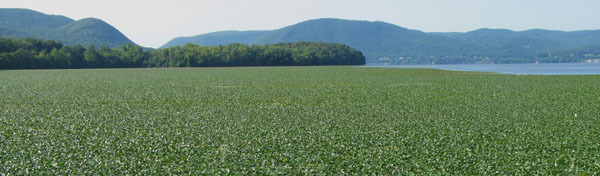
7/1 - Greene County: I paddled over this morning to check on bald eagle nest NY203. Unlike my two previous visits this week, both adults were present with the nestlings. One was in the nest and the other was perched nearby. It was difficult to tell how near they were to fledging; if their size meant anything, it would be soon. 7/1 - East Fishkill, HRM 66: Three black bears were in my yard today. It appeared to be a male, a female, and a cub. They stayed for about three hours just walking around but at one point the cub fell asleep. The male tried unsuccessfully to take down our bird feeders aligned on a high cable. As soon as it was safe, we brought our feeders into the house. [Male black bears will kill cubs, so it is unusual to see a female and cub accompanied by a male. However. it is also breeding season. Females can be fiercely protective of their cubs; perhaps this female had already established some ground rules regarding the pleasure of her company. Steve Stanne.] 7/1 - Manhattan, HRM 1: We checked our sampling gear at the River Project’s station at Pier 40 and in one of the killifish traps we found a tiny black sea bass (10 mm). A bit further south, on the lighthouse tender Lilac at Pier 25, we caught a northern pipefish (170 mm). It was a male, “pregnant” with eggs in his brood pouch. There was also a mating pair of mud crabs on top of one of the killifish traps. [Male pipefish and sea horses have brood pouches in which they carry fertilized eggs deposited by the females. In one of the rare instances in the animal kingdom, it is the males that give live birth. Tom Lake.] 7/2 - Town of Poughkeepsie: “Peep,” the immature that fledged 18 days ago from bald eagle nest NY62, hung out in the nest tree all afternoon. Dad arrived after a while, dropped off a catfish, and kept right on going. That is what I would have done as well. This fledgling tends to be a bully when he is hungry, which is just about all of the time. 7/2 - New Hamburg, HRM 67.5: A decade ago, our home, Rabbit Island (1.3 square acres), was totally surrounded by water chestnut. We were virtually “landlocked” from the island's eastern edge to the shore (135 feet), and extending from the southern and western edges of the island for a considerable distance to where the water depth prevented it from rooting. My wife, Kathleen, was determined that we would not succumb to the invasive plant so, over the course of several seasons, we waded out, pulled up very last plant, and composted them in the woods. After three years of intense effort, we now have to annually contend with maybe a half dozen plants that are easily dislodged. It was a labor intensive effort but it prevented us from becoming a peninsula and kept us as an island. [Eurasian water chestnut (Trapa natans), an invasive aquatic plant, was introduced into the Hudson River watershed in the late nineteenth century. In shallow water it can form thick floating mats [see banner photo] that deny access to water craft. However, those same “green carpets” create feeding perches for wading birds like herons and egrets. Water chestnut has poor nutritional value for migratory waterfowl and it out-competes native, more nutritional aquatic vegetation such as wild celery. Beaver, white-tailed deer, and waterlily leaf beetles will sometimes feed on the rosettes, stems, and seeds. Water chestnut seem to have a brackish-water intolerance as live plants are not usually found below the Hudson Highlands. The fruit is a four-spined seed, green at first, but turning black with age and remaining viable for many years. Students call them “devil’s heads.” The sharp horns of the seeds have all but eliminated going barefoot on many Hudson River beaches. Tom Lake.] 7/3 - Town of Colonie, HRM 157: There were now two osprey nests near the Crescent Power Plant along the Mohawk River. However, as far as I could tell, neither nest had young. I saw a single adult osprey perched near the original nest, but showing no signs that the nest was occupied. I am guessing that the same pair of birds may have built both nests.
7/4 - Ulster County, HRM 92: I found many, many songbird fledglings being fed stream-side this weekend near Esopus Creek in Shandaken. Among them were cedar waxwings, chestnut-sided warbler, Louisiana waterthrush, American redstart, yellow warbler, downy woodpecker, eastern phoebe (still in the nest, perhaps a second brood), and a parent-only view of a male scarlet tanager eating honeysuckle berries and then flying down to the stream where it bathed. 7/4 - Town of Poughkeepsie: The fledgling from bald eagle nest NY62 was 100 days old today and still hanging out in an ever-widening radius from the nest tree. He now regularly ventured down to the Hudson River and then returned to some favorite perches inland. There seemed to be fewer food deliveries so maybe be was learning. 7/4 - Anthony's Nose, HRM 46: Hiking to the top of Anthony’s Nose offered a grand panoramic view of the Hudson Highlands. I often overlook the fact that, closer to the ground, there are lizards in the Hudson Highlands. On my way back down I heard a rustling in the leaves that I took to be a chipmunk. It was an adult five-lined skink. He was a very sleek and stealthy traveler as he effortlessly crossed all sorts of terrain, up and over large rock formations, and into the forest. [Five-lined skinks (Plestiodon fasciatus) are small lizards fairly common in the Hudson Highlands. Being diurnal, they are frequently seen during the day. Their broad and varied diet includes crickets, grasshoppers, beetles, and caterpillars. As juveniles, the five-lined skink has an incredibly beautiful blue tail that serves as a survival aid. Predators grabbing the skink by its colorful tail will find that it breaks off; the skink escapes and eventually regenerates another tail. Tom Lake.] 7/5 - Town of Colonie, HEM 157: This morning, an osprey with a large fish clutched in its talons, landed not far from its nest on the tower north of the Crescent Power Plant along the Mohawk. A photo revealed the fish to be a shorthead redhorse. [The shorthead redhorse (Moxostoma macrolepidotum) is a member of the sucker family of fishes (Catostomidae). They are native to the Mississippi watershed and likely arrived here via the canals that link the Great Lakes to the Mohawk River. They were first collected from the main stem of the Hudson River at the Poesten Kill (HRM 151.5) near Troy in 2001. Tom Lake.] 7/5 - Peekskill, HRM 43: I was still in search of carp as I fished the ebb-to-low tide today. The catfish were still there and biting, even though the river became very shallow as low tide approached. There were no carp again, but I caught and released three channel catfish; the two largest weighed about four pounds each. 7/5 - Manhattan, HRM 25: We checked our sampling gear at the River Project’s station on the lighthouse tender Lilac at Pier 25. While striped sea robins are not uncommon, one killifish trap had a northern sea robin (100 mm), a bit of a surprise. In addition, there were two oyster toadfish (45-50 mm), one northern pipefish (50 mm), and four lined seahorses (80-95 mm). One of them, a male, was “pregnant” with eggs. SUMMER 2016 NATURAL HISTORY PROGRAMS Saturday, August 13: The Fifth Annual Great Hudson River Estuary Fish Count HUDSON RIVER MILES The Hudson is measured north from Hudson River Mile 0 at the Battery at the southern tip of Manhattan. The George Washington Bridge is at HRM 12, the Tappan Zee 28, Bear Mountain 47, Beacon-Newburgh 62, Mid-Hudson 75, Kingston-Rhinecliff 95, Rip Van Winkle 114, and the Federal Dam at Troy, the head of tidewater, at 153. The tidal section of the Hudson constitutes a bit less than half the total distance – 315 miles – from Lake Tear of the Clouds to the Battery. Entries from points east and west in the watershed reference the corresponding river mile on the mainstem. TO CONTRIBUTE YOUR OBSERVATIONS OR TO SUBSCRIBE Smartphone app available for New York outdoor enthusiasts! Copies of past issues of the Hudson River Almanac, Volumes II-VIII, are available for purchase from the publisher, Purple Mountain Press, (800) 325-2665, or email purple@catskill.net |
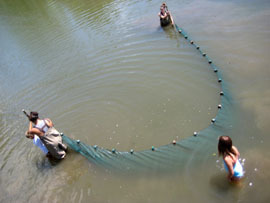 Seines are commonly mentioned in Almanac observations pertaining to fisheries research and education. They are an excellent tool used to sample and collect aquatic animals without injuring the catch. Haul seines, long nets that required a boat to set and many strong arms to haul, were used in Hudson River commercial fishing from Colonial times until the last decade of the 20th century. They have since been outlawed; in the hands of competent fishers, they are simply too efficient. This week a reader asked an important question: Why do we seine? [Photo of seining at Norrie Point courtesy of Chris Bowser.]
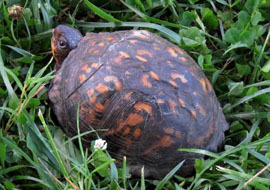 6/29 - Town of Poughkeepsie: The fledgling from bald eagle nest NY62 was perched for much of the day in trees near the nest. The adults were elsewhere. As we watched and waited, a box turtle wandered past us, having come up from a small pond. [Photo of box turtle courtesy of Mark Courtney.]
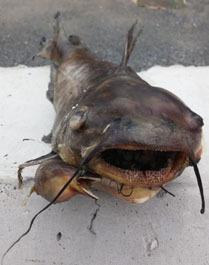 7/1 - Green Island, HRM 153.4: A cold front had triggered a weather change. A strong wind had shifted to the southeast, the sky had blackened, and a thunderstorm was imminent. A tornado warning was issued for areas of the upper estuary and not far downriver there was hail and heavy rain. I decided to leave before the weather broke but came upon a dead channel catfish (23 inches long) lying along the high tide line. That was not unusual, but the foot-long dead American eel protruding from its gill cover was. It appeared that the eel was trying to cannibalize the catfish by boring into one gill cover and exiting out the other side (eels are well known for entering the body cavities of fish like shad, striped bass, and sturgeon. Somehow, this one got stuck and died. The river was 79 degrees F. [Photo of dead catfish and eel courtesy of Tom Lake.]
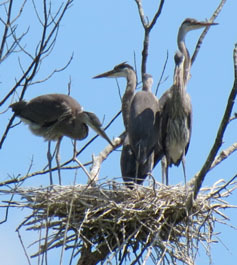 7/3 - Bedford, HRM 35: The fledglings were flying the coop at the great blue heron rookery! There were as many as five empty nests and two others had four adult-sized birds crowded inside. Most of the other nests had two or three birds with much jumping around and flapping from branch-to-branch. It was just about impossible to tell the adults from the immatures. [Photo of adult great blue heron with four young in nest courtesy of Jim Steck.]
|
The New York State Department of Environmental Conservation respects your right to privacy and welcomes your feedback. | Update preferences or unsubscribe. | Learn more about DEC Delivers. |
|
Connect with DEC:   
|
 |
| NOW AVAILABLE: Receive DEC's Twitter feed via email. | |
| Andrew M. Cuomo, Governor * Basil Seggos, Commissioner | |