
Hudson River Almanac 6/19/16 - 6/23/16
The New York State Department of Environmental Conservation sent this bulletin on 07/01/2016 04:47 PM EDT |
| DEC Delivers - Information to keep you connected and informed from the NYS Department of Environmental Conservation |
| Share or view as a web page || Update preferences or unsubscribe |
|
|
|
OVERVIEW As summer arrived, the river warmed, and carp put on a show with their spawning frenzies. A suite of fishes, including seahorses, highlighted weekly catches off Manhattan’s west side. In the watershed, black bears continued to catch our attention. HIGHLIGHT OF THE WEEK 6/19 - Newburgh, HRM 61: We were biking at Stewart State Forest in the early evening when one of our tires had a flat. As we made the long walk back along the paved trail, my six-year-old grandson Nicolas said, “Look!” No more than 60 feet in front of us in the middle of the trail was a large black bear. We watched as it sniffed the air and slowly ambled into the vegetation on the side. We waited a while and made some noise as we passed the area, and were surprised when a smaller bear catapulted across the trail following the big bear. We continued to make a lot of noise until we reached the parking area. NATURAL HISTORY NOTES
6/19 - Waterford, HRM 159: This evening at dusk I had just finished up a kayak trip down a reach of the river north of Waterford. As I unloaded gear from my boat and got ready to bike up to get my car at the launch site, I heard a growl from the edge of a nearby meadow. I grabbed a flashlight and saw a pair of eyes staring back at me about a foot off the ground. I yelled at the animal to chase it off, but it stood its ground. I could not see it well but caught a glimpse of a hunched back and a long tail. We faced off against each other like that for a while until it finally walked away, stopping every so often to look at me over its shoulder. I saw the animal again in my headlights as I drove away. I had been facing off against an angry fisher. 6/19 - West Sand Lake, HRM 145: This proved to be a fruitful day for upland observations. It began when we spotted our first monarch of the season. This evening as dusk approached, we counted 64 little brown bats exiting from our attic colony. Last year's high number was 75 at the end of the season, so it looks like our bats are doing well. As darkness fell our field lit up with fireflies, always a welcome sight. When I woke up in the wee hours of the morning, I noticed the nearly-full moon was already so bright it was casting long shadows across the field. This was an auspicious start to full blown summer! 6/19 - Millbrook, HRM 82: My morning’s walk was almost as much an olfactory experience as a visual one. The predominant fragrance in the air was that of the pervasive marsh bedstraw, possibly the sole redeeming feature of this invasive European plant. Local patches of early milkweed, privet, multiflora rose, field bindweed and even Canada thistle mixed their scents as well, as did fresh-mown fields and lawns. This reminded me of the T.S. Eliot line about a perfume collection, how it: “...troubled, confused and drowned the sense in odors.” 6/19 - Dutchess County, HRM 78: Bears in Hyde Park! This morning I found my bird feeder pole bent over to the ground, feeder gone, and my trail camera showing a black bear having had his way overnight. 6/19 - Town of Poughkeepsie: Across 16 years, we have seen many odd occurrences at bald eagle nest NY62, and this one was as odd as any. The new fledgling was in the nest feeding on a fish brought by one of the adults when an osprey appeared overhead. The fish hawk circled several times, called out, and then made two runs at the nest, the nestling, and quite possibly the fish. On one of the sorties the osprey came within a couple of feet of the nest. Failing to either steal the fish or upset the nestling, the osprey left. [In past seasons, nestlings and fledglings from NY62 have been ritually harassed by many birds, including red-tailed hawks, crows, blue jays, Baltimore orioles, red-winged blackbirds, and northern mockingbirds. We can now add osprey. Tom Lake.] 6/19 - Town of Fishkill, HRM 63: A crow landed at the birdbath with an entire rice cake in its beak. The bird dropped the cake into the water, let it sit for 15 seconds, then retrieved it and flipped it over. After another 15 seconds, the crow grabbed it, threw it to the ground, and began eating by tearing it apart. That bird felt the same way I do about rice cakes. 6/19 - Putnam County, HRM 52: As we were canoeing in Constitution Marsh Sanctuary, we came upon countless carp spawning! It was absolutely amazing to see these huge fish splashing around on the surface, almost close enough to touch. The marsh also had many great blue herons and red-winged blackbirds.
6/20 - Beacon, HRM 61: The summer solstice arrived at 6:34 PM and, on a very warm day (89 degrees Fahrenheit), we wanted to be in the water (75 degrees F). The solstice coincided with a full moon and a low tide and that drew the water off the beach, making seining easier. The downside was that water chestnut (Trapa natans) was creeping closer inshore. Soon seining here will be very difficult until October. Most of the local species were around, including white perch, banded killifish, spottail shiners, tessellated darters and, one surprise, a yearling largemouth bass 85 millimeters [mm] long.
6/20 - Manhattan, HRM 1: We checked our sampling gear at the River Project’s station on the lighthouse tender Lilac at Pier 25 in Hudson River Park. In one crab pot we found a gravid (with eggs) tautog (255 mm). The killifish traps were filled with six oyster toadfish (50-100 mm), a black sea bass (80 mm), an Atlantic tomcod (65 mm), and a northern pipefish (185 mm). 6/21 - Hudson Highlands, HRM 57-44: Insect traps set at Bear Mountain State Park came back positive for the southern pine beetle (Dendroctonus frontalis), a bark beetle native to the forests of southern United States, Mexico and Mesoamerica. They were also found in last year’s samples, indicating that the beetle is very likely established at Bear Mountain. If you are looking for a hike this weekend, we need monitors to go out and do a ground survey and look for signs of infestation. This would involve looking for any pitch pines or other pines with the rusty-red “popcorns,” “copper-tops,” or no needles at all. This is a true early detection and rapid response scenario. If you help out with this effort to locate infested trees at Bear Mountain, please let us know what you find. Contact Heather Darley, Assistant Invasives Program Coordinator at invasives@nynjtc.org . 6/21 - Croton Point, HRM 35-34: It continues to be a big year for snapping turtle nests. I cannot recall a year where I have encountered four large snapping turtles laying eggs at varying locations on Croton Point all within three days. 6/22 - Town of Poughkeepsie: Six days after fledging, “Peep” from eagle nest NY62 was fully into flying. He had established some favorite perches for resting, feeding, and spending the night, but otherwise he was exploring the area by flight. 6/22 - Bedford, HRM 35: The nestlings at the great blue heron rookery were growing rapidly and becoming more vocal. As a group, it sounded like a lot of collective chatter. Herons are strong fliers and usually circle around the rookery before landing on their nest to feed the eagerly awaiting nestlings. The adults regurgitate the food into the bottom of the nest where the nestlings feed more equally. This may be a factor in why almost all of the nestlings survive to fledging. 6/22 - Manhattan, HRM 1: We checked our sampling gear at the River Project’s station on the lighthouse tender Lilac at Pier 25. In one crab pot we found a lined seahorse (105 mm). In the killifish traps we found two oyster toadfish (75-90 mm) and one black sea bass (80 mm). We continue to receive less than average rainfall and, with rising water temperatures, our dissolved oxygen (DO) numbers have fallen to 3.2 parts-per-million [ppm]. [The River Project tanks on Pier 40 contain Hudson River water refreshed by a once-through system. If dissolved oxygen in the tanks drops to 3.0 ppm, we begin to worry; if DO drops to 2.0, we release the fish we have in our tanks. This past week, at the 3.0 range, many of our fish were breathing heavily (tautog, spotted hake, and winter flounder). Minimally, we like the DO to be at 5.0; anything above that is much better for aquatic life. Jacqueline Wu.] 6/23 – Dutchess County, HRM 84: Our celebrity leucistic red-tailed hawk, dubbed “Lucy,” was spotted perched in a distant tree this morning. I have been photographing this hawk in the area for more than four years. [Leucism is an abnormal plumage condition caused by a genetic mutation that prevents pigment, particularly melanin, from being properly deposited on a bird’s feathers. As a result, the birds do not have the normal, classic plumage colors listed in field guides, and instead the plumage have several color changes, including: white patches where the bird should not have any; paler overall plumage that looks faint, diluted or bleached; overall white plumage with little or no color discernable. Leucism affects only the bird’s feathers, and typically only those with melanin pigment - usually dark feathers. Birding.about.com] 6/23 - Croton Bay, HRM 34-33: The shoal water along this mile of river was in turmoil. Scores or more of common carp, 10-30 pounds each, were exploding the surface in their spawning frenzy. The loud eruptions always makes me think someone is tossing cement blocks into the water. The river was 73 degrees F and the salinity was 7.6 parts-per-thousand. [One of my favorite C. Lavett Smith (former curator of ichthyology at the American Museum of Natural History) stories was his debunking of the Lake Champlain “monster” (their Loch Ness monster), Champ! The legend may still have its adherents, and at the time, 25 years ago, Champ was almost mainstream. The most compelling “evidence” was a 30-second video taken by a boater with a hand-held camcorder. It showed a long and broad series of undulating ripples with what could be construed as a “head” on one end and a “tail” on the other. Smitty took that video, slowed it down to study it frame-by-frame, and after a painstaking analysis he concluded that it was just a large congregation of spawning common carp, with the males leap-frogging over the females, creating the undulating illusion. Tom Lake.] 6/23 – New York City, HRM: 4: Twice in the last three days a lion’s mane jellyfish was spotted right under Pier 84 at Hudson River Park. Lion’s mane jellyfish have not been seen around as frequently in the past seasons. They come in a variety of colors and are often red or purple. Lion’s mane jellyfish is one of the few planktonic organisms drifting with the tides and currents that is big enough so that we can see with our human eye. [Most of us encounter the lion's mane jellyfish (Cyanea capillata) when it is washed up on a beach, its reddish bell or mantle splayed on the sand. These are a cold-water stinging jellyfish that favor northern waters but are sometimes found in the lower estuary. They can reach a diameter of 10 feet with 200-foot tentacles, but most that we see are less than two feet in diameter with tentacles up to 30 feet long. Dery Bennett.] 6/23 - Manhattan, HRM 2: At the River Project’s sampling station at Pier 40, we caught a mud crab that seemed like it had a bleached carapace. A photo revealed that it was a white-fingered mud crab (Rhithropanopeus harrisii). 6/23 - Manhattan, HRM 1: We checked our sampling gear at the River Project’s station on the lighthouse tender Lilac at Pier 25. Inside one crab pot, or rather clinging to the top of one, was a male blue crab (140 mm point-to-point across its carapace). In the killifish traps we found one oyster toadfish (50 mm) and a lined seahorse (85 mm). Dissolved oxygen remained low at 3.0 ppm. HUDSON RIVER MILES The Hudson is measured north from Hudson River Mile 0 at the Battery at the southern tip of Manhattan. The George Washington Bridge is at HRM 12, the Tappan Zee 28, Bear Mountain 47, Beacon-Newburgh 62, Mid-Hudson 75, Kingston-Rhinecliff 95, Rip Van Winkle 114, and the Federal Dam at Troy, the head of tidewater, at 153. The tidal section of the Hudson constitutes a bit less than half the total distance – 315 miles – from Lake Tear of the Clouds to the Battery. Entries from points east and west in the watershed reference the corresponding river mile on the mainstem. TO CONTRIBUTE YOUR OBSERVATIONS OR TO SUBSCRIBE Smartphone app available for New York outdoor enthusiasts! Copies of past issues of the Hudson River Almanac, Volumes II-VIII, are available for purchase from the publisher, Purple Mountain Press, (800) 325-2665, or email purple@catskill.net
|
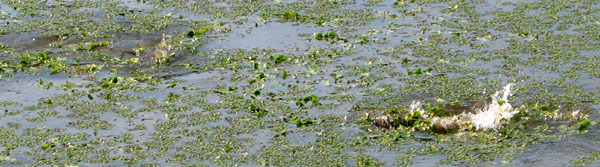
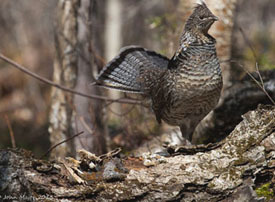 6/19 - Town of Minerva, HRM 284: We were heading up a trail on Moxham Mountain when we heard a commotion and saw a brown critter charging toward us. I quickly realized that it was a ruffed grouse and a “terrifying situation” turned quite comical. The grouse ceased its charge but crossed the trail in front of us. We soon ran into another hiker who had seen a covey of chicks close to the trail and we came to the realization that she had been protecting her babies. [Photo of ruffed grouse by John Major/DEC.]
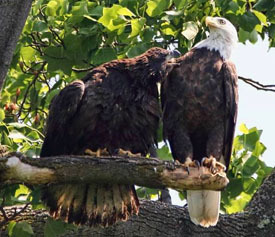 6/20 - Town of Poughkeepsie: The fledgling from bald eagle nest NY62 was on his favorite perch about twelve feet over the nest when he was joined by Dad. As they sat wing-to-wing, the fledgling, “Peep,” yet to acquire social skills, was all in Dad’s face, pecking at him, pulling his breast feathers, making him lean away from the assault. He endured the unwelcome attention for a while before moving off to another branch. Dad may have missed a fish delivery. [Photo of young bald eagle with its father courtesy of Terry Hardy.]
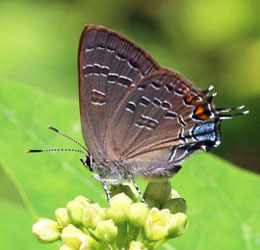 6/20 - Brinton Brook Sanctuary, HRM 36: Many flowers were in bloom and butterflies were emerging and adding to the diversity of nature. I had recently seen little wood-satyr, silver-spotted skippers, Delaware skippers, and several skippers I struggled to identify. Today, for the first time this season, I saw a beautiful banded hairstreak that posed for a photograph. [Photo of banded hairstreak courtesy of Edward Mertz.]
|
The New York State Department of Environmental Conservation respects your right to privacy and welcomes your feedback. | Update preferences or unsubscribe. | Learn more about DEC Delivers. |
|
Connect with DEC:   
|
 |
| NOW AVAILABLE: Receive DEC's Twitter feed via email. | |
| Andrew M. Cuomo, Governor * Basil Seggos, Commissioner | |